
Traditional high-cost Colorado car title loans are effectively prohibited, because Colorado puts consumer lending under a strict 12% and 36% APR framework instead of giving title lenders a special high-cost carveout. If a lender is advertising a “title loan” in Colorado, treat that as a warning sign, not an opportunity.
That matters because borrowers don't need another confusing sales pitch. They need the plain truth: in Colorado, the product many people mean by a car title loan does not function like it does in other states, and the language lenders use is often designed to blur that fact. The safe move is to separate what the law allows from what an ad is trying to sell you.
Table of Contents
- The Reality of Car Title Loans in Colorado
- Understanding Colorado Lending Laws and APR Caps
- Spotting Illegal Workarounds and Auto Pawn Schemes
- How Vehicle Liens and Repossession Work in Colorado
- Safer Borrowing Alternatives for Colorado Residents
- Steps to Take If You Signed a Questionable Contract
- Colorado Regulators and Consumer Assistance Directory
- Frequently Asked Questions About Auto Title Lending
The Reality of Car Title Loans in Colorado
A car in the advertisement does not make the offer a lawful title loan. In Colorado, the central question is how the lender structures the transaction, what it charges, and whether it creates a lien on your vehicle. Traditional high-cost title lending does not have a separate path around the state's consumer-credit rules. Colorado-focused lending summary
What borrowers may actually be offered
People searching for Colorado car title loans usually want quick cash secured by a paid-off vehicle. Lenders know that urgency. Some may relabel the product as a title-based secured loan, an auto-pawn arrangement, or another vehicle-backed offer. The label changes, but the risks can remain: expensive charges, a lien against the car, and loss of transportation if the borrower defaults.
A vehicle lien and a lawful secured loan are permitted concepts. They do not automatically make a high-cost title-loan scheme acceptable. The contract still needs to disclose the repayment obligation, total charges, default terms, and the lender's rights if payments stop.
Watch the sales pitch, not just the product name. If an ad says “bring your title and drive away today” while avoiding the APR, total repayment, and lien terms, treat it as a workaround pitch. Do not hand over your title or sign under pressure.
What Colorado's framework means in practice
Colorado uses consumer-credit limits rather than a special exemption for title lenders. A company cannot sidestep those requirements merely by calling the transaction “title-based” or routing it through an auto-pawn style structure. If the representative refuses to explain the cost or says the vehicle makes Colorado's rules irrelevant, leave.
Practical rule: If the offer relies on urgency, your car, and vague contract language, walk away.
A legitimate secured lender must document its interest through Colorado's titling and lien system. That process does not turn an expensive arrangement into a safe one, but it gives you a concrete place to examine the claimed lien and contract terms. Colorado DMV titling rules Check the paperwork before signing, and choose an alternative that does not put your transportation at risk when one is available.
Understanding Colorado Lending Laws and APR Caps
Colorado handles vehicle-secured borrowing through its broader consumer-credit rules rather than a separate, permissive title-loan regime. A lender does not escape those rules because the contract uses your vehicle as collateral or calls the product “title-based.” The Colorado consumer-credit overview provides background on the framework. The practical question is whether the transaction's price and structure comply with Colorado requirements.
Why the APR cap matters
Colorado's lending framework identifies a 12% per year finance-charge limit for ordinary consumer loans and a 36% per year limit for supervised loans. Those limits leave little room for the triple-digit pricing associated with title loans elsewhere. A lender cannot make that pricing acceptable by splitting it into fees, renaming the product, or placing it in an auto-pawn style contract. APR cap discussion
A simple cost check shows why the stated APR matters. A $1,000 supervised loan at 36% APR over 12 months produces $360 in finance charges and $1,360 in total repayment before any additional permitted costs, using simple annual APR math. The Colorado consumer-credit overview can help you identify the category that applies, but read the signed disclosure rather than relying on an advertisement.
What Colorado permits
A secured loan can be lawful when the lender follows the applicable consumer-credit rules and properly records its lien. Security for repayment does not authorize unlimited pricing. If a lender presents a vehicle lien as permission to charge extreme rates, reject the offer.
Read the contract from the cost backward. Find the finance charge, total of payments, payment schedule, late charges, and default terms. Then check origination, document, processing, membership, or other fees added to the balance. A low monthly payment can conceal an expensive obligation, especially when the repayment period is extended or fees are financed.
Bottom line: A Colorado offer built around extreme APRs is a warning sign, not a clever exception.
Use the Colorado lending rules and loan options guide to compare borrowing choices. Judge the deal by its total cost, disclosures, and lien terms, not by the label on the storefront or application.
Spotting Illegal Workarounds and Auto Pawn Schemes
Colorado's lending caps do not stop every risky vehicle-backed product. Some lenders change the product's label, possession rules, or governing-law clause to make a prohibited deal look acceptable. Treat the paperwork as the product. If the structure feels designed to avoid Colorado protections, do not sign it.
Use this contract checklist
First, check who controls the vehicle. A conventional secured loan generally uses a lien while you keep driving the car. An auto-pawn arrangement may require you to surrender the vehicle, hand over the keys, or authorize storage at the lender's location. Wording such as “possession and use of collateral” or “delivery of vehicle to lender” deserves a written explanation before you proceed. If the lender can take physical control before a lawful default process, reject the offer.
Next, identify the stated governing law. Online lenders may point to a tribal entity or an out-of-state company and insert language such as “choice of law”, “laws of the lender's jurisdiction”, or “sovereign immunity.” Those terms do not automatically erase Colorado protections. Ask which entity is making the loan, where it is licensed, which regulator handles complaints, and which law the lender believes controls. If the answers are vague, walk away.
Read every line describing a membership, benefit, or access charge. A phrase such as “membership fee due upon enrollment” can turn a loan into a bundled product with another payment obligation. Do not accept a separate service agreement just because the advertised interest rate looks manageable. Demand the total amount you must repay, including every required charge, in writing.
Practical rule: A lender operating lawfully should explain the rate, lien, repayment schedule, possession terms, governing law, and complaint process in plain English.
The consumer-rights brief on prohibited vehicle-title lending describes how vehicle-title products can appear under different structures across jurisdictions. That matters because “auto pawn,” “sale-leaseback,” tribal lending, and other labels may obscure the actual transaction. Judge the substance, not the storefront name.
Keep a copy of the complete contract, every addendum, and all payment instructions. Compare the lender's explanation with Colorado title-loan alternatives and loan guidance, then choose a product that leaves you with possession of your car and a clear path to challenge misconduct.
How Vehicle Liens and Repossession Work in Colorado
Before you hand over a title, ask the lender to show the Colorado DMV lien-perfection receipt. Check that it identifies the vehicle, VIN, lienholder, and fee paid. A lender's possession of your title does not by itself authorize seizure. Colorado requires specific paperwork before a lien is recognized in the state system, including the vehicle's year and make, VIN, lienholder name and address, lien amount, and the owner's signature. The lien becomes perfected only after the required documents and fee are received. Read the Colorado DMV titling rules before signing.
What perfection means in practice
Perfection confirms that the state recognizes the lender's claimed interest in the vehicle. It does not give the lender immediate possession or exempt the transaction from consumer-protection laws. A lender that skips the lien process, leaves filing details vague, or treats your title as a blank check is not following Colorado's vehicle-title system.
A lender cannot repossess a car simply because it holds the title. It must follow the law.
That distinction matters if a lender pressures you by claiming that any missed payment means immediate loss of your car. A lawful secured loan remains subject to the lien process, the written contract, and Colorado rules governing collection activity. Lien documents support a legal claim. They are not permission to threaten, harass, or take the vehicle outside lawful procedures.
Repossession is not the same as ownership
A legal repossession follows a default and the contract's terms, not a lender's personal decision. The lender must still respect the borrower's rights and Colorado's consumer-credit rules. Do not hand over your keys or vehicle casually. Once the lender controls both the paperwork and the car, your bargaining position can deteriorate quickly.
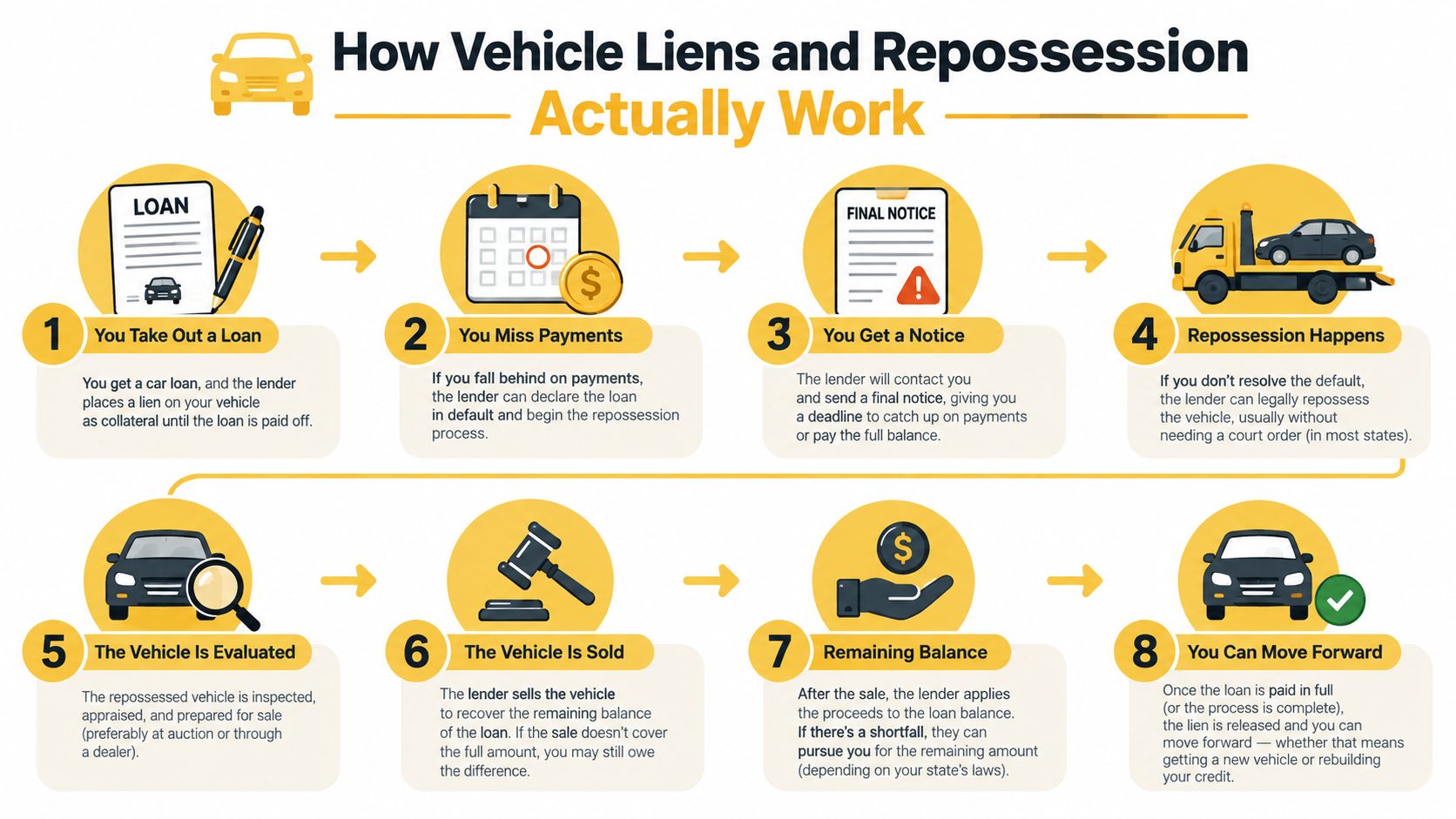
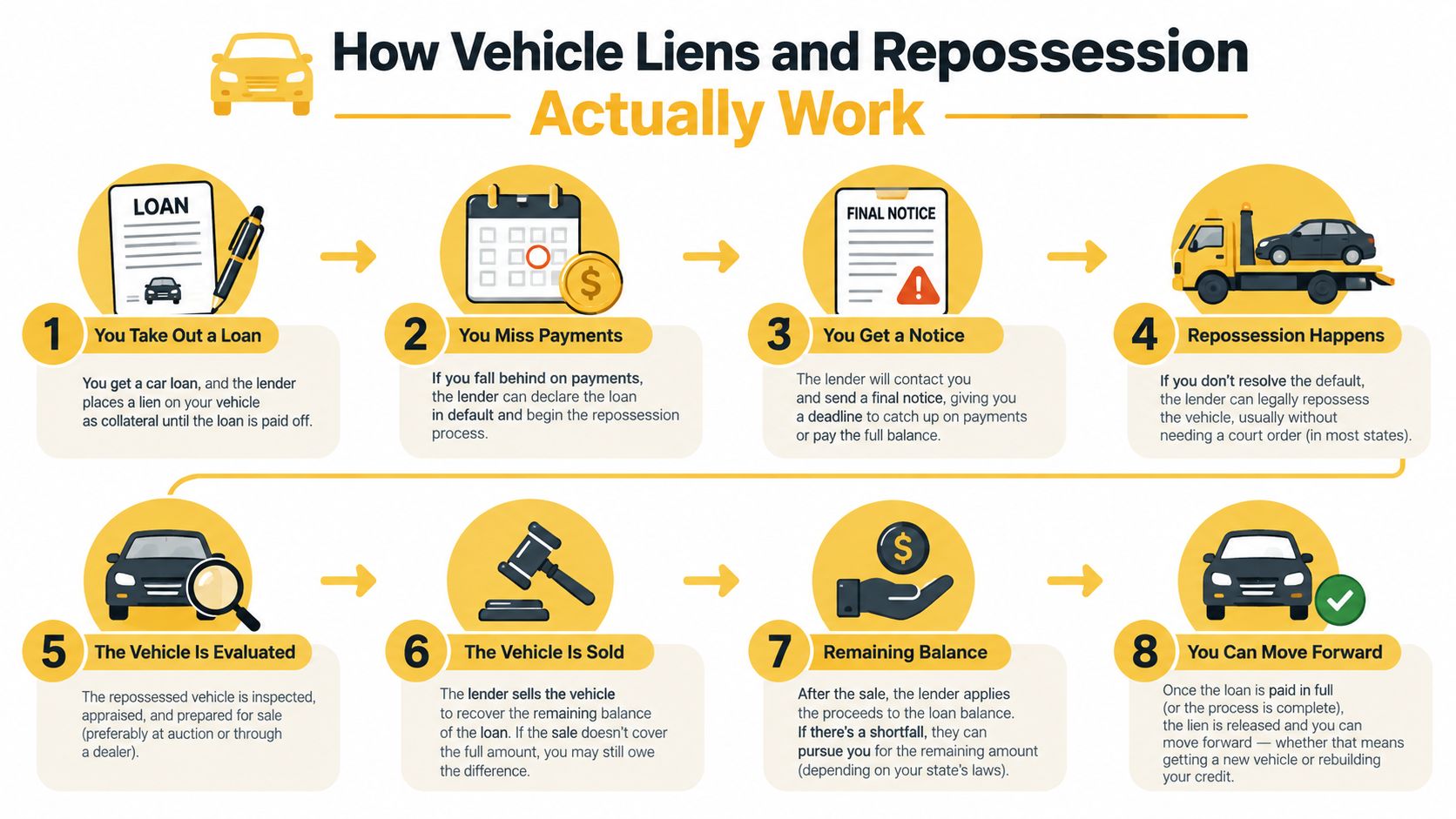
Treat every vehicle-backed offer as a contract problem before treating it as a cash solution. Read the lien terms, default language, payment schedule, and possession provisions before signing. If the lender refuses to give you time to review them, stop the transaction and keep the vehicle. The infographic detailing the eight-step process of vehicle liens and the legal car repossession procedure. provides a visual overview of the process.
Safer Borrowing Alternatives for Colorado Residents
If you need cash fast, the answer is not to chase a banned or questionable title-loan product. The right move is to compare lawful options that don't put your vehicle in immediate danger. Some will be cheaper, some faster, and some less convenient, but they're all better than signing a predatory contract just because an ad looks urgent. For a state-specific starting point, use Colorado personal loan options.
Compare the choices before you borrow
| Loan Type | Max Legal APR | Funding Speed | Collateral Required |
|---|---|---|---|
| Payday Alternative Loan, from a federal credit union | Varies by lender, but designed to be capped and lower-cost than payday or title products | Often slower than a storefront title offer | Usually no |
| Regulated personal installment loan | Subject to Colorado's consumer-credit limits | Can be relatively quick | Sometimes no |
| Credit-builder loan | Low-cost by design | Usually not instant | No |
| Payment plan with a provider or creditor | No interest if negotiated that way | Depends on who you're negotiating with | No |
What to pick first
If you can qualify for a credit-union option, start there. If you need flexibility, a regulated installment loan is usually safer than any vehicle-title workaround. If the debt is medical, utility-related, or tied to another bill, ask for a payment plan before you borrow at all. That often solves the problem without touching your car.
The point is not to find the fastest cash at any price. It's to avoid a loan that turns a short-term emergency into a long-term vehicle risk. That's the tradeoff predatory lenders count on.
Practical rule: The best alternative is the one that solves the cash problem without creating a repossession problem.
Steps to Take If You Signed a Questionable Contract
Don't panic, and don't ignore it. Start by reading the contract line by line and figuring out the actual cost, including every fee that lands on the balance. If the loan's effective APR blows past Colorado's cap, or if the lender is demanding possession of the car instead of a normal lien, you have a serious problem.
Do this in order
- Collect the documents. Keep the contract, payment schedule, fee disclosures, lien paperwork, and every email or text from the lender.
- Calculate the full cost. Look at the interest plus all added charges, not just the stated rate.
- Demand a written explanation. Ask the lender to identify the Colorado law it believes allows the offer.
- Refuse verbal promises. If the lender offers a “fix,” get it in writing.
- Escalate the complaint. Use state and federal complaint channels if the company won't comply.
- Protect the vehicle. Don't miss meetings, ignore notices, or hand over possession casually.
The CFPB's 2025 annual complaint report shows about 1,100 title-loan complaints in 2025, with 79% sent to companies for response and 91% of complainants saying they first tried to resolve the issue with the company. That pattern tells you something important, borrowers often try to fix the problem directly before escalating, and many still hit a wall. CFPB annual complaint report
If your lender refuses to cooperate, don't treat that as the end of the road. It's a sign to move the dispute into a formal channel and get help from people who deal with consumer debt complaints every day.
Colorado Regulators and Consumer Assistance Directory
Colorado borrowers dealing with a bad vehicle-secured loan should contact the right office early, not after the lender has already boxed them in. Start with the state consumer protection side if the marketing, contract terms, or collection tactics look deceptive. Then move to federal complaint tools if the lender is operating across state lines or ignoring state limits. For a state-by-state resource hub, see Colorado and state assistance directories.
Where to turn
- Colorado Attorney General consumer protection resources: Use them when you suspect deceptive lending practices, misleading advertising, or unlawful collection behavior.
- State banking or lending regulators: Use them when the lender is licensed in Colorado and the issue involves rate limits, disclosures, or a lender's compliance posture.
- Consumer Financial Protection Bureau complaint portal: Use it when the company won't respond, the dispute crosses state lines, or you need a documented federal paper trail.
- 211 Colorado: Use it for local referrals to emergency support, nonprofit counseling, and benefit resources.
- Nonprofit credit counseling agencies: Use them if you need budgeting help, debt management guidance, or help negotiating with creditors.
- Legal aid organizations: Use them if the lender is threatening repossession, suing, or trying to enforce a questionable contract.
The best complaint is specific. Bring dates, amounts, screenshots, and the contract. Vague stories get slower responses, while clean documentation gives the reviewer something concrete to act on.
Practical rule: File the complaint before the lender turns pressure into a tactic.
Frequently Asked Questions About Auto Title Lending
Can an out-of-state lender repossess my car if it's parked in Colorado? Not just because it says so in the contract. The lender still has to have a valid legal basis, and Colorado's consumer-credit rules still matter. If the offer was illegal or the lien was never properly handled, don't assume the company's threats are automatic or lawful.
Will a title-loan inquiry hurt my credit? A simple inquiry by itself is not the main issue. The bigger problem is signing a bad contract that later creates missed payments, collections, or a repossession fight. Focus on the loan terms first, because that's where the actual damage starts.
What about a “pink slip” loan, is that different? Usually it's just another label for a vehicle-title loan. Don't get distracted by the name. If the lender is using your car title as collateral and the deal looks high-cost or evasive, treat it as the same risk.
What if I already own my car outright? That does not make a title loan safe or lawful. It only means the lender may be trying to use your equity against you. A paid-off car is an asset, and predators know that.
Can I use my vehicle to borrow money in Colorado at all? Yes, but only through lawful structures that fit Colorado's consumer-credit limits and lien rules. That is very different from the high-cost title-loan model people see advertised elsewhere.
The right move in Colorado is to protect the car, not gamble it on a lender's sales pitch. Use the state's consumer-credit rules as your filter, and if a company won't explain itself clearly, don't sign. Keep your options open, and choose the loan that leaves you with a vehicle and a path forward.
If you're weighing a vehicle-backed loan, compare your options before you put your title at risk. BadCreditMD helps borrowers sort out state rules, safer loan choices, and free local assistance so you can avoid a deal that looks fast but costs you your car.