
A background check does not automatically include a credit check. More than 96% of employers conduct some kind of background check, while more than 51% check a prospective employee's credit, so credit screening is common but not universal. Whether your report includes financial information depends on who orders it, the specific job or lease, and state law, and employers and landlords must get your written consent first.
You may be filling out a job application, applying for an apartment, or volunteering with an organization that asks for permission to screen you. The phrase “background check” can sound broad enough to include everything, including your credit score, debts, and payment history. That assumption creates unnecessary anxiety.
The practical question is narrower: What type of report did the organization request, and what information is relevant to the decision? A criminal-record search, employment verification, tenant-screening report, and credit report are different products, even though a screening company may offer them together.
Table of Contents
- The Short Answer on Background and Credit Checks
- What Shows Up on a Consumer Report
- Employment Versus Housing Screening Rules
- Your Legal Rights and State Level Restrictions
- Navigating Adverse Action and Disputing Errors
- How to Prepare for an Upcoming Screening
The Short Answer on Background and Credit Checks
A background check is an umbrella term, not a single standardized report. It may cover criminal records, employment history, education, driving information, identity details, or public records. A credit check is a separate financial component that the requester may add when the purpose and law permit it.
For employment, the Consumer Financial Protection Bureau explains what employers may see in employment reports, including credit checks, criminal background checks, bankruptcy filings, and employment history. That doesn't mean every employer orders every part. The role, the employer's policy, the screening company, and the state all affect the scope.
A routine criminal check for a warehouse position may not involve credit information. A role that handles company funds, makes financial decisions, or carries fiduciary responsibilities may receive closer financial scrutiny. Even then, the employer must follow the Fair Credit Reporting Act, commonly called the FCRA, when it obtains a consumer report through a reporting company.
Housing screening works differently in practice. A landlord or property manager may request a tenant-screening report that includes rental history and credit information, but the label “background check” still doesn't tell you exactly what was ordered. Ask directly whether the report includes a credit history, a rental record, criminal records, or another category of information.
Volunteering can vary even more. An organization screening a volunteer who works with children may focus on identity and criminal records, while a volunteer handling donations may face a different review. Federal guidance largely discusses employment reports, so consumers shouldn't assume the employment model applies identically to renting, volunteering, or opening a financial account.
Practical rule: Before signing, ask what categories of information will be checked, who will receive the report, and how the organization will use it.
The consent form should make the screening purpose understandable. If the requester won't explain what it plans to review, pause before authorizing the check and request clarification in writing.
What Shows Up on a Consumer Report
A consumer report can combine several data categories, but the contents depend on the report package selected. The FTC's consumer-report guidance explains that a report may include credit information, criminal records, public records, and employment history. The same basic file can look very different depending on why it was requested.
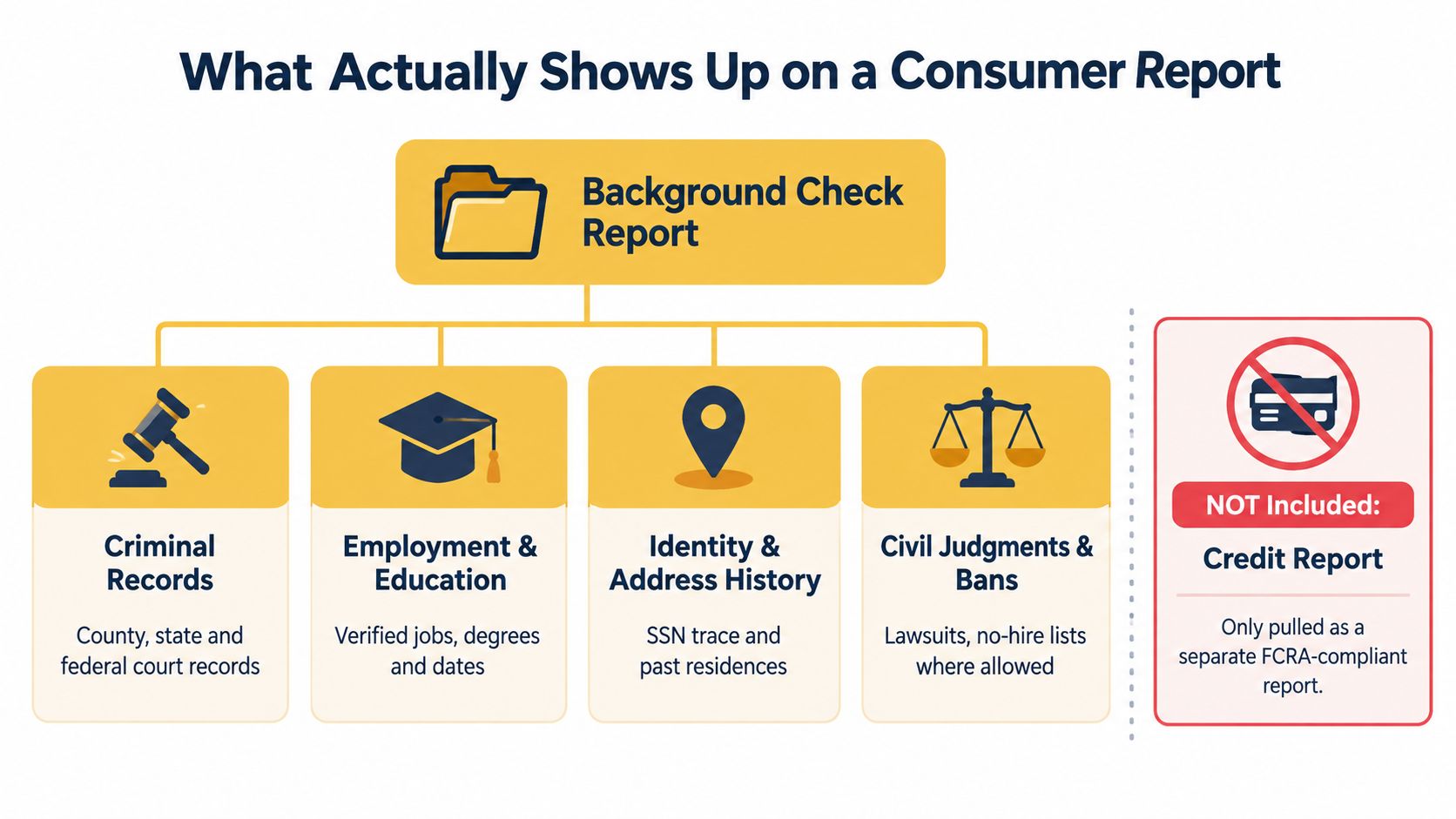
The nonfinancial side
A general screening report may contain:
- Criminal records: Court information that the reporting company is legally permitted to report.
- Employment history: Past employers or employment details that the requester asks the screening company to verify.
- Driving records: Relevant for jobs involving vehicles or driving responsibilities.
- Public records: Information such as bankruptcy filings may appear in a consumer report, depending on the screening purpose and applicable reporting rules.
A credit component adds a different set of details. It usually concerns credit history, such as account activity, payment patterns, debts, and certain public-record information. That is separate from a credit score, which is only a summary number, not the full record. If you want a plain-language overview of how scores are built, see this credit score guide.
That difference matters in real life. A landlord may review credit history to judge payment risk, while a volunteer organization may care more about identity checks or criminal records for roles involving children or donations. The same “background check” label can hide very different contents, so the only safe move is to ask what categories are included before you consent.
Hard pulls and soft inquiries
People often worry that an authorized screening will lower a score. The FTC's consumer-report guidance says an employment report is typically treated as a soft inquiry for the applicant, so it does not affect the consumer's score the way a lender's hard pull can. That is why a job screening usually does not change the number a lender sees.
Reviewing your own information can help separate a real screening issue from a score myth. The important question is not just whether a check will happen, but what type of report the requester will use and what it is legally allowed to see.
Employment Versus Housing Screening Rules
The same phrase, “background check,” can mean different things in a job application and an apartment application. An employer may order a package focused on criminal history and employment verification. A landlord may be more interested in rental history, unpaid housing-related obligations, and credit information that helps evaluate an application.
That doesn't mean every landlord orders a credit report, and it doesn't mean every employer avoids one. The CFPB explains that employment reports can include credit history, criminal records, employment history, and driving records, but the agency's employment-focused guidance doesn't establish one universal scope for rental or volunteer screening.
Employment screening
For a job, financial screening is more likely to be connected to the duties of the position. Roles involving financial responsibility, access to sensitive financial information, or authority over money may give the employer a stronger reason to request a credit report. Many ordinary jobs don't have that connection.
The employer still needs to provide a standalone written disclosure and obtain written permission before ordering a consumer report. If it later relies on the report for a negative decision, additional notice requirements apply.
Housing screening
A rental applicant should read the authorization carefully and ask whether the landlord is requesting a tenant-screening report with a credit component. The report may be used alongside income verification, rental references, identity information, and other application materials.
Housing decisions also involve fair housing protections. A landlord can't treat applicants unlawfully because of a protected characteristic, and a credit-related policy should be applied consistently. If the landlord denies an application because of information in a consumer report, the applicant may have rights to receive information about the report and the reporting company.
Volunteering sits outside the usual employment-versus-housing comparison. A nonprofit may order a limited screening package tied to the volunteer's duties. Ask for the scope rather than assuming that a volunteer check includes credit history.
This video offers a visual explanation of how screening processes can differ by context:
Your Legal Rights and State Level Restrictions
A credit check is not a free-for-all. Under the FCRA, a consumer report is protected information, and an employer that wants one for screening must give you a standalone written disclosure and get your written authorization first.
The disclosure should be clear and separate from the job application. It should say the employer may obtain a consumer report for employment purposes. Your signature lets the employer move ahead, but it does not waive your other rights.
If the employer may act on the report, federal law also gives you time to respond before the decision becomes final. You should receive a copy of the report and a summary of your rights in the pre-adverse action stage, then an adverse action notice if the employer goes forward.
State rules can narrow the use of credit information even more. The EEOC's summary of SHRM research on credit background checks identifies California, Colorado, Connecticut, Illinois, Kansas, Nevada, and Vermont as states that prohibit background checks for credit information, with exceptions often applying to financial institutions. It also describes narrower conditions in places such as Hawaii, Maryland, Oregon, and Rhode Island.
That is why a single national rule can be misleading. A financial job may allow a credit review in one state, while a similar role faces tighter limits somewhere else. Employers that hire across state lines need to match the screening policy to the applicant's location and the job's actual duties.
Before you consent: Confirm why the report is being requested, look for the standalone disclosure, and check your state's current screening rules. For a quick state-by-state starting point, see the state-specific information available through BadCreditMD.
A consent form also does not guarantee accuracy. If the report contains an error, the FCRA gives you a process for disputing it.
Navigating Adverse Action and Disputing Errors
A negative screening result does not end the process by itself. If an employer, landlord, or volunteer coordinator plans to rely on a consumer report to turn you down, the pre-adverse action step should come first. That is your chance to see the report, understand what is being used, and respond before the final decision is made.
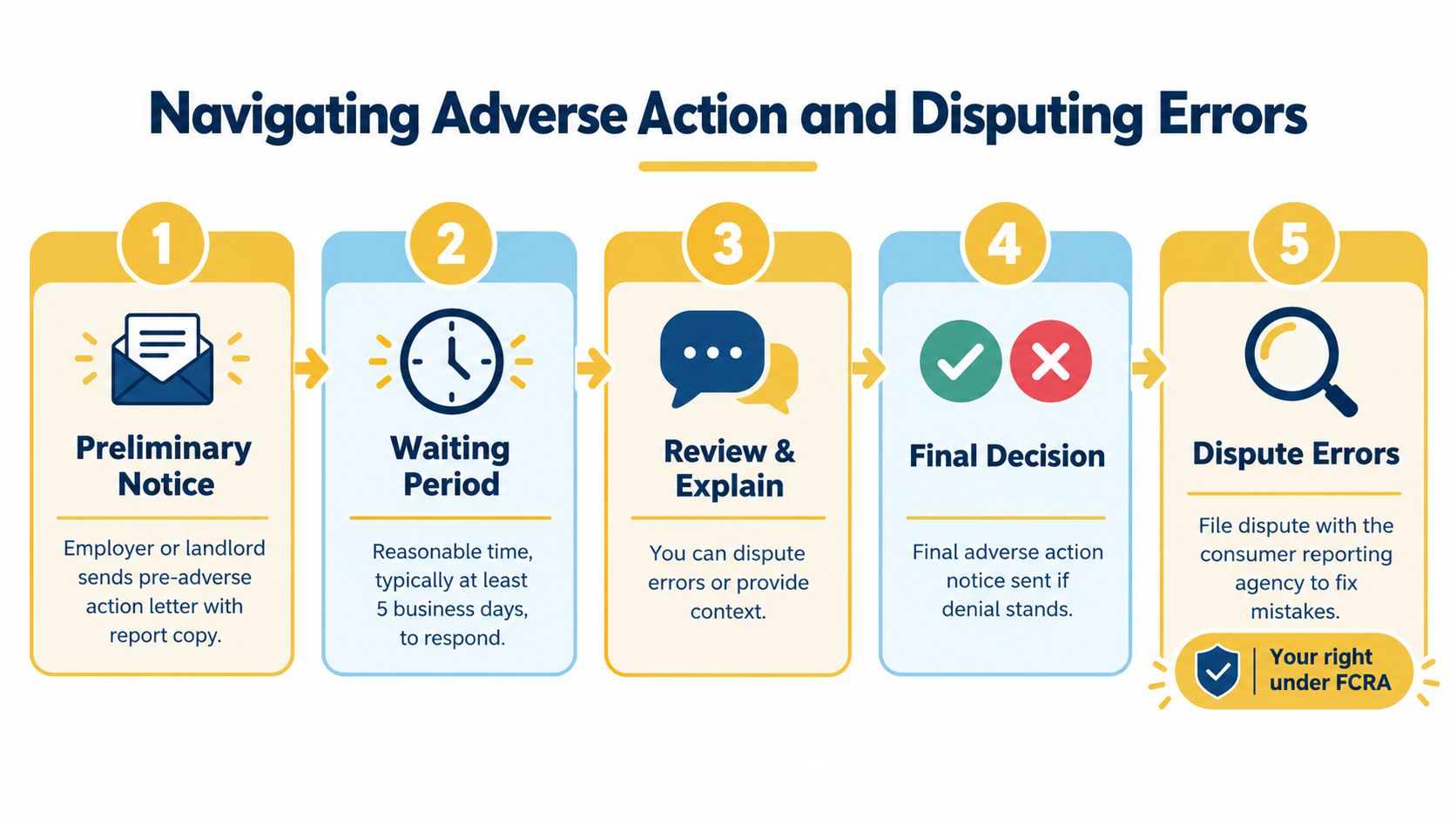
Read the notices carefully
The first notice should usually include a copy of the report and a summary of your FCRA rights. Review it line by line, not just the headline result. Check your name, address history, account data, dates, court records, and any employer, landlord, or organization name listed in the file.
The most common problems are mixed files, outdated entries, duplicate accounts, and records that belong to someone with a similar name. Sometimes the item is yours, but the report leaves out the context that changes how it should be read. A missed payment after a layoff, for example, is different from a pattern of missed payments, even if the report presents both in the same plain format.
Write down each item you dispute and gather support for it. Account letters, payment records, court papers, pay stubs, rental history, and identity documents can help show what is wrong. A short, organized file is easier to review than a pile of loose papers.
Dispute the error
Send a focused dispute to the consumer reporting company that created the report. State exactly what is wrong, identify the entry, and attach copies of supporting documents rather than originals. Keep a full record of what you sent, when you sent it, and how the company responded.
Tell the requester, too. An employer, landlord, or volunteer group should know that the report is being challenged, because the file may need to be paused while the company investigates. The FTC's guidance for employers using background information explains the pre-adverse and adverse action steps when a business relies on a report.
If the result still goes against you, the final notice should say that adverse action was taken and name the consumer reporting company that supplied the report. That company is usually not the one making the decision, so disputing the file and addressing the requester are separate tasks.
For help finding next steps, use a nonprofit counseling and legal-aid directory to look for consumer help, legal aid, regulator contacts, or complaint options. Avoid any company that promises to erase accurate negative information just because it appears on a screening report.
How to Prepare for an Upcoming Screening
A rental application can stall when an applicant expects only an income check but the property manager also orders a consumer report. A volunteer role can raise similar questions, especially if it involves children, older adults, finances, or access to a home. Before applying for a job, apartment, or volunteer position, ask what the organization plans to review and whether a credit report is included. That answer helps you prepare without guessing.
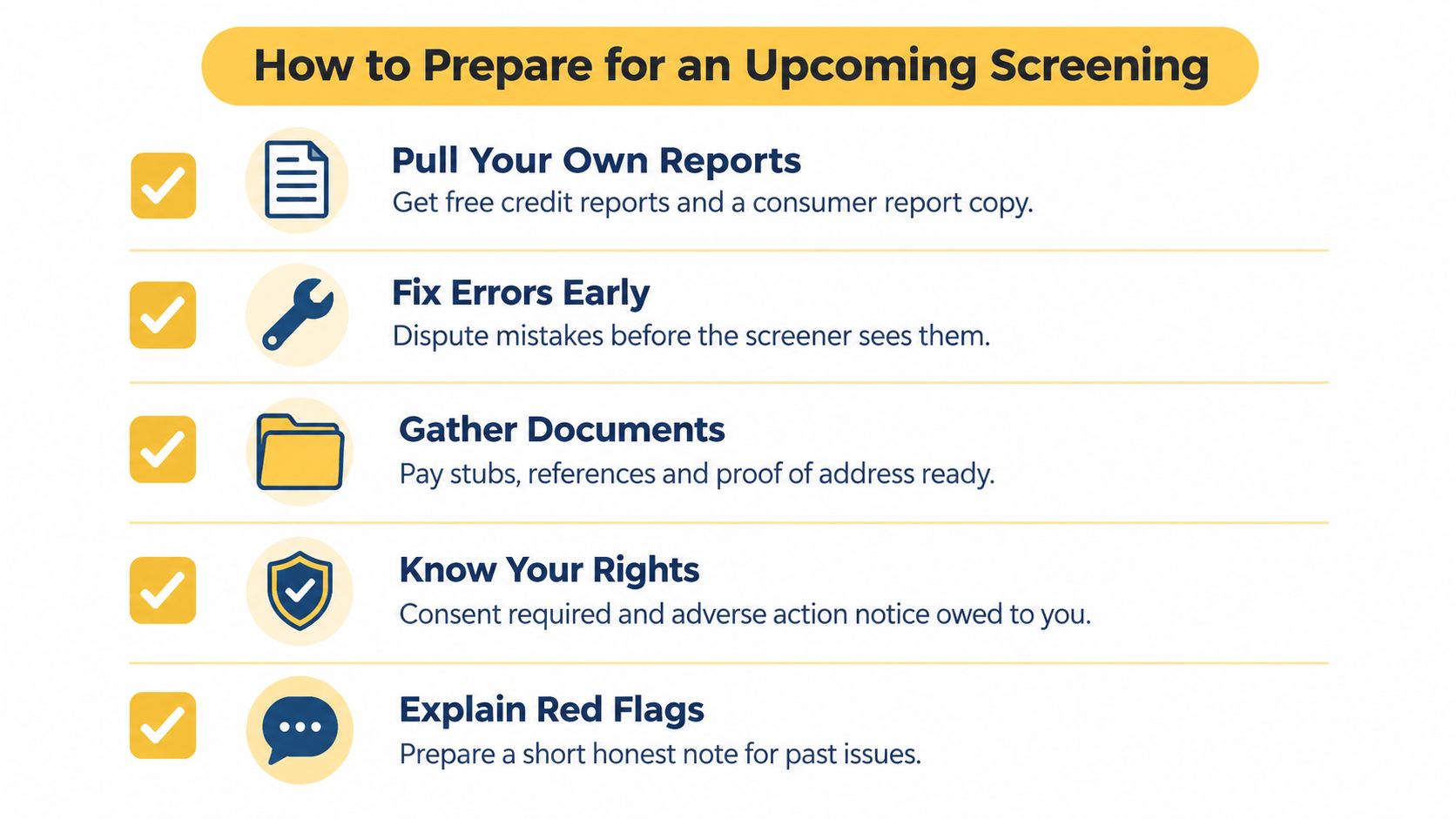
Use this checklist:
- Review your own reports: Check for identity errors, unfamiliar accounts, wrong payment details, and addresses that do not belong to you. If the requester later relies on a screening report, ask for a copy.
- Address mistakes early: Gather the documents needed for a focused dispute and keep a record of the date sent. The FCRA sets an investigation deadline, so noting when the company receives your dispute helps you track the response.
- Gather context: Keep proof of income, rental references, employment records, or a short explanation of a past financial problem when those materials fit the application.
- Protect your authorization: Read the disclosure before signing. Confirm whether the check supports employment, housing, volunteering, or another purpose, and ask what information will be obtained.
- Check the inquiry type: A screening report is typically a soft inquiry for the applicant. It generally does not affect a credit score in the same way as a lender's hard pull, as the FTC explains in its consumer-report material.
A past bankruptcy, collection account, or missed payment does not explain everything by itself. If asked about one, give a brief, truthful account focused on what happened, what changed, and which records support your explanation. Share only information relevant to the decision.
For broader information about credit, borrowing alternatives, and local assistance, read the BadCreditMD credit and borrowing guides. Reading educational material does not trigger a credit check. A check occurs when you authorize a request through an application or service.
BadCreditMD offers plain-language information about credit, state rules, borrowing options, and assistance directories. Visit BadCreditMD to review local resources before a screening.