
Licensed installment loans of $3,000 or less are legal in Georgia under the Installment Loan Act, with up to 36 months and 15 days to repay. Payday loans, however, are illegal in the state.
That distinction is the most important starting point for understanding Georgia installment loans. Many borrowers hear “small-dollar loan” and assume every product follows the same rules. It doesn't. Georgia separates a licensed installment loan, which uses scheduled payments, from illegal payday lending and other high-cost structures.
The more difficult question isn't only whether a loan is legal. It's whether the offer is affordable after you account for the APR, finance charge, fees, payment schedule, and total repayment amount. Georgia's statutory interest ceiling can sound reassuring, but the stated interest rate isn't always the same as the borrower's real annual percentage rate.
This guide explains the rules in practical terms. You'll find the legal framework, licensing requirements, permitted and prohibited product types, statutory limits, a worked cost example, lender-verification steps, lower-cost alternatives, and complaint resources. If you're comparing options for imperfect credit, you can also review this installment loan guide for broader borrowing considerations.
The legal claims below are based on information from Georgia regulators and the state Attorney General. This article is educational, not a lending offer, and a lender's actual terms must be reviewed in the agreement before you sign.
Table of Contents
- Introduction to Georgia Installment Loans
- How the Georgia Installment Loan Act Works
- Permitted Loan Types Versus Illegal Products in Georgia
- Statutory Limits and Caps at a Glance
- A Worked Cost Example for a $3,000 Loan
- Verifying a Lender's Georgia License
- Lower-Cost Alternatives to Installment Borrowing
- Where to File Complaints and Get Help
- Quick Reference for Georgia Borrowers
Introduction to Georgia Installment Loans
A loan can comply with Georgia law and still be expensive. That distinction matters more than the label in an advertisement. Licensed installment lenders may offer loans under $3,000 when they follow the Georgia Installment Loan Act and applicable rules. At the same time, the Georgia Attorney General's payday-loan guidance states that payday loans are illegal in Georgia.
The products may appear similar because both can be marketed to people facing urgent expenses or limited credit history. Their repayment structures differ. An installment loan generally divides the balance into scheduled payments. A payday-style product commonly uses a short deadline and a lump-sum repayment. Calling a product an “installment loan” does not make it lawful.
The question borrowers should ask first
Start with “What product am I being offered, who is licensed to provide it, and what will I repay in total?” Approval is only one part of the decision. The product category, lender's license, payment schedule, and written contract determine what you are actually considering.
Georgia's statutory interest ceiling is not the same thing as the borrower's real cost. The ceiling applies to stated contract interest, while the APR, finance charge, fees, payment schedule, and total repayment amount show how the loan affects your budget. Origination or documentation charges, insurance, late charges, and other contract terms may increase the amount paid. A low-looking monthly installment can therefore conceal a costly overall obligation.
A practical review works like checking a price tag line by line. Identify the legal product, examine its limits, calculate the total cost, verify the lender, and compare alternatives before signing. Borrowers comparing options for imperfect credit can also review this installment loan guide for broader borrowing considerations.
The central lesson is simple: legality and affordability are separate tests. Georgia law addresses whether the lender and product may operate under the installment-loan framework. Your income, expenses, and total repayment obligation determine whether the debt fits your household budget.
How the Georgia Installment Loan Act Works
Georgia's installment-loan rules are narrower than many advertisements suggest. The main framework covers consumer loans of $3,000 or less under Title 7, Chapter 3 of the Official Code of Georgia Annotated, commonly called the Georgia Installment Loan Act. For a state-specific overview of permitted products and limits, see this Georgia installment-loan guide.
The law regulates both the loan and the business offering it. A company that advertises, solicits, offers, makes, or services covered installment loans generally needs a Georgia installment-lender license, unless a statutory exemption applies. Licensing runs through the Nationwide Multistate Licensing System, known as NMLS.
What the main limits mean
A licensed installment lender may lend up to $3,000 for no more than 36 months and 15 days, with interest capped at 10% per year on the face amount of the contract. The Georgia Department of Banking and Finance explains the interest rules in its interest-rate guidance.
These limits address separate parts of the transaction:
- Loan amount: Is the principal within the installment-loan framework?
- Term: Does the repayment period stay within the permitted maximum?
- Interest: Does the stated contract interest remain within the statutory ceiling?
- License: Is the business authorized to make or service this loan?
The 10% ceiling is not the same as the borrower's APR. It limits stated contract interest on the face amount. The APR and total repayment can also reflect fees, the timing of payments, and how much money the borrower receives. A loan can satisfy the interest ceiling and still require close cost comparison.
Why the contract term changes the calculation
Georgia treats contracts differently according to their length. For contracts lasting 18 months or less, interest may be discounted in advance. For longer contracts, interest is added to the principal.
That distinction changes the amount delivered, the balance used for repayment, and the payment stream. Ask whether interest is deducted before disbursement or added to the balance. Compare the cash received with the total obligation, rather than relying only on the face amount printed in the contract.
Loans above $3,000 may fall under different state and federal rules. Similar advertising language does not make these limits apply to a larger loan.
Permitted Loan Types Versus Illegal Products in Georgia
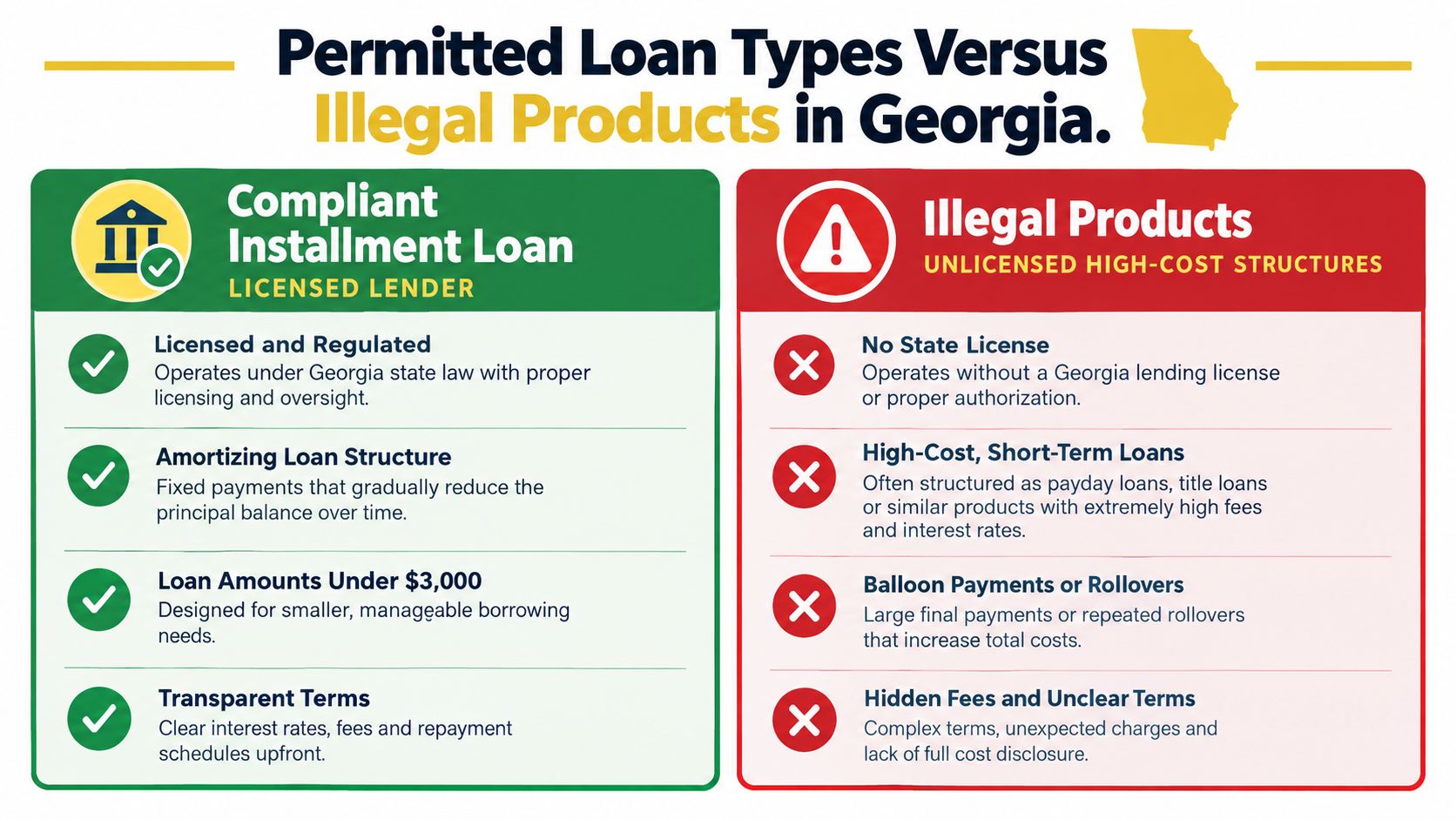
A loan can be legal and still be expensive. Separate the 10% statutory interest ceiling from the borrower's actual APR, then examine the lender, contract, fees, and collateral. A compliant Georgia installment loan should identify a licensed lender, a written agreement, scheduled payments, the finance charge, APR, payment schedule, and total payments.
A product deserves closer review if the lender will not identify its license, refuses to provide the full agreement before signing, or highlights only the next payment. The label is less important than the contract's structure and disclosures.
How the categories differ
Compliant installment credit generally comes from a lender licensed under Georgia's framework, unless an exemption applies. The borrower receives a stated amount and repays it through scheduled installments under a written contract. The agreement should show what the borrower receives, what the borrower owes, and when each payment is due.
Payday lending is a separate product category. The Georgia Attorney General states that payday loans are illegal in Georgia. Changing the advertising language or calling the product an installment loan does not remove that restriction.
Fees can also make a product costlier than its headline suggests. Compare the APR and total repayment amount, rather than treating a flat fee as proof that borrowing is inexpensive.
Be careful with title-based borrowing
Car-title loans add a separate risk because the vehicle secures the debt. Federal regulatory analysis has reported that some Georgia car-title loans can reach 300% interest. The same analysis describes non-bank lenders as able to charge interest and fees totaling as much as 60% APR on loans of $3,000 or less. See the Georgia Department of Banking and Finance annual report for that regulatory discussion.
These figures do not describe every offer. They show why classification and cost review belong together. Before signing, verify the lender, identify the security interest, read the default and repossession terms, and compare the full repayment obligation with alternatives that do not place a vehicle at risk.
Statutory Limits and Caps at a Glance
A 10% statutory interest ceiling does not automatically make a loan inexpensive. The ceiling addresses interest on the contract's face amount. The borrower's actual cost can be higher after permitted fees, insurance, and other charges are reflected in the APR and total repayment amount.
| Rule | Limit | What It Means for Borrowers |
|---|---|---|
| Loan amount | $3,000 or less | This threshold identifies the consumer installment-loan framework described here. |
| Maximum term | 36 months and 15 days | A covered licensed installment loan cannot exceed this stated period under the applicable rule. |
| Statutory interest maximum | 10% per year | The ceiling applies to interest calculated on the contract's face amount. |
| Licensing | Generally required | A business making, offering, soliciting, advertising, or servicing covered loans generally must hold a license unless an exemption applies. |
| Interest treatment | 18 months or less versus longer contracts | Interest may be discounted in advance for shorter contracts and added to principal for longer contracts. |
Loan size
The $3,000 ceiling marks the category covered by the Georgia Installment Loan Act. It does not give every loan below that amount the same rate, fees, or repayment schedule. A loan above the threshold is not automatically unlawful, either. Different rules may apply, so confirm which statute governs the specific contract.
Repayment period
The 36-month-and-15-day maximum limits the stated term for a covered loan under this framework. Extending repayment can lower each scheduled payment while keeping your income committed to the debt for longer. Compare the payment amount with the total amount due.
Interest rate
The 10% annual maximum is a statutory limit on interest tied to the contract's face amount. It is not the same measure as the APR, which is intended to show the broader cost of credit. Origination, documentation, insurance, or other permitted charges can make the APR higher than the stated interest rate. Read the finance-charge disclosure before treating a loan as affordable.
Licensing
Licensing provides a practical check before you apply or sign. Search the business through the Georgia Department of Banking and Finance or the NMLS system. The legal name on the agreement should match the entity you researched, and the lender should be able to explain any claimed exemption.
The 18-month dividing line
Interest treatment can change based on whether the contract lasts 18 months or less or runs longer. Ask for the calculation in writing. Confirm the amount you will receive, whether interest is discounted in advance, how charges are added, and the total amount the contract requires you to repay.
Source: Georgia Department of Banking and Finance interest-rate guidance, last checked October 2026.
A Worked Cost Example for a $3,000 Loan
A loan can comply with Georgia's stated interest ceiling and still cost more than the rate suggests. Consider a hypothetical $3,000 contract with the statutory 10% annual interest rate and a one-year term. The face-amount interest would be $300, creating a principal-and-interest obligation of $3,300 before permitted fees or other charges. The statutory rules and rate appear in the Georgia Department of Banking and Finance interest-rate guidance.
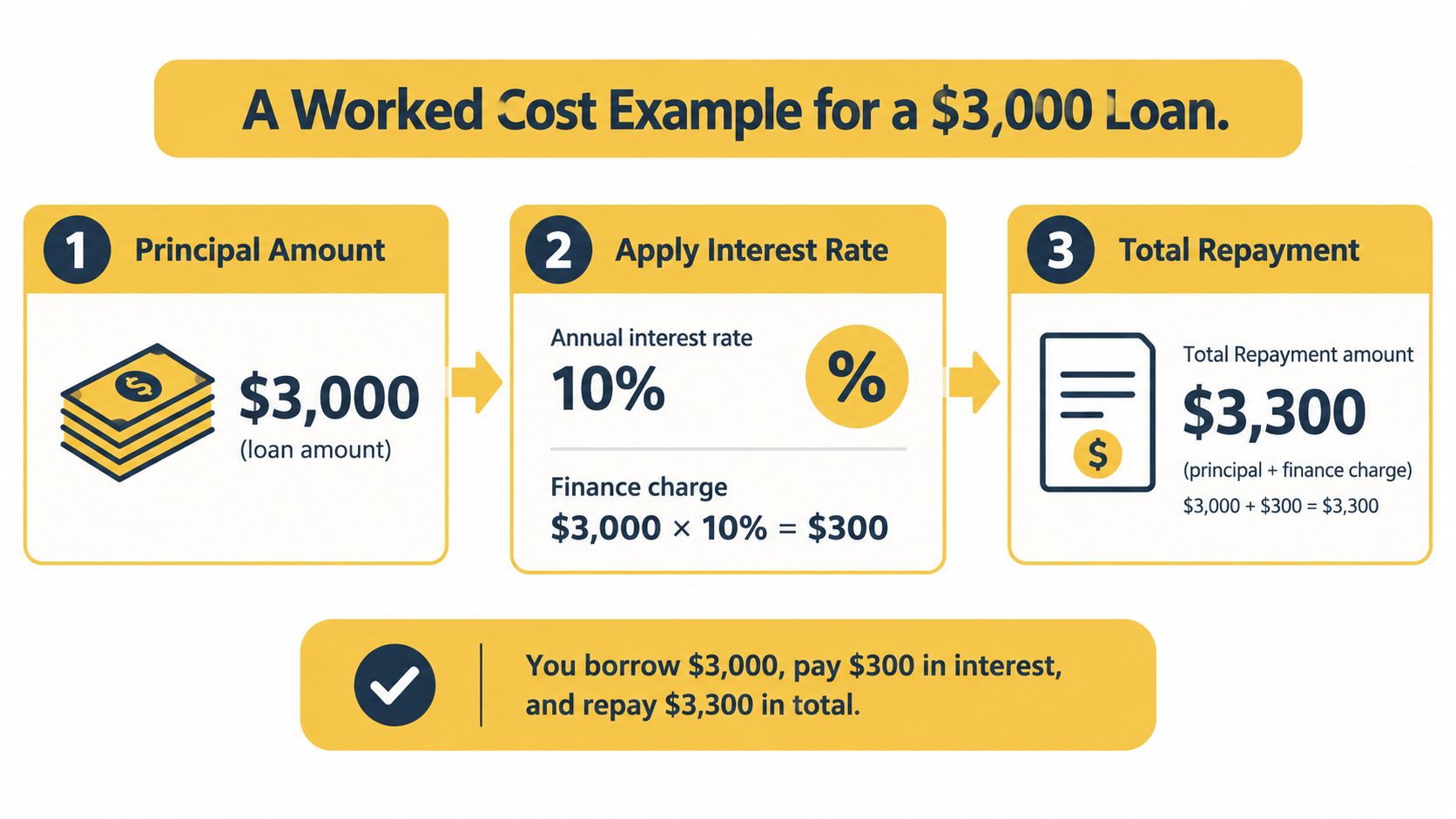
If the agreement spreads that obligation across scheduled payments, each payment reduces the balance according to the contract. For a contract lasting 18 months or less, interest may be discounted in advance. The amount you receive could therefore be lower than the face amount used to calculate the loan, even though repayment is based on the stated obligation.
Add the charges the rate doesn't show
An origination charge, documentation charge, insurance cost, or another permitted add-on can increase the borrowing cost. Do not assume these amounts are included in the 10% interest figure. Review the disclosed finance charge, APR, total of payments, payment schedule, and late-charge terms before judging affordability.
The rate calculation is only the starting point. Federal analysis has described some non-bank Georgia loans of $3,000 or less as having interest and fees that reached 60% APR. That example shows how a stated interest rule can differ from the complete cost of credit. It does not predict the cost of this hypothetical contract.
Compare the cash delivered to you with the total repayment required. A loan payment calculator can help test payment schedules, but the signed agreement determines what you owe.
Verifying a Lender's Georgia License
A lender can follow Georgia's 10% statutory interest ceiling and still offer costly credit. The reason is simple: the interest rate is one part of the contract, while fees, payment timing, and other charges affect the borrower's real APR. Verify the license before submitting sensitive information or signing.
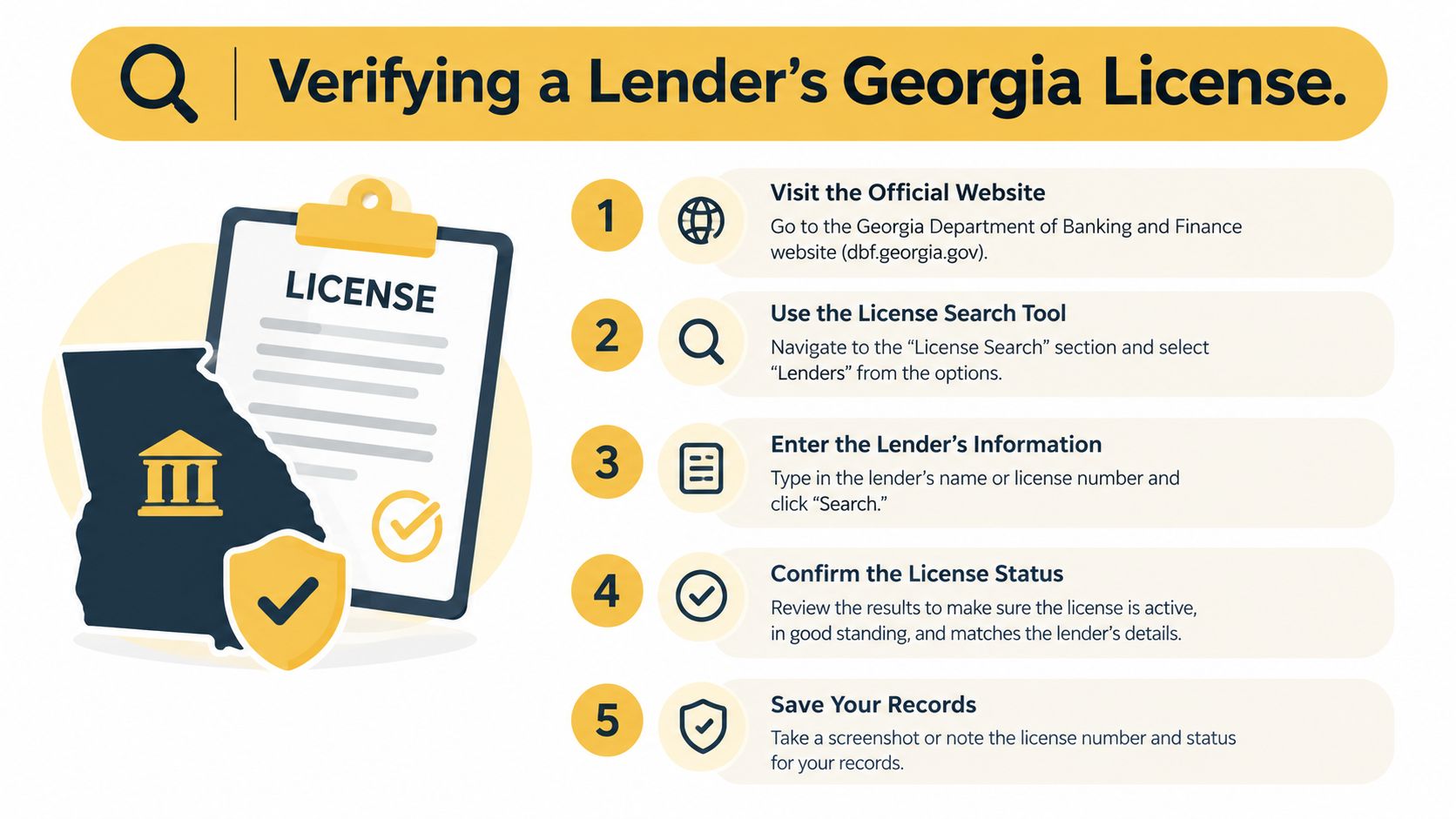
The Georgia Department of Banking and Finance administers installment-lender licensing through the Nationwide Multistate Licensing System, or NMLS. Consumer installment lenders making loans of $3,000 or less generally need a license unless an exemption applies.
Search by the lender's legal name, not just its brand. A website may use a trade name, while the contract identifies a different company. Matching the legal entity, address, telephone number, and NMLS identifier helps prevent a search for the wrong business.
A practical verification sequence
- Identify the legal entity. Find the full company name, physical address, phone number, and NMLS identifier in the application or disclosures.
- Search the official system. Look up the company through NMLS, then compare its details with the offer.
- Confirm the product category. A license record does not tell you whether the contract is an installment loan, title loan, payday-style obligation, or fee arrangement. Read the product description and repayment terms.
- Request complete disclosures. Check the finance charge, APR, payment schedule, total of payments, late-charge terms, and every add-on cost. These details show the cost that the 10% interest figure alone cannot.
- Pause when details conflict. Stop the application if the legal name, license information, or repayment terms do not match. Contact the department before providing more information.
What the license count shows
The regulated market has remained relatively stable. The department reported 169 licensed installment lenders at the end of 2023, 171 at the end of 2024, and 171 again at the end of 2025, according to its 2025 annual report.
That count measures licensed providers, not loans made, borrower outcomes, or actual APRs. A license confirms regulatory status, not affordability or approval of a particular offer. Verify the company, then compare the written contract's total repayment with the cash you will receive.
Lower-Cost Alternatives to Installment Borrowing
An installment loan may solve an immediate cash shortage, but it isn't the only route. Compare the total repayment amount, risk, timing, and eligibility requirements of several options before borrowing.
A credit union may offer a payday alternative loan, often called a PAL, for members who meet its requirements. Credit-builder loans and secured credit cards can also provide structured ways to establish payment history, although they may not solve an immediate bill and their terms vary by provider.
Ask the biller before asking a lender
A utility, medical provider, landlord, or creditor may offer a payment arrangement. Contact the organization before the account becomes more difficult to manage and ask for the terms in writing. A negotiated plan may avoid adding a separate high-cost credit account, but confirm whether late fees, collections activity, or other consequences continue during repayment.
Free assistance can also change the decision:
- Call 211: Ask about local emergency help, food support, utility assistance, and community programs.
- Contact nonprofit credit counseling: A counselor can help organize debts and compare repayment options.
- Check legal aid: Legal-aid offices may help with debt collection, contract questions, or consumer disputes.
- Review public benefits: Benefits screening can identify support that reduces the amount you need to borrow.
When borrowing isn't the right answer
If the proposed payment leaves too little for housing, food, transportation, or utilities, the loan may worsen the underlying problem. Compare the complete obligation using the cost method from the worked example, and review this comparison of loan types before deciding.
Researching options doesn't affect your credit by itself. A credit check may occur only when you submit a request and a lender or lending partner processes it, so reading terms and asking questions is a safer first step than applying everywhere.
Where to File Complaints and Get Help
Contact the Georgia Department of Banking and Finance when the concern involves an installment lender's license, regulated conduct, or a possible violation of Georgia lending law. Include the lender's legal name, transaction date, loan documents, and a concise account of what occurred.
The Attorney General's consumer protection office may be appropriate for deceptive advertising, unclear product descriptions, or conduct that conflicts with Georgia's payday-lending rules. Its consumer guidance explains that payday loans are illegal in Georgia and distinguishes them from compliant licensed installment lending.
Match the complaint to the problem
Ask the lender in writing to correct a servicing error before escalating the matter. Keep a copy of your request and any response. State regulators generally fit licensing and state-law concerns, while the Consumer Financial Protection Bureau offers a federal complaint channel for problems involving covered financial companies.
Describe the remedy you want, not only the unfair treatment you experienced. You might request a corrected payment record, an explanation of a charge, a response to a disputed balance, or review of a suspected licensing problem. Clear requests help the receiving office understand what resolution you seek.
Keep an evidence file
Organize the records that show what the lender promised, what the contract required, and what you paid:
- Signed agreement: Keep every page, disclosure, amendment, and payment schedule.
- Payment records: Save bank statements, receipts, confirmations, and failed-payment notices.
- Communications: Preserve emails, texts, letters, and notes from phone calls.
- Advertising: Capture the original webpage or message if the offer's wording later changed.
- Timeline: Record application, approval, funding, payment, and complaint dates.
Before filing, compare the advertisement with the signed contract and payment history. A lender may describe a product broadly in an advertisement, while the agreement controls the amount due and the consequences of missed payments.
Free support may be available through 211, nonprofit credit counseling, and legal aid. These services can help you understand a contract, organize records, prepare a repayment plan, or decide whether a formal complaint fits the problem. If you suspect immediate collection misconduct or another legal violation, seek advice promptly.
Quick Reference for Georgia Borrowers
A legal label does not make a loan affordable. Georgia borrowers should check three separate questions: Is the lender licensed? Does the contract show the full cost? Will the payment fit after housing, food, utilities, and other required bills?
| Item | Key Fact | Where to Read More |
|---|---|---|
| Legal status | Licensed installment loans of $3,000 or less may be offered under Georgia's Installment Loan Act. Payday loans are illegal. | Georgia Attorney General guidance |
| Loan-size ceiling | The covered installment-loan framework centers on $3,000 or less. | Georgia installment-lender information |
| Maximum term | Georgia law allows up to 36 months and 15 days for a licensed installment loan under the stated framework. | Georgia interest-rate rules |
| Statutory interest maximum | The maximum stated interest rate is 10% per year on the face amount of the contract. | Georgia interest-rate rules |
| License check | Verify the lender through the Georgia Department of Banking and Finance and NMLS before signing. | Georgia installment-lender information |
| Cost documents | Request the finance charge, APR, payment schedule, late-charge terms, and total of payments. | See the worked cost example above. |
| Complaint path | Contact the state department for licensing issues, the Attorney General for consumer-protection concerns, and the CFPB for applicable federal complaints. | See the complaints section above. |
The 10% statutory interest ceiling is only one part of the price. Fees and the repayment schedule can raise the borrower's real APR, much as a low menu price can grow after required charges are added. A loan may follow the Installment Loan Act and still cost more than the budget can handle.
Before accepting an offer, complete these five checks:
- Confirm the product: Make sure it is a licensed installment loan, not a payday-style or title-based product.
- Verify the lender: Match the legal business name with the official license record.
- Read the total cost: Compare the APR, finance charge, fees, and total of payments.
- Test the payment: Compare each scheduled payment with income remaining after required expenses.
- Save the paperwork: Keep the agreement, disclosures, payment records, and communications.
Use the statutory limits as a legal baseline, not as a recommendation that the loan is affordable. Read the contract's fee terms and payment schedule together, then decide whether the repayment risk fits your finances.
BadCreditMD offers state-specific borrowing explainers, loan-type comparisons, worked cost examples, and directories for alternatives such as nonprofit assistance and credit counseling. Visit BadCreditMD to compare Georgia installment-loan options and review questions to ask before submitting a request.