A transmission failure, an overdue rent payment, and a thin credit file can turn an ordinary week in Minnesota into an urgent borrowing decision. If your credit score is low, a bank may say no while payday and online lenders say yes immediately. That approval can feel like relief, but the rate, fees, term, and repayment schedule matter more than the approval itself.
Minnesota gives borrowers more protections and product choices than many quick-search loan pages suggest. Licensed installment loans, regulated payday products, credit-union alternatives, payment plans, and free community assistance can look similar at first glance, but they don't carry the same cost or risk. The right choice depends on the size of the shortfall, how soon you can repay it, and whether another payment would make next month's budget fail.
Table of Contents
- When Bad Credit in Minnesota Forces a Borrowing Decision
- Loan Types Available to Minnesota Borrowers With Poor Credit
- How Minnesota Law Caps What You Can Be Charged
- Payday Loan Fees in Minnesota Step by Step
- A Worked Example for a $2,000 Minnesota Installment Loan
- Why Title Loans Are Rarely the Right Fix in Minnesota
- Non-Loan Alternatives Minnesota Borrowers Should Try First
- Free Local Help and Complaint Contacts in Minnesota
- How BNPL and Split Payments Change the Borrowing Math
- Pre-Signing Checklist for Any Minnesota Bad Credit Loan
- Frequently Asked Questions About Loans for Bad Credit in MN
When Bad Credit in Minnesota Forces a Borrowing Decision
Maya works in child care in Rochester. Her transmission failed during the same week her landlord raised the rent. Her credit score is 595, she has $1,100 in savings she doesn't want to drain, and her next paycheck won't arrive until the 30th.
She has three immediate choices. She can pay rent late and face a late charge, use savings and risk an overdraft next month, or seek a $1,500 loan after a bank has already rejected her personal-loan application. In the Twin Cities, she may find storefront lenders, credit unions, and nonprofit counselors within reach. In Greater Minnesota, travel distance and fewer local providers can make a fast decision feel like the only decision.
Maya shouldn't start by asking, “Who will approve me?” She should ask three harder questions:
- Which product fits the emergency? A short gap may call for a payment arrangement rather than a new loan.
- What can the lender legally charge? Minnesota rules distinguish regulated installment loans from small payday products, and the written disclosure should show the amount financed, APR, and repayment schedule. Minnesota lending-law guidance describes the state's regulated installment framework and the maximum principal amount reported for personal installment loans.
- When should she borrow nothing? If the repair, rent, or utility bill can be delayed through a hardship plan, borrowing may create a longer problem from a short cash shortage.
Practical rule: Borrow only when the payment solves a defined problem and still leaves room for food, housing, utilities, transportation, and the next ordinary bill.
Bad credit doesn't make Maya irresponsible. It does mean she has less room for an expensive mistake. The rest of this guide compares Minnesota products by cost and risk, then points to free help when a loan isn't the right answer.
Loan Types Available to Minnesota Borrowers With Poor Credit
Minnesota borrowers can find several forms of credit, but approval standards and costs vary sharply. Credit bands are useful for orientation, not guarantees. A lender may weigh income, existing obligations, employment, and collateral alongside a score.
| Loan Type | Typical Credit Profile | Loan Size Range | Key MN-Specific Note |
|---|---|---|---|
| Licensed installment loan | Sub-580 to 659 | Small to larger personal amounts | Licensed lenders must disclose APR, fees, and repayment terms under the applicable Minnesota framework |
| Payday loan | Sub-580 to 619 | Up to $350, with a separate tier above that | Minnesota uses stepped fees and requires online and storefront lenders to be licensed |
| Credit-union PAL or PAL II | Thin, damaged, or rebuilding credit | Small-dollar amounts | Membership, underwriting, and product rules come from the credit union and federal PAL framework |
| Credit-builder loan | Thin file or rebuilding credit | Small, fixed loan | Payments may help build history while borrowed funds are held until repayment |
| Secured credit card | Limited or damaged credit | Credit-line product | A deposit supports the account, but it isn't emergency cash |
| Auto-title loan | Very poor credit with a vehicle | Vehicle-secured amount | The car secures the debt, so missed payments can threaten transportation |
| Online or tribal-marketed loan | Any weak-credit profile | Varies by lender | The lender's Minnesota licensing status matters, regardless of its marketing location |
A licensed installment loan can make sense when you need more than a payday product and can support fixed monthly payments. A PAL usually deserves attention first for a smaller emergency because it keeps the vehicle out of the collateral pool. A credit-builder loan is better for rebuilding than for an immediate repair, since the structure may not put cash directly in your hands.
A secured card can improve payment history over time, but it doesn't pay today's rent. Title lending offers speed, yet it puts an essential asset at risk. Before comparing applications, use a structured loan-type comparison and verify whether the lender is licensed to make the product in Minnesota.
How Minnesota Law Caps What You Can Be Charged
Minnesota's rules make the written contract decisive. For licensed installment loans of $100,000 or less that are repayable in more than four installments, the state framework described in the Minnesota Regulated Loan Act limits charges through an APR ceiling of up to 50% when the lender completes the required ability-to-repay analysis. The state's public lending summaries also describe a maximum principal amount of $100,000 for personal installment loans under the regulated framework. Minnesota's state guide provides a consumer-oriented overview, but borrowers should read the contract and current regulator information before signing.
The ability-to-repay test isn't a formality. For Minnesota consumer small loans, the lender must use documented evidence of net income, major obligations, and basic living expenses, then determine that the borrower can meet payments and living expenses during the 30 days after repayment. That requirement matters because a lender shouldn't approve a payment that only works if you immediately borrow again.
Read the complete price, not the headline
A lender may advertise a monthly payment or a fast decision. Those figures can hide origination charges, administrative fees, optional products, and a long repayment term. Ask for these items in writing:
- Amount financed, the money provided after permitted deductions.
- APR, including charges that must be included in the disclosure.
- Payment amount and due dates, matched against your deposit schedule.
- Total of payments, so you can compare the full repayment burden.
- Prepayment terms, including whether early payoff changes the cost.
A legal loan can still be unaffordable. A regulated cap limits what may be charged, but it doesn't turn a high-rate loan into a good deal. If the contract is unclear, the lender won't identify its Minnesota license, or the payment leaves no room for essentials, walk away.
Payday Loan Fees in Minnesota Step by Step
Minnesota payday pricing uses a stepped fee schedule rather than one simple APR. For loans of $350 or less, the state schedule allows a $5.50 fee on amounts of $50 or less, 10% plus $5 on amounts from $50.01 to $100, 7% plus $5 on amounts from $100.01 to $250, with a minimum $10 fee in that tier, and 6% plus $5 on amounts from $250.01 to $350, with a minimum $17.50 fee. The Minnesota Department of Commerce payday-lender guidance also states that loans from $350.01 to $1,000 may carry no more than 33% annual interest plus a $25 fee, and that lenders must be licensed even when operating online.
| Loan Amount | Fee Tier | Maximum Charge | Total Repaid | Cost per $100 Borrowed |
|---|---|---|---|---|
| $100 | 10% plus $5 | $15 | $115 | $15 |
| $250 | 7% plus $5 | $22.50 | $272.50 | $9 |
| $350 | 6% plus $5 | $26 | $376 | About $7.43 |
| $500 | 33% annual interest plus $25 | Depends on term | Depends on term | Depends on term |
| $800 | 33% annual interest plus $25 | Depends on term | Depends on term | Depends on term |
The $350-and-under calculations show the fee at the maximum permitted amount for each listed principal. The larger tier can't be reduced to one fixed total without knowing the repayment period, because annual interest accrues over time.
A legal fee can still cause trouble if the original shortfall remains. Refinance limits and waiting requirements don't solve a budget deficit. If the borrower needs another loan immediately after repayment, the product has failed its purpose.
A Worked Example for a $2,000 Minnesota Installment Loan
A $2,000 loan can look manageable when a lender quotes only the monthly payment. Compare the full repayment instead. The following illustration uses the supplied representative scenarios, assumes on-time payments, and excludes a prepayment penalty.
| Scenario | APR | Term | Monthly Payment | Total Interest Paid | Total Repaid |
|---|---|---|---|---|---|
| Licensed installment lender | 36% | 18 months | Near $129 | About $322 | About $2,322 |
| Higher-rate licensed installment lender | 49.9% | 18 months | Roughly $143 | Around $575 | Around $2,575 |
| Credit-union PAL example | 28% | 12 months | About $178 | Roughly $136 | Roughly $2,136 |
The first installment option costs about $322 in interest, while the higher-rate version costs around $575. The PAL example has the lowest cumulative interest, but its payment is higher because the term is shorter. A borrower who can safely manage that payment saves substantially compared with stretching the debt at a higher rate.
Apply the payment test
Don't choose the smallest monthly payment automatically. Ask whether you can make it after rent, food, utilities, transportation, insurance, and existing debt. A longer term can reduce monthly strain while increasing the total cost, and a shorter term can save interest while creating a payment that breaks the budget.
Decision rule: If a PAL or credit-builder product is available and its payment fits, it usually deserves priority over a high-rate installment loan for a borrower below 660.
The example doesn't promise approval. Credit unions set membership and underwriting requirements, and lenders make their own decisions. Use the Minnesota installment-loan guide to compare structure, then request the actual disclosure before accepting an offer.
Why Title Loans Are Rarely the Right Fix in Minnesota
A title loan turns a cash shortage into a transportation risk. The lender uses your vehicle title as collateral, and a missed payment can place the car in danger of repossession. That risk is especially serious for a Minnesota borrower who needs the vehicle to reach work, child care, medical appointments, or a rural community with limited transit.
Title lending can appear attractive because the lender may focus less on credit history. The trade is severe: the cost can outrun other small-dollar products, while the collateral is an asset you may need every day. A credit-union credit-builder loan keeps savings or proceeds within a structured account, and a PAL leaves your car outside the loan agreement.
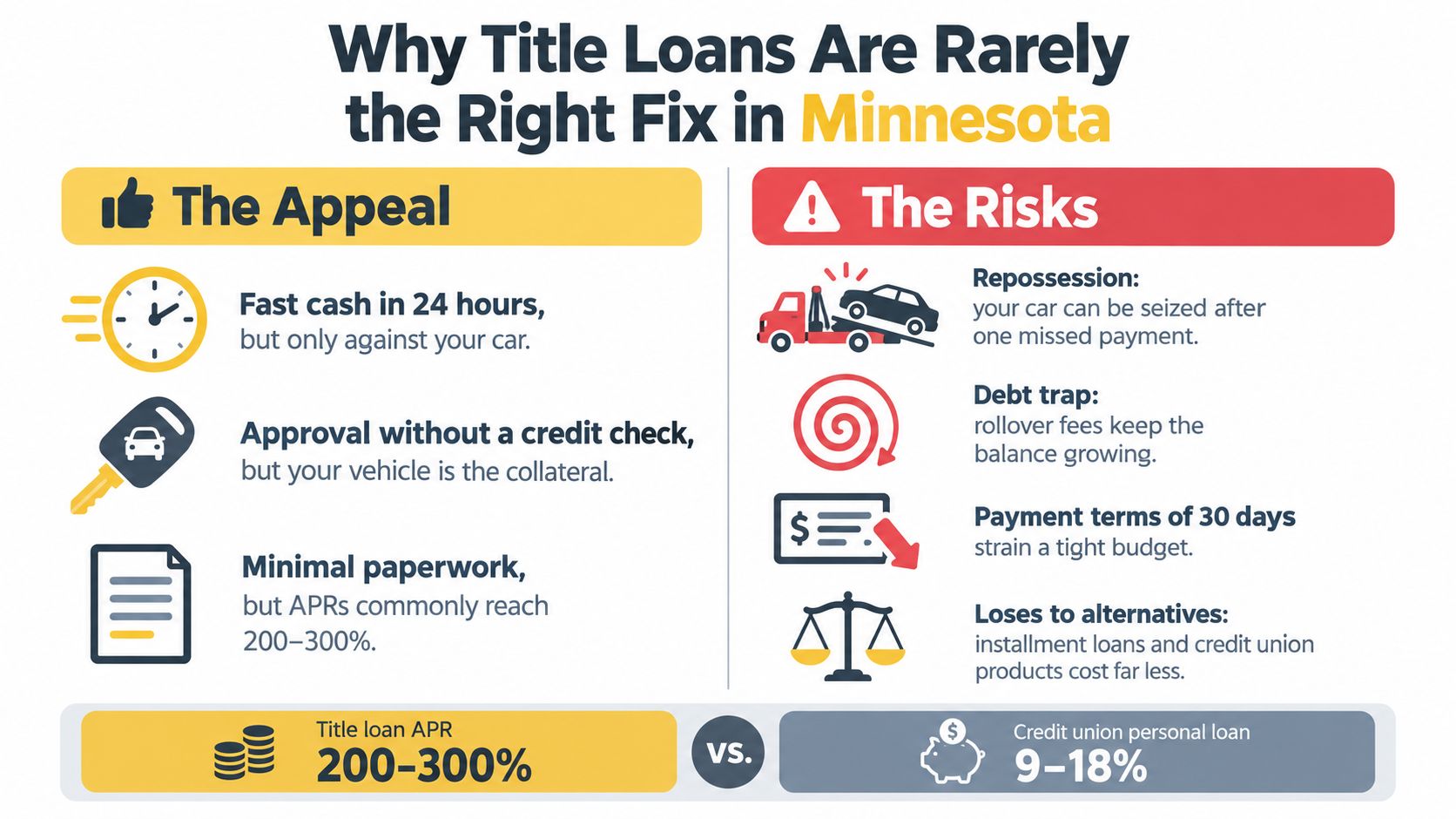
Before pledging a car, ask whether the expense can be handled through a payment plan, a credit-union product, or nonprofit assistance. The Minnesota title-loan overview can help identify the collateral and repayment risks, but it shouldn't replace a written cost comparison.
Never sign a title loan for an expense that a small PAL, creditor arrangement, or community-assistance referral could cover. Losing transportation can create missed shifts, new repair costs, and a second emergency that the original loan never addressed.
Non-Loan Alternatives Minnesota Borrowers Should Try First
Before applying for a loan, call the utility, hospital, landlord, mechanic, or creditor. Ask for a hardship arrangement, split payment, changed due date, or written payment plan. A negotiated bill can solve the immediate problem without adding another account or interest charge.
| Option | Typical Cost | Best Fit |
|---|---|---|
| Credit-union PAL | Lower-cost structured credit, subject to the credit union's terms | Small emergency when repayment is reliable |
| Credit-builder loan | Interest and account terms vary by institution | Rebuilding payment history |
| Secured credit card | Deposit-backed credit product with issuer-specific pricing | Establishing or repairing revolving credit |
| Medical payment plan | Often negotiable and may avoid new loan interest | Hospital or clinic balance |
| Utility hardship plan | Provider-specific, potentially interest-free | Xcel Energy or another utility bill |
| Nonprofit counseling | Free or low-cost depending on service | Debt pressure, collections, or repeated borrowing |
| 211 referral | Free referral service | Rent, food, utility, and emergency-assistance needs |
A PAL is usually the first option to check for a smaller emergency, provided membership and approval are realistic. Compare its full cost with a licensed lender's offer before signing. Borrow only when the payment fits your budget without requiring another loan next month.
A credit-builder loan fits a longer-term rebuilding goal, not a bill due this week. A secured credit card can help establish or repair revolving credit, but use it for manageable purchases and pay as agreed. These products address credit history rather than an immediate shortage of cash.
For medical or utility debt, request a payment plan before accepting high-cost credit. The arrangement addresses the original bill instead of placing a lender between you and the provider. If rent, food, utilities, or another basic need is at risk, use a free 211 referral and ask about available assistance.
Borrowers with negative or no credit histories may turn to payday or pawn products when small-dollar needs arise. That pattern makes it worth checking payment plans, assistance, and nonprofit counseling before accepting the fastest offer. The Federal Reserve's 2024 household well-being report provides broader national context on household borrowing.
If repayment would force you to skip another necessary bill, do not borrow. Contact the provider or a nonprofit counselor first.
Free Local Help and Complaint Contacts in Minnesota
Don't treat a loan application as your only next step. Minnesota borrowers can ask for help before signing, while a loan is active, or after a lender refuses to resolve a problem.
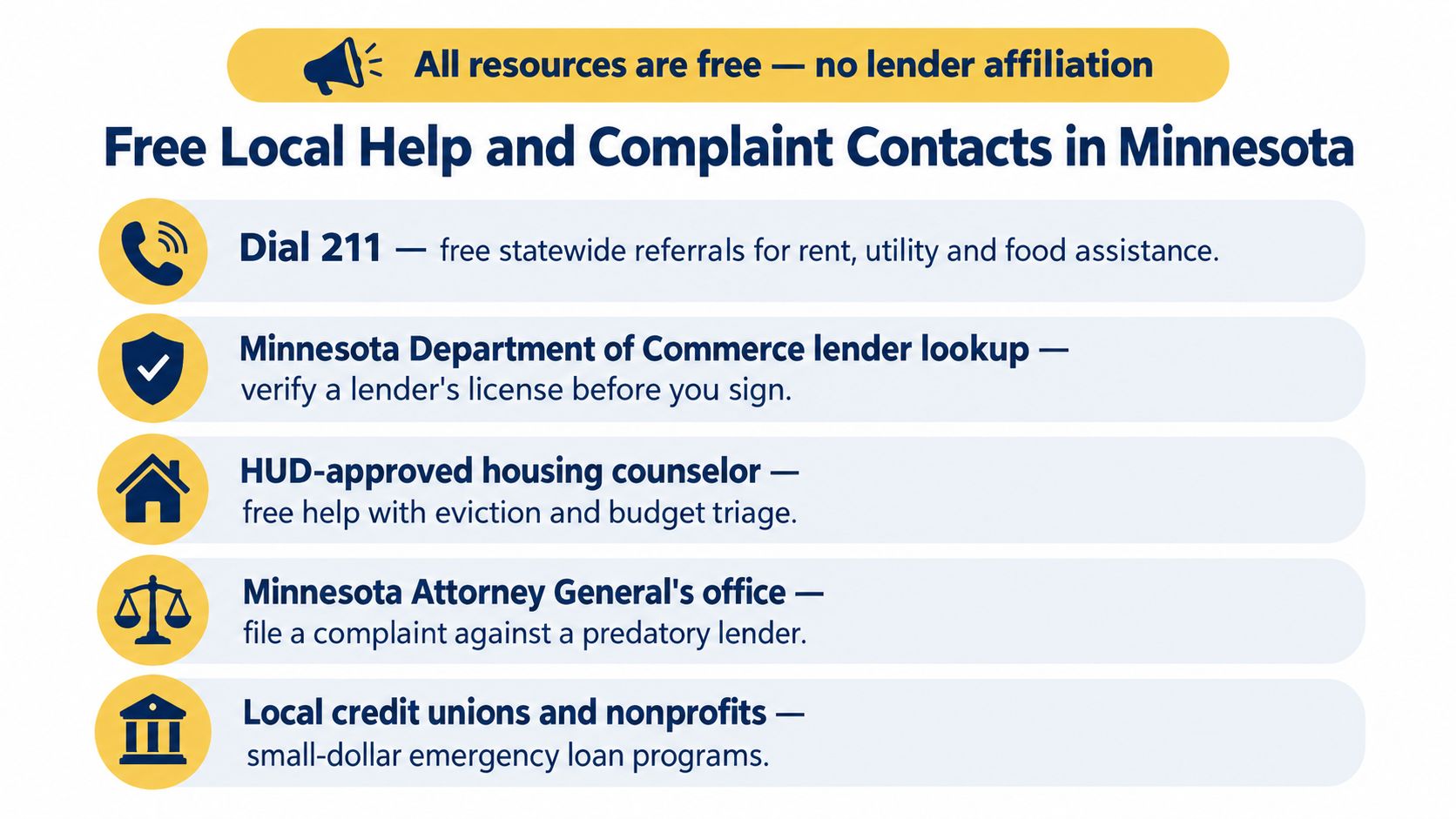
- Call 211: Request statewide referrals for rent, utilities, food, transportation, and other urgent needs.
- Check the lender: Use the Minnesota Department of Commerce non-depository lender information to confirm that an online or storefront lender is licensed.
- Contact a housing counselor: HUD-approved counselors can help with eviction, foreclosure, and household-budget triage through HUD's housing-counselor resources.
- Speak with a nonprofit counselor: Lutheran Social Service Financial Counseling and GreenPath can help evaluate debt-management options.
- Seek legal support: Mid-Minnesota Legal Aid and Southern Minnesota Regional Legal Services can help eligible consumers with consumer-defense questions.
- File a federal complaint: Use the CFPB complaint portal when a lender's conduct warrants federal review.
Keep the contract, payment history, emails, text messages, and account statements. Request a written payoff amount, record the date and name of every representative, and send important requests in writing. If you believe a cancellation or rescission right applies, follow the contract's notice instructions promptly and keep proof of delivery.
How BNPL and Split Payments Change the Borrowing Math
A new installment loan competes with every payment already leaving your account. Count active Buy Now, Pay Later obligations, including Afterpay, Klarna, Affirm, and similar plans, before accepting another due date. Four small withdrawals can create the same cash-flow pressure as one larger payment if they hit during the same pay cycle.
The Federal Reserve's 2024 Survey of Household Economics and Decisionmaking found that nearly three in ten adults with credit scores from 620 to 659 used BNPL, about three times the rate among adults with scores of at least 720. The Federal Reserve report also describes consumers with weaker or absent credit histories using nonbank products for small-dollar needs.
| Credit Score | Used BNPL | Avg. Active Plans |
|---|---|---|
| 620 to 659 | Nearly three in ten | Not reported in the verified data |
| At least 720 | Roughly one-third the rate of the 620-to-659 group | Not reported in the verified data |
The second-row comparison is expressed as a ratio of the reported usage rates, not as a directly reported percentage. The survey does not provide an average number of active plans, so do not use an invented figure to judge affordability. List each plan, its next withdrawal, remaining balance, and whether the purchase was necessary.
Splitting a bill changes its timing, not its cost. BNPL may cover a necessary purchase, but several plans can consume cash needed for rent, utilities, food, or an existing loan. If those withdrawals already strain your budget, skip another bad-credit loan and address the shortfall through a payment arrangement, reduced spending, or free counseling. Repeat borrowing turns a temporary gap into several competing due dates.
Pre-Signing Checklist for Any Minnesota Bad Credit Loan
Use this checklist for a lender, a PAL, or any secured product. If the provider won't supply the information, don't sign.
Documents and identity
- Photo ID: Provide a valid government photo ID.
- Income records: Gather recent pay stubs covering the relevant pay period.
- Bank statements: Have recent statements available if the lender requires them.
- Minnesota address: Be ready to verify residency for an in-store application.
Setup and timing
- Contact details: Use a phone number you answer and an active email address.
- Deposit schedule: Match the first payment to your actual income date.
- Funding timing: Confirm whether funds arrive the same day or the next business day.
- Collateral records: For a secured loan, understand exactly what asset supports the debt.
Rate and contract review
- APR in writing: Don't accept only a monthly-payment quote.
- Total repayment: Compare the full amount paid over the entire term.
- Early payoff: Check the contract for prepayment terms and penalties.
- License verification: Confirm the lender's Minnesota registration before signing.
Walk away if a lender demands a prepaid debit card before funding, refuses to disclose the APR, or won't explain cancellation rights and fees. Run the same checklist against a credit union, payment plan, or counselor recommendation. A safer alternative still needs clear terms.
Frequently Asked Questions About Loans for Bad Credit in MN
Will reading loan guides or requesting quotes hurt my credit
Reading information doesn't affect your credit. A lender's prequalification may use a soft inquiry, but you should ask whether accepting an offer will trigger a hard inquiry before submitting a full application. Don't submit multiple full applications blindly.
How long does approval take with a Minnesota lender
Timing varies by product, lender, documentation, and membership status. A storefront may make a decision while you're there, an online lender may take longer to verify information, and a credit union may require membership before a PAL can be funded. Treat “instant” as a marketing claim until the lender confirms the actual funding time in writing.
Must online lenders be licensed in Minnesota
A lender making loans to Minnesota residents generally must comply with Minnesota licensing and lending rules, including the rules that apply to online operations. Verify the lender through the Minnesota Department of Commerce rather than relying on a website's claims. Be especially cautious with tribal or out-of-state marketing, because the licensing question still matters to the Minnesota borrower.
What should I do if payday refinancing has already trapped me
Stop taking new loans to cover old ones. Contact a nonprofit credit counselor, ask the current lender whether it offers an extended payment arrangement, preserve every contract and payment record, and submit a complaint through the CFPB when the lender won't address a serious issue. Call 211 if the underlying problem is rent, food, utilities, or another basic need.
BadCreditMD offers state-specific explainers, cost comparisons, loan-type guides, and directories for free assistance, including Minnesota resources for borrowers with imperfect credit. Use BadCreditMD to compare the product before you apply, then verify the lender's terms and license before signing.