Most advice about a personal loan in Michigan starts with rates, approval odds, and lender comparisons. That's the wrong order. If you're facing a car repair, medical bill, utility shutoff, or credit-card balance, the first question isn't “Who will approve me?” It's “Can I solve this without adding another required payment?”
Michigan borrowers have access to nonprofit credit counseling and free financial coaching that may address the underlying cash-flow problem without creating new debt. Detroit's Financial Education Center, for example, offers free one-on-one help with budgeting, debt reduction, credit reports, credit improvement, and referrals, with no income or residency requirements, as described by Michigan's debt-management guidance. A loan can be useful, but it should earn its place in your budget.
Table of Contents
- Why a Loan May Be the Wrong First Move
- What Counts as a Personal Loan in Michigan
- Michigan Interest-Rate Rules and Federal Preemption
- Common Personal Loan Options for Imperfect Credit
- A Worked Cost Example on a Two-Thousand-Dollar Loan
- Disclosure Checklist and Red Flags to Watch For
- Comparing Personal Loans With Lower-Cost Alternatives
- Free Michigan Help Before You Sign Anything
- A Four-Step Decision Sequence for Michigan Borrowers
- Quick-Reference Matrix for Michigan Borrowers
Why a Loan May Be the Wrong First Move
A personal loan makes sense when the expense is unavoidable, the repayment source is clear, and the new payment fits after your existing obligations. It's usually a poor first move when you're borrowing to cover a recurring shortfall, delay an unpaid bill, or combine debts without changing the spending problem that created them.
Start with the bill, not the application. Ask the medical provider about a payment arrangement. Ask the utility about a hardship plan or extension. Ask a creditor whether it can change the due date or temporarily reduce the required payment. These conversations may take persistence, but they can cost less than a high-priced installment contract and won't necessarily require a hard credit inquiry.
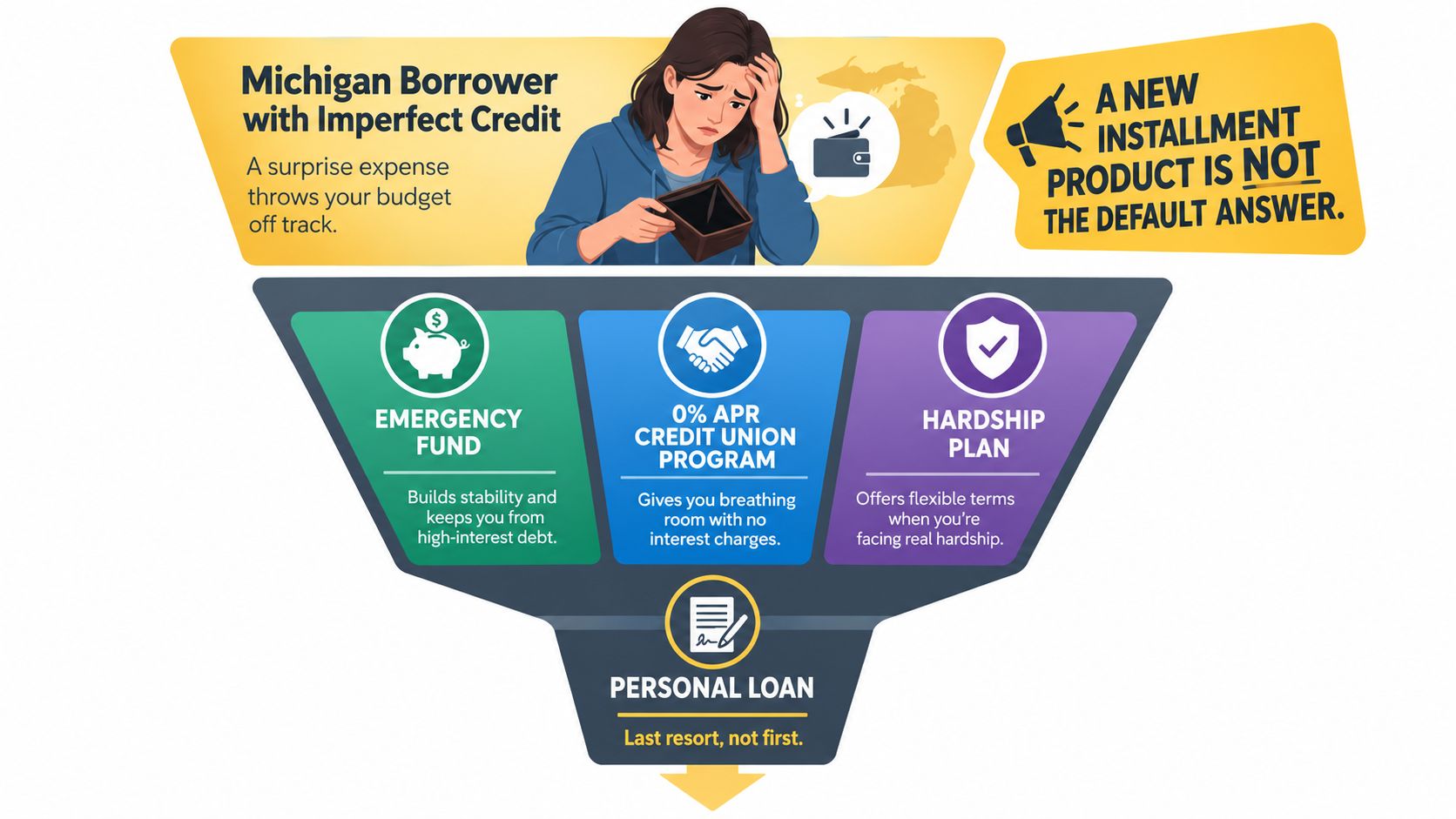
Use a simple triage test
- One-time expense: Consider whether you have a definite way to repay the money, such as a scheduled paycheck or insurance payment.
- Negotiable bill: Contact the creditor, provider, landlord, or utility before applying for credit.
- Recurring shortage: Treat the budget gap as the main problem. A loan only spreads that problem across future paychecks.
- Several old debts: Speak with a nonprofit counselor before replacing multiple obligations with one new contract.
Practical rule: If you can't explain exactly how the new payment will fit every month, don't sign the loan yet.
A credit counselor can help you review debts and create an individualized debt-management plan. Counseling is different from debt settlement, and it doesn't mean someone hands money to creditors for you. It means you get help deciding whether a new loan belongs in the plan at all.
What Counts as a Personal Loan in Michigan
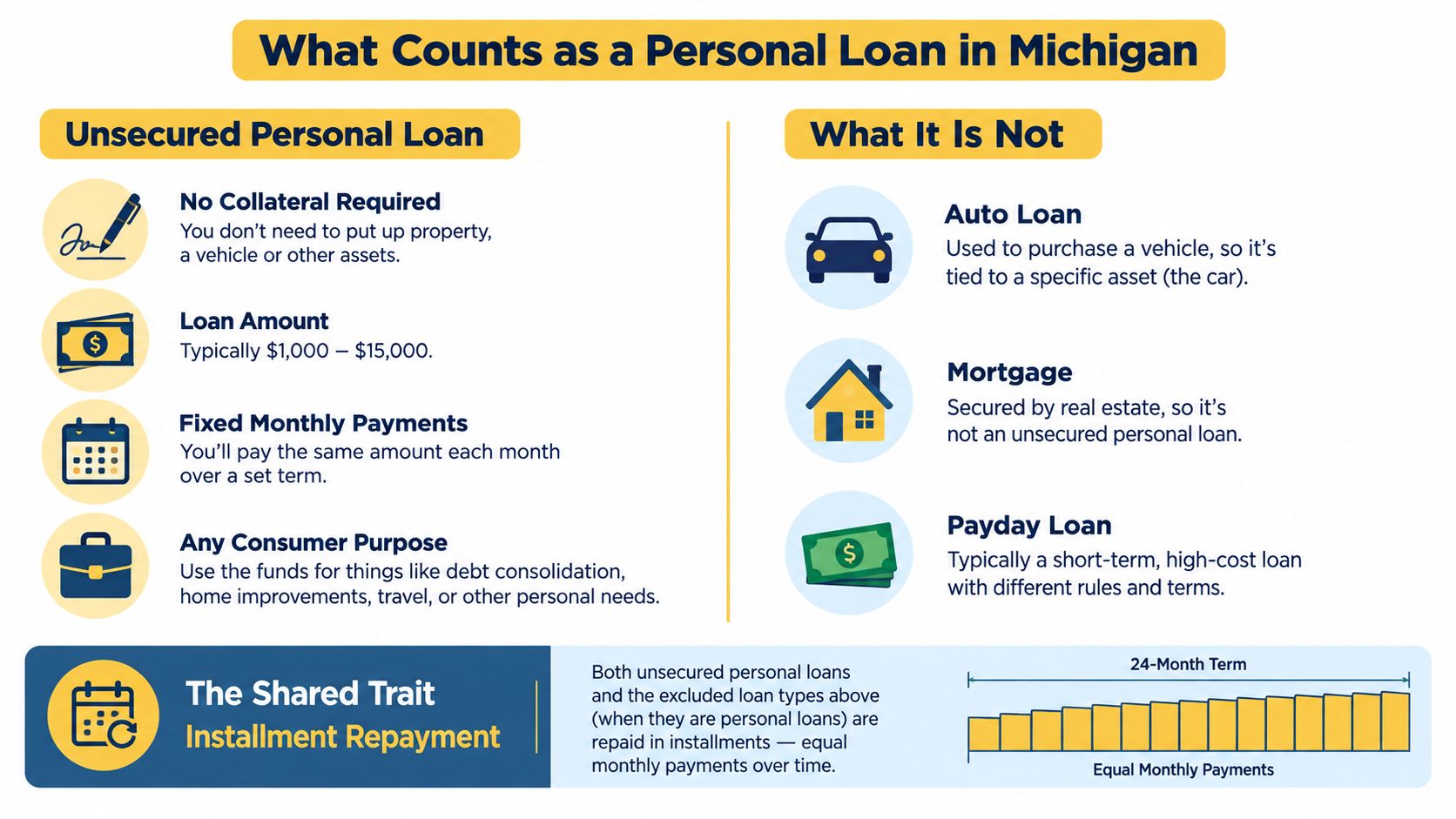
A personal loan is generally a consumer loan used for a purpose such as an emergency expense, debt consolidation, home repair, or another personal need. It may be unsecured, meaning the lender doesn't take a specific asset as collateral, or secured by savings, a certificate of deposit, a vehicle, or another asset. The important features are usually a stated principal, a repayment schedule, and scheduled installments.
The label matters because Michigan borrowers don't face one universal rulebook. A bank, credit union, finance company, licensed non-bank lender, payday provider, title lender, and pawnbroker may operate under different statutes or federal rules.
Identify the product before comparing it
A conventional installment loan isn't the same as a payday or deferred-presentment product. A title loan uses a vehicle as security. A pawn transaction uses the pawned item as collateral. An auto loan finances a vehicle purchase, while a mortgage finances real estate. A credit card is revolving credit, not a fixed installment obligation.
Read the agreement for the lender's legal name, license information, collateral language, payment schedule, and fee disclosures. Don't rely on an advertisement's use of “personal loan.” The contract tells you which product you are considering.
Two offers with the same borrowed amount can have very different costs because the lender type, collateral, fees, rate structure, and repayment terms may differ.
If an offer looks like a short-term payday product rather than a conventional installment loan, compare it separately. The Michigan loan options guide can help you identify the product category before you evaluate the price.
Michigan Interest-Rate Rules and Federal Preemption
Michigan's foundational interest-rate statute is Act 326 of 1966. The statute states a default legal interest rate of $5 per $100 per year, equivalent to 5% annually, and permits parties to stipulate in writing for up to 7% per year, subject to statutory exceptions and other applicable Michigan laws. The statute itself doesn't create one universal ceiling for every personal-loan product. Its exclusions and interactions with other laws matter.
That distinction is essential. A borrower can't look at the general 5% or 7% figures and assume they reveal the lawful APR for every offer in Michigan. The lender's charter, product type, written agreement, fees, and applicable federal rules all affect the analysis. The statute is available in the Michigan Legislature's Act 326 document.
The rate table is a starting point, not a verdict
| Lender type | Governing law | Default rate | Maximum permitted rate |
|---|---|---|---|
| Lender subject to Act 326 | Michigan general interest-rate statute, subject to exceptions | 5% annually | Up to 7% annually when properly stipulated in writing, subject to applicable law |
| Federally authorized bank, savings bank, or credit union | Federal authority and the applicable state or federal framework | Depends on the governing framework | May depend on most-favored-lender authority and the relevant loan law |
| Other specialized products | Product-specific Michigan or federal law | Varies | Varies by product and lender |
Michigan's Department of Insurance and Financial Services explains that federally authorized banks, savings banks, and credit unions may have most-favored-lender authority under the Depository Institutions Deregulation and Monetary Control Act of 1980. An eligible institution may be able to charge the greater of one percentage point above the Federal Reserve discount rate or the highest rate permitted under state law for the relevant loan type.
That's why an APR that looks inconsistent with Act 326 may still require a lender-specific analysis. Don't guess from a marketing page. Ask which law authorizes the rate and whether the lender is relying on federal authority.
Common Personal Loan Options for Imperfect Credit
Borrowers with thin or damaged credit usually encounter a mixture of bank products, credit-union programs, online offers, and secured loans. The right comparison is about fit, not just approval.
| Product | Typical amount | Typical APR | Best fit | Key caution |
|---|---|---|---|---|
| Credit union small-dollar alternative | Small emergency amount | Varies by program and eligibility | A member facing a one-time cash gap | Membership, underwriting, and program rules apply |
| Credit-builder loan | Small structured installment amount | Varies by institution | Someone focused on establishing repayment history | You still owe each payment, even if the borrowed funds are held until completion |
| Online installment loan | Varies by lender | Can be expensive for imperfect credit | A borrower with a documented emergency and clear repayment source | Fees, aggressive refinancing, and high total cost can turn it into a trap |
| Bank or credit-union unsecured loan | Varies by institution | Usually depends heavily on underwriting | A borrower with stable income and stronger credit | Thin files may receive a denial or less favorable terms |
| Secured loan | Varies by collateral and lender | Varies | Someone willing to pledge savings or another asset | Default can put the collateral at risk |
A credit union alternative may be worth asking about before an online loan. The institution can explain its membership requirements, underwriting, rate, payment count, and whether it offers a small-dollar program. Don't assume the product is affordable until you see the written total cost.
A credit-builder loan is a rebuilding tool, not emergency cash in the usual sense. Ask whether the institution reports payments to the credit bureaus, when you receive access to the funds, and what happens if you miss a payment.
Online lenders deserve the most scrutiny. A fast decision doesn't make the loan cheap. Review the lender's legal identity, license information, origination fee, late-fee policy, and refinancing language. For a separate look at short-term products and their risks, consult the Michigan payday-loan information page.
A Worked Cost Example on a Two-Thousand-Dollar Loan
Use the lender's figures to calculate three things: the money that reaches you, the scheduled repayment total, and the burden created by the payment frequency. A stated principal isn't necessarily the amount you receive if an origination fee comes out before disbursement.
The verified example below shows a $2,000 loan at a nominal 36% annual rate over 24 months, with a payment of approximately $118 per month and scheduled payments of about $2,835 before additional fees. Those figures come from the Federal Reserve personal-loan analysis and Michigan borrowing guidance.
| Scenario | APR | Term | Monthly payment | Total interest or finance cost | Total repaid |
|---|---|---|---|---|---|
| Amortizing loan example | 36% | 24 months | Approximately $118 | Included in scheduled total, before additional fees | Approximately $2,835 before additional fees |
| Same structure with an origination fee deducted | 36% stated rate | 24 months | Approximately $118, subject to contract | Higher effective cost because proceeds are lower | Scheduled payments remain based on the contract |
| Longer-term offer | Varies | Longer than the original term | Usually lower than the original payment | Generally higher total interest when the rate and balance remain comparable | Generally higher total repayment |
The second row exposes a common trick in comparison shopping. If the contract says you borrowed $2,000 but deducts an origination fee before sending the money, you're repaying the scheduled balance while receiving less cash. Evaluate the amount financed and the amount disbursed separately.
A longer term can make the monthly bill look manageable, but it keeps the debt active for more months and generally increases total interest. Don't choose a term solely because its payment fits today. Choose it only after comparing the full repayment schedule with a lower-dollar alternative, a creditor arrangement, or a free counseling option.
Disclosure Checklist and Red Flags to Watch For
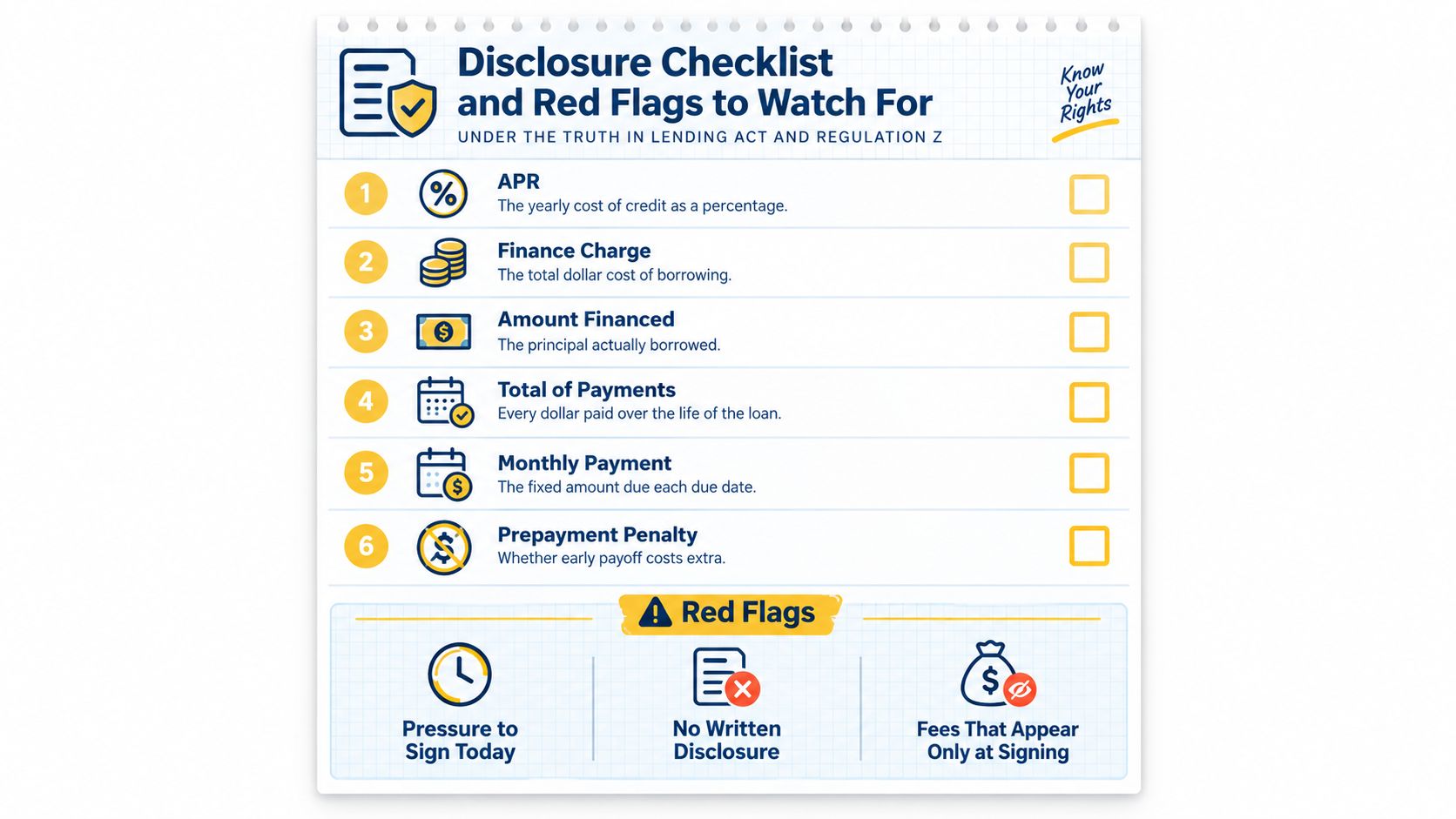
Before signing, ask for a complete written disclosure. You should be able to identify the APR, finance charge, amount financed, total of payments, payment count, late fees, and prepayment treatment without decoding a sales pitch.
Mark each item before you commit
- APR: The annualized cost used to compare offers.
- Finance charge: The dollar cost of borrowing under the disclosure.
- Amount financed: The amount used to calculate the repayment obligation, which may differ from cash received if fees are deducted.
- Total of payments: The scheduled amount paid over the loan's life.
- Payment schedule: The number, frequency, and amount of payments.
- Late-fee policy: The charge and consequences if a payment arrives late.
- Prepayment treatment: Whether early payoff is allowed without an extra charge.
Walk away if the lender refuses to put the terms in writing. Treat a demand for an upfront prepaid card, wire, or “insurance” payment as a serious warning sign. Don't share sensitive information until you can verify who the lender is and whether the business is authorized to operate.
Michigan DIFS handles consumer-finance licensing and supervision. Use the department's consumer information and verification resources before signing, and keep copies of the application, disclosure, agreement, payment history, and every message with the lender.
A legitimate loan can survive careful reading. If the salesperson pressures you to skip the paperwork, the product isn't ready for your signature.
Comparing Personal Loans With Lower-Cost Alternatives
A personal loan is only one way to address an emergency or debt problem. Compare each option on cash received, total cost, credit effect, time to resolution, and collateral risk.
| Option | Cost question | Credit effect | Resolution path | Collateral risk |
|---|---|---|---|---|
| Personal installment loan | What is the APR and total repayment after fees? | Depends on lender reporting and payment history | Fixed schedule | None if unsecured |
| Credit union alternative | What rate, membership rules, and payment count apply? | Ask whether payments are reported | Usually structured for a defined short-term need | Usually none if unsecured |
| Credit-builder loan | Are funds immediately available, and what fees apply? | Often designed around reported payments, but confirm with the institution | Builds a scheduled payment record | Funds may be held under the program terms |
| Secured credit card | What deposit and ongoing charges apply? | May help establish revolving payment history when reported | Requires ongoing monthly management | Deposit is at risk under the card agreement |
| Creditor hardship arrangement | Can the creditor reduce, pause, or restructure payments? | Ask how the arrangement is reported | Resolves the existing account directly | Usually no pledged asset |
A credit union alternative may cost less than an expensive online installment loan, but the only reliable comparison is the written offer. A hardship arrangement can be even more practical because it addresses the account that needs attention instead of creating a new creditor.
A credit-builder product can help someone whose main goal is rebuilding a file, but it may not solve an urgent bill. A secured card can support credit management over time, yet it isn't a substitute for cash if the immediate expense must be paid.
Use a Michigan installment-loan comparison to understand how fixed payments differ from revolving credit and short-term products. The personal-loan option still has a place when the emergency is one-time, the payoff source is credible, and the contract's total cost is acceptable.
Free Michigan Help Before You Sign Anything
Free help is often the better first appointment. Michigan's debt guidance directs consumers toward nonprofit credit counselors that can help create individualized debt-management plans. Reputable counseling is commonly nonprofit and may be available locally, online, or by phone.
Detroit's Financial Empowerment Center provides free one-on-one assistance with budgeting, debt reduction, credit reports, credit improvement, and referrals. It has no income or residency requirements, so a borrower shouldn't assume they're disqualified before asking for help.
Choose the right kind of assistance
- Budget and debt planning: A nonprofit credit counselor can review income, bills, and debt payments, then discuss a workable plan.
- Immediate social-service referrals: Michigan's statewide referral system can help identify local assistance for basic needs and bills.
- One-on-one financial coaching: Detroit's Financial Wellness Center is appropriate when you need a person to review your budget and options with you.
- Legal defense: Legal-aid organizations are the right door for questions about collection lawsuits, garnishment, contract disputes, or consumer rights.
- Regulatory complaints: DIFS is for concerns involving regulated financial businesses, licensing, and conduct. The Michigan Attorney General's consumer-protection function is another route for reporting suspected misconduct.
Counseling, legal aid, and complaints serve different purposes. A counselor helps you make a plan. A lawyer may defend your rights. A regulator receives and evaluates complaints about businesses. None should be confused with a lender promising guaranteed approval.
BadCreditMD also provides informational guides about loan types, state rules, alternatives, local assistance, and complaint resources. Use the BadCreditMD help directory as a starting point, then confirm current program availability directly with the relevant Michigan organization.
A Four-Step Decision Sequence for Michigan Borrowers
You can make a disciplined decision in one evening without submitting multiple applications.
Triage the expense. Write down the bill, its due date, the consequence of nonpayment, and whether the problem is one-time or recurring. If the expense has no clear repayment source, borrowing deserves a hard pause.
Check free and direct alternatives. Call the creditor, utility, medical provider, or landlord. Ask about a hardship arrangement, extension, payment plan, or fee waiver. Contact a nonprofit counselor before allowing several lenders to review your credit.
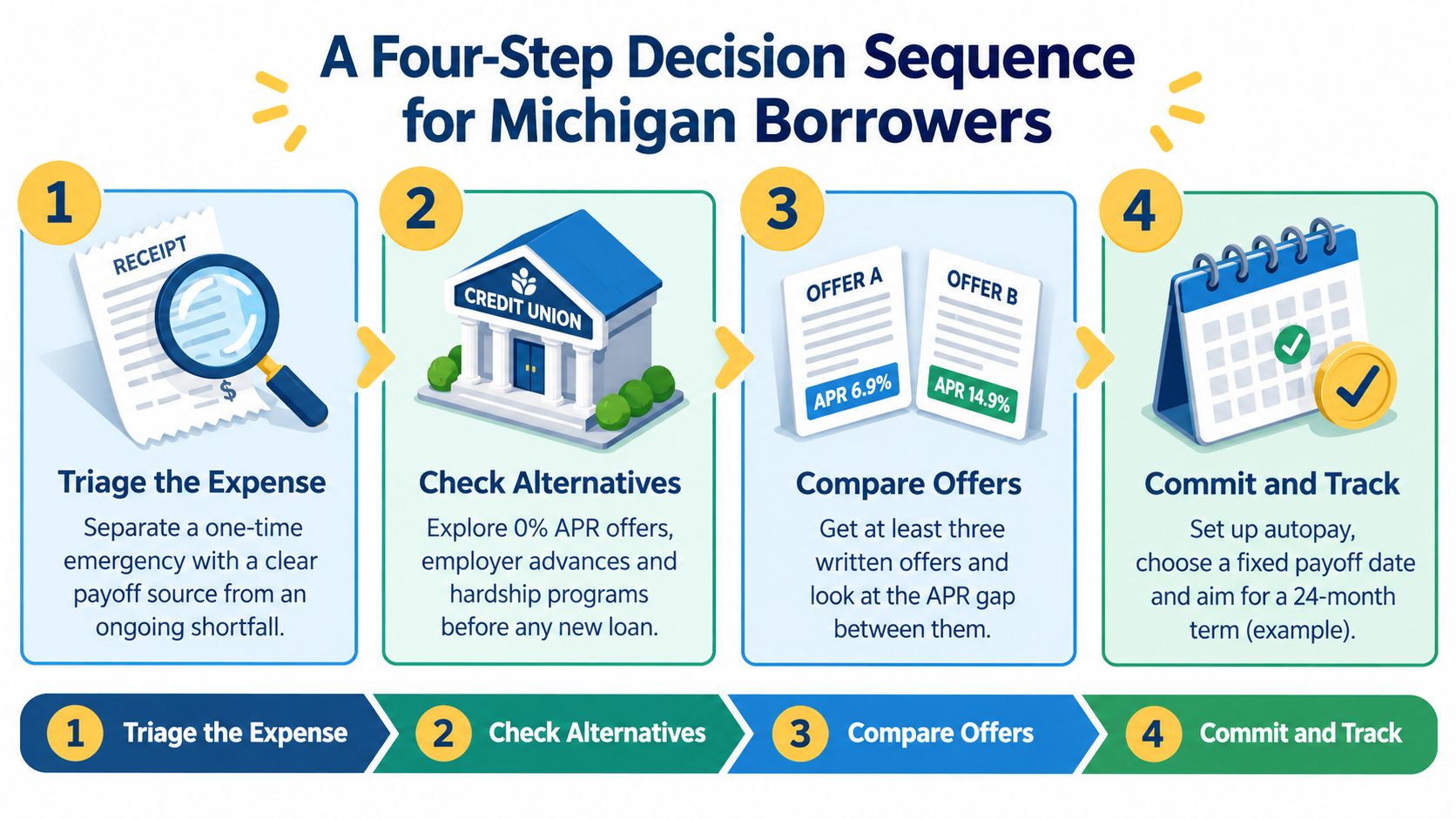
Model the offer. Record the amount you receive, the finance charge, every scheduled payment, the total repayment, and every fee. Compare the loan with a lower-dollar solution instead of stretching the term just to reduce the payment.
Verify before signing. Confirm the lender's legal name and DIFS information where applicable. If the lender is a bank or credit union relying on federal authority, ask which charter and legal framework supports the rate. Keep the disclosure and contract together.
Don't borrow simply because the application says yes. Borrow only when the expense is necessary, the repayment source is clear, and the written cost is acceptable.
A workable repayment plan may be better than consolidation. If the loan doesn't solve the underlying cash-flow issue, it only moves the same pressure into future months. For practical decision-making, this video guide on evaluating borrowing choices can supplement the written checklist.
Quick-Reference Matrix for Michigan Borrowers
Use the matrix below as a starting point, not as a substitute for reading the contract. Costs, eligibility, reporting, and availability vary by lender and program. Confirm the current terms directly, especially when a product involves a credit union, nonprofit counselor, or secured asset.
| Borrower situation | Recommended Michigan path | Typical cost range | Verify with |
|---|---|---|---|
| One-time emergency | Ask a credit union about a small-dollar alternative, then compare it with a creditor hardship plan | Varies by institution, program, and written terms | Michigan 211, the credit union, and DIFS where applicable |
| Building or rebuilding credit | Consider a credit-builder loan through a local credit union or community lender after confirming reporting and fees | Varies by program | Detroit Financial Empowerment Center, the lender, and a nonprofit counselor |
| Consolidating multiple debts | Speak with a nonprofit credit counselor about a debt-management plan before taking a new loan | Varies by debts, plan, and creditor concessions | GreenPath, another nonprofit counseling agency, or a qualified counselor |
| Suspected lender misconduct | Don't send more money or personal information until the business is verified | No loan should require an unexplained upfront payment | DIFS and the Michigan Attorney General's consumer-protection resources |
Act 326 of 1966 may be relevant to a lender subject to Michigan's general interest statute, but it isn't the only rule that can govern a consumer loan. Federal authority, lender charter, product structure, collateral, and other Michigan laws can change the analysis. Ask the lender to identify the authority for the rate instead of assuming the general statutory figures answer the question.
If you're considering a loan because several accounts are already difficult to manage, a counselor-managed plan may address the problem more directly than another installment contract. If the emergency is temporary and the payment source is certain, compare the written loan offer with every available hardship or credit-union option before choosing.
BadCreditMD offers state-specific borrowing explainers, Michigan loan-rule information, cost comparisons, and directories for free assistance, but it isn't a lender or broker. Review the BadCreditMD Michigan resources before submitting an application, and use the written checklist to determine whether borrowing is the right next step.