Forget the usual advice to “just get a payday loan if your credit is bad.” In Colorado, that advice is outdated and often wrong. The state changed the rules hard enough that the main job is no longer hunting for a classic high-cost payday loan, it's figuring out which legal small-dollar option fits your cash flow and won't trap you in a rollover cycle.
Colorado's modern rules matter because they reshaped what lenders can charge and how they can structure repayment. Voters approved Proposition 111 in 2018, the 36% APR cap took effect in 2019, and many lenders moved toward alternative charge loans under the state credit code instead of the old payday model (Responsible Lending report). If you're searching for a Colorado bad credit loan, stop looking for the old stereotype and start looking at the law, the term, and the actual payment schedule.
Table of Contents
- The Reality of Payday Lending in Colorado
- Understanding the Tiered APR Structure
- Deferred Deposit Loans Versus Installment Products
- Identifying Legal Lenders and Avoiding Scams
- Safer Alternatives to High-Cost Borrowing
- The Debate Over Earned Wage Access Apps
- Managing Default and Filing Complaints
- Making the Right Borrowing Decision
The Reality of Payday Lending in Colorado
Colorado is not a free-for-all payday state anymore. That's the first thing borrowers need to understand, because a lot of online advice still talks as if the old triple-digit APR market is alive and well here. It isn't, at least not in the way the term “payday loan” is commonly meant.
The big shift came when voters approved Proposition 111 in 2018, which capped nearly all deferred-deposit payday loans at 36% APR, with the change taking effect in 2019 (Responsible Lending report). Before that, Colorado payday lending could be brutally expensive. State and policy materials note that loans were once allowed to reach 214% APR under the old structure, and earlier rules limited loan size to $500 or 25% of gross monthly income, whichever was smaller, with a minimum six-month term (Kansas legislative testimony).
Practical rule: If a lender's pitch sounds like the old payday market, assume the ad is outdated until you verify the Colorado terms in writing.
That change didn't make bad credit borrowing disappear. It changed the shape of the market. Colorado later reported that many lenders shifted toward alternative charge loans under the Uniform Consumer Credit Code, which can lawfully carry higher rates than the 36% payday ceiling (Responsible Lending report). So the key question isn't “Can I find a payday loan?” It's “What type of regulated loan am I being offered?”
If you still see generic payday language online, treat it as a warning sign. A loan marketed as “fast cash” can be a tightly regulated installment product, a deferred deposit loan, or something that doesn't fit Colorado law at all. The right move is to read the repayment structure first and the marketing second.
For a broad state-specific overview of what borrowers often see first, start with this Colorado payday loan guide, then compare every offer against the actual state limits rather than the sales page.
Understanding the Tiered APR Structure
Colorado's consumer-credit pricing rules are tiered, and that's where borrowers get tripped up. People often ask for the APR as if one rate tells the whole story. In Colorado, it doesn't. The amount you borrow changes the ceiling.
For supervised consumer loans, the statutory finance charge schedule uses 36% per year on the first $1,000, 21% per year from $1,000.01 to $3,000, and 15% per year above $3,000, computed under the actuarial method (Goodwin law summary). That means a borrower comparing a $900 loan and a $2,500 loan should not assume the same legal cost model applies. It doesn't.
How to read the tiers
If the amount you need sits inside the first tier, the lender's pricing room is narrower. If the loan crosses into the next band, the legal maximum changes for the slice of principal in that band. That's why a single headline APR can be misleading on Colorado installment offers.
| Colorado Supervised Loan APR Tiers | Maximum Legal APR |
|---|---|
| First $1,000 of principal | 36% |
| Portion from $1,000.01 to $3,000 | 21% |
| Amount above $3,000 | 15% |
A practical example makes this clearer. Suppose you're looking at a $2,500 installment loan. The first $1,000 sits in the 36% tier, and the next $1,500 sits in the 21% tier. That doesn't tell you the exact payment, because term length and fee structure still matter, but it does tell you the legal benchmark you should be using before you sign.
Borrower rule: Don't ask whether the lender is “low rate.” Ask which part of the loan amount sits in which tier, then compare the offer against that tier.
Colorado also allows, for certain closed-end supervised loans of $1,000 or less with 6- to 12-month terms, an alternative structure with an acquisition charge up to 8% plus monthly handling charges that range from $8.50 to $17.50 depending on the amount financed (Goodwin law summary). That matters because the all-in cost can shift fast when a lender uses a fee-heavy structure instead of a simple rate.
If you're comparing products, use this loan-type comparison page as a framework, then plug the Colorado tier into the offer you're being quoted. The law is the benchmark, not the marketing.
Deferred Deposit Loans Versus Installment Products
Colorado's regulated small-dollar market splits into two very different paths. One is the short-term deferred deposit loan, which is tightly constrained. The other is the longer-term installment product, which is usually the more rational choice when your budget is already strained.
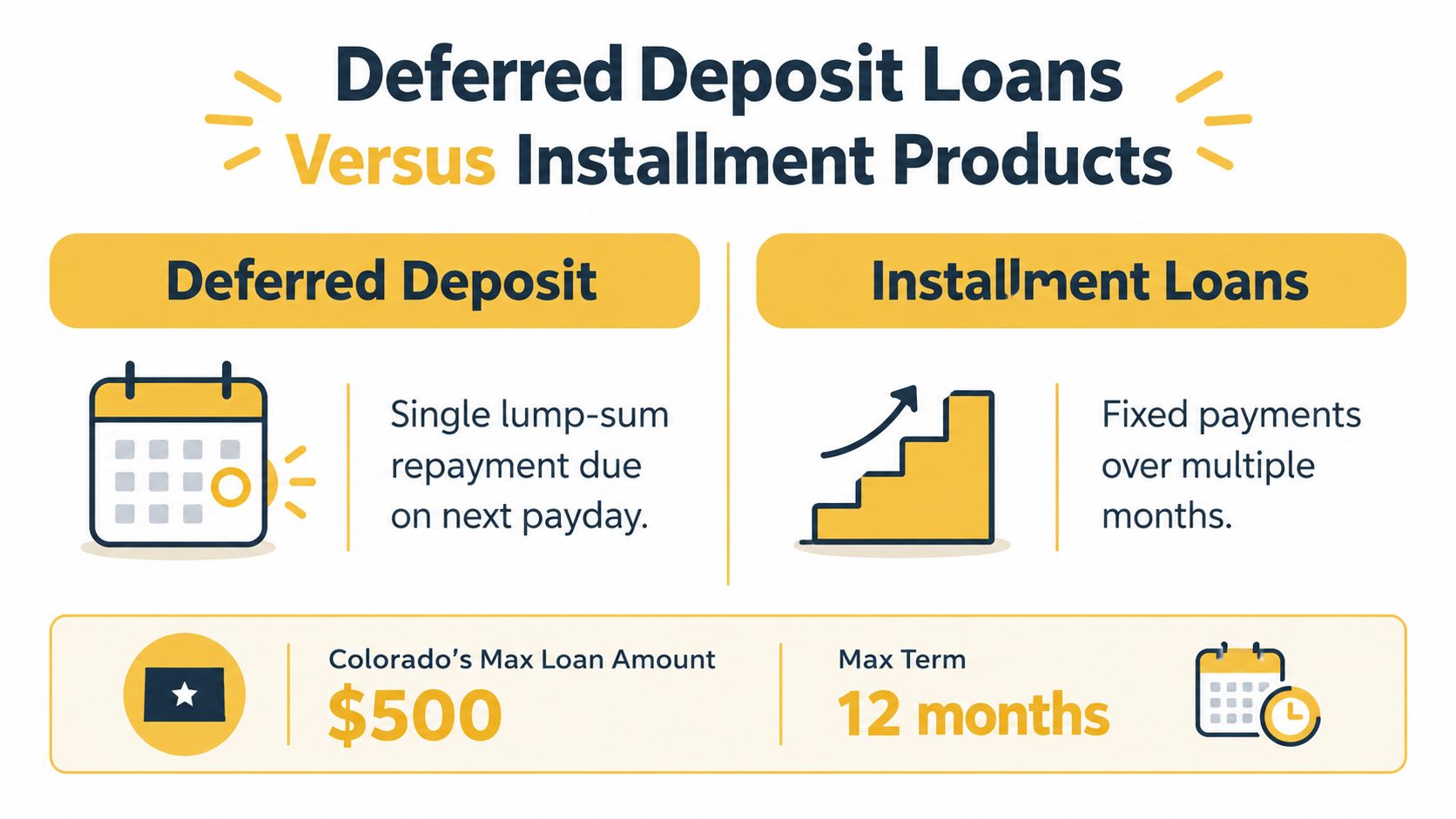
The deferred deposit rules are strict. A lender may not advance more than $500 to a consumer at any one time, and if multiple loans are made, the total amount financed still cannot exceed $500, with at least a 30-day waiting period between loans (Colorado UCCC text). That structure exists to limit the kind of repeated borrowing that turns a temporary cash gap into a debt cycle.
Why installment products usually make more sense
Supervised installment loans in Colorado must generally amortize in substantially equal installments and, for loans at or below $3,000, the maximum repayment period is 25 months for loans of $1,000 or less and 37 months for loans above $1,000 (Colorado UCCC text). That longer structure gives the borrower a real payment schedule instead of a cliff payment.
That difference matters more than most borrowers realize. A deferred deposit loan asks you to solve the problem fast, usually with one lump-sum repayment. An installment loan spreads the obligation across months, which is far easier to manage if the problem is rent, car repairs, or a utility shutoff.
For a borrower with bad credit, the safer product is usually the one that matches actual cash flow. If you can't reasonably clear the whole balance on the next payday, the short-term product is the wrong tool. Use this installment-loan resource to compare how longer repayment can change the shape of the obligation.
Bottom line: In Colorado, repeated short-term borrowing is exactly what the law tries to discourage. Longer-term installment repayment is usually the more stable path.
Identifying Legal Lenders and Avoiding Scams
Bad-credit borrowers get targeted because they're under pressure and often shopping fast. That's when bad actors lean in. If a lender won't clearly show that it's licensed in Colorado, or the terms look nothing like Colorado law, walk away.
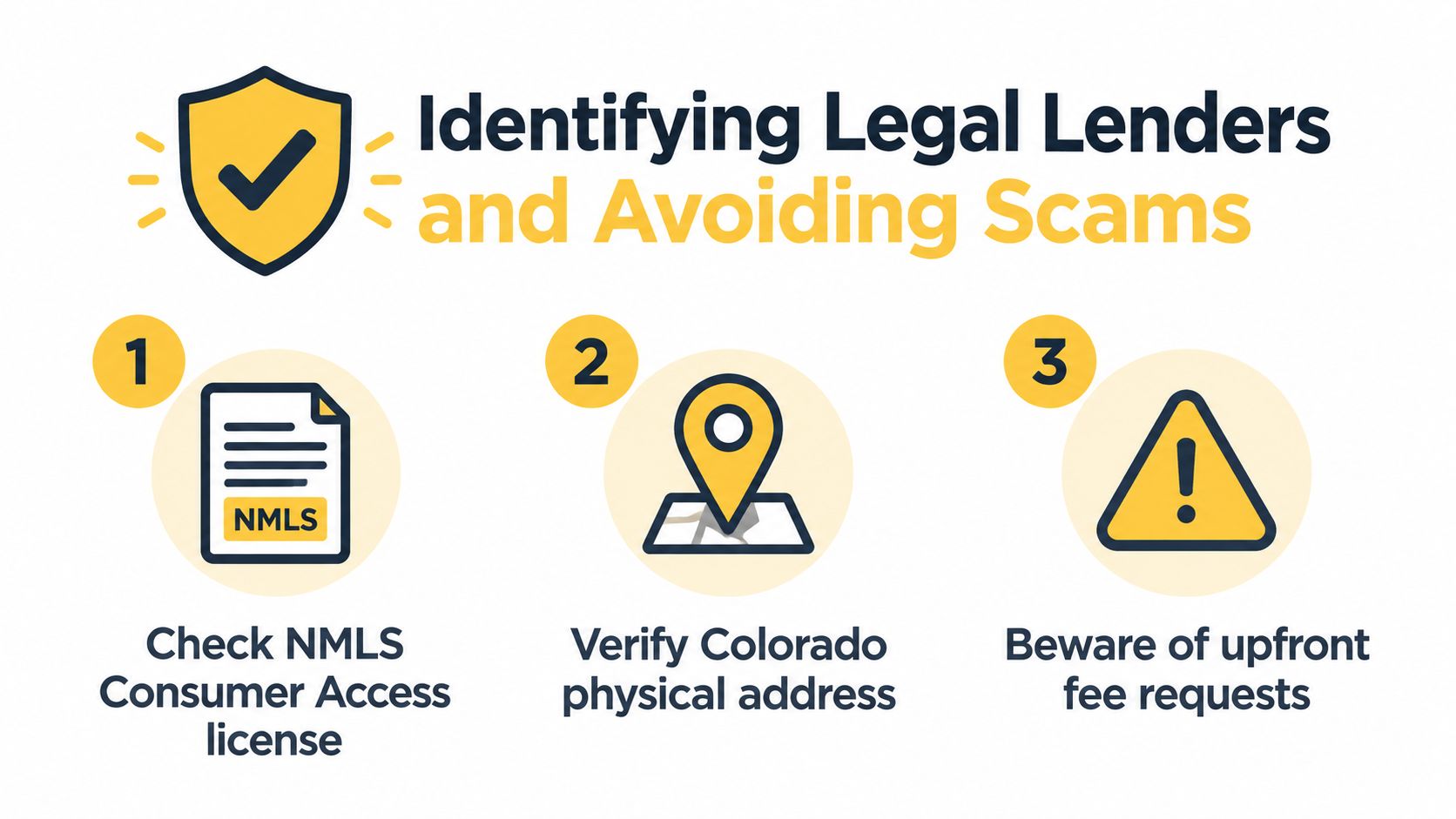
Start with licensing. Check the company's information through the Colorado Attorney General's office and the Department of Law, and verify whether the lender is listed in a legitimate licensing database before you hand over banking details. If a site won't give you a physical Colorado address, that's another red flag. A real lender operating here should not hide behind vague contact details.
Three checks that catch most scams
- Check the license. Look up the lender in NMLS Consumer Access and confirm that the business is authorized to operate.
- Verify the address. A real lender should have a traceable Colorado physical address, not just a mailbox or a blank contact page.
- Reject upfront fee demands. If someone asks for payment before funding, treat that as a serious warning sign.
The reason this matters is simple. Colorado's lending rules are specific, and scam lenders usually ignore the specifics. They advertise “instant approval,” use generic brand names, and push applicants to move money quickly before they compare terms. That's not convenience. That's pressure.
You should also be careful with offers that look like car-title loans or other high-risk products pitched to stressed borrowers. The legal label matters less than whether the offer is licensed and compliant. For a closer look at that risk, use this Colorado car title loans guide only as a caution point, not a recommendation.
If the lender refuses to answer basic licensing questions, don't keep applying.
Your banking info is not worth a mystery loan.
Safer Alternatives to High-Cost Borrowing
The smartest move in a bad-credit emergency is to check for cheaper money before you accept a subprime offer. Colorado borrowers have more options than they think, especially if they can borrow from institutions that are built to help members rather than squeeze them.
One strong option is a Payday Alternative Loan, usually called a PAL, from a federal credit union. PALs are designed specifically to replace ugly short-term borrowing with a more controlled structure. They're worth asking about when the amount you need is small and the repayment window is tight.
Better options to check first
- Payday Alternative Loans: Ask a local federal credit union whether it offers a PAL and what membership rules apply.
- Credit-builder loans: These help you establish a payment history instead of digging a deeper hole.
- Secured credit cards: Useful when you need a small revolving line and can keep the balance low.
- Direct payment plans: Medical providers and utility companies often have hardship arrangements if you ask before the account goes delinquent.
The practical reason to start here is simple. These options can help you cover a gap without locking you into a lender whose business model depends on repeat borrowing. A PAL or payment plan may still cost money, but it's usually easier to manage than a high-cost loan from an out-of-state lender who doesn't care about your long-term budget.
Credit-builder loans and secured cards also help in a way a one-time payday-style product never will. They create positive payment history. That matters if you're trying to move from emergency borrowing to better terms later.
Ask before you borrow: Can this debt help me recover, or will it just buy me two weeks and cost me more stress?
If the problem is a one-off bill, ask the provider for a payment plan before you borrow elsewhere. If the problem is recurring, stop using short-term borrowing as the patch. That's how people get stuck.
The Debate Over Earned Wage Access Apps
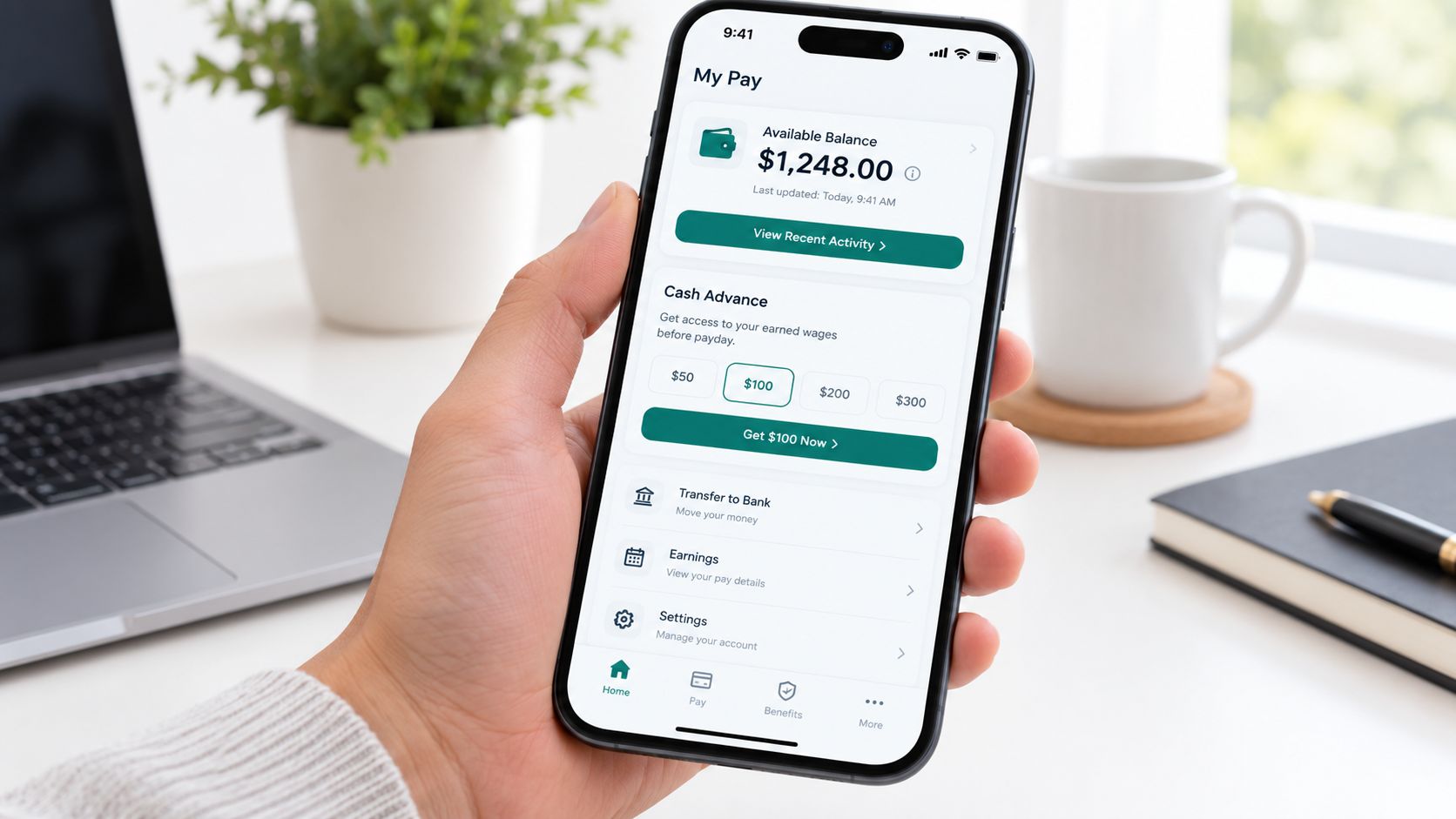
Earned wage access apps look harmless because they don't always market themselves like loans. That's exactly why borrowers need to slow down. If an app advances money before payday, then takes repayment back automatically, the practical effect can look a lot like borrowing even when the marketing avoids that label.
Colorado's lending-law debates now include these newer cash-advance products, which is a sign that regulators and consumers are still sorting out where they fit. The state's rules require borrowers to pay attention to substance, not branding. If a product gives you cash now and gets repaid out of wages later, ask whether it is acting like a loan and what protections apply.
What to watch for
Expedited transfer fees can add friction even when the app calls itself “free.” Tip prompts can do the same thing by turning a voluntary payment into a routine cost. If you use an earned wage access app once and then rely on it every pay period, you're not solving a budget gap, you're formalizing one.
That's the core problem. These apps are easiest to misuse when you're already short. They can blur the line between cash-flow smoothing and recurring debt. If you keep needing them, your budget is telling you something blunt.
The safest way to think about these apps is as a stopgap, not a plan. Use them only if the advance keeps you from a bigger fee or a missed bill, and even then, compare the app against a regulated installment loan or a credit union option before you move money.
Colorado borrowers should also ask a direct question: is this thing legally treated as a loan in my state, and if not, why not? Marketing language is not protection. State law is.
Managing Default and Filing Complaints
If you miss payments, don't panic and don't go silent. Colorado's consumer-credit rules give borrowers remedies on default, and that matters because the state does not want lenders using heavy-handed tactics to force bad outcomes (Colorado UCCC text). Your first move is to open the conversation early and keep records.
What to do first
- Contact the lender immediately. Ask for the exact payoff amount, due dates, and whether any cure option exists.
- Save every message. Keep screenshots, emails, and payment confirmations.
- Stop guessing. If the terms are unclear, demand the written contract and the itemized cost breakdown.
- Escalate if needed. File a complaint with the CFPB and the Colorado Attorney General if the lender violates state law.
- Get local help. Use 211 and nonprofit credit counseling if the payment problem is bigger than one loan.
The key point is this, default is not the same thing as moral failure. It's a cash-flow problem with legal consequences. If the lender is violating Colorado law, you need documentation, not embarrassment.
When a lender starts making threats that don't match the contract, or the collection pattern feels abusive, complain. State and federal complaint systems exist for a reason, and they're far more useful when you act early rather than after the file has gone cold.
Keep the record clean.
If the lender says one thing on the phone and another in writing, the written version matters more.
Making the Right Borrowing Decision
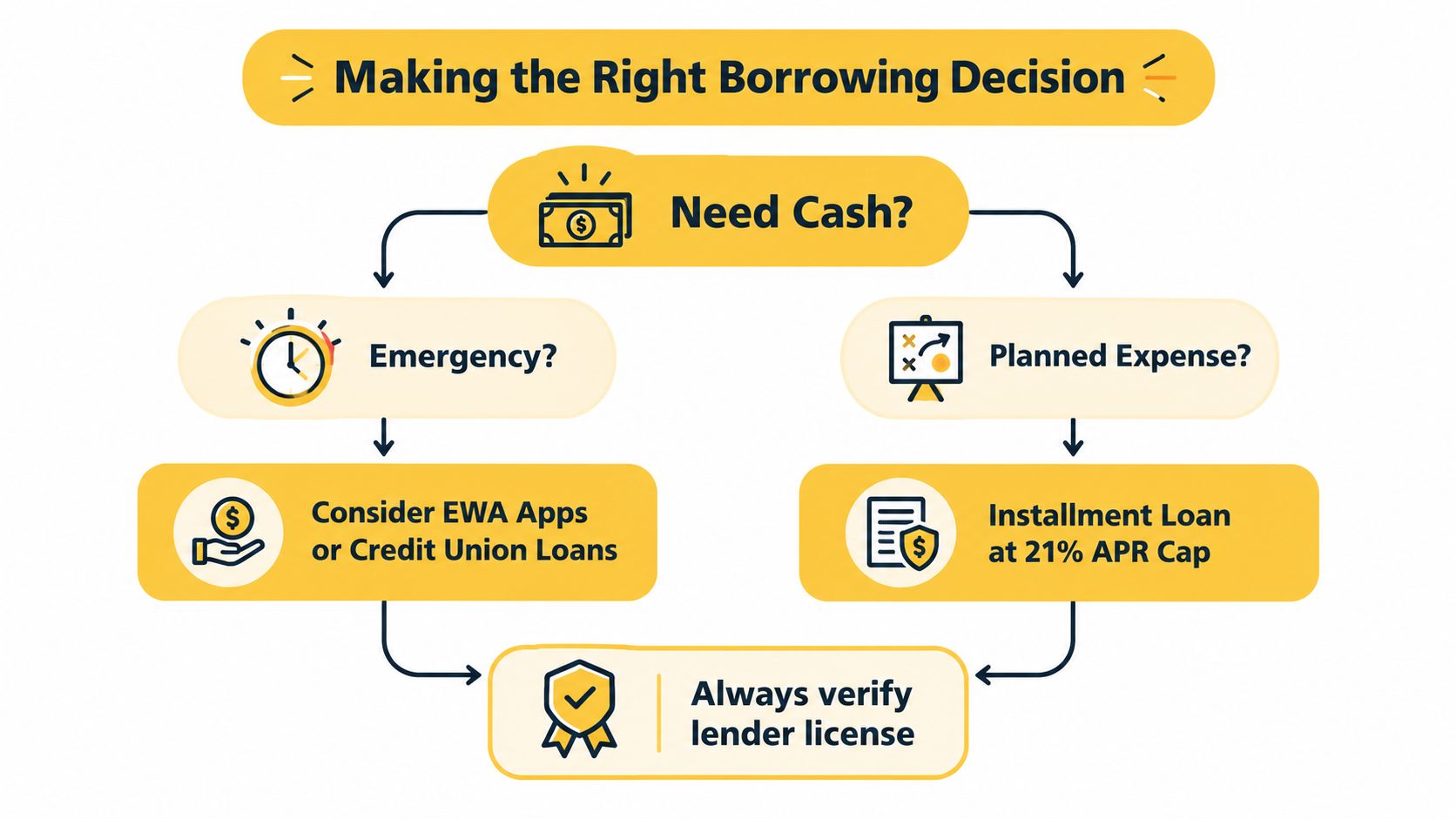
The right choice in Colorado starts with a simple filter, how much money do you really need, and how fast can you repay it without breaking next month's budget? If the answer is “I need a tiny amount and can clear it fast,” a tightly regulated short-term option might be workable. If the answer is “I need breathing room,” you should move toward an installment structure or a credit union alternative.
The legal framework in Colorado is built to stop the old payday rollover trap. That's good for borrowers, but it also means you need to think differently. Don't shop by the promise of speed. Shop by the repayment shape, the license, and the total cost.
Use this decision filter
- Emergency and short bridge: Consider a credit union option or earned wage access only if the cost is lower than the harm you're avoiding.
- Planned expense with a few months to repay: Compare supervised installment loans and check the tier that matches the loan amount.
- Any unclear lender: Verify the license before you send personal or banking information.
- Any product that pressures repeat borrowing: Walk away.
The best Colorado bad credit loan is the one that doesn't trap you. That means verifying the lender, matching the term to the problem, and refusing products that only work if you borrow again next month. If you want clearer state-by-state guidance, practical borrowing comparisons, and plain-language help on what to do next, visit BadCreditMD and use it to compare your options before you sign anything.