
The most popular advice about personal loans in Colorado is also the most misleading: “Colorado has a 36% APR cap, so any legal loan is safe.” A legal ceiling protects borrowers from certain extreme charges. It doesn't tell you whether the payment fits your budget, whether fees inflate the cost, or whether the repayment schedule will leave you short of rent and utilities.
Colorado's rules are layered, and the market includes products with very different structures. You need to compare the APR, finance charge, total of payments, term, fees, and payment schedule, not just the advertised interest rate. A lender's approval means the lender believes repayment is possible under its underwriting model. It doesn't prove that repayment is sensible for your household.
Table of Contents
- The Reality of Colorado APR Caps
- Understanding State Interest Rate Tiers
- Required Disclosures and Contract Verification
- Installment Loans Versus Deferred Deposit Products
- Recent Market Trends and Average Loan Sizes
- Testing True Repayment Affordability
- Local Assistance and Non-Loan Alternatives
- Final Evaluation and Quick Reference Checklist
The Reality of Colorado APR Caps
Colorado's 36% APR limit is not a guarantee of affordability. Proposition 111 established a 36% APR cap for payday loans, which are a separate small-dollar product, while Colorado's broader consumer-credit framework uses different rules depending on the lender, loan size, and product category. The state's official rules and statutory materials should be checked before treating any headline limit as a universal answer. Colorado banking rules and statutes provide the relevant regulatory starting point.
A compliant loan can still create financial stress. The APR may include some costs, but the borrower still needs to examine the amount financed, the finance charge, mandatory products, origination charges, late fees, and the time allowed for repayment. A shorter term can produce a larger scheduled payment even when the total balance is modest. For someone with irregular income, that payment may collide with essential expenses before the loan reaches maturity.
Legal does not mean suitable
The practical question isn't “Can this lender charge this rate?” It's “Can I make every scheduled payment without borrowing again?” That distinction matters most for applicants with damaged credit, variable hours, seasonal work, or existing debt obligations.
Consumer rule: Treat the legal limit as a ceiling, not a recommendation.
A personal loan should be evaluated against the household budget before the application is submitted. Compare the proposed payment with rent, utilities, food, transportation, insurance, medical costs, and existing minimum payments. If the payment only works when every paycheck arrives on time, the loan is fragile by design.
Borrowers researching Colorado bad-credit loans should be especially skeptical of approval-focused advertising. “Guaranteed approval,” urgent funding language, and vague fee disclosures don't answer the affordability question. Ask for a complete written offer and calculate the total dollars repaid before giving a lender permission to proceed.
Why repayment math beats the headline
A lower principal can reduce the dollar amount of interest, but it doesn't automatically make the loan manageable. Fees can raise the amount owed, while payment frequency can make cash flow tighter than a monthly budget suggests. The advertised APR also won't tell you whether a late payment triggers additional charges or whether an ancillary product is optional in practice.
The safe approach is simple. Verify the rate framework, identify every charge, calculate total repayment, and reject any payment that leaves no realistic buffer. Colorado law can limit abusive pricing, but only your budget can determine whether the offer belongs in your life.
Understanding State Interest Rate Tiers
Colorado doesn't apply one universal interest-rate ceiling to every borrowing product. General usury rules and regulated consumer lending operate through separate frameworks, so the lender's status and the contract's legal category matter before you interpret a rate.
Under Colorado's general usury rules, a written agreement may provide for a rate of up to 45% per year, while the default rate when no rate is agreed in writing is 8% annually. For regulated consumer loans made by non-supervised lenders, the Colorado Consumer Credit Code generally limits finance charges to 12% per year on the unpaid balance. Supervised lenders can use a tiered structure, or a permitted flat structure, subject to applicable consumer-credit requirements. These distinctions are summarized in Colorado's consumer usury framework.
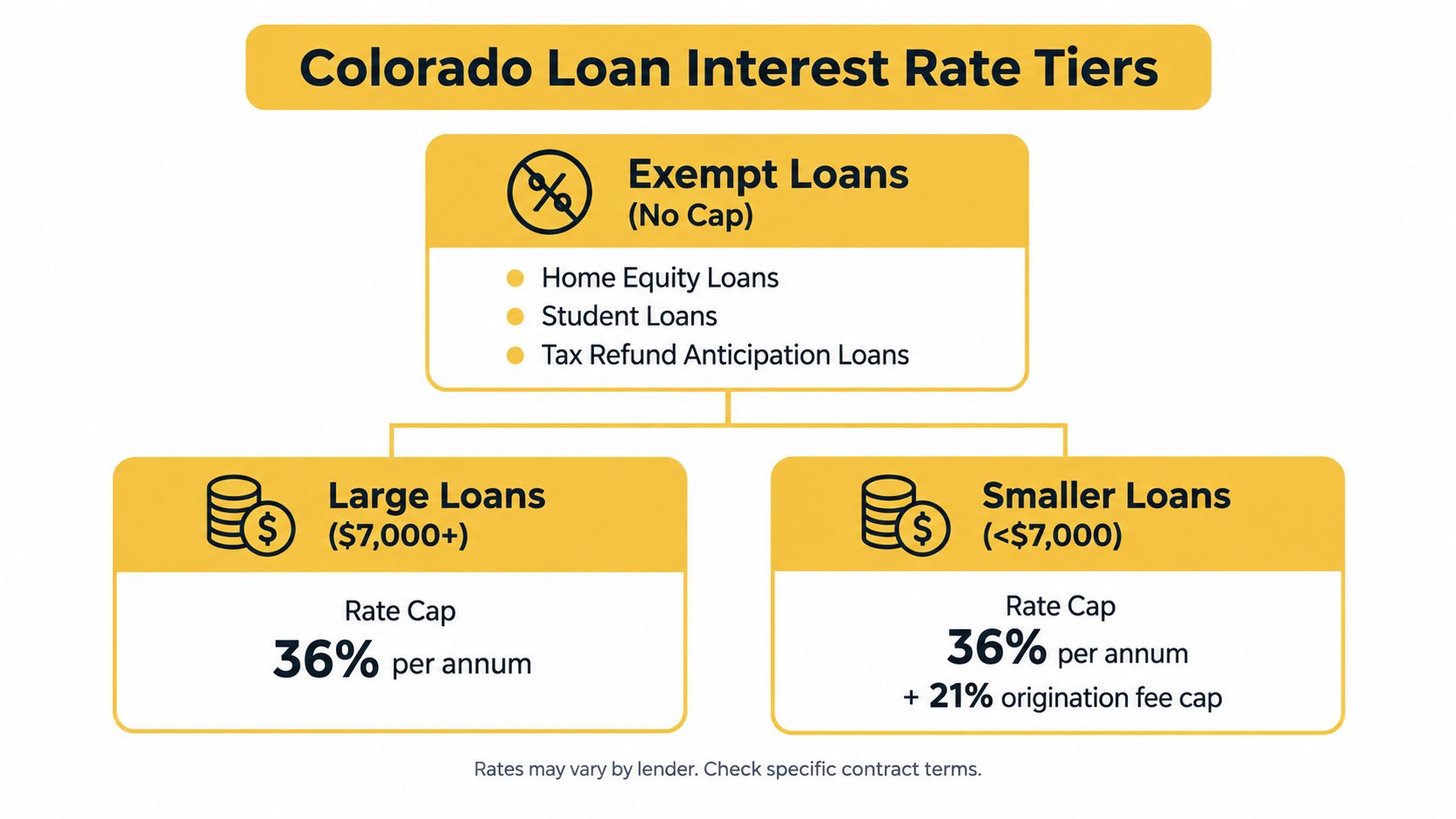
How the supervised-lender tiers work
The alternative tiered structure permits 36% annually on the first $1,000, 21% on the portion from $1,001 through $3,000, and 15% on amounts above $3,000. A 21% flat annual rate may also be permitted in applicable circumstances. Those are rate components, not a promise that every borrower will receive the same offer or that fees disappear.
A $500 balance sits entirely in the highest tier. A larger balance can place part of the principal in lower tiers, but the contract still controls the actual finance charge, payment timing, and additional costs. You can't determine the total cost by looking at the lowest tier alone.
Read the product category, not just the number
Colorado also treats payday lending separately. Proposition 111 established a 36% APR cap for payday loans, but a payday loan isn't interchangeable with a conventional personal installment loan. The correct comparison depends on whether the lender is supervised, how charges are calculated, and which consumer-credit rules govern the agreement.
Ask these questions before signing:
- Who made the offer? Confirm the lender's licensing or supervised status and the legal category of the product.
- Which rate applies? Determine whether the contract uses a tiered calculation or a flat annual rate.
- What else is charged? Look for acquisition charges, account-handling fees, origination costs, late fees, and ancillary products.
- What is the total repayment? Use the disclosed finance charge and payment schedule, not a promotional monthly figure.
The central mistake is treating “36% cap” as a complete price. It isn't. The applicable tier, fee structure, repayment period, and amount financed determine what the borrower pays.
Required Disclosures and Contract Verification
A legal loan can still be a bad loan. The way to catch that is simple. Ignore the sales pitch and verify the contract line by line before you sign.
Federal Truth in Lending and Regulation Z disclosures are designed to show the cost in a standardized way Colorado supervised-lender reporting materials. That matters because a Colorado personal loan can look reasonable when a lender highlights one rate or one payment amount, while the full repayment picture says something else. Your job is to pin down the amount financed, the finance charge, the APR, the payment schedule, the total of payments, and the maturity date. If any of those items are missing, the quote is not ready for approval.
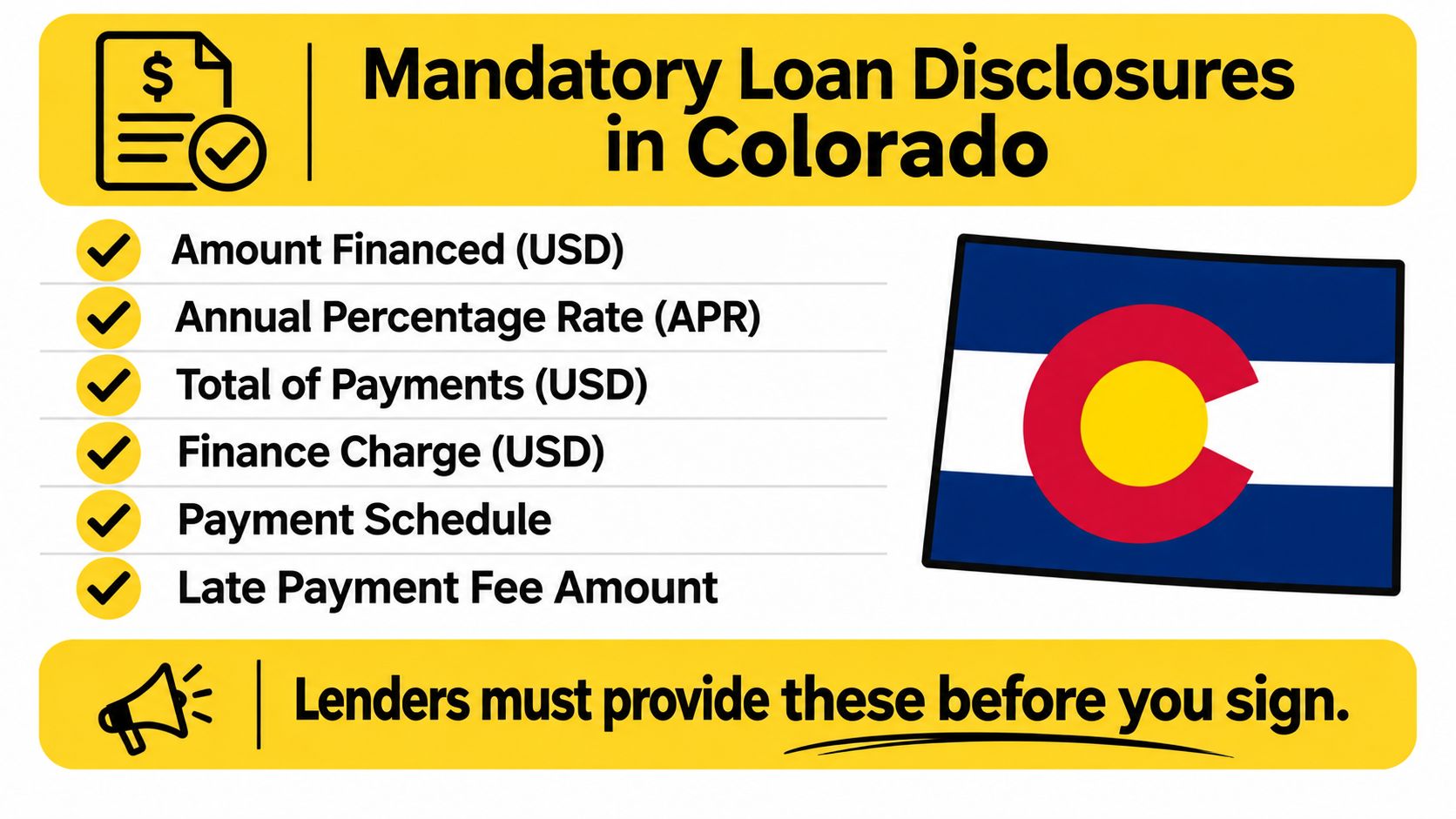
The document check
Use the disclosure like an audit sheet.
Start with the amount financed. It should match what you will receive after any permitted deductions. Then check the math. The stated finance charge should reconcile with the scheduled payments and the total repayment shown in the contract. If it does not, stop there and get the explanation in writing.
Review these items carefully:
- APR and finance charge: The APR is a standardized annual measure of credit cost. It is not the same as a monthly rate, a promotional figure, or a fee shown on its own.
- Payment schedule: Confirm every due date, payment amount, and payment frequency. A loan can comply with disclosure rules and still strain your budget if the timing clashes with your pay cycle.
- Maturity date: The contract should tell you exactly when the debt ends. Loose wording around payoff timing deserves scrutiny.
- Late-payment terms: Read the fee terms, any grace period, and the consequences of missing a payment.
- Optional products: Ask whether add-ons such as credit insurance or membership features are truly optional. If you would pay for them, count them in your affordability test.
Red flags that should end the conversation
Walk away from automatic renewal language, a balloon payment you were not expecting, pressure to sign on the spot, or blank spaces where dollar amounts should appear. A lender should also be willing to give you the agreement before asking for a commitment and should be able to explain how the price was calculated.
Ask for the contract before you commit. A trustworthy lender can explain the numbers clearly and give you time to compare offers.
If the rate, term, fees, or payment amounts change after you start asking detailed questions, treat that as your answer and leave.
Installment Loans Versus Deferred Deposit Products
A fast approval means nothing if the repayment design is built to break your budget. That is the core divide between a personal installment loan and a deferred-deposit product.
An installment loan usually spreads repayment across scheduled payments over a defined term. A deferred-deposit or payday product is far more likely to force repayment into a short window or a single large withdrawal. That structure matters more than marketing language. Even a smaller advance can become the more dangerous debt if the full balance hits before your next rent, utilities, or groceries are covered.
Colorado's historical lending records make that difference hard to ignore. State reporting from 2015 showed an average contracted APR of 188.57% for deferred-deposit loans, calculated under federal Truth in Lending and Regulation Z from the amount financed, finance charge, and scheduled term. Treat that figure as a warning about product design, not as a quote for any current loan.
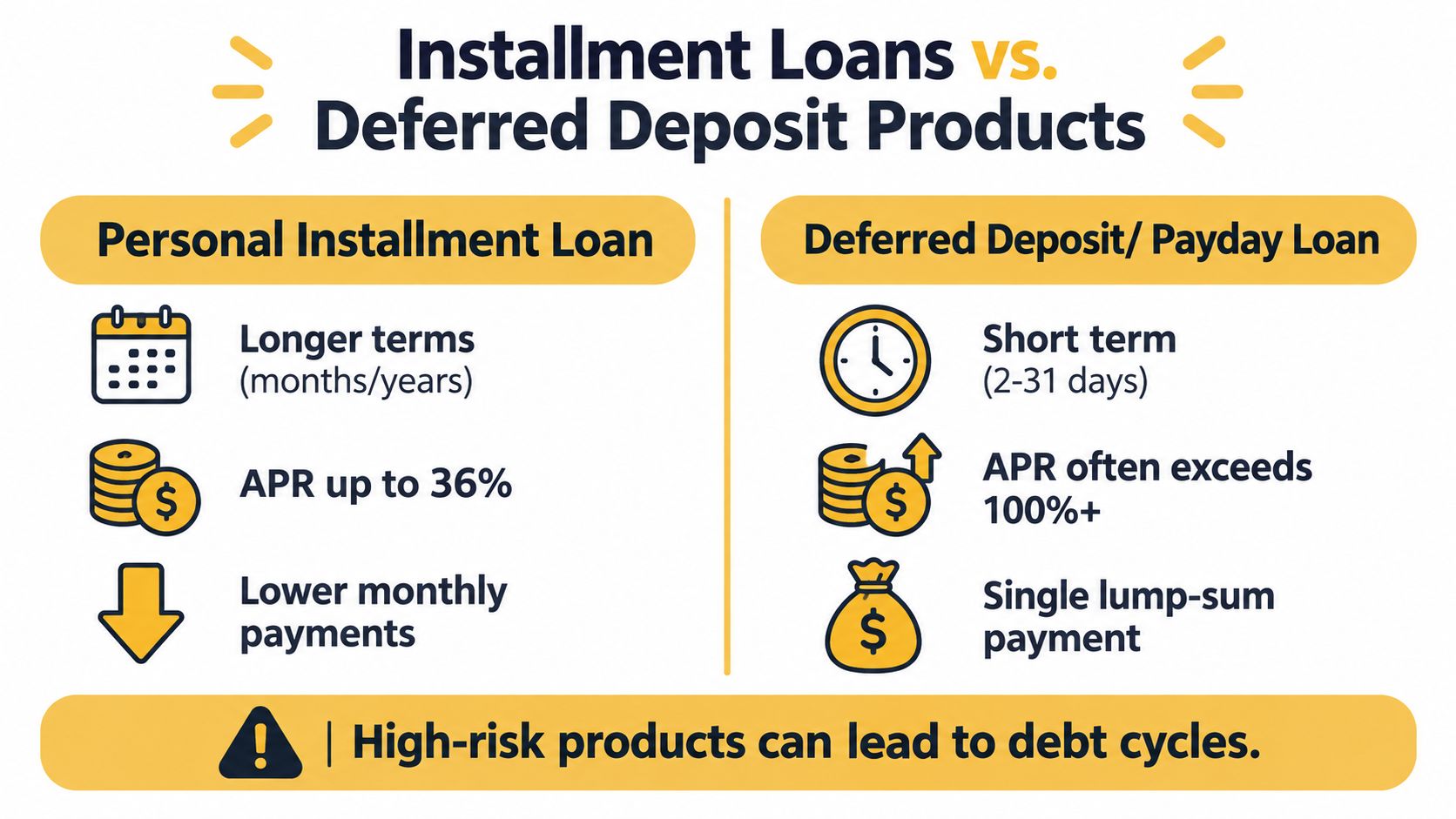
The repayment structure changes the risk
Payment timing drives the outcome. With an installment loan, you can at least test whether each scheduled payment fits your actual cash flow. That does not make the loan cheap or safe. It does give you a real chance to compare the payment against your paycheck and monthly bills before you sign.
Deferred-deposit products create a different problem. A single due date can wipe out the same paycheck you need for essentials, and renewal pressure can turn one shortage into repeated fees.
Historical Colorado data shows how extreme that pricing became. A 2009 supervised-lender study reported an average amount financed of $366.96 and an average APR of 343.31% for payday loans. It also found that 52.75% were written at the maximum permitted loan amount, with $500 loans representing 40.58% of payday loans. The Colorado 2009 study is a reminder that a modest-looking principal does not mean modest risk.
Colorado later reduced average pricing on deferred-deposit loans, but lower than extreme is still expensive. Do not get distracted by the headline APR cap on other products. The question is simple: how much cash leaves your account, and when? A loan can be legal, fully disclosed, and still be unaffordable for a subprime borrower.
A clear line for rejecting the offer
Check the amount financed, total finance charge, payment schedule, and maturity date. If the lender will not put all of that in front of you clearly, leave. If the offer relies on automatic renewal, a balloon-style payoff, or any triple-digit APR, reject it and look for a credit union option, a utility payment arrangement, or nonprofit help instead.
If you want a plain-language overview of the traps, read this guide to payday loans in Colorado. Short-term debt should not be paying recurring household bills. If the bill keeps coming back, another loan only adds another payment.
Recent Market Trends and Average Loan Sizes
Colorado's formal unsecured-loan market became more active while the average principal became smaller between 2022 and 2023. Aggregate data released by the Colorado Attorney General's Office covers unsecured loans originated by supervised lenders, making it more useful for understanding supervised consumer credit than a single lender's advertising data.
In 2022, supervised lenders originated 23,429 unsecured loans totaling more than $201.4 million in principal. In 2023, originations rose to 25,560 loans, while total principal declined slightly to $193.1 million. The result was a shift toward more loans with smaller average balances, as shown in the Colorado market data.
Colorado unsecured loan market shift
| Metric | 2022 Data | 2023 Data | Change |
|---|---|---|---|
| Unsecured loans originated | 23,429 | 25,560 | Up roughly 9.1% |
| Total principal | More than $201.4 million | $193.1 million | Declined slightly |
| Average principal per loan | Approximately $8,599 | Approximately $7,555 | Down about 12.1% |
The average principal fell from approximately $8,599 to $7,555, a reduction of about 12.1%, while the number of loans rose by roughly 9.1%. That pattern suggests broader origination activity alongside smaller balances. It doesn't show that borrowers became safer or that the offers became cheaper.
What smaller balances do and don't tell you
A smaller principal generally limits the dollar amount exposed to interest, but it doesn't settle affordability. The rate, term, payment frequency, and fees still determine the scheduled burden. A borrower can struggle with a smaller balance if the payment arrives at the wrong time or if charges are deducted before funds are delivered.
Use the market data as context, not as a benchmark for your approval. Compare your offer with other written offers and focus on total repayment. Resources explaining common loan amounts can help you identify whether the request is larger than the immediate need, but the contract's disclosed cost remains decisive.
Testing True Repayment Affordability
A lender's approval is not a household budget. Test the payment yourself, using the expenses that leave your account.
Start with take-home income, not gross wages. Use a conservative figure if your hours vary, commissions fluctuate, or overtime isn't guaranteed. Then subtract essential costs before considering a new loan.
Run the household test
- List fixed essentials: Include rent, utilities, insurance, transportation, and required medical costs.
- Add variable necessities: Budget realistically for food, fuel, prescriptions, and other recurring needs.
- Include existing debt: Count minimum payments, court-ordered obligations, and any payment plan already in force.
- Insert the new payment: Use the exact scheduled amount and frequency from the disclosure.
- Stress the budget: Test the result against a lower-income month, a utility spike, or an urgent repair.
If the new payment consumes the money needed for essentials, reject the loan. Don't rely on an expected tax refund, uncertain overtime, or a future job change to make the schedule work.
Calculate the real price
Add every scheduled payment. Then compare that total with the amount financed. The difference is the finance charge and any included costs reflected in the schedule. Review whether early payoff reduces the remaining cost and whether the contract imposes a prepayment penalty.
You can use a loan payment calculator to model the schedule, but don't enter only principal and interest if the contract includes fees. The calculator is useful for testing scenarios. The signed disclosure controls the obligation.
Walk away when the payment works only under perfect conditions. A safe loan leaves room for ordinary financial disruption.
If the need is recurring, borrowing is treating the symptom. Ask the creditor, utility, medical provider, or landlord about a payment arrangement before adding a new fixed obligation.
Local Assistance and Non-Loan Alternatives
A cash shortfall doesn't automatically require a personal loan. Colorado residents can often solve the immediate problem by negotiating the bill, accessing community resources, or choosing a lower-risk credit product.
Start with 211, which can connect residents with local food, housing, utility, health, and emergency resources. Availability depends on location and eligibility, so explain the exact bill, deadline, household income, and risk of service interruption. Don't wait until the payment is already overdue if a provider offers hardship arrangements.
Match the solution to the problem
A utility bill may call for a payment plan or energy-assistance referral, not an unsecured loan. A medical balance may be negotiable through the provider's financial-assistance office. A recurring grocery shortage may require benefits screening or local food support rather than repeated borrowing.
For credit needs that can wait, ask a federal credit union about a Payday Alternative Loan or a credit-builder program. These products still require careful review, but their structure may be more suitable than a deferred-deposit product. A secured card can also help build payment history without turning every emergency into a high-cost cash advance.
Get professional help before signing
Nonprofit credit counselors can review debts and cash flow without selling a loan. Legal aid may help with collection issues, wage claims, housing disputes, or creditor problems. Public-benefits portals can identify programs you might miss when searching alone.
Take a practical sequence:
- Call the biller: Ask for a hardship plan, changed due date, fee waiver, or split payment.
- Contact 211: Request local assistance for the specific expense, not generic financial advice.
- Speak with a nonprofit counselor: Bring statements, income records, and every debt balance.
- Use legal aid when rights are involved: Don't sign a settlement or repayment agreement you don't understand.
- Borrow only after alternatives fail: Compare written offers and reject any payment that destabilizes essentials.
The best loan is often the one you don't need to take. Assistance and negotiation can preserve cash flow without adding another creditor to your monthly budget.
Final Evaluation and Quick Reference Checklist
Evaluate a Colorado loan offer in this order: legal category, disclosed cost, repayment structure, and household affordability. Don't reverse that order because a lender advertises a low monthly payment.
First, identify the lender and product. Determine whether the lender is supervised or licensed and which Colorado rules apply. Then check whether the APR and finance charges fit the applicable framework. A general 36% headline isn't enough because Colorado uses separate rules for different products, lenders, and loan sizes.
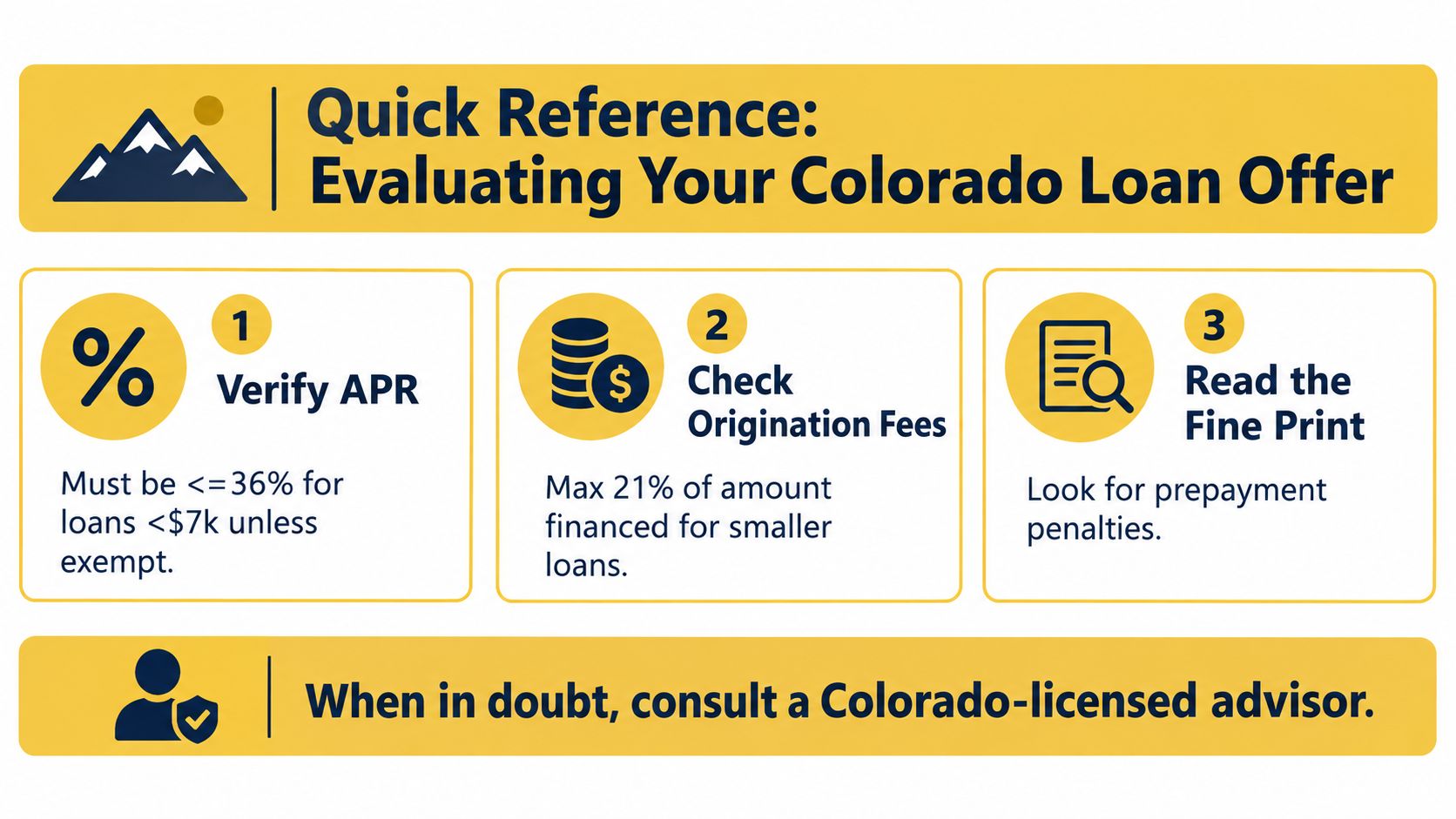
The final document review
Before signing, confirm all of the following:
- Verify the APR: Check the disclosed APR against the rules that govern the specific product and lender.
- Confirm the amount financed: Make sure you know what you receive after deductions.
- Add the total payments: Compare scheduled repayment with the amount financed.
- Inspect every fee: Include origination, account-handling, late, membership, and ancillary-product charges.
- Read the schedule: Note the payment frequency, due dates, maturity date, and consequences of default.
- Check early payoff terms: Find out whether prepayment reduces cost and whether a penalty applies.
- Test the budget: Subtract the new payment from conservative take-home income after essentials and existing debts.
- Search for alternatives: Contact the creditor, 211, a nonprofit counselor, a credit union, or legal aid first.
The decision that matters
If the lender won't provide a complete disclosure, stop. If the payment leaves no margin for ordinary expenses, stop. If repayment requires renewal, another loan, or an uncertain future income event, stop.
Legal compliance protects a boundary. It doesn't create affordability, and it doesn't repair an unstable budget. Choose a loan only when the total cost is clear, the repayment schedule is predictable, and the payment remains manageable after essential expenses.
BadCreditMD offers state-specific borrowing guidance, loan-cost explainers, affordability tools, and directories for alternatives such as 211, nonprofit counseling, and legal aid. Review the Colorado resources at BadCreditMD before submitting a loan request, especially if the offer depends on high fees, a short repayment period, or uncertain income.