
An average can hide more than it reveals. Investopedia, citing Federal Reserve data, reported that the national average personal-loan interest rate was 11.92% in the second quarter of 2024. That's a useful starting point, but it's not the price you'll necessarily pay. Your own unsecured loan rate could sit well below that figure or far above it, because an unsecured loan has no car, home, or savings account backing it. The lender is trusting your promise to repay, so it charges for the risk it sees in your credit, income, and current debts.
Think of the average as the price on a menu board outside a restaurant. It tells you roughly what kind of place you've walked into. It doesn't tell you what your meal will cost until you see the full bill, including fees. This guide works the same way. You'll start with today's market reference points, translate them into a realistic range for your profile, check whether the payment fits your actual cash flow, and only then compare offers side by side.
Table of Contents
- What Unsecured Loan Rates Look Like Today
- APR, Total Cost and Loan Term
- What Sets Your Unsecured Loan Rate
- When the Lowest Rate Is Still Too Expensive
- Cheaper Alternatives and Free Local Help
- How to Compare Offers and Sign With Confidence
What Unsecured Loan Rates Look Like Today
Today's market reference for an unsecured loan rate sits near 12%, and that single number describes a blended borrower rather than you. Two benchmarks frame the market, and they measure different things. Knowing what each one counts keeps you from mistaking a national average for a personal quote.
The first benchmark comes from commercial banks. The Federal Reserve's G.19 consumer-credit release put the commercial-bank benchmark for a 24-month personal loan at 11.90% APR in August 2026. That figure captures each bank's most common rate and then reports a simple unweighted average across banks, rather than an average weighted by loan volume. It is not seasonally adjusted, and for variable-rate loans the Fed records the initial rate. Big lenders and small lenders count the same here, and a rate that later changes is captured at its starting point.
The second benchmark is a private market series, the Bankrate Monitor average for unsecured personal loans, built from rates that lenders report. It has recently tracked slightly above the Fed figure. When a bank survey and a lender-reported series land in the same neighborhood, you can trust the neighborhood even if neither one gives you your exact address.
Why the Average Misleads Many Borrowers
An average works like a class average on a test. Half the class scores 95, the other half scores 55, the average is 75, and nobody scored 75. Personal-loan pricing works the same way: strong files pull the published average down, weak files push it up, and your offer lands wherever your own file places you. The spread matters more than the midpoint when you shop with imperfect credit.
The table below sets the benchmarks beside profile-based figures so you can find the row closest to you. Treat every figure as a reference point rather than an offer, approval, or promise.
Unsecured loan rates by borrower profile
| Borrower profile | Typical APR | What to know |
|---|---|---|
| Credit score above 720 | The lowest published rates | Well-qualified borrowers are the group the averages describe |
| Commercial-bank average, 24-month personal loan | 11.90% (August 2026) | Federal Reserve G.19 benchmark, a survey average rather than a quote |
| National average, unsecured personal loans | Slightly above the bank benchmark | Bankrate Monitor data, a private market series |
| Fair or thin credit | No reliable published range | Each lender prices these files individually |
| Subprime borrowers | Well above both averages | Limited history or past late payments commonly push quotes higher |
You may notice one row has no tidy percentage. That gap is real. With a short credit history, few accounts, or no score at all, lenders have little evidence to price from. One lender may treat a thin file cautiously and quote high. Another may weigh your income and bank history more heavily and quote lower. Each lender sets its own rates and terms, so no published range can predict what you will be offered.
Find the row that matches your score and income stability, and treat it as your starting expectation. Then judge every real offer against that row rather than against the national average.
If your score is above 720, an offer near 12% should prompt questions about fees or loan size. If your file is subprime, the same offer raises a different question: whether charges outside the headline rate push the true APR higher. Either way, the next step is identical. Compare the APR and the total you will repay, because each lender must show you the APR before you sign.
APR, Total Cost and Loan Term
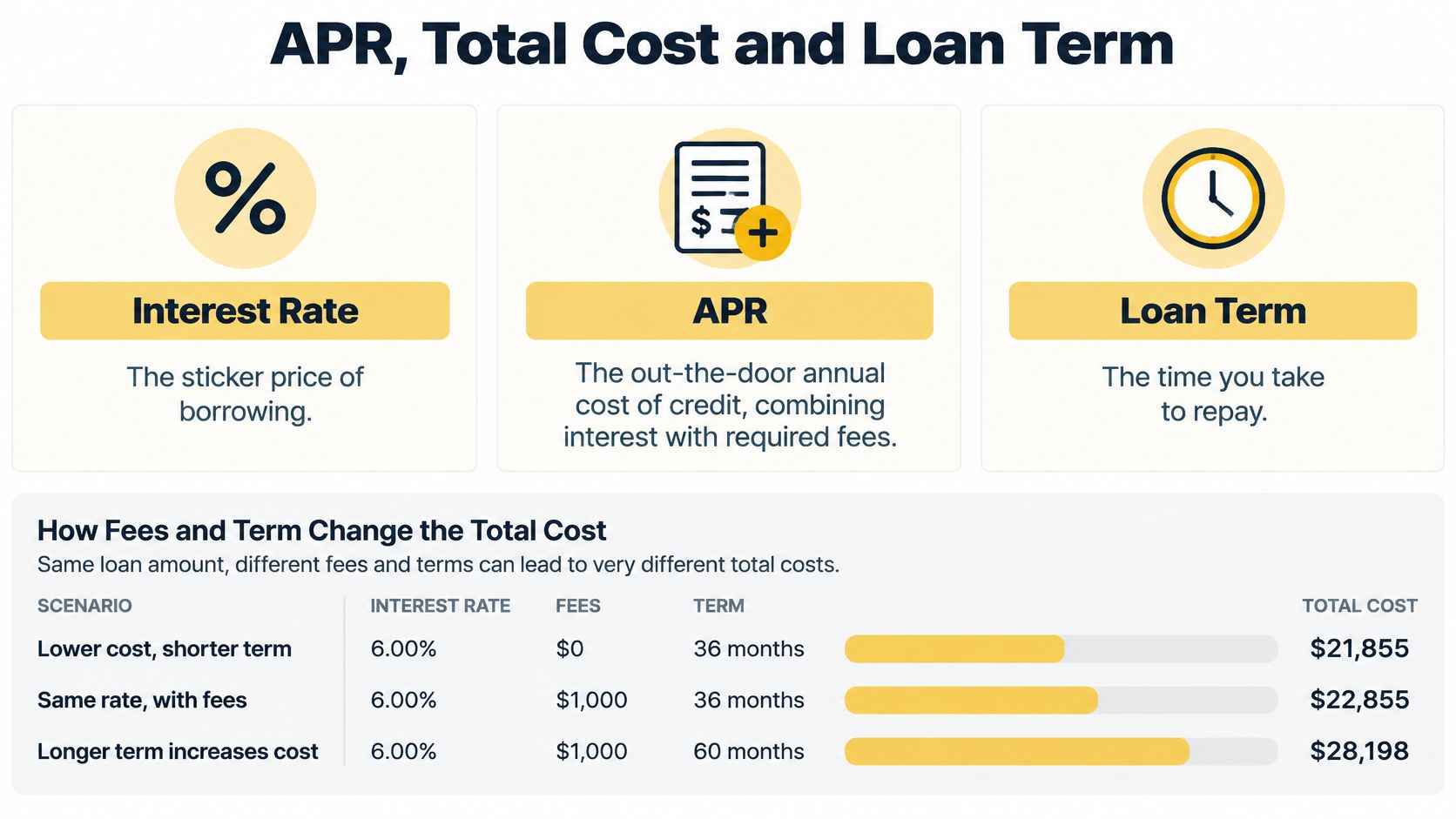
Here's the analogy that makes loan pricing click. The interest rate is the sticker price of borrowing. APR, or annual percentage rate, is the out-the-door annual cost of credit, expressed as a percentage. It combines interest with required charges such as origination fees. When you buy a car, you don't judge the deal by the window sticker alone. You ask what you'll hand over before you drive away. APR answers that same question for a loan.
How an Origination Fee Changes What You Receive
Say you borrow $5,000 and the lender charges a 5% origination fee. The lender deducts $250 before sending your money, so you receive $4,750. You still repay based on the full $5,000, plus interest on that amount. If your car repair costs $5,000, you're already $250 short on day one, even though your loan balance says $5,000. That gap is why two loans with the same interest rate can cost different amounts.
This is also why APR is the fairer comparison tool. The national-average series maintained by the Federal Reserve Bank of St. Louis from Bankrate Monitor data reported 12.36% on October 28, 2026, after 12.55% on October 21 and October 14, a move of 0.19 percentage points, or 19 basis points. That series illustrates how a national average can shift week to week, and the source notes that a nominal interest rate may omit fees while APR incorporates interest and certain mandatory charges. Small weekly moves matter less to your budget than the fees and term on your specific offer.
Cost examples on our site are labeled illustrative until lender rate sheets confirm them, so treat the worked example below as arithmetic, not a quote. It shows what happens when you stretch the same loan over more months.
Same $5,000 loan at 20% APR across three terms (illustrative)
| Term | Approx. monthly payment | Approx. total repaid | Approx. interest |
|---|---|---|---|
| 24 months | $254 | $6,096 | $1,096 |
| 36 months | $185 | $6,670 | $1,670 |
| 60 months | $132 | $7,948 | $2,948 |
Work through it line by line. Stretching from 24 to 60 months cuts the payment from about $254 to about $132, roughly half. That looks like relief. But total interest jumps from about $1,096 to about $2,948, roughly 2.7 times higher. You're renting the money for three extra years, and rent adds up. Add the 5% fee from the earlier example and the picture sharpens further. You'd receive $4,750 while repaying on $5,000, so the fee becomes part of your true cost even though it never reaches your bank account.
You can reproduce these trade-offs with your own numbers using our loan payment calculator before you talk to any lender. Enter the amount, APR, and term, then write down the monthly payment and total repaid for two or three terms. Seeing both numbers together prevents the most common shopping mistake, which is choosing by monthly payment alone.
Why Benchmarks Do Not Cover Every Loan
The long-running benchmark itself has limits. The Federal Reserve's G.19 historical series for 24-month personal loans at commercial banks has been tracked monthly since February 1972, when the rate was 12.50%, and it recorded 11.36% in February 2026 and 11.90% in August 2026. That history proves rates move materially across economic cycles. It also reminds you that a 24-month benchmark does not represent every personal loan. Longer terms, online lenders, credit unions, and subprime products may carry different rates and total costs.
Practical rule: The cheapest loan isn't the one with the lowest nominal rate or the lowest monthly payment. It's the one with the lowest total repayment you can afford, using the shortest term whose payment still fits after essential bills.
What Sets Your Unsecured Loan Rate
Lenders price an unsecured loan by asking one question from several angles. How likely is this person to repay every payment on time, and how hard will repayment be if something goes wrong? Because there's no collateral to recover, your profile carries the full weight of that decision. The factors below are ordered by the impact they usually have on your quoted APR.
Credit score and history come first. A long record of on-time payments tells a lender you've handled this exact promise before. Recent late payments, collections, or a very short history tell a riskier story. Recent reporting in the Charlotte Observer citing Federal Reserve and Experian data placed the average rate on a 24-month personal loan at commercial banks near 11.65%, while borrowers with FICO scores above 720 may qualify near 6% and subprime borrowers may face rates above 20%. That gap is the price of perceived risk, expressed as a percentage.
Debt-to-income ratio and income stability come next. Your debt-to-income ratio compares your monthly debt payments with your monthly income. If most of your pay already goes to rent, cards, and other loans, a new payment squeezes what's left, and lenders price that squeeze. Irregular pay raises the same concern even when your yearly income looks fine. A gig worker with strong months and weak months may look riskier than a salaried worker earning less overall but paid predictably.
Loan size, term, fees, and lender type then shape the final offer. A large amount relative to your income asks the lender to take a bigger unsecured risk. A longer term gives more time for something to go wrong. Fees raise your APR even when the interest rate looks competitive. Lender type matters too, since banks, credit unions, online lenders, and subprime lenders serve different borrowers and set pricing differently.
Factors that move an unsecured loan rate
| Factor | Stronger profile | Weaker profile |
|---|---|---|
| Credit score | Above 720 with a long history | Thin file or past late payments |
| Debt-to-income ratio | Low existing debt | High existing debt |
| Income | Steady, documented pay | Irregular or unverified income |
| Loan size | Amount matched to a clear need | Large amount relative to income |
| Loan term | Shorter term | Longer term (lower payment, more total interest) |
| Origination fee | None or low | High fee deducted from proceeds |
| Lender type | Bank or credit union with published criteria | Lender with high fees or unclear pricing |
Lenders set their own rates and terms and decide whether to lend. Offers also depend on your credit, income, state of residence, and each lender's criteria, so two lenders can view the same application and answer differently. If your score sits in the fair range, our guide to borrowing with a 580 to 669 credit score explains how lenders in that band typically weigh these same factors.
Thin-file borrowers deserve a specific warning. A score built from one or two young accounts doesn't carry the same information as the same score built over ten years. Your pricing may not match a standard score-band table, because limited history can produce outcomes the score alone doesn't predict. Don't assume a denial or a high quote from one lender settles the question, and don't assume an advertised starting APR applies to you either.
Two levers are in your control before you apply. First, pay down existing balances where you can, since lower debt improves the ratio lenders calculate. Second, ask each lender what type of credit check it runs at the quote stage and at formal application, so you know when your score could be affected and can time your applications sensibly.
When the Lowest Rate Is Still Too Expensive
The lowest rate you're offered can still be the wrong loan. That sounds backwards, but rate shopping answers only one question: what borrowing costs. It says nothing about whether you can carry the payment in a bad month, and many households have little room left to carry anything. The Federal Reserve Bank of New York reported that 4.4% of outstanding household debt was in some stage of delinquency in Q2 2025 and 4.5% remained delinquent in Q3 2025. It also found that non-prime auto-loan delinquencies increased for lower-income households in Q3 2025.
When bills and a new loan offer land on the same table, the payment number deserves more scrutiny than the APR.

Run a Cash Flow Screen Before You Compare Rates
Do the arithmetic on paper before you look at anyone's offer. Add up the monthly bills you cannot skip: housing, utilities, food, transport, insurance, and the minimum payments on debts you already owe. Subtract that total from the income you can count on in a weak month, not your best month. What remains is your monthly surplus, the margin that absorbs everything that doesn't arrive on a schedule. Now subtract the proposed loan payment. If little or nothing is left for irregular costs like copays, school expenses, or car repairs, the loan fails the screen at any rate.
Say your reliable surplus is $300 and the new payment is $254. On paper it fits. In practice, one missed shift or one high utility bill puts you behind, and falling behind on an unsecured loan isn't free just because there's no collateral. Missed payments can bring late fees, collection calls and letters, and credit damage that raises the price of future borrowing. The lender still expects repayment and can pursue it through collections. No collateral means the lender can't take a specific asset for this loan. The debt itself doesn't disappear.
This short video walks through how payments stack up against a household budget when money is already tight.
Faster, easier products marketed as solutions deserve extra skepticism here. Payday loans, title loans and some online installment loans can carry very high fees or APRs. A title loan also puts your car at risk if you can't repay, which can threaten the job that produces your income. Our comparison of installment loans and payday loans breaks down how their repayment structures differ. Short-term loans are costly and are not a long-term financial solution, so borrow only what you can repay on time.
If the screen says the payment doesn't fit, a lower APR won't fix it. A $254 payment strains the same $300 surplus whether the loan behind it is cheap or expensive, because the shortfall sits in the budget, not in the pricing.
Cheaper Alternatives and Free Local Help
Before you borrow, check the options that don't add a new monthly payment. They're less glamorous than a loan approval, but they often cost little or nothing, and they don't put your credit at risk if a bad month hits. Work through them in this order, cheapest and simplest first.
Ask the creditor for a payment plan first. Utilities, medical providers, landlords, and other creditors frequently offer hardship plans, due-date changes, or installment arrangements when you call before you fall behind. A medical office may split a bill into interest-free monthly amounts. A utility may place arrears into a budget plan. You won't know until you ask, and asking costs nothing. Get any agreement in writing, including the amount, due dates, and whether fees pause during the plan.
Check local help through 211. Dialing 211 connects you with local assistance for rent, utilities, food, and other essentials. Freeing up money for groceries or a power bill can shrink the gap you're trying to borrow across, sometimes to zero. Public benefits portals can also reveal assistance you already qualify for but haven't claimed. Rules and availability vary by state and by program, so confirm eligibility where you live.
Talk to a nonprofit credit counselor. A counselor can review your budget, contact creditors with you, and explain whether a structured repayment plan fits your situation. This help is different from companies that charge upfront fees to settle debts. If a creditor or collector appears to be breaking the law, for example by threatening actions it can't legally take, legal aid organizations can advise you on your rights. For predatory lending or unfair collection practices, you can also submit a complaint through the CFPB complaint process, which forwards your issue to the company and tracks its response.
Lower Cost Borrowing if a Gap Remains
If you still need to borrow after those steps, start with lenders built for smaller, safer loans. Credit union small loans are often lower-cost than payday or title products, and our guide to payday alternative loans from credit unions explains how those loans are structured. If your need isn't urgent and you're planning ahead, a credit-builder loan or a secured credit card can help you build a stronger record now so a future unsecured loan prices lower later. Those tools build credit. They aren't fast cash for today's emergency, and treating them that way leads to disappointment.
Our free directories link to 211, nonprofit credit counseling, legal aid, benefits portals, and the CFPB complaint process in one place.
Use this sequence every time. Ask the creditor for a hardship plan, then check local help, then compare loans only if a gap remains.
How to Compare Offers and Sign With Confidence
You've confirmed the payment fits and no cheaper alternative closes the gap. Now compare offers with a fixed procedure, so a polished sales pitch can't reorder your priorities. Each step exists because skipping it causes a specific, common mistake.
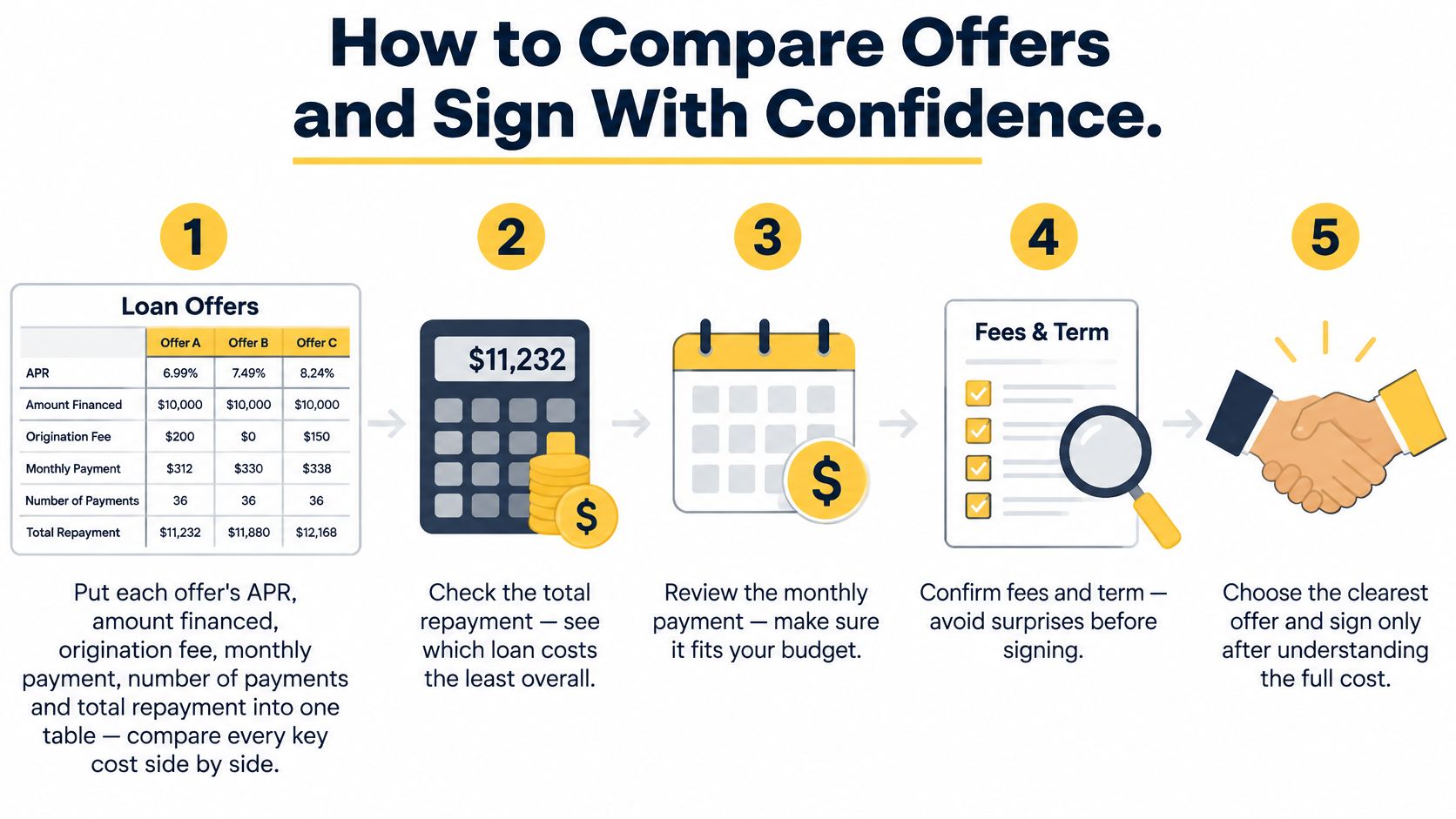
- Build one comparison table. For each offer, record the APR, amount financed, origination fee, monthly payment, number of payments, and total repayment. Offers described in different formats can't be judged fairly until they share the same rows.
- Compare total repayment for the same amount and term. If one quote is for 36 months and another for 60, ask both lenders to quote the same term. Otherwise you're comparing the term, not the lender.
- Check the APR shown before you sign. Each lender sets its own rates and terms and must show the APR before you sign, so use that disclosure rather than any rate mentioned in advertising or an early phone call.
- Confirm the amount you'll receive. Ask directly whether an origination fee is deducted from your proceeds. The amount deposited, not the amount approved, is what pays your bill.
- Ask whether the rate is fixed. A fixed rate keeps your payment predictable. Also ask about late fees and prepayment penalties, since a penalty for paying early can erase the benefit of extra payments.
- Verify state permission and licensing. Confirm the loan type is allowed in your state and the lender is licensed there. State rules shape what's legally offered to you, and an unlicensed lender is a reason to walk away.
- Choose the shortest term that fits and set the payment date. Pick the shortest term whose payment fits after essentials, then align the due date with your pay schedule where the lender allows it. A payment due two days before payday invites avoidable late fees.
Documents and Final Decision Rule
Gather your paperwork before you apply, so a lender's request doesn't stall you or rush you into borrowing elsewhere. You'll typically need these items:
- Photo ID: A driver's license or other government-issued identification.
- Proof of income: Recent pay stubs or other documentation of steady earnings.
- Recent bank statements: Statements showing deposits and your current obligations.
Keep expectations realistic at the application stage. Submitting a request does not mean you will be approved or funded, or receive any particular amount or rate. An individualized offer, once you have one, is the only price that counts.
End with this decision rule. Borrow only when the total repayment is affordable in a weak month, the amount you'll receive covers the need, and no lower-cost alternative fits. If any one of those conditions fails, pause and revisit your options rather than signing under pressure. A loan you decline costs you nothing. A loan you can't repay costs you fees, stress, and credit standing you'd rather keep.
If you're weighing an unsecured loan with imperfect credit, BadCreditMD gives you plain-language loan explainers, state-by-state rules, and worked cost examples so you can judge any offer by its APR and total repayment before you sign. Visit us to compare your options by credit score and loan amount, and to find free local help through 211, nonprofit credit counseling, and legal aid if borrowing turns out not to be the right step.