“Choose an installment loan because it's cheaper” is incomplete advice. A lower APR doesn't guarantee a smaller total bill, and a manageable-looking payment doesn't prove you can afford the debt. When comparing installment loans vs payday loans, choose the offer that you can repay without sacrificing essentials or borrowing again, not the one with the friendlier label.
Table of Contents
- Why This Comparison Is Trickier Than It Looks
- How Each Product Actually Works
- A Side-by-Side Cost Comparison You Can Verify
- State Rules, Availability, and What Restriction Actually Does
- When Installment Loans Are Not Actually Safer
- A Pre-Sign Checklist That Actually Catches Problems
- Which Product or Alternative Fits Your Situation
- The Short Decision Framework and Common Questions
Why This Comparison Is Trickier Than It Looks
A borrower facing a disconnected utility or an urgent repair needs usable money, not a lecture about budgeting. But urgency makes it easy to answer the wrong question: Can I get approved? Approval matters less than whether repayment leaves you short again.
My recommendation is straightforward: prefer an affordable installment offer over a payday loan, but don't assume every installment offer is affordable. Reject either product if you already expect to need another advance to make its payments.
Judge the offer, not the category
Separate the decision into distinct tests:
- Cost: Compare the full repayment obligation, not just the advertised fee or rate.
- Cash flow: Match each required payment to money that will be available after essentials and existing debts.
- Exit: Identify how the balance reaches zero without refinancing, another advance, or an unpaid household bill.
These tests can produce an uncomfortable answer. A longer loan might reduce immediate pressure while keeping you committed to an expensive obligation. A short loan might have a smaller upfront finance charge but demand more cash on its due date than your paycheck can support.
A loan hasn't solved the emergency if paying it back creates the next emergency.
Your state also belongs in the decision. An online offer isn't evidence that the product is permitted where you live, and a lender's willingness to accept an application isn't a substitute for checking the applicable rules.
Start with the actual shortfall. Identify the bill, its deadline, and the smallest amount needed to resolve it. Then distinguish a temporary timing problem from an ongoing gap between income and expenses. Those are different problems, and they shouldn't receive the same borrowing recommendation.
How Each Product Actually Works
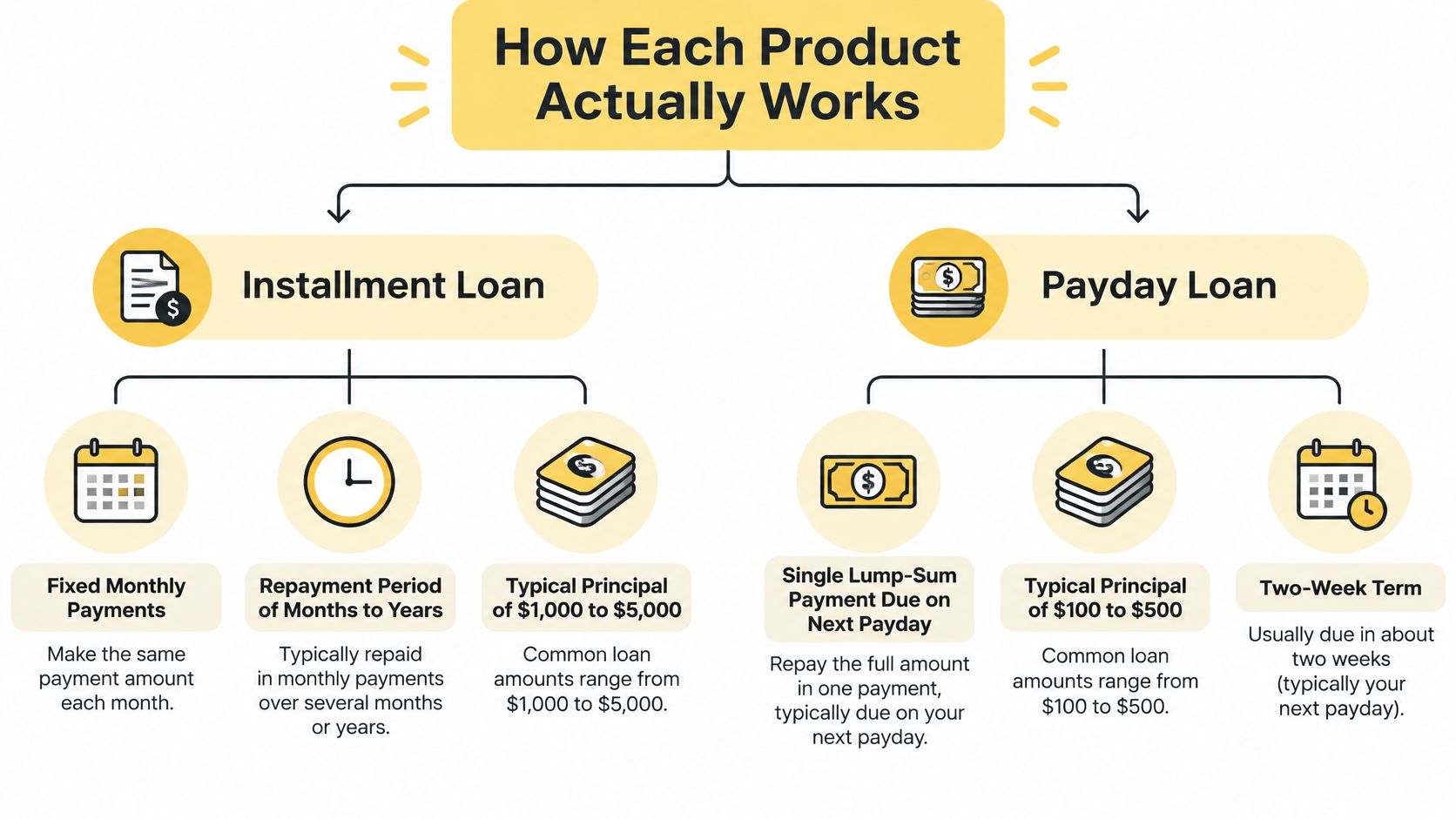
Installment describes a repayment structure. Payday describes a short-term borrowing arrangement generally tied to an upcoming payday. Neither name tells you everything you need to know about the contract.
| Mechanical difference | Payday loan | Installment loan |
|---|---|---|
| Repayment shape | Generally a single lump sum | Multiple scheduled payments |
| Main budgeting challenge | Having the full payoff available at maturity | Sustaining payments throughout the term |
| Pricing detail to inspect | Dollar fee and disclosed APR | APR, fees, and total scheduled repayment |
| Question to ask | What happens if I can't pay in full? | How does each payment reduce my balance? |
The payment pattern is the first distinction to understand.
Follow the principal through repayment
With an installment offer, ask for the complete payment schedule. Look for amortization, meaning the process by which payments reduce what you owe over the loan's life. Don't settle for a salesperson naming an attractive monthly payment without showing the remaining balance and final payment.
With a payday offer, focus on the amount due at maturity. A flat borrowing fee can sound manageable when discussed separately from the principal. Your budget, however, must accommodate the combined payoff.
Ask how the lender expects to collect. If the agreement includes an automatic debit or postdated check, identify the collection date, authorized amount, and procedures for changing the arrangement. Inspect those terms before providing account access.
Don't infer approval or credit benefits
Ask each lender what information it uses to evaluate the application, whether applying involves a credit inquiry, and what repayment information it reports. Don't assume either product automatically helps you rebuild credit.
The same discipline applies to loan size. Request only what the emergency requires, even if the lender offers more. A larger approval isn't additional income, and spreading repayment out doesn't turn unnecessary borrowing into a bargain.
Get the answers in writing. If the lender can explain the deposit but can't clearly explain the payoff, stop the application.
A Side-by-Side Cost Comparison You Can Verify
Compare dollars and dates alongside APR. APR measures annualized price; total repayment measures the money you must return. You need both, plus the payment schedule, to judge an offer.
Payday vs Installment Loan at a Glance
| Feature | Payday Loan | Installment Loan |
|---|---|---|
| Repayment obligation | Principal and fee generally due together | Payments spread across a schedule |
| Immediate pressure | Concentrated at maturity | Distributed across payment dates |
| Longer-term concern | Needing another loan at payoff | Paying substantial charges over a longer term |
| Essential comparison | Full payoff against available cash | Every payment and total repayment |
| Deal-breaker | Payoff requires replacement borrowing | Payments compete with necessities |
The CFPB's research example uses a $350 storefront payday loan, a $15 fee per $100 borrowed, and a 14-day term: the fee is $52.50, repayment is $402.50, and the annualized rate is approximately 391%, according to its payday lending research highlights.
That APR doesn't mean the borrower pays a full year's interest during the short term. It expresses the short-term cost on an annual basis so borrowers can compare products with different durations. The immediate affordability question remains whether the entire payoff is available on the required date.
Why a lower rate can still mean more dollars
A comparison described in Federal Reserve research on small-dollar credit illustrates a $1,000 payday loan at 391% APR for 14 days with a $150 finance charge, versus a $1,000 installment loan at 36% APR over 365 days with $360 in interest.
Treat that as an illustration of duration versus annualized cost, not a universal installment-loan quote. Don't turn the stated annual interest into an assumed monthly payment without checking the actual amortization schedule.
Practical rule: Compare offers for the amount you actually need. Don't accept a larger loan simply because its payment looks smaller.
Use the loan payment calculator to pressure-test an installment quote against the lender's written schedule. Confirm that the inputs reflect the actual rate, term, and financed charges.
Before signing, write down cash received, APR, total repayment, and required payment amounts with dates. Then ask whether mandatory charges are reflected in the disclosed APR and which contingent charges, such as late or returned-payment fees, could increase what you pay. A calculator can check arithmetic; it can't supply missing contract terms.
State Rules, Availability, and What Restriction Actually Does
Check the rules where you live before submitting a request. Don't rely on a nationwide advertisement, a map without a review date, or an online lender's statement that it serves your area.
Use the visual below as an orientation aid, not as a current legal determination for an individual state.
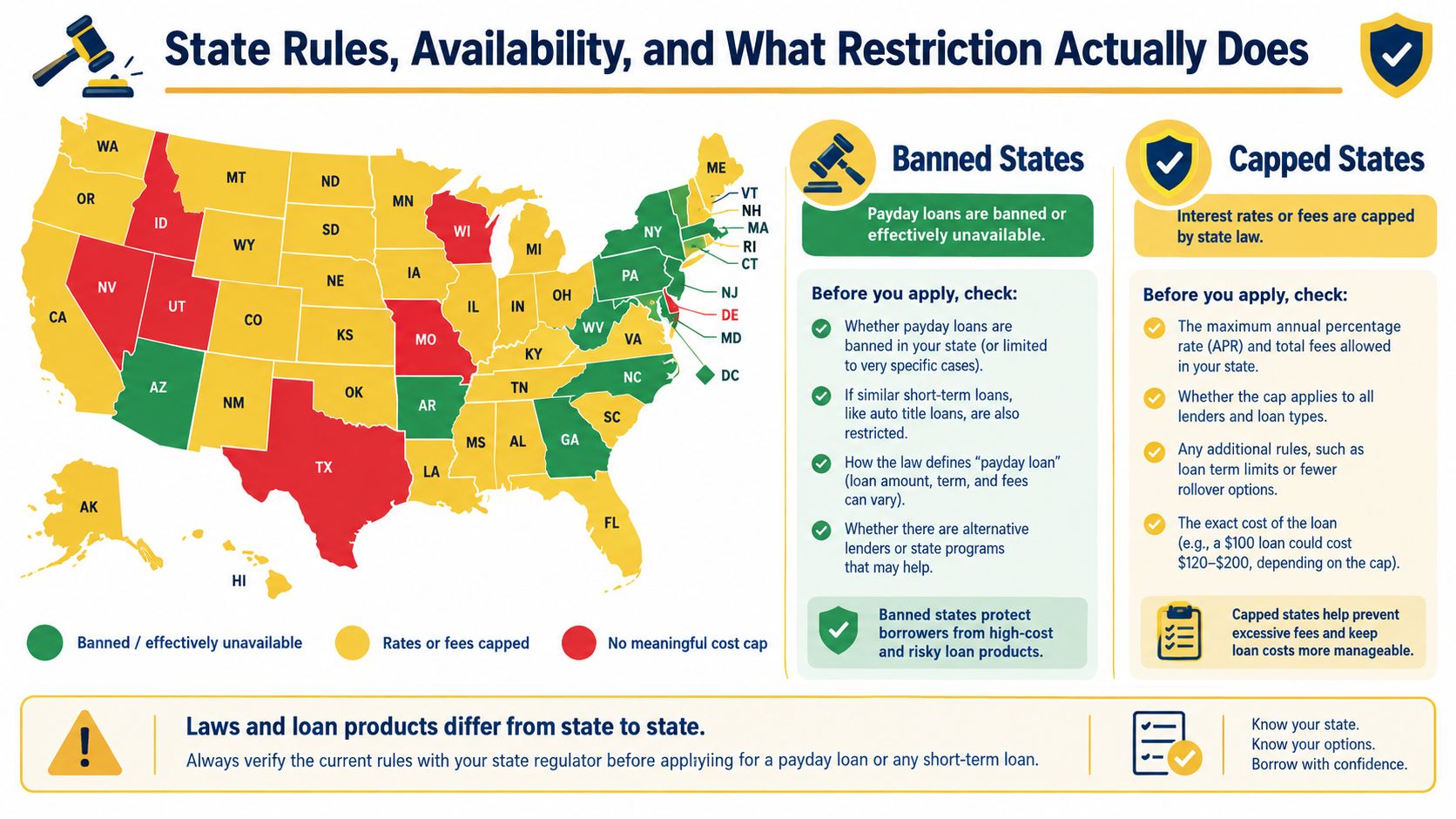
Verify the product and the provider separately
Your state check should answer practical questions:
- Permission: Is this particular loan structure permitted for residents of your state?
- Limits: Which rate, fee, principal, and repayment restrictions apply?
- Licensing: Does the provider hold the authorization required for the product?
- Recourse: Which regulator handles complaints, and where can you request assistance?
Use a state guide as the starting point, then follow its official references. For example, the Georgia installment loan guide provides a state-specific route for investigating the rules rather than treating a national comparison as legal advice.
Don't infer that a product is appropriate merely because it's lawful. Legal availability and household affordability answer different questions.
Restrictions need a replacement conversation
Access concerns are real: in 2025, 7% of U.S. adults used a payday, pawn, auto-title, or tax-refund-anticipation loan, while one-third of credit applicants were denied or received less than requested, according to the Federal Reserve's household credit report.
That leaves borrowers with an immediate practical question when an expensive product isn't available: What pays the bill instead? Saying “don't borrow” without addressing the deadline isn't useful counseling.
At the same time, don't assume unrestricted high-cost credit is the only workable response. Evaluate the underlying need directly. A provider's payment arrangement may address a bill without creating a separate lending obligation; benefits assistance or local emergency support may address a household expense without requiring repayment.
My recommendation is to run the legal check and the replacement search together. While confirming whether an offer is permitted, contact the creditor and investigate assistance. You shouldn't have to finish a loan application to discover that the original bill could have been handled another way.
When Installment Loans Are Not Actually Safer
An installment lender can offer a comfortable-looking payment on an uncomfortable contract. The question isn't whether the payment sounds smaller than a payday payoff. It's whether the complete obligation leaves you financially better positioned to finish repayment.
The illustration highlights the need to inspect contract pricing. Its depicted rate is illustrative, not a finding from the research cited below.
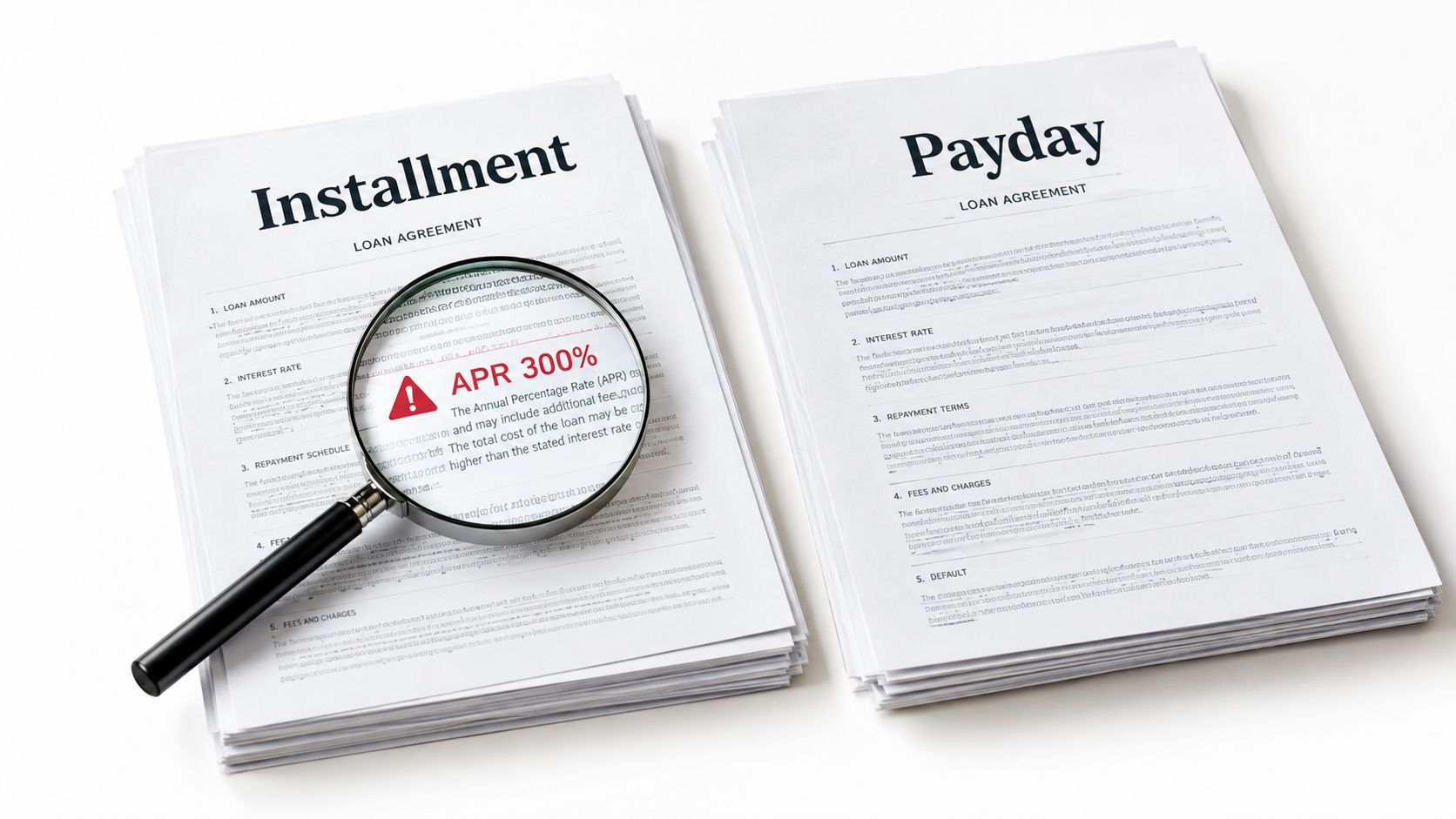
A 2026 analysis reported high-cost installment APRs as high as 195%, including a $1,300, 10-month loan with a calculated 159% APR and $2,454.24 in total repayment; roughly three-quarters of borrowers also used app-based payday or earned-wage products, according to the Center for Responsible Lending's high-cost installment analysis.
A new payment can hide an old shortfall
That evidence challenges the assumption that a longer repayment schedule necessarily replaces short-term borrowing. A borrower can have an installment payment and still need an advance to cover groceries or another debt.
Debt stacking is the issue to investigate. Don't review a proposed payment in isolation from existing obligations, including app advances and payments already scheduled to leave your account.
Ask what changes after funding. If the loan pays an existing balance, will that account be cleared? If it covers living expenses, what changes before the next billing cycle? Without a credible answer, you may be extending the shortfall rather than resolving it.
Smaller payments aren't safer when you need another loan to keep making them.
Read the exit terms before entering
Request written explanations of refinancing, early payoff, automatic debits, and missed-payment procedures. Don't accept “we can work with you later” as a repayment strategy.
Before proceeding, review what to consider if you default on a payday loan and ask the installment provider equivalent questions about its own contract. Planning for a difficult month isn't pessimism. It's part of evaluating whether the offer is tolerable.
Choose an installment loan only after the full contract passes review. The repayment format alone earns no recommendation.
A Pre-Sign Checklist That Actually Catches Problems
Run this check using pay records, account activity, and the written offer. Don't use expected overtime, a possible refund, or a hoped-for side job to make the budget balance.
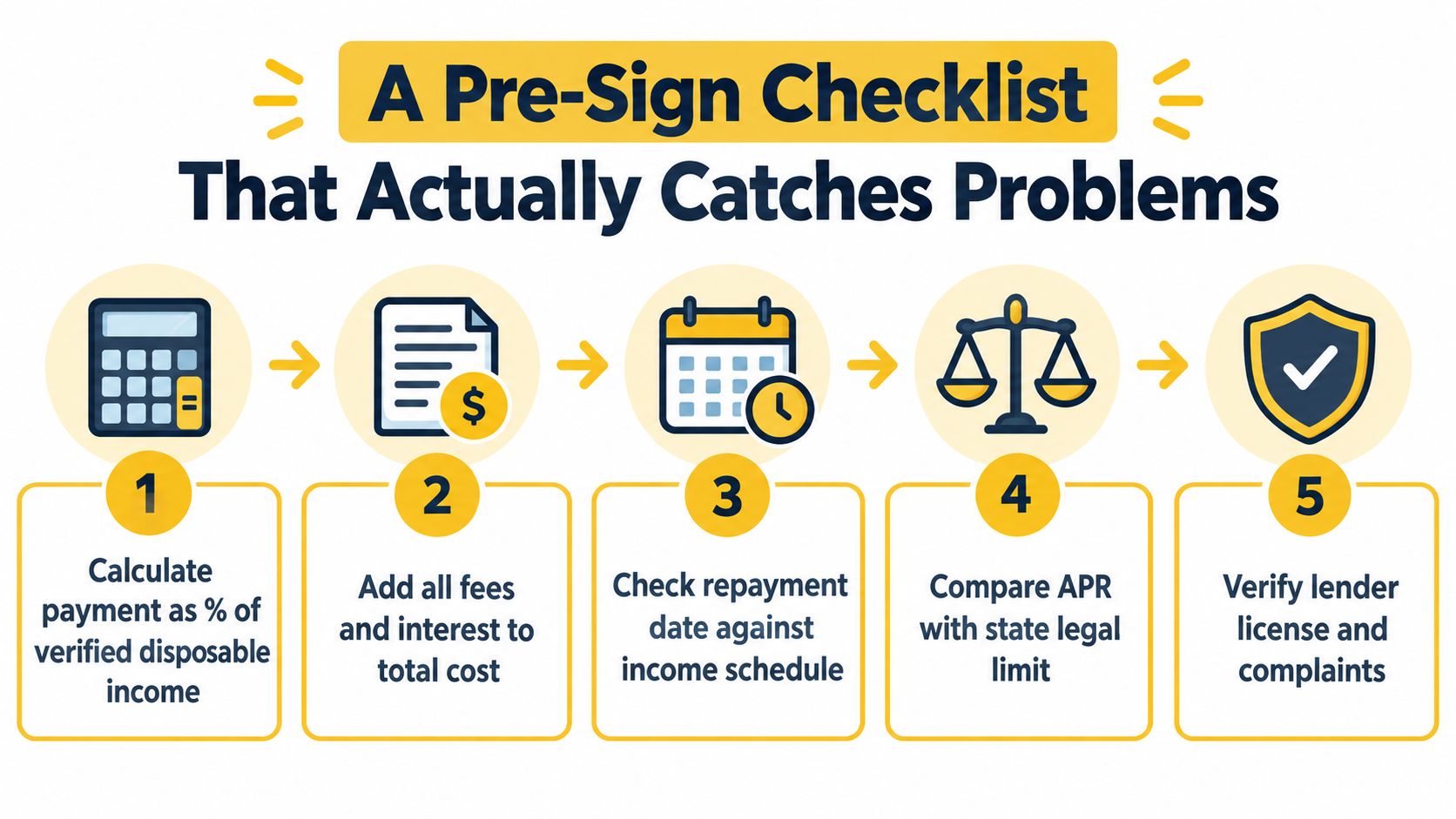
Keep this checklist beside the agreement while you review it.
Pressure-test the actual payment
Calculate payment against verified disposable income. Start with take-home income for the relevant payment period, then subtract essentials and existing required obligations. Divide the proposed payment by what remains to express its share of your available money. Don't substitute a generic approval ratio for your household budget.
Build a single repayment calendar. Include existing loan payments, app advances, and the proposed debit. Look at the running account balance between paydays, not merely whether the month's income exceeds the month's expenses.
Demand the complete cost. Ask about origination, late, returned-payment, refinancing, and early-payoff charges. Request the net amount deposited and the scheduled total repayment in writing.
Identify the permanent exit. Write down what the loan pays for and what allows you to finish repaying it. If your plan includes another advance, renegotiate the original expense or pursue assistance instead.
Confirm the legal and collection details. Verify applicable state limits, licensing, complaint contacts, and debit authorization. Resolve discrepancies before signing.
The pass-or-fail threshold is practical: after every scheduled payment, you must still be able to cover essentials and existing obligations without replacement borrowing. There is no defensible universal payment percentage in the evidence discussed here. Do not invent one to make a risky offer appear to pass.
Use the video as supplementary context, not a replacement for reviewing your own paperwork.
If the lender won't provide the information needed to complete this check, don't proceed. Missing information isn't a minor inconvenience when you're authorizing repayment from an already stretched budget.
Which Product or Alternative Fits Your Situation
Match the response to the expense, not to the easiest application. My preference is to resolve the bill directly when possible, then consider borrowing only for the remaining gap.
| Your situation | First move | Borrowing decision |
|---|---|---|
| A temporary timing gap with reliable income | Request a due-date adjustment | Compare a minimal loan only if repayment fits |
| An emergency requiring more repayment time | Seek a payment arrangement and credit-union quote | Consider an affordable installment offer |
| A medical or utility bill | Ask the provider about assistance and installments | Avoid replacing a workable provider plan with expensive debt |
| A recurring household deficit | Contact assistance programs and nonprofit counseling | Don't add a payment without a credible budget change |
| Existing advances competing for your paycheck | Map all due dates and seek help | Reject another loan that merely postpones the collision |
When borrowing can be defensible
A single, non-renewed payday loan can sometimes carry a smaller dollar charge than a longer loan, as the earlier cost illustration shows. That doesn't make it my default recommendation. Consider it only after checking alternatives and confirming the full payoff won't disrupt essentials.
An installment offer fits better when you need repayment time and can sustain the schedule. Ask a credit union about a payday alternative loan, and compare the actual eligibility requirements, cost, and timing rather than assuming you won't qualify.
The emergency borrowing guide can help organize options around an urgent expense. Use it alongside direct conversations with the creditor, not instead of them.
When another route deserves priority
Ask medical providers, utilities, and other creditors about payment arrangements before moving their balances into a new loan. For an ongoing shortage, investigate 211, public benefits, nonprofit credit counseling, and legal aid, depending on the problem.
If you're considering pledging an item rather than using an unsecured product, Idaho Pawn & Gold Exchange's explanation of pawn loan vs personal loan options offers another comparison to examine. Ask what happens to the pledged item if you can't repay before treating that route as acceptable.
Credit rebuilding is a separate objective. Don't use an expensive emergency loan merely because someone suggests it could improve your credit.
The Short Decision Framework and Common Questions
Use this order: confirm state legality, test the payment against available income, compare total repayment, and check nonloan alternatives before committing. Proceed only when the offer passes every check.
Common questions borrowers should settle
Is a payday loan ever rational? Potentially, for a temporary gap with a reliable payoff and no better available solution. Don't choose it when repayment depends on renewing it.
Does refinancing fix an unaffordable loan? Treat refinancing as a new offer. Compare the replacement balance, added charges, payoff date, and remaining obligation before agreeing. A lower payment alone isn't enough.
What happens to my credit if I can't repay? Don't assume either product has no credit consequences. Ask about reporting, default, and collection procedures in writing, and seek counseling before missing a payment.
Should I choose a credit-builder loan instead? First ask when you can access the funds and what the arrangement is designed to accomplish. Don't confuse a credit-building goal with solving an immediate cash emergency.
Final check: If you can't explain how you'll make the last payment without borrowing again, don't sign yet.
The strongest choice may be an installment loan, a narrowly justified short-term loan, or no new loan at all. Choose the solution you can finish, not just the application you can complete.
Visit BadCreditMD for loan-type explainers, state-specific borrowing guides, and directories of free local assistance. It's an informational resource, not a lender or broker. Use its resources to check the rules, compare your written offer, and investigate help before accepting a new repayment obligation.