
A medical bill can be reported only as an unpaid medical collection that is at least one year old with an initial reported balance of $500 or more. Paid medical collections and medical collections that started under $500 generally should not appear on the three nationwide reports.
That narrow test explains a sharp national drop. From March 2022 to June 2023, the share of U.S. consumers with medical collections on their credit records fell from about 14% to about 5%, according to the Consumer Financial Protection Bureau analysis of medical collections. Fewer bills now reach reports, but the door isn't closed. If you're asking can medical bills be reported to credit bureau files in 2026, the answer depends on who holds the bill, how old it is, how it first appeared, and where you live.
Table of Contents
- When a Medical Bill Can Reach a Credit Bureau
- How a Medical Bill Reaches a Credit Bureau and What the 2025 Ban Changed
- State Laws That Can Block Medical Reporting
- What Happens to Real Bills Under These Rules
- How to Dispute a Medical Collection on Your Reports
- Settle the Bill Before It Becomes New Debt
When a Medical Bill Can Reach a Credit Bureau
An overdue bill on a hospital or clinic's books is not automatically a credit bureau entry. It generally must become a collection account and meet the bureaus' reporting conditions. The bureaus' announcement on medical collection reporting describes the policies shared by Equifax, Experian, and TransUnion.
In July 2022, the three bureaus removed medical collections paid in full and extended the waiting period before reporting from six months to one year. Starting April 11, 2023, they also excluded medical collection accounts with an initial reported balance below $500.
Can This Medical Bill Be Reported
| Bill status | Can it appear | Why |
|---|---|---|
| Still billed by the hospital or clinic | Generally no | It has not become a collection account furnished to a bureau |
| In collections for less than one year | Generally no | The bureaus' waiting period is one year |
| Medical collection paid in full | No | The bureaus remove paid medical collections |
| Initial reported collection balance under $500 | No | The bureaus exclude these accounts |
| Unpaid, initial balance of $500 or more, at least one year old | Yes, if state law allows | It meets the bureaus' stated conditions |
| Paid with a credit card, even under $500 | Yes, as card debt | The card issuer reports ordinary revolving debt, not a medical collection |
Use the rows to identify what kind of account you're dealing with. A bill still held by the provider calls for a billing conversation. A collection that appears too soon, or a paid or small collection that remains on a report, may call for a correction request.
Exclusion from a credit report does not cancel the bill. It means the account should not appear as a medical collection on that report.
Paying a medical provider with a credit card changes the type of debt. The card issuer reports the balance as ordinary revolving debt, so the medical collection rules for balances under $500 do not apply. For planned care, implant affordability guidance for Katy patients discusses payment choices before a balance is charged to a card.
What the Dollar Test Actually Measures
The key phrase is initial reported balance. The test looks at the amount when the collection was first reported, not the amount left after a partial payment. If a collector first reports $650 and you later pay $200, the remaining $450 does not make the account an excluded collection under $500.
The same rule works in reverse: if the first reported amount was $450, later fees do not change that starting balance. Ask for the itemized bill, the insurer's explanation of benefits, and the collector's first reported balance in writing.
If calls become threatening or misleading while you sort out the account, the guide to creditor harassment and your response options explains ways to document contact and set limits. Keep the bill, insurance records, and collection notices together so you can compare the amounts before deciding what to do.
How a Medical Bill Reaches a Credit Bureau and What the 2025 Ban Changed
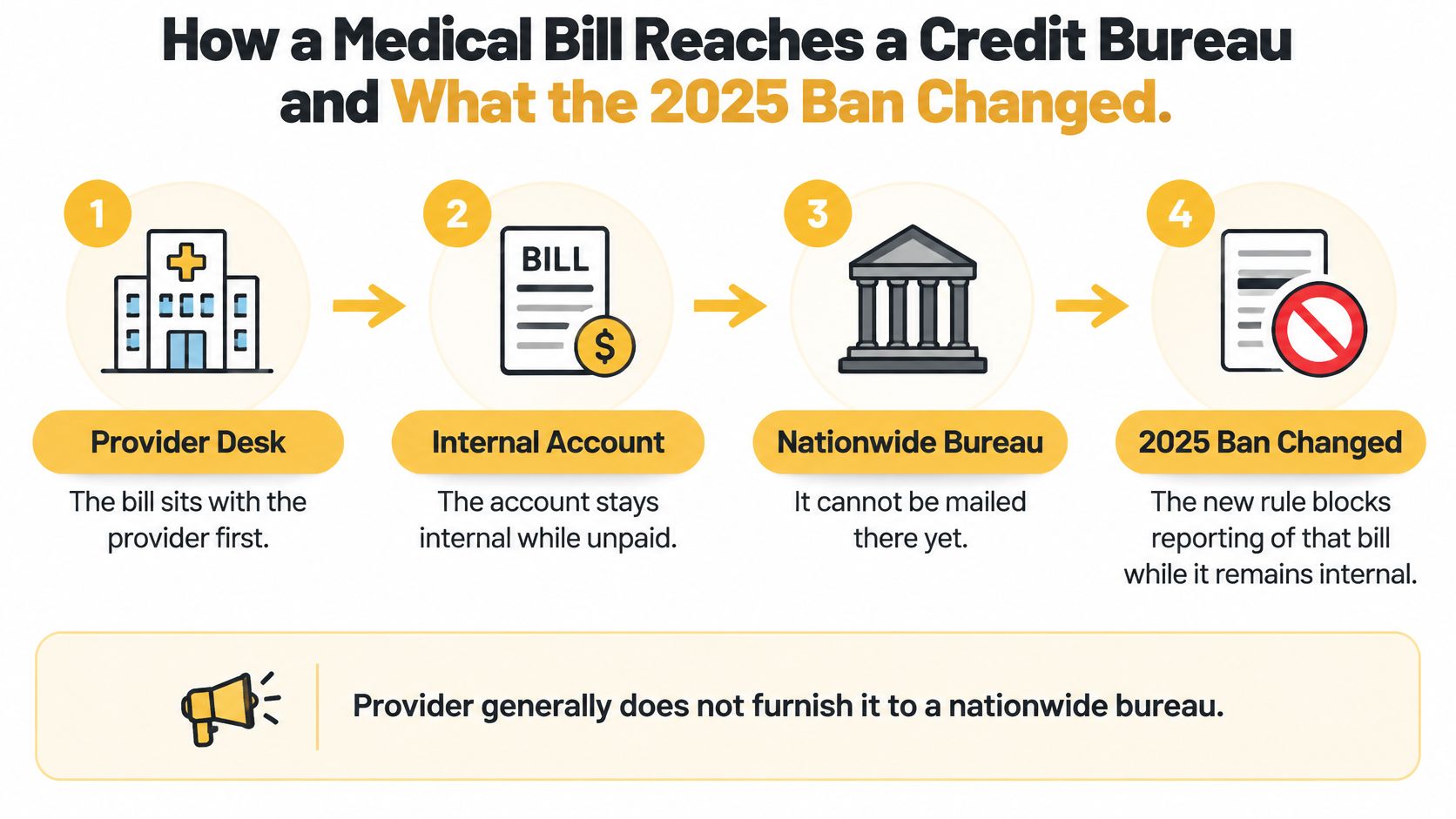
Think of the bill as a package that can't be mailed while it still sits on the provider's desk. The hospital, clinic, lab, or ambulance company usually bills your insurer first. You may get statements while claims are pending, denied, recoded, or split between primary and secondary coverage.
Those early statements often look final when they're not. A balance can shrink after a contractual adjustment, grow after a deductible is applied, or disappear after a coding fix. That's why the path from statement to tradeline matters.
From Provider Ledger to Collection Furnisher
The CFPB guidance on medical bills sent to collections explains that a medical provider generally does not report an ordinary unpaid bill directly to a credit bureau while it remains an internal account. Reporting typically becomes possible after the debt is transferred or assigned to a collection agency. That collector then acts as a data furnisher under the Fair Credit Reporting Act, or FCRA.
Say a surgery center bills $3,800. Your insurer pays part, applies part to your deductible, and writes off part under its contract. If the remaining balance stays unpaid, the surgery center may keep sending internal notices for a while. It may later assign the account to an outside collector for calls and letters, or sell it to a debt buyer.
Only then does the account enter the reporting pipeline. The furnisher sends account data to one or more bureaus, and the bureau places a collection tradeline on reports it maintains. A collector might furnish to Experian but not to TransUnion, so one clean report doesn't prove the others are clean.
The flow below shows where reporting normally becomes possible and where it does not.
Furnishers and bureaus don't get to guess. They must use reasonable procedures for maximum possible accuracy, investigate qualifying disputes, and avoid information that's incomplete or misleading. Wrong balances, missing insurance adjustments, and accounts tied to the wrong patient are accuracy problems, not personal failures.
What the One Year Buffer Does and Does Not Do
The one year period gives the messy parts of medical billing time to finish. An insurer can reprocess a claim. A hospital can correct a code, review a charity care application, or place you on a payment plan. You can compare the itemized bill against the explanation of benefits line by line.
Use that time actively. Calendar the date of service, the first statement showing patient responsibility, and every insurer decision. If an appeal is pending, tell the provider and collector in writing and ask them to note it.
Practical rule: Treat the waiting period as a work window, not as a grace period that solves the bill by itself.
The buffer doesn't erase a valid balance. It doesn't automatically stop collection letters, settlement offers, or a lawsuit where state law allows one. It also doesn't stop a qualifying account from being reported after the waiting period ends.
Insurance timing creates the most confusion. A claim may still be under review when a provider's internal clock says the account is old. Keep proof that the claim was submitted, denied, appealed, or paid, because dates decide whether a tradeline appeared too early.
The 2025 Rule That Did Not Become a Permanent Ban
Many readers heard in early 2025 that medical debt was being banned from credit reports nationwide. For a short time, that was the direction of federal policy. A Congressional Research Service summary of the medical debt rule notes that the CFPB finalized a rule in January 2025 that would have prohibited credit bureaus from including medical debt and lenders from using it in credit decisions, potentially removing $49 billion affecting about 15 million Americans.
That rule is not the law you should rely on now. A federal court vacated it on July 11, 2025, finding that it exceeded CFPB authority and conflicted with the FCRA. Vacated means the court set the rule aside. An announced rule, a delayed rule, and a vacated rule aren't the same as a permanent nationwide prohibition.
What remains is a narrower framework. The FCRA can permit coded medical debt information when it doesn't reveal the provider or the nature of treatment. Voluntary bureau policies still limit which medical collections the three nationwide bureaus display. Your state may add stricter rules on top of both.
That's why headlines alone can't answer your case. If a lender, landlord, or collector tells you medical debt can never be considered, ask which law or policy they're relying on and whether it survived the July 2025 decision. If a collector says every unpaid bill will hit your reports next week, ask how it passes the age and dollar tests.
Three Facts to Pin Down on Any Tradeline
Start with the original creditor. Is it the hospital you visited, a separate emergency physician group, a lab, or an anesthesia practice you never chose directly? Separate providers can create separate bills from one visit.
Next, pin down the initial balance. Compare it with the itemized statement after insurance adjustments, not with the first inflated chargemaster total. Then confirm the delinquency date. A debt buyer's purchase date doesn't restart the account's history.
Write those three facts on one page with the collector's name and account number. You'll use that page for validation, disputes, assistance applications, and any state complaint. Guessing from memory is how duplicate collections and wrong balances survive.
State Laws That Can Block Medical Reporting
The July 11, 2025, court decision vacated the federal ban adopted earlier that year. Whether a medical bill can appear on a credit report now depends on bureau policy and the law of the state involved. State protections can set a stricter limit than bureau policy or require extra steps before a provider or collector reports a debt.
A 2025 Commonwealth Fund review of state protections against medical debt found that 14 states prohibited medical debt from appearing on credit reports, while five more allowed reporting only under specified conditions. The count reflects the review's snapshot; state laws can change.
Who Decides Whether Medical Debt Is Reportable
| Rule | What it requires before reporting | Example | If it is ignored |
|---|---|---|---|
| Nationwide bureau policy | Unpaid medical collection, at least 1 year old, with an initial balance of $500 or more | Equifax, Experian, and TransUnion | Dispute the tradeline; the underlying bill may remain |
| Full state reporting ban | Medical debt may not appear on a credit report | 14 states, according to the 2025 review | The report may violate state law as well as bureau policy |
| Conditional reporting | A required condition must be met before reporting | Some states limit reporting unless specified steps are completed | Reporting may be improper if the condition was skipped |
| State remedy | The remedy depends on the state's statute | State-specific rules | A dispute may not be the only available remedy |
A conditional rule works like a gate: the provider or collector must meet the state's requirements before reporting. The exact condition and remedy depend on the state, so a rule that applies to one bill may not apply to another.
Ask the State Question in Full
Check whether the law covers this provider, collection agency, or debt buyer, and whether it applies to this balance. Then find out what notices or other steps the law requires and what remedy may apply if those steps were skipped.
Start with the state statute or consumer guidance from your state attorney general, insurance regulator, or financial regulator. Note when you checked. The state connected to the care may matter, and a debt buyer operating elsewhere does not automatically make the same rules apply everywhere.
If your state bars the reporting and a medical tradeline appears, save a copy of the report, the collector's letters, and the relevant statute. Those records can help you explain why the entry may violate state law, rather than only contain a balance or date error.
What Happens to Real Bills Under These Rules
The national picture shows both fewer medical collections and bills that may still appear on credit reports. The Urban Institute's analysis of medical debt in collections found that about 27 million consumers had medical debt in collections on their credit records in August 2022. By August 2023, the share of adults with medical debt in collections had fallen from 11.6% to 5.0%.
Those figures describe a change in reported medical debt, not a guarantee that every bill stays off a report. The January 2025 federal ban was vacated on July 11, 2025, so the practical test is bureau policy and the law in your state.
How the Rules Apply to Three Real Bills
| Bill | Balance | Age and status | Can it appear |
|---|---|---|---|
| Emergency room bill sent to collections | $400 | Under 1 year | No, excluded under the under-$500 rule |
| Post-insurance balance placed with a collector | $2,400 | 14 months unpaid | Yes, unless state law forbids it |
| Collection already paid in full | $850 | Any age | No; a remaining entry is a dispute |
Suppose a $400 emergency room bill goes to collections after a few months. It should stay off the three nationwide credit reports under the under-$500 policy, but the provider or collector may still seek payment through lawful channels. Check the bill and resolve it; a missing credit entry does not cancel the balance.
The $2,400 post-insurance balance has been unpaid for 14 months in this example. If the collector reports it, it may appear unless state law blocks reporting. A credit-card application that reviews your reports could then take the entry into account.
A paid $850 collection should not remain listed as unpaid. If it does, keep proof of payment and dispute the inaccurate status rather than paying the same balance again.
This video walkthrough shows how a medical collection tradeline may be reviewed before you decide what to challenge.
Paying the $2,400 balance with a credit card changes the type of debt; it does not erase the bill's history. The medical collection may be replaced by revolving card debt, which can add interest costs and affect card utilization. Before shifting the balance, consider how paying off collections may affect your credit score.
For a reported collection, check the original delinquency date. Under the FCRA, it generally falls off seven years after that date, not seven years after a debt buyer acquires it. A newer account-opening date should not make an old bill look new.
How to Dispute a Medical Collection on Your Reports
Use one sequence and finish each step before you jump ahead. Phone calls feel fast, but paper trails win disputes. Your goal is to force the bureau and furnisher to match the tradeline against real records.
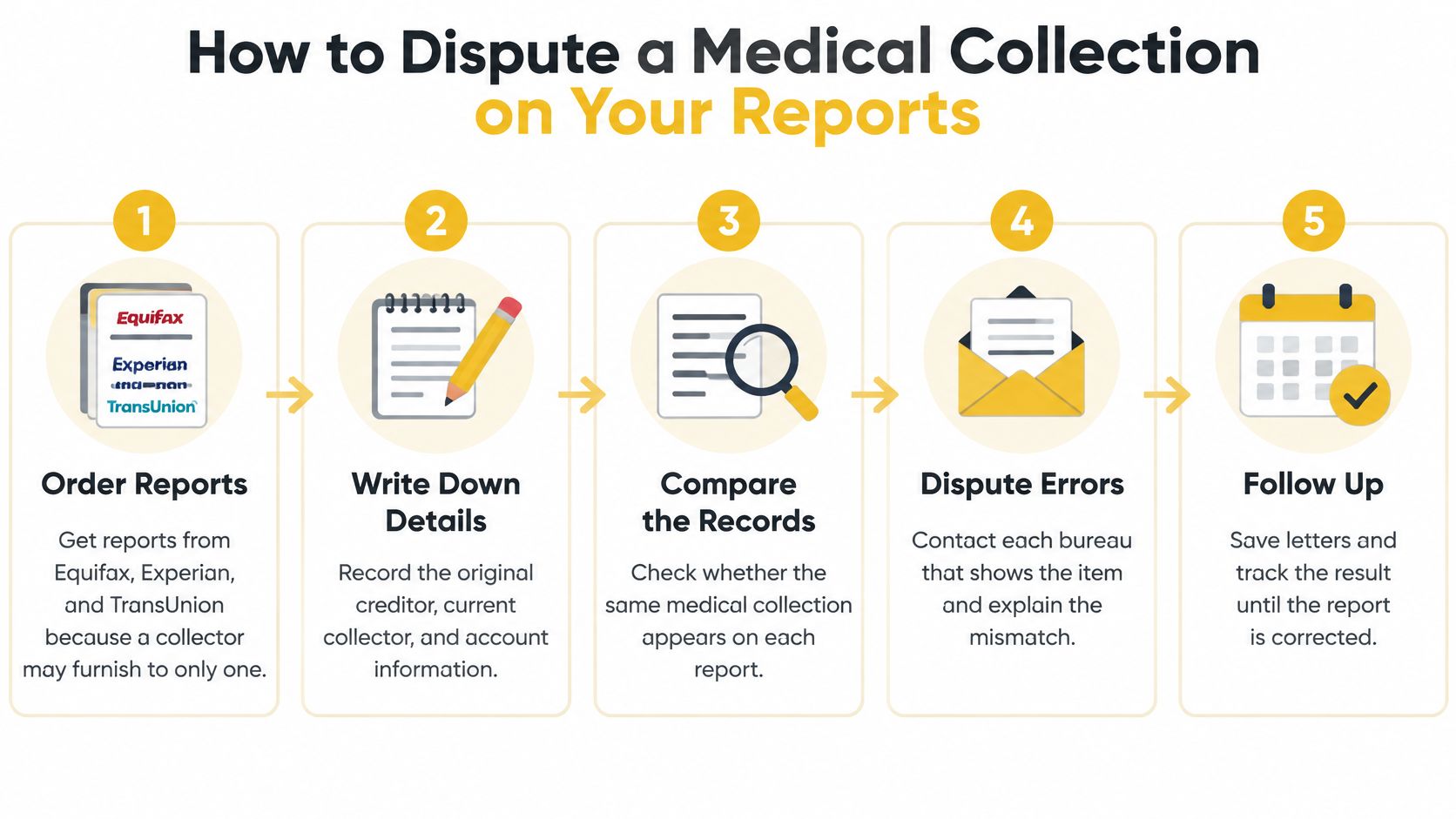
The Six Step Dispute Sequence
- Order all three reports: Get your Equifax, Experian, and TransUnion reports because a collector may furnish to only one bureau, and use the credit report guide for reading each section if the layouts blur together.
- Build an account sheet: Write the original creditor, current collector or owner, account number, initial balance, current balance, date of service, and delinquency date. Mark any insurance adjustment that's missing.
- Request debt validation: Send the collector a written request asking it to verify the debt, the amount, and its authority to collect. Keep a copy and proof of mailing.
- Dispute with both sides: Send written disputes to each bureau showing the item and to the furnisher that supplied it. Attach the itemized bill, explanation of benefits, payment proof, identity records, or financial assistance decision that supports your point.
- Name the exact eligibility failure: State plainly if the account was paid, first reported under the dollar threshold, reported too early, duplicated, tied to another person, or barred by your state law. Vague complaints invite vague investigations.
- Escalate when the answer is thin: If the item comes back verified without new proof, or reappears after deletion, file complaints with the CFPB and your state regulator or attorney general. Include your dated letters and the responses.
Documents That Make a Dispute Specific
- Itemized statement: Shows each charge, code, adjustment, insurer payment, and patient balance.
- Explanation of benefits: Shows what your plan allowed, paid, denied, or assigned to deductible.
- Payment proof: Bank records, card statements, cancelled checks, or a paid in full letter.
- Assistance records: Applications, approvals, denials, and notices that may trigger state conditions.
- Identity proof: Useful when a bill belongs to a relative, a former spouse, or a stranger with a similar name.
Don't pay a stranger by phone before validation just because they promise deletion. Get the agreement, the amount, and the reporting update in writing first.
A successful dispute removes or corrects reporting. It doesn't automatically forgive a valid bill that a provider can still pursue outside the reports. Keep a single file with reports, statements, insurer letters, and every dated dispute until the account is fully resolved.
Settle the Bill Before It Becomes New Debt
If your bill is still young or small, spend the protected time on the bill itself. Request an itemized review, appeal an insurer denial, apply for hospital financial assistance or charity care, and ask the provider for a written payment plan that doesn't require a credit card. If you don't have insurance, My Policy Quote's bill negotiation guide offers practical language for asking about cash prices, discounts, and errors before a balance hardens.
If a valid collection is already reporting, negotiate in writing. Confirm the payoff or installment amount, the due dates, whether interest or fees continue, and how the furnisher will update the tradeline. A structured hardship payment plan for bills can help you fit that promise into rent, utilities, and other essentials.
Keep new borrowing separate from the medical account. Credit union payday alternative loans, credit builder loans, secured cards, and provider or utility plans are usually safer than taking a high cost payday or title loan to clear a bill that may not even be reportable. For hands on help, call 211, contact nonprofit credit counseling or legal aid, and use the CFPB complaint portal when a company won't investigate.
Do one thing this week. Match your bill to the reporting tests, then dispute it, apply for assistance, or set a written plan.
If a medical collection is squeezing your budget or blocking your next application, visit BadCreditMD for free explainers on credit reports, hardship plans, state borrowing rules, and lower cost alternatives to high cost loans. You'll find plain language guidance and directories to 211, nonprofit counseling, legal aid, and regulators, without paying for information or affecting your credit just by reading. Start with your state's page and the bill in front of you, then take the next documented step.