
“Pay the collection and your credit score will jump” is popular advice, but it promises more than anyone can reliably deliver. Paying a collection resolves a debt, while improving a score depends on how that payment is reported and which scoring formula evaluates it. Those outcomes can happen together, but they aren't interchangeable.
Table of Contents
- Does Paying Off Collections Help Your Score
- Why Scoring Models Change the Answer
- How Paid and Unpaid Collections Differ
- Why Medical Collections Follow Different Rules
- What Score Changes Look Like in Practice
- How to Pay Dispute or Wait
- What to Do Before You Borrow Again
Does Paying Off Collections Help Your Score
You've received a collection notice and want to know whether paying will help you qualify for your next apartment, credit card, or loan. The honest answer is sometimes, not a guaranteed increase. Paying can help a score, produce no visible change, or matter to a lender even when the score stays put.
The question isn't just whether you can afford the payment. It's whether the account is accurate, what you're trying to accomplish, and how the collection will be treated afterward. A collector's demand isn't proof that the balance, dates, or ownership are correct.
Separate the Goals Before Spending
Debt resolution means addressing what you owe. Score improvement means changing information that a particular scoring model uses negatively. You might accomplish the former without accomplishing the latter, especially when an older scoring model continues to consider a paid collection.
Keep these distinctions in mind:
- The scoring model: Your consumer app and a prospective lender might calculate scores differently.
- The debt category: Medical collections have reporting protections that ordinary collections don't.
- The reporting result: An account updated to paid isn't necessarily an account deleted from your report.
The practical implication is straightforward: don't spend money based on a promised point increase. First determine whether you should validate the account, negotiate written terms, resolve an accurate debt, or request removal under an existing reporting policy.
Practical rule: Decide what a successful payment would accomplish before agreeing to it. A resolved balance can be worthwhile even without a higher score.
Keep the Larger Credit Picture in View
If you're preparing to rent, collections may be only part of your concern. For a broader starting point, the renter credit advice from M&N, Mediation & Negotiation Services, offers a related resource to consider alongside your collection-account review.
Reading credit guidance doesn't change your score. You can take time to understand your options without treating research as a credit application.
Start with a clear question: are you trying to close an unresolved obligation, address a lender's concern, or improve the score used for a specific application? Your answer helps you judge whether payment is the right next step rather than assuming it's an automatic credit repair.
Why Scoring Models Change the Answer
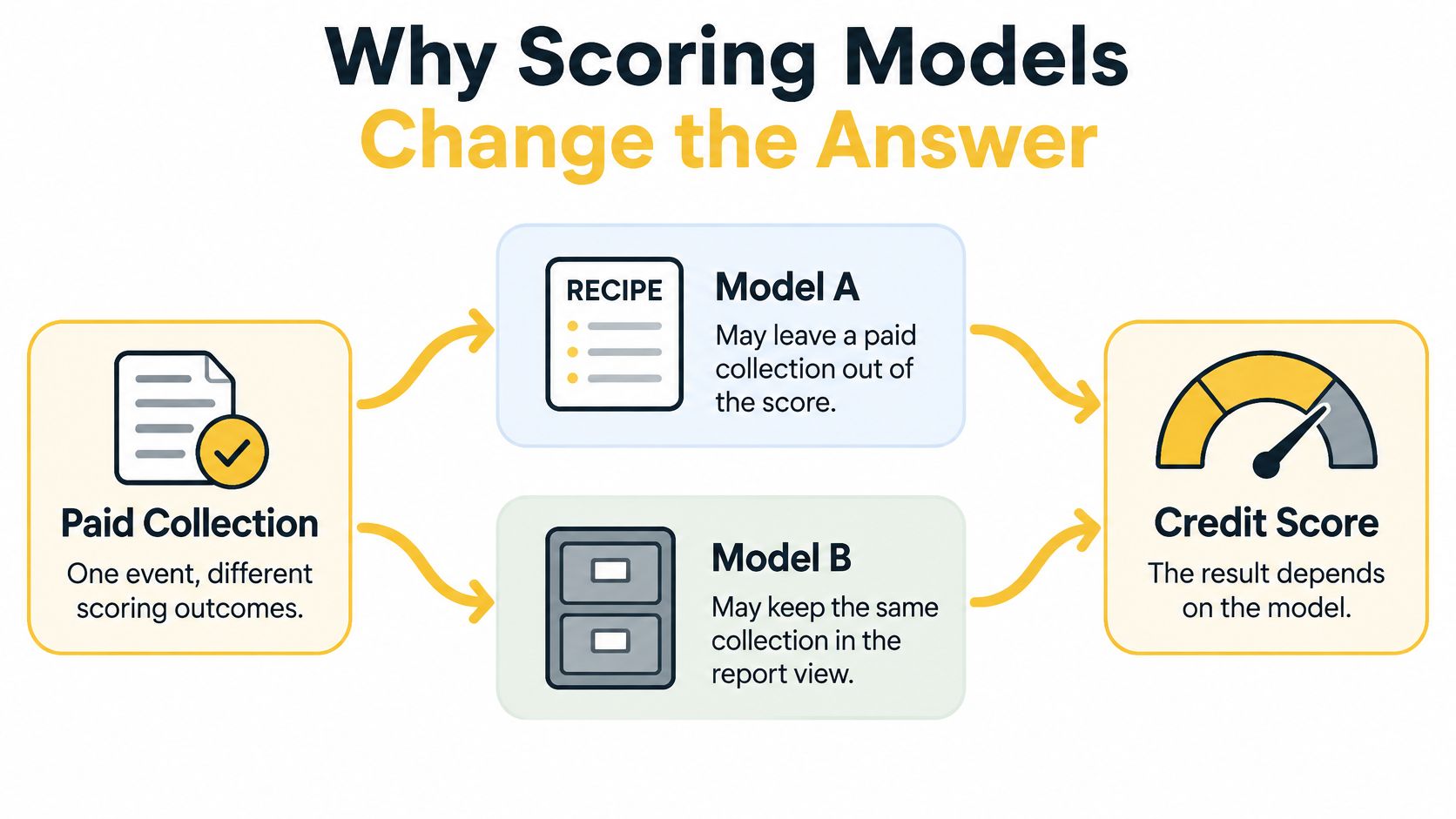
Think of a credit score as a recipe. Different kitchens can start with the same ingredients and produce different results because they follow different instructions. Likewise, scoring companies can evaluate the same collection account differently.
Your credit report contains account information. A scoring model uses selected information from that report to calculate a score. Removing an item from a calculation isn't the same as removing it from the underlying report.
The diagram illustrates that split between account information and scoring treatment.
The Formula Determines What Counts
According to the Congressional Research Service's explanation of credit scoring and collections, VantageScore 3.0 and 4.0 ignore paid collections and medical collections regardless of payment status, while older FICO models may continue considering paid collections that remain on reports for up to seven years from the original delinquency date; payment history accounts for approximately 35% of a general FICO Score.
Those rules explain why payment doesn't necessarily reverse the harm from a collection. The account's balance can change without erasing the history that an older formula still evaluates. Nor does removing one collection's scoring effect guarantee a return to your previous score, because the rest of your report matters too.
The infographic's different paths represent scoring decisions, not separate promises about deletion. A model can disregard a paid collection while the account remains visible to someone reviewing the report.
Ask About the Intended Application
Instead of asking a collector how many points you'll gain, ask the prospective lender what scoring model it uses. The collector controls neither that formula nor the lender's approval standards.
Useful questions include:
- Model identification: Which scoring family and version will you use for this application?
- Report information: Which credit bureau's information will you evaluate?
- Underwriting requirements: Would resolving this collection address a separate approval concern?
A lender may not be able to predict your eventual score. You're looking for enough information to avoid paying solely to influence a score that won't be used.
Treat any point estimate cautiously. Even when a model ignores paid collections, the report must reflect the changed status before the calculation can reflect it. Under an older model, the visible score change could be small or absent despite a properly reported payment.
How Paid and Unpaid Collections Differ
An unpaid collection records an unresolved collection balance. Payment changes that status, but it doesn't automatically erase the account or the original delinquency. For ordinary nonmedical debt, the important question is what the model does with the account after it's reported with a zero balance.
Experian's guide to removing paid collections explains that FICO Score 9 and 10 disregard paid collections, while FICO Score 8, the most widely used FICO version, generally still considers paid collections with original amounts of at least $100.
Paid Collections by Scoring Model
| Scoring approach | Paid collection treatment | What to verify |
|---|---|---|
| Newer FICO versions identified above | Disregard paid collection accounts | The collector reports the account as resolved with no remaining balance |
| Widely used older FICO approach identified above | Can continue considering a paid collection | The original collection amount and the lender's actual model |
| VantageScore versions discussed earlier | Exclude paid collections from scoring | The report used for that score reflects the payment |
| Other older or specialized models | Treatment may differ | The lender's scoring version and separate underwriting requirements |
The distinction matters when comparing credit-card offers, auto financing, or another loan. A score displayed by one service doesn't establish how a different lender will evaluate the account.
Get the Reporting Terms in Writing
Before sending money, request written account confirmation. Compare the creditor, collector, amount, and identifying details with your records. If you're negotiating a settlement, ask how the collector will report the resolved balance and whether any separate reporting agreement is available.
Don't confuse a request for deletion with a guarantee of deletion. Ask for clear written terms rather than relying on a telephone assurance that payment will “fix” your credit.
For an old account, review the statute-of-limitations guide and consider legal assistance before committing to an arrangement. Don't assume that credit-reporting questions and questions about an old debt's enforceability have the same answer.
After payment, retain the agreement, receipt, and confirmation that the obligation is resolved. Check every bureau that previously listed the collection, not just the report connected to your preferred app.
A payment receipt proves you paid. Your credit report shows whether the account information was actually updated.
If the balance or status remains wrong, use those records to request a correction. Don't make another payment because the score hasn't changed.
Why Medical Collections Follow Different Rules
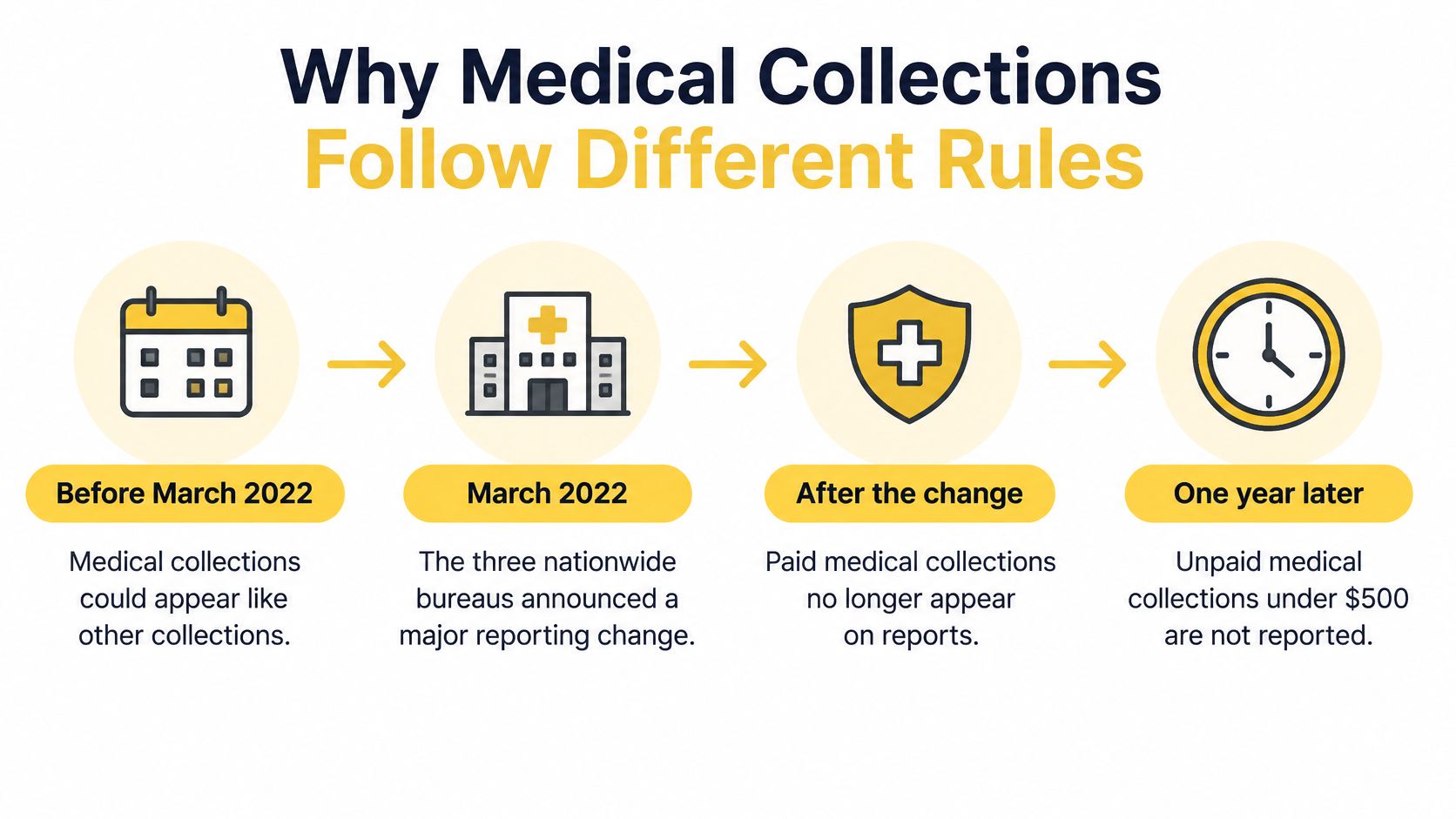
Medical collections have followed separate reporting policies, though those policies do not settle every question about a bill. A collection can leave a credit report because of its medical category, its original balance, its age, or a correction. Removal from a report and a higher score are separate outcomes.
The nationwide credit bureaus announced changes in March 2022. They began removing paid medical collections in July 2022, extended the waiting period before reporting from about 180 days to one year, and stopped reporting collections with initial balances under $500 in April 2023. The CFPB's analysis of medical-collection reporting changes describes these policy changes.
Reporting Removal Isn't Always a Payment Result
In its analysis, the CFPB reported that 43 million people had allegedly unpaid medical bills on their credit reports in 2021. It estimated that about half of consumers with reported medical debt would have some collection removed, and projected that two-thirds of medical-collection entries would no longer appear once the bureau changes took full effect.
Those estimates describe reporting changes, not promised score increases. They also count different things: people and individual collection entries. One person may have several entries, so the two measures cannot be treated as interchangeable.
An account might stop appearing for several reasons:
- Payment: Under bureau policy, paid medical collections are removed.
- Initial balance: Collections below the applicable balance threshold may not be reported, whether paid or unpaid.
- Age: A collection may be within the waiting period before it can appear.
Check Why the Account Is There
If a medical collection disappears after you contact a provider, the contact may not be the reason. The account could have been removed because of its category, balance, reporting age, or corrected information.
Compare the provider's bill and insurance records with the collection entry. Check whether the debt is yours and whether the reported balance matches what remains owed.
A missing entry does not prove that the bill has been resolved. And paying a bill you believe is wrong does not correct the error that led to it.
What Score Changes Look Like in Practice
The following situations are hypothetical illustrations, not customer case studies or forecasts. They show why checking the right score matters more than searching for a universal point increase.
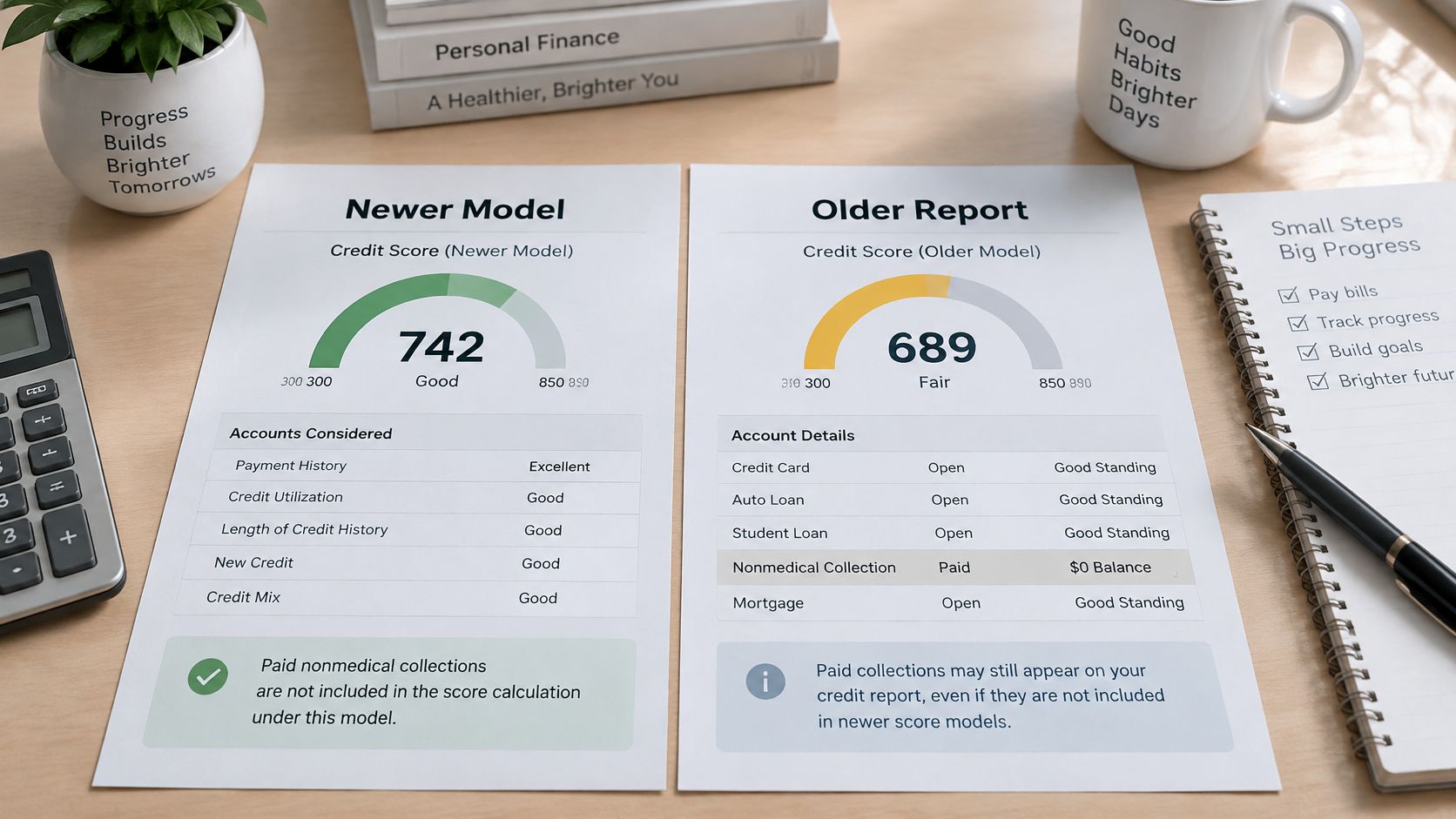
This comparison image highlights the need to identify which score you're viewing.
The App Improves but the Mortgage Score Doesn't
A borrower pays an accurate nonmedical collection and confirms the updated balance. Their free app uses a model that disregards the resolved account, so the displayed score improves. Later, a mortgage lender uses an older scoring version that still evaluates the collection.
Neither score is necessarily wrong. They answer different questions using different formulas, and potentially different report information. Experian's explanation of collection removal and scoring differences supports this distinction between collection status and its continuing relevance to a lender's scoring approach.
An educational score can help you follow your credit, but it isn't necessarily the underwriting score used for a decision. “Free” doesn't identify the model, and paying for access wouldn't automatically make a score the lender's preferred version.
The Medical Account Disappears for Another Reason
Another consumer sees a medical collection disappear while reviewing a provider dispute. The account qualifies for a reporting protection already discussed, so payment isn't necessarily what caused the removal.
Before connecting a score change to a particular action, compare the reports from before and afterward. Look for the account's status, balance, and presence, rather than relying only on the number at the top of an app.
For an additional perspective on the payment question, the following video can accompany your review.
The Score Stays Flat but Resolution Still Helps
A borrower resolves an accurate collection and sees no score change. The payment can still satisfy the creditor, end collection activity on that resolved obligation, and address questions during underwriting. Those are practical benefits, not promises of approval.
If you're also managing current revolving debt, keep that work separate. The DIY credit-card guide is a related resource, but handling an old collection and managing an active card aren't interchangeable tasks.
Judge the result against your original purpose. An unchanged app score doesn't prove payment was useless, just as an improved app score doesn't guarantee a lender will approve you.
How to Pay Dispute or Wait
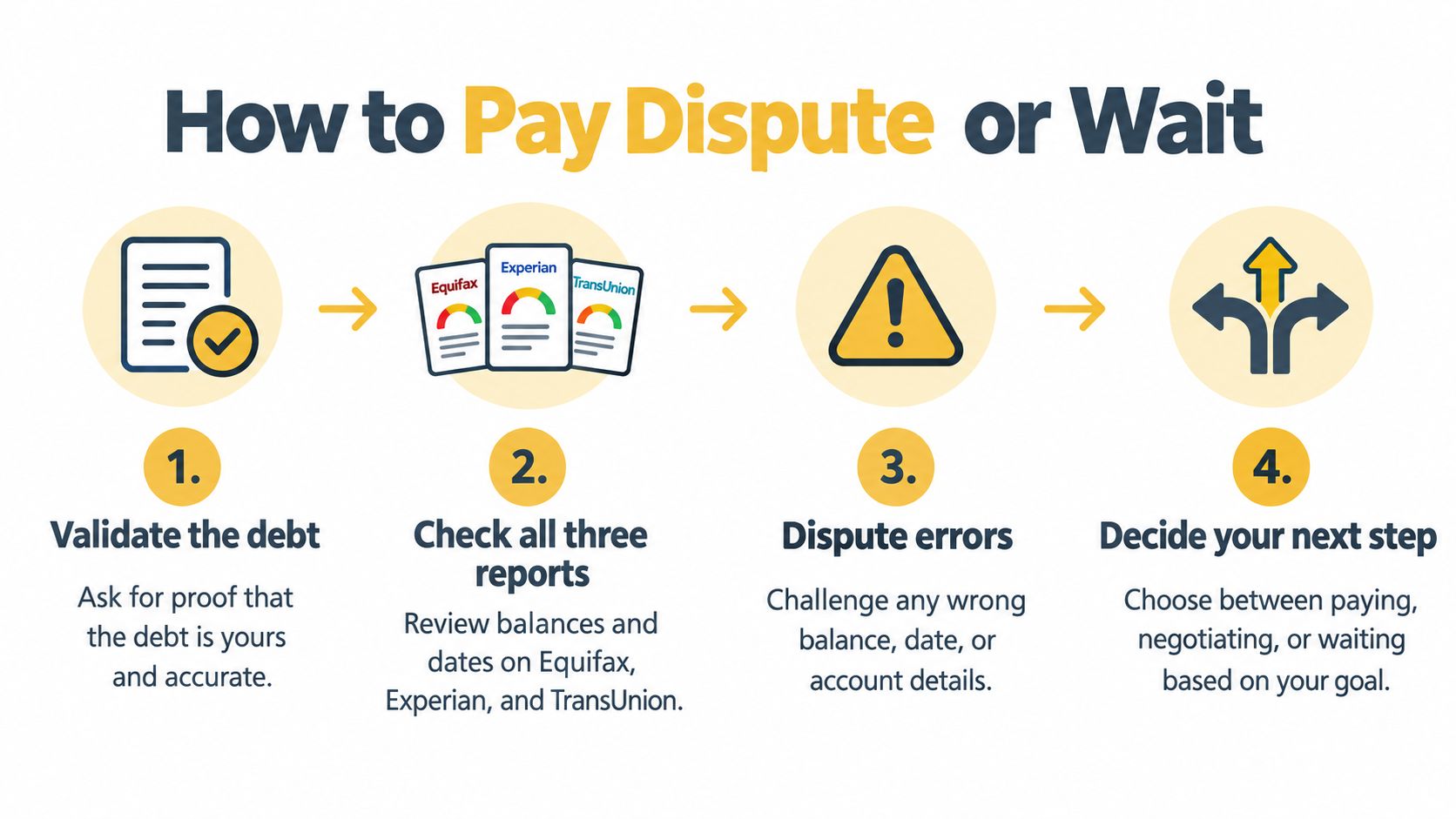
Start with accuracy, not urgency. Request confirmation of the debt, then compare the account with your own records and the credit reports where it appears. Use the credit-report guide to organize that review before making a payment commitment.
This checklist keeps verification ahead of negotiation.
Correct the Record Before Choosing a Payment
Check the creditor's name, account ownership, balance, and dates. If something is wrong, dispute the specific error and keep supporting records. For medical bills, ask the provider and insurer to reconcile any discrepancy before you pay a collector.
Payment doesn't fix an incorrect bill. If insurance or provider assistance could change what you owe, investigate that possibility rather than borrowing to cover an unverified balance.
The current federal-rule distinction matters: the CFPB's January 2025 medical-debt reporting rule was vacated in July 2025, so voluntary bureau policies, not a federal ban, remain the relevant framework, as explained in Experian's medical-debt and credit-score guidance.
Don't assume that every medical collection is prohibited. Apply the bureau protections described earlier to the actual account details.
Choose Based on What You've Verified
- Pay or settle an accurate debt: Negotiate affordable terms where possible and obtain the agreement before sending money.
- Seek a provider or insurance correction: Pursue billing adjustments when the amount or responsibility is unresolved.
- Request a reporting correction: If a medical protection already applies, address the improper reporting instead of paying solely to remove it.
- Consider waiting deliberately: Distinguish waiting for a reporting protection from ignoring an unresolved bill. Ask what obligations remain.
If cash is short, start with nonprofit credit counseling, local assistance through 211, legal aid, or a provider payment plan. These are alternatives to taking on another debt, not guarantees that a particular bill will be covered.
If borrowing remains necessary, compare total costs and repayment demands. A credit-union payday alternative loan may deserve consideration; credit-builder loans and secured cards serve different credit-building purposes and shouldn't be treated as interchangeable sources of emergency cash.
After any agreement, keep the paperwork and verify the resulting account update. Your decision isn't finished when you send the payment.
What to Do Before You Borrow Again
Build a collection inventory before choosing your next application. Record the account name, whether it's medical, the initial amount, current balance, relevant dates, and the bureaus listing it. Add the status of any dispute or payment agreement.
Then write down the borrowing goal that matters. A mortgage application, replacement vehicle, and emergency expense call for different conversations. Don't let an unrelated app score become the sole measure of readiness.
Create an Application File
Keep the documents a lender may ask you to explain together:
- Account records: Collection notices, billing statements, and any evidence supporting a correction.
- Resolution documents: Written settlement terms, payment receipts, and confirmation of the final balance.
- Report changes: Copies showing whether an account was corrected, updated, or removed.
- Application context: The intended lender's scoring information and any stated requirements concerning collections.
If a lender requests an explanation, the guide to a letter of explanation for derogatory credit can help you prepare a factual account. Describe what happened, what you did, and what documentation supports it. Don't promise that an explanation substitutes for the lender's requirements.
Decide Whether Borrowing Solves the Right Problem
Before financing a collection payment, ask whether the new debt would be manageable even if your score didn't improve. If the answer is no, a predicted score increase isn't a sound repayment plan.
Consider free assistance before a high-cost loan. A nonprofit credit counselor can help you examine the budget; legal aid may help clarify a disputed or old obligation; a provider may discuss a payment arrangement. Availability depends on your circumstances, so ask rather than assuming assistance or approval.
Before you apply: Be able to explain what changed on your report, what remains unresolved, and why the proposed payment fits your budget.
Your next concrete step is to gather the reports and identify errors before deciding which accurate accounts to resolve. Match your decision to the intended application, keep written terms, and confirm the reporting afterward.
The useful question isn't whether paying collections helps credit scores. It's whether paying this verified account, on these terms, advances your specific financial goal without creating a less manageable obligation.
BadCreditMD is an informational site, not a lender or broker, offering loan-type explanations, state-specific borrowing rules, and references to free assistance without making credit decisions. Visit BadCreditMD to compare alternatives before borrowing to pay a collection; reading the guides doesn't affect your credit, and any credit check would arise only if you later choose to submit a request through a lending partner where offered.