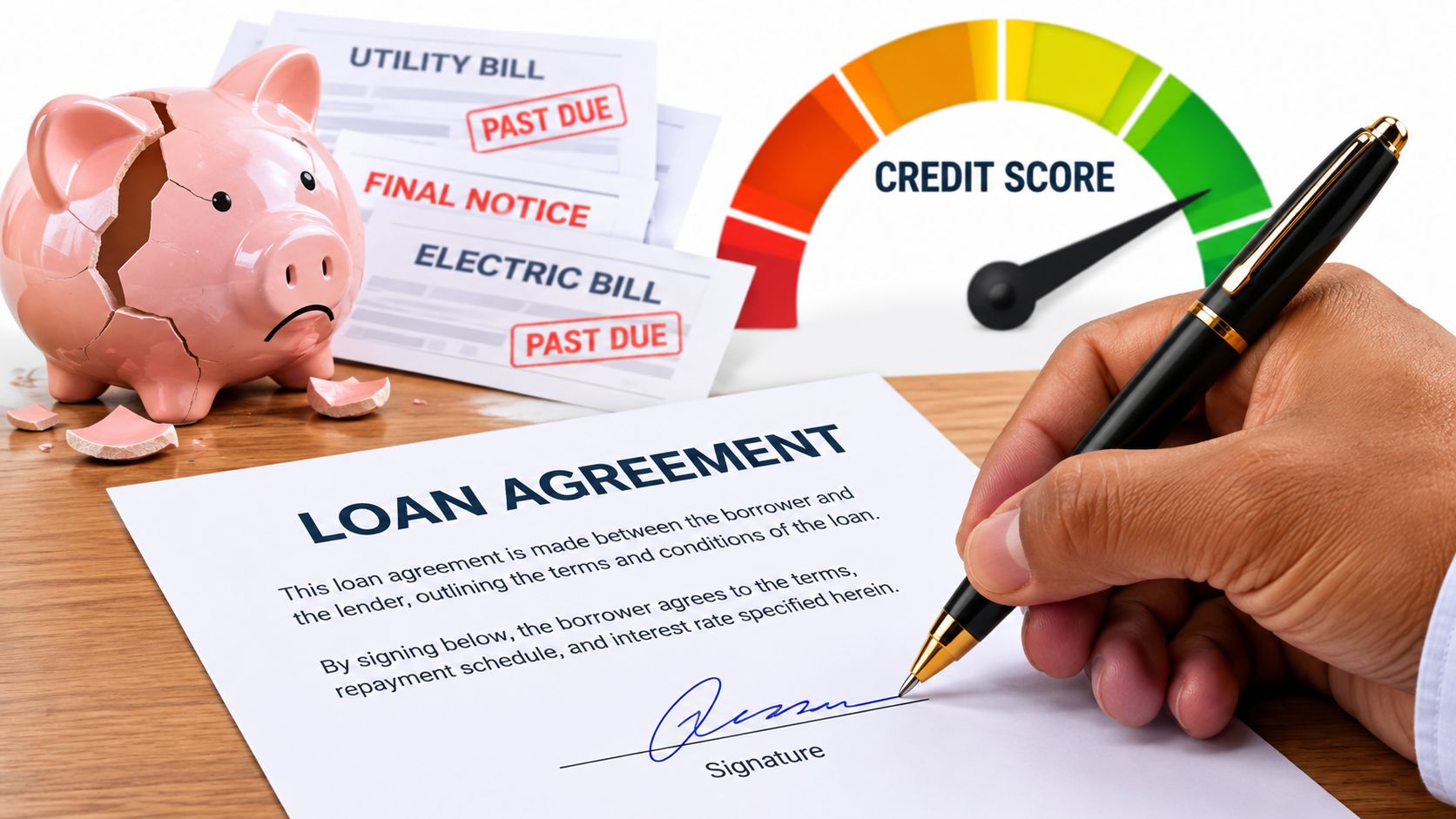
The repair shop says your car needs work before you can drive it safely. Rent is coming due, your savings won't cover both, and an old missed payment is still hurting your credit. A loan offer that promises quick cash can feel like relief before you've even read the agreement.
Signature loans for bad credit can help with a temporary cash shortage, but approval isn't proof that repayment will fit your budget. Before applying, compare the proposed payment with your take-home income, essential expenses, and what you'd earn during a difficult month.
Table of Contents
- Why Borrowers With Bad Credit Look at Signature Loans
- What a Signature Loan Actually Is
- How Lenders Decide to Approve Bad-Credit Applicants
- Typical Rates and the True Cost of Borrowing
- How Signature Loans Compare to Other Small-Dollar Options
- Steps That Improve Your Approval Odds Before You Apply
- Alternatives Worth Trying Before Signing Anything
- Verifying the Lender and Protecting Your Credit Afterward
Why Borrowers With Bad Credit Look at Signature Loans
When you need money urgently, the immediate question is often whether anyone will lend to you. Perhaps your bank declined an application, or you're worried that applying will lead to another rejection. Searching for signature loans can seem like a way around those barriers.
The appeal is understandable: you're looking for borrowing that doesn't require handing over an asset as security. But not needing collateral and not needing a credit review are different things. A lender still needs a reason to believe you'll repay, and an offer aimed at borrowers with weak credit isn't necessarily affordable.
Separate the emergency from the ongoing shortage
Start by naming the expense. A necessary car repair that lets you keep working is different from borrowing to cover a household budget that already falls short every month.
For the repair, ask whether your regular income can cover future payments once the immediate problem is resolved. For the recurring shortage, ask what will change before the first payment comes due. If nothing changes, borrowing may add another bill without fixing the underlying problem.
- Identify the actual gap. Subtract available cash and any realistic assistance from the essential expense.
- Protect everyday needs. Don't count money reserved for rent, groceries, or utilities as available for repayment.
- Consider timing. A bill extension may solve a mismatch between your payday and a creditor's deadline without creating new debt.
Practical rule: A loan should solve the current emergency without making your next ordinary month unaffordable.
You don't have to decide whether borrowing is right based on urgency alone. Treat qualification, cost, and affordability as separate questions. A lender may answer the first question with yes while your budget answers the last one with no.
What a Signature Loan Actually Is
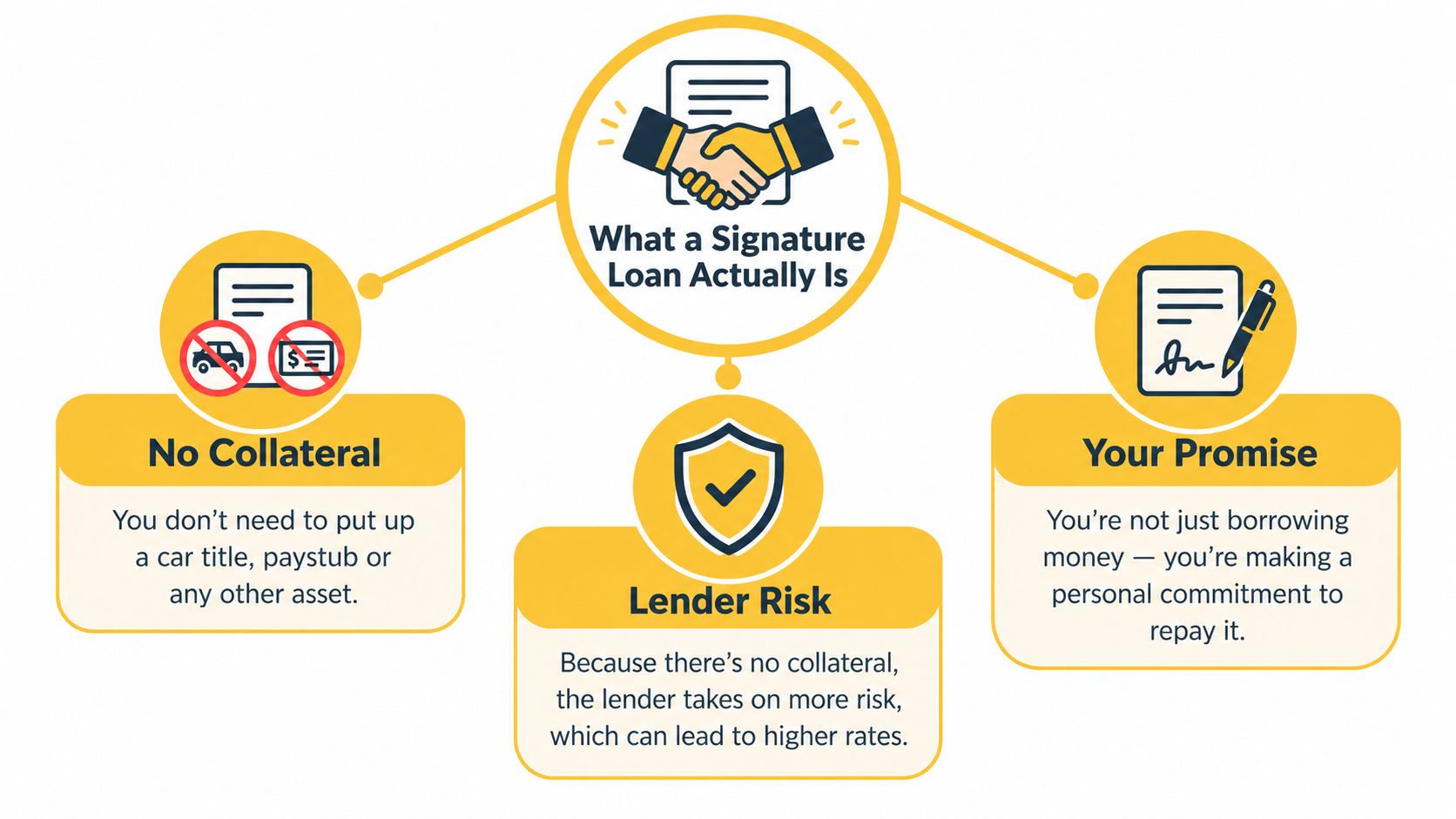
A signature loan is an unsecured, closed-end personal loan based primarily on your promise to repay. Think of it as a repayment agreement rather than an agreement backed by a particular possession: you receive funds and commit to paying them back under the contract.
The absence of pledged collateral changes what the lender must evaluate. Instead of relying on a car or other asset as security, the lender focuses on your creditworthiness and repayment capacity. Unsecured borrowing can involve higher pricing or stricter eligibility requirements, as described in the Center for Responsible Lending's discussion of unsecured installment lending.
This diagram illustrates the basic relationship between your promise, collateral, and lender risk.
Read the agreement, not just the product name
The word signature doesn't tell you the payment amount, fees, or repayment schedule. You need the actual agreement to understand those obligations.
A signature loan can also be an installment loan. Unsecured describes the absence of collateral; installment describes repayment through scheduled payments. They aren't opposing categories, so don't assume an offer becomes safer merely because the lender uses one label instead of another.
- Signature loan. Look for the amount you'll receive, scheduled payments, and total repayment obligation.
- Secured borrowing. Identify what property backs the agreement and what the contract says can happen after default.
- Payday or title offer. Examine the repayment deadline and any collateral requirement rather than assuming it works like a personal loan.
“No collateral” doesn't mean “no consequences.” You still owe the debt, and collection consequences can remain serious even when no specific asset was pledged.
For your budget, the important question is practical: does the agreement require payments you can make from regular income, or will you need another loan to keep this one current?
How Lenders Decide to Approve Bad-Credit Applicants
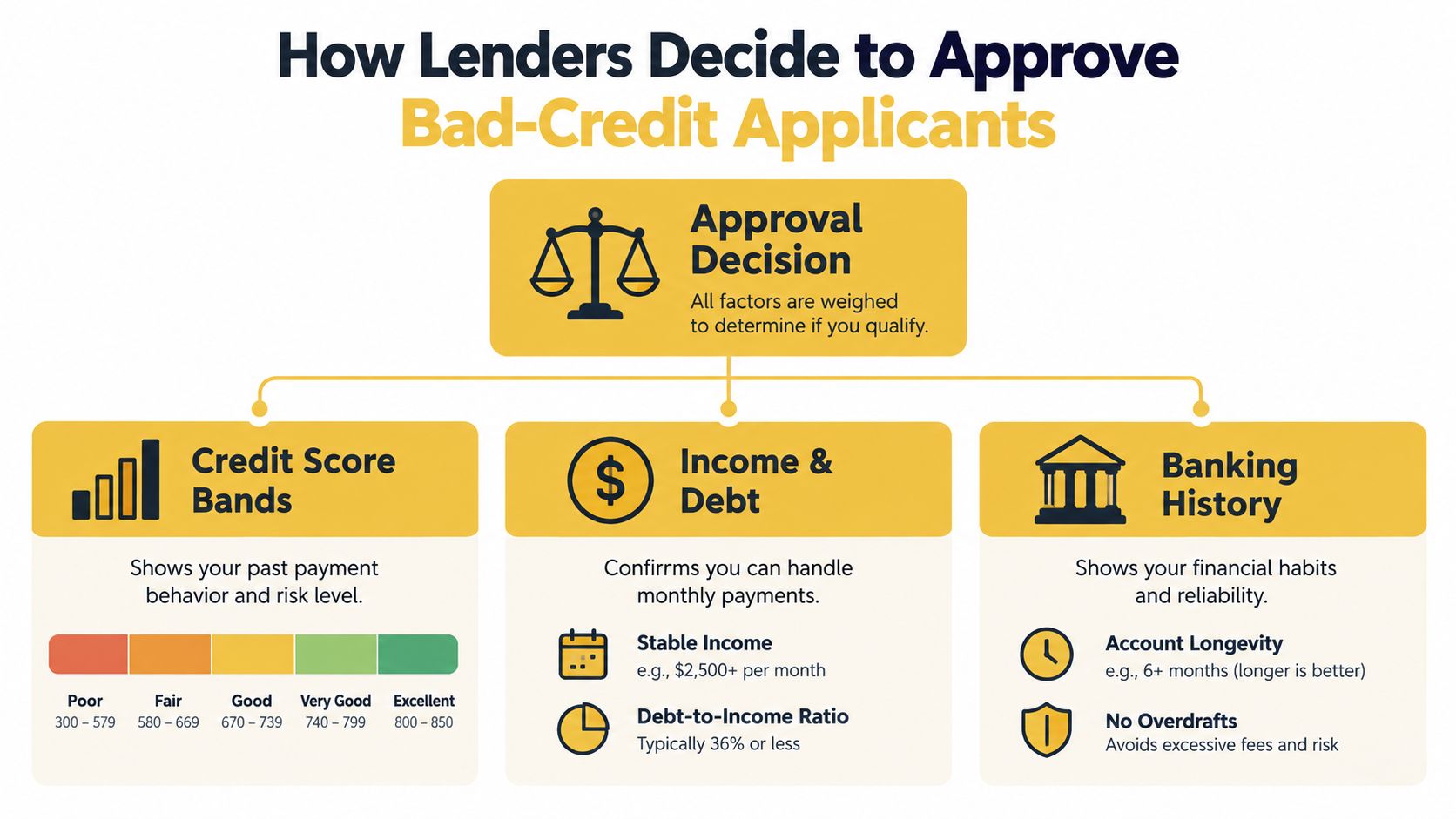
A credit score tells a lender something about your borrowing history. It doesn't fully describe what you earn today, how reliably money enters your account, or how much remains after necessary expenses. That's why a bad-credit application can involve more than a score.
Federal Reserve research examining 2017–2023 credit-bureau data identified fintech lenders and alternative-data underwriting as important drivers of expanded unsecured personal-loan access; by 2022, below-prime borrowers represented 66% of borrowers in that market, according to the Federal Reserve research on unsecured personal lending. That history shows access is possible, not that any particular applicant will qualify.
The visual below organizes the main questions a lender may ask.
What your application needs to demonstrate
Verifiable income helps a lender assess where repayment money will come from. If you work variable shifts or earn side income, organized records make your circumstances easier to evaluate than an unsupported monthly estimate.
Existing obligations matter because income already committed to debt isn't available for the new loan. A debt-to-income comparison focuses on debt payments, while your personal affordability check must also include food, housing, transportation, and other necessities.
Cash-flow history can provide context that a weak credit score misses. But lenders set their own standards, so don't assume they'll accept every form of alternative information or overlook recent repayment problems.
If an application involves another person, distinguish a co-borrower arrangement from applying alone. For an education-related situation, CFII financing help for students offers a focused resource for approaching a co-borrower conversation. Don't treat another person's participation as a substitute for checking affordability.
For additional context while considering an application, you can review this video.
A lender is deciding whether repayment seems likely. You're deciding whether repayment leaves enough money to live on. Those judgments can differ.
Typical Rates and the True Cost of Borrowing
APR, monthly payment, and total repayment answer different questions. APR helps compare annualized borrowing costs. The payment tells you what must leave your budget on schedule. Total repayment shows the overall obligation you're accepting.
Historical FDIC small-dollar program guidance cited existing bank programs with APRs of roughly 12%–32% and encouraged APRs no higher than 36%, with low or no fees, in its guidance on affordable small-dollar lending. These are reference points, not a current rate quote or a guarantee that a bad-credit applicant will receive those terms.
Compare offers without guessing the payment
For an illustrative comparison, keep the requested amount and term unchanged. The table below deliberately leaves payment results to the lender's disclosure or a calculator, rather than treating an assumed rate as an actual offer.
Cost Comparison for a $2,500, 24-Month Signature Loan
| APR | Monthly Payment | Total Repaid | Total Interest |
|---|---|---|---|
| Lower verified offer | Calculate using its actual terms | Add all scheduled payments | Subtract principal from repayment, checking fee treatment |
| Higher verified offer | Calculate using the same amount and term | Add all scheduled payments | Compare with the lower offer |
| Offer with mandatory fees | Verify the disclosed all-in APR and payment | Include mandatory costs without double-counting | Separate interest from fees where disclosed |
Use a loan payment calculator to examine an offer, then reconcile the result with the agreement. Ask how much reaches your account after any deductions, whether mandatory fees are reflected in APR, and what happens if an automatic debit arrives before your paycheck.
Run the payment-to-income stress test
Federal Reserve small-dollar loan data reported a median monthly payment of $89; that payment equals 8.9% of monthly take-home income of $1,000, or 17.8% at $500, before essential expenses, as explained in the Federal Reserve small-dollar lending snapshot. The dataset doesn't provide representative APRs.
A payment can look small in dollars and still be too large for the income left after necessities.
Calculate proposed monthly payment ÷ monthly take-home income, expressed as a percentage. Then subtract essentials, existing debt payments, and the new payment from your income. Repeat using a realistic low-income month.
There's no universal safe percentage established by these figures. If the low-month budget leaves you short, the loan doesn't fit, even if its APR compares favorably.
How Signature Loans Compare to Other Small-Dollar Options
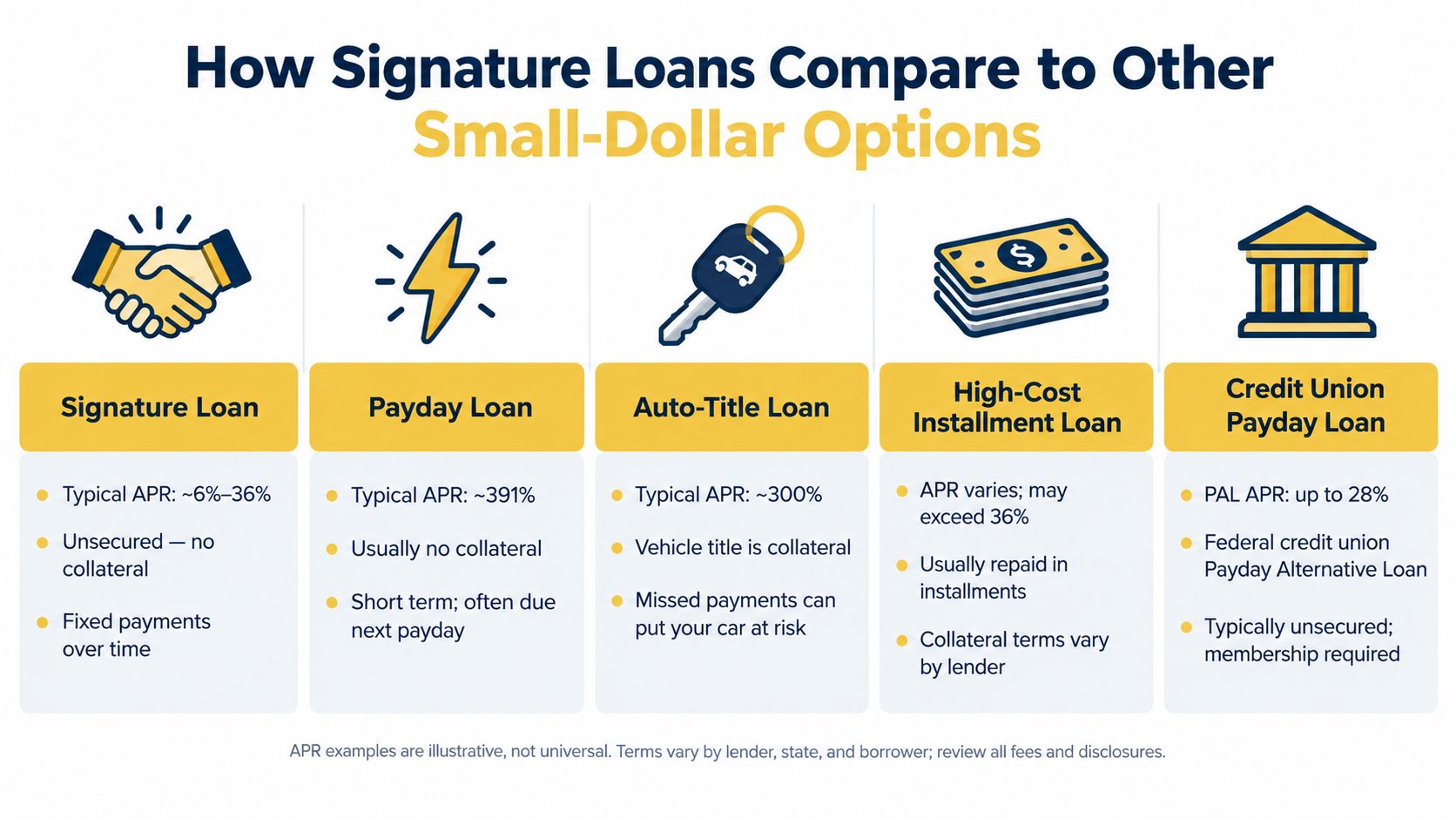
Compare borrowing options by what happens on payday, not just by how quickly money arrives. A product that solves today's shortage but requires an unmanageable repayment can leave you choosing between another loan and an unpaid essential bill.
The comparison graphic provides a starting point. Any rate language in a general visual should be checked against the actual written offer.
Match the repayment structure to your cash flow
| Option you're considering | What to inspect | Budget question |
|---|---|---|
| Signature loan | Scheduled payments and total repayment | Does each payment fit a difficult month? |
| Payday loan | Amount due and repayment deadline | Can you repay while covering the next round of essentials? |
| Auto-title loan | Collateral and default provisions | What would losing access to the vehicle mean for work and daily needs? |
| High-cost installment loan | All-in cost and length of commitment | Does the longer schedule remain manageable throughout the term? |
| Credit-union alternative | Eligibility, fees, and available terms | Is its actual offer more workable than the competing offers? |
A longer installment schedule can make each payment appear easier while keeping you obligated for longer. As noted in the earlier discussion of unsecured lending, you need to inspect the whole agreement rather than its label.
Consider a car-repair scenario. A scheduled-payment offer may work if your usual budget has enough room after the repair. An offer requiring repayment from the next paycheck may not work if that paycheck is already needed for rent. Pledging the car adds another concern when the vehicle is how you earn your income.
A smaller loan isn't automatically a cheaper loan. Compare the same usable proceeds across offers, and include fees and the full repayment schedule. If the products use different payment frequencies, map every due date onto your paycheck calendar rather than comparing unlike payment amounts.
A comparison of small-dollar loan types can help you identify contract features to examine. The deciding factor should remain your worst-month budget, not a claim that one product is universally best.
Steps That Improve Your Approval Odds Before You Apply
The most useful preparation is making your financial situation accurate, documented, and easier to assess. You can't promise a lender will approve you, but you can avoid presenting an application with preventable errors or unsupported income claims.
Start with your records rather than a new application. Reviewing your credit information and organizing your budget can also reveal that you need a smaller amount, or that borrowing should wait.
Use the same workspace to review your reports, collect income records, and write down essential expenses.

Prepare in a practical sequence
- Review your credit reports. Look for unfamiliar accounts, incorrect balances, and payment information that doesn't match your records. Follow the applicable dispute process instead of assuming an error will resolve itself.
- Document income. Gather pay records, benefit statements, or records of recurring side income. Separate dependable earnings from money you only occasionally receive.
- List existing commitments. Include debt payments and household expenses. A complete picture is more useful than a budget built around your best earning period.
- Explain relevant circumstances. If a past disruption caused derogatory credit, a concise explanation can provide context when a lender accepts one. This guide to writing a letter of explanation for derogatory credit can help you organize the facts.
Avoid improvements that weaken your emergency budget
Paying down balances may be worth considering, but don't empty the money needed for food or housing just to make an application look stronger. Likewise, don't borrow extra because a lender says you qualify for it.
Ask prospective lenders whether checking eligibility involves a credit inquiry and whether you can review preliminary terms before submitting a full application. Don't assume every application process works the same way.
Before applying: Write down the maximum payment your low-month budget supports, then treat that amount as your limit.
If another person would join the agreement, discuss repayment responsibilities openly. An application that looks stronger on paper still needs a repayment plan everyone understands.
Alternatives Worth Trying Before Signing Anything
Needing help with an unexpected bill doesn't mean you've failed at budgeting. Federal Reserve survey findings show that 18% of adults could cover less than $100 using savings alone, while 63% could handle a hypothetical $400 emergency with cash, savings, or a credit card paid off at the next statement, according to its report on household savings and emergency expenses.
The important distinction is whether you need more money, more time, or help reducing the expense. Those problems call for different responses.
If the bill is the problem, contact the biller
For a medical bill, ask the provider about financial assistance and a payment arrangement. For a utility bill, ask about hardship options and whether the due date can be adjusted.
Explain what you can realistically pay and when. Request the terms in writing, including any fees, so you can compare the arrangement with borrowing.
| Your situation | Alternative to investigate |
|---|---|
| A bill arrives before your income | A due-date change or direct payment plan |
| Essential needs exceed available cash | Local assistance through 211 and benefits resources |
| Existing debts already strain your budget | Nonprofit credit counseling |
| You can afford repayment but need better terms | A credit-union small-dollar option |
| Your goal is future credit access, not immediate cash | Whether a credit-builder product suits that goal |
Don't confuse credit-building with emergency funding
A product intended to help establish a repayment record isn't necessarily designed to cover today's bill. Ask when you can access funds, what you must pay, and whether the product addresses the actual problem.
If urgent searching has led you toward approval promises, review the risks surrounding no-credit-check payday loan offers before treating them as a solution.
For a disputed debt or collection concern, nonprofit counseling or legal aid may help you identify the next step. Assistance availability varies, so contact the relevant provider rather than assuming help is guaranteed.
The best alternative is the one that resolves the gap with an obligation your budget can support. Sometimes that's a payment plan. Sometimes it's assistance. Sometimes it's choosing not to add debt.
Verifying the Lender and Protecting Your Credit Afterward
A workable payment doesn't make an unfamiliar lender trustworthy. Before sharing sensitive information or signing, confirm who you're dealing with and whether the lender is authorized to offer the product in your state.
Verification also matters after funding. The CFPB reported approximately 13,500 personal-loan complaints in 2025, including consumer reports that small-dollar loan servicers placed incorrect or fraudulent accounts on credit reports, in its annual consumer-response report.
Check legitimacy before sending money
- Confirm the identity. Match the company's legal name and contact information across the agreement and relevant state regulator records.
- Question guaranteed approval. Treat promises that ignore your financial circumstances as warning signs, especially when paired with pressure to act immediately.
- Refuse advance-payment demands. Don't send money to access promised loan proceeds. Distinguish a disclosed contractual fee from a stranger demanding payment before releasing funds.
- Keep someone informed. If a family member is helping you evaluate an offer, compare concerns before responding to the caller or message.
If you're helping an older relative assess a suspicious offer, you can browse senior scam prevention advice for additional context on fake-loan warning signs.
Verify the account after disbursement
Ask whether the lender reports to credit bureaus, which ones receive information, and when reporting begins. Don't assume repayment will rebuild credit if the lender doesn't report the account.
Save the signed agreement, funding confirmation, payment receipts, and correspondence. Check that any reported balance and payment status match those records, and keep notices about a servicing transfer or account sale.
If you find inaccurate information, dispute it through the relevant credit bureau and contact the company responsible for the entry. Identify the specific error and retain copies of what you submit. If the problem remains unresolved or involves suspected fraud, consider the appropriate regulator or CFPB complaint process.
Keep monitoring the budget too. If your income changes, contact the servicer before the payment becomes unmanageable rather than relying on fresh borrowing to cover it.
BadCreditMD offers loan-type explainers, state-specific borrowing guides, and directories for free local assistance; it's an informational resource, not a lender or broker. Visit BadCreditMD to compare signature loans with alternatives and check the rules that apply where you live before submitting a borrowing request.