
Borrowers with credit scores below 320 received average auto-loan rates above 21% in 2023, according to Federal Reserve analysis. That's a secured loan, where the lender can repossess the vehicle. For someone seeking an unsecured personal loan with imperfect credit, a low advertised bank average may be a poor guide to the price they'll receive.
The useful question isn't whether installment loan interest rates are high or low. It's whether your offer's APR, dollar finance charge, and total repayment make sense for the cash you'll receive and the time you'll need to repay it.
Table of Contents
- Installment Loan Interest Rates by Credit Tier
- Why Two Borrowers See Different Prices
- How a Rate Turns into the Payment
- Worked Totals for the Same Loan Amount
- How Markets and State Rules Move the Offer
- When Fixed Payments Hide a Debt Cycle
- Check the Offer Before You Sign
Installment Loan Interest Rates by Credit Tier
A commercial-bank average can be useful context, but it can mislead a subprime applicant. One published benchmark for a 24-month personal loan at commercial banks was about an 11.4% finance rate for borrowers approved at banks. That figure helps explain the market, yet it leaves out declined applicants, applicant-specific fees, and the pricing many subprime borrowers face.
The small-dollar lending figures reported in the Congressional Research Service's small-dollar lending report point to a different reality. Small personal loans of $1,000 or less are often used by borrowers with lower credit scores, but a product category is not a rate quote. A borrower needs the APR, dollar finance charge, and payoff total on an actual offer before judging cost.
A bank average works like a citywide rent estimate. It gives you a starting point, but the price for a specific apartment depends on the building, the lease terms, and the landlord's rules. Installment loan pricing works the same way. Lenders set their own rates, fees, and terms based on credit, income, state of residence, and their own criteria.
Reported installment pricing by product and credit
| Product | Who it describes | Reported rate | What it leaves out |
|---|---|---|---|
| 24-month personal loan at commercial banks | Borrowers approved at banks | Benchmark example, about 11.4% finance rate | Applicant-specific fees, declined applicants, and pricing for many subprime applicants |
| Small-dollar personal loans of $1,000 or less | Borrowers using small personal loans | No single national APR in this source | A rate quote for an individual small-dollar borrower |
| 2023 auto installment | Score about 780 | About 6.79% | Unsecured personal-loan pricing, because the vehicle secures repayment |
| 2023 auto installment | Score below 320 | About 21.13% | An unsecured personal-loan quote and applicant-specific fees |
These are market benchmarks, not personal quotes. The APR rows describe completed loans, while the commercial-bank row is a finance-rate benchmark. Neither tells you what every applicant was offered, and neither includes people who applied but did not obtain a loan.
That distinction matters most for a subprime applicant. A low bank average may describe borrowers with stronger credit profiles or loans with different fee structures. Your comparison should use three numbers from your own offer: the APR, the finance charge in dollars, and the total amount you will repay.
Choose the closest comparison
Start with the same product, then the closest credit group. An unsecured personal-loan APR is more useful for evaluating another unsecured personal loan than a vehicle-backed rate, even when the vehicle-backed rate looks more attractive. Auto loans are secured by the vehicle, so they belong in a separate comparison.
Avoid treating a published band as a promise. Lenders can evaluate income, existing obligations, loan size, repayment term, and state rules in different ways. A completed-loan average also reflects the people who accepted and received funding, not everyone who searched for credit.
Benchmark rule: Use an average to understand the market. Use your written offer to decide whether to borrow.
A finance-rate average may omit origination charges. An APR includes interest and certain finance charges, but it still does not describe every possible late fee, optional purchase, or future refinancing cost.
Before deciding that an offer is competitive, collect:
- Applicant-specific APR: The annualized borrowing cost on your actual offer.
- Dollar finance charge: The disclosed cost of credit in dollars.
- Term and payment schedule: How long repayment lasts and when payments fall due.
- Payment reporting: Whether the lender reports your payment history to credit bureaus.
The closest table row gives you perspective. Those written details give you a decision.
Why Two Borrowers See Different Prices
Two applications for the same loan amount can come back priced far apart. The Federal Reserve's auto-installment analysis shows how far: in 2023, average rates were approximately 21.13% for borrowers scoring below 320, compared with 6.79% for borrowers scoring 780. These are auto-loan figures rather than unsecured personal-loan quotes, but they demonstrate why a single national average can conceal very different borrowing experiences.
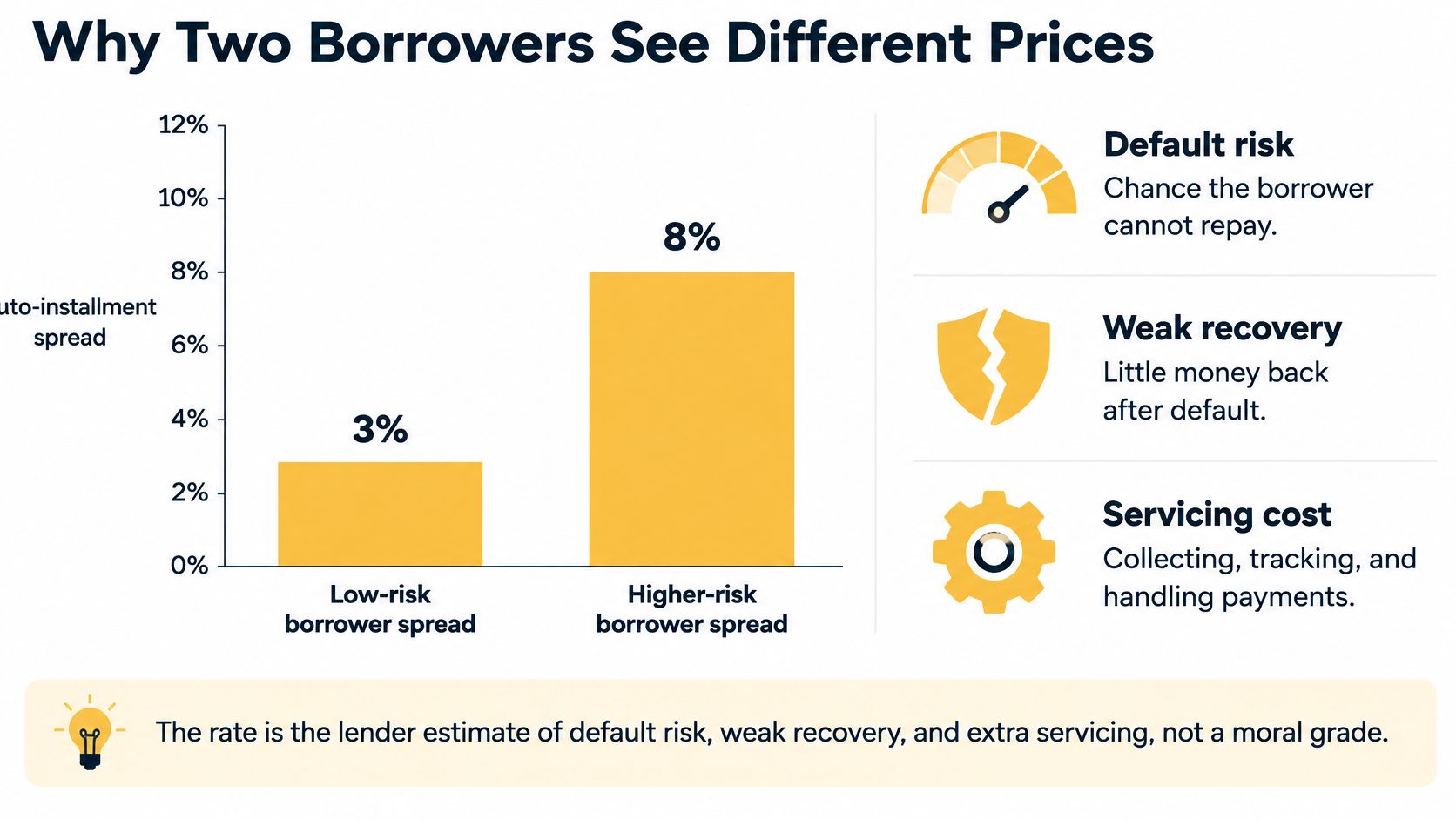
Lenders call the practice risk-based pricing. It works like insurance underwriting applied to credit: the lender estimates how likely a borrower is to miss payments, how much it might recover after a default, and how much servicing and collection work the loan may require, then charges accordingly. Because each lender sets its own rates and terms and must show the APR before you sign, the quote on your offer reflects one company's model applied to your file.
The graphic illustrates the pricing factors. Treat its spread labels as conceptual, rather than as substitutes for the measured rates above.
What lenders price beyond your score
A credit score is a sorting tool, and two applicants inside the same band can still receive different offers because lenders apply different underwriting criteria.
- Income and obligations: A lender considers whether earnings can support another payment alongside existing debts.
- Loan amount and term: The size of the balance and the time allowed for repayment affect the lender's exposure.
- Collateral: A pledged asset gives the lender a possible recovery route, while putting that asset at risk for the borrower.
- Fees and underwriting: Different origination charges and approval standards can produce different APRs.
The rate also changes what each payment accomplishes. On a fixed, amortizing loan, a higher rate sends a larger share of every early payment to interest, so the principal falls more slowly even when each payment arrives on time.
That is why comparisons should hold principal, term, payment frequency, and collateral constant. Otherwise, you might mistake a longer repayment period or a pledged asset for a cheaper offer.
Approval isn't an affordability verdict
A lender's willingness to approve you means its risk math works. It says nothing about whether the payment fits comfortably into your household budget, so test the proposed amount against interrupted income, reduced work hours, or an unavoidable expense before accepting. Borrow only what you can repay on time.
Also establish whether the rate can change. The distinction between fixed and variable interest rates matters because an initially affordable payment may not describe the entire repayment experience.
For an additional explanation of borrowing costs and repayment, use this video alongside the written offer.
How a Rate Turns into the Payment
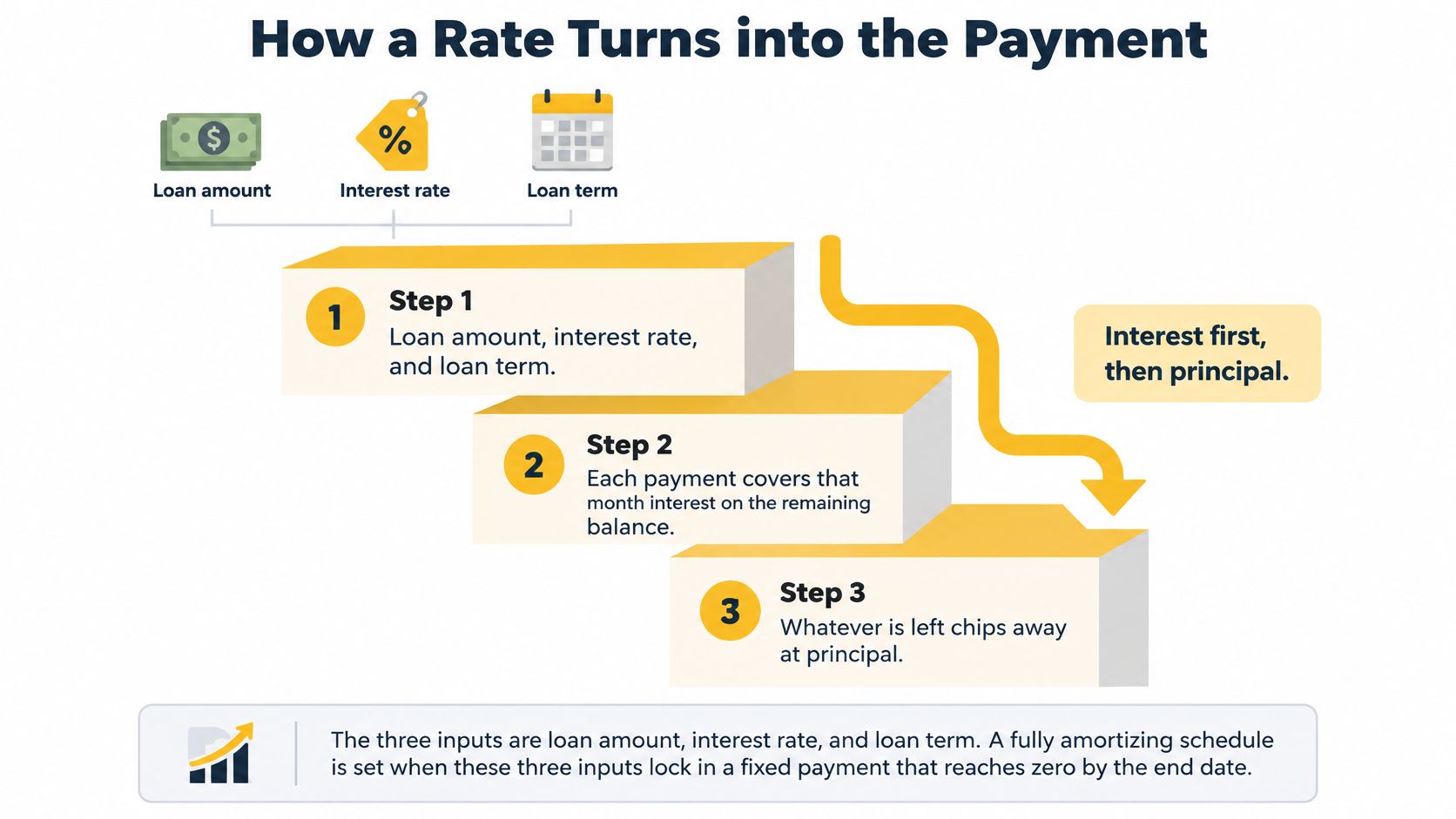
Think of repayment as walking down a staircase. Each payment covers the interest charged on the remaining balance, then applies the rest toward principal. As principal falls, the interest portion generally gets smaller and more of the fixed payment reduces what you owe.
A fully amortizing loan is designed to reach a zero balance by the final scheduled payment. Its payment calculation uses the amount borrowed, the periodic interest rate, and the number of payments.
The staircase graphic shows how those inputs connect.
Calculate with the contract rate
For a conventional monthly amortization calculation, convert the annual note rate, expressed as a decimal, into a monthly rate by dividing it by the number of months in a year. The payment is then the amount that pays the balance down to zero over the agreed schedule.
The standard formula is:
Payment = P × r ÷ [1 − (1 + r)^−n]
Here, P is principal, r is the periodic interest rate, and n is the number of payments. When the periodic rate is zero, the payment is principal divided by the number of payments.
Be careful about entering APR into that formula. APR and the note rate aren't always interchangeable. If there are no additional finance charges and the repayment assumptions align, they may match; when fees are involved, use the contractual interest rate and actual cash flows to reproduce the lender's schedule.
For example, an origination fee withheld from the proceeds can leave you with less spendable cash even though interest is calculated on the contractual loan balance. A required add-on may also affect the disclosed cost of credit. That's why the payment formula alone doesn't fully evaluate an offer.
Read rate, dollars, and time separately
The scale of personal borrowing makes this distinction important: a Federal Reserve publication reports approximately $356 billion in personal-loan debt, equivalent to about 10% of nonrevolving consumer credit. For an individual household, the practical issue is much smaller and more immediate: what leaves the checking account, and for how long?
Read the Truth in Lending disclosure lines as answers to different questions:
- APR: What is the annualized cost of credit, including applicable finance charges?
- Finance charge: How much does the disclosed credit cost in dollars over the scheduled term?
- Amount financed: How much credit is provided to you or on your behalf?
- Total of payments: How much will you pay if you follow the schedule?
- Payment schedule: What amounts are due, and when?
A percentage describes a rate. A finance charge describes dollars. A payment schedule describes the commitment.
Check the cash you'll receive against the amount you need. A payment that looks affordable won't solve the original problem if withheld fees leave the proceeds short.
Worked Totals for the Same Loan Amount
The same loan can produce very different totals. Take an illustrative $3,000 unsecured loan, repaid monthly over 36 months, with no origination fee, no optional products, no late payments, and ordinary monthly amortization.
The figures below are hypothetical calculations based on those stated assumptions, not offers from any lender. Actual disclosures can differ because of payment dates, rounding, fees, and interest-calculation methods.
Illustrative cost of a $3,000 loan over 36 months
| APR | Monthly payment | Total of payments | Finance charge |
|---|---|---|---|
| 12% | About $99.64 | About $3,587 | About $587 |
| 24% | About $117.70 | About $4,237 | About $1,237 |
| 36% | About $137.41 | About $4,947 | About $1,947 |
Totals use unrounded calculated payments, then round to the nearest dollar.
At the lowest illustrative rate, the borrower repays the original principal plus a comparatively smaller interest charge. Moving to the middle rate raises the monthly payment by about $18, yet the finance charge more than doubles because the higher rate applies across all 36 payments.
At the highest illustrative rate, the payment may still appear manageable when viewed by itself. Yet moving from the lowest to the highest rate adds approximately $1,360 in interest on the same hypothetical principal and repayment period.
Three rows of the same loan show why a borrower with imperfect credit gets more from an offer's own numbers than from a market benchmark. A national bank average describes one broad reference point. Your offer sets the APR, the dollar finance charge, and the payoff total you will face, and those applicant-specific figures are the ones worth comparing side by side.
The origination-fee twist
Now give the same hypothetical loan a 5% origination fee on $3,000, or $150. If the lender deducts that fee from the proceeds, you receive $2,850, even though the contractual balance may still be $3,000.
If the original bill requires the full $3,000, you cover the gap from another source or borrow more, and borrowing more raises the cost again.
A lower note rate with a fee can cost more than a somewhat higher note rate without one. The APR exists to reflect applicable finance charges as well as interest, so a fee-bearing offer will not necessarily show the lower APR its note rate suggests. Compare both offers using the same usable proceeds and repayment period.
Change the term without changing the rate
Keep the hypothetical principal at $3,000 and APR at 24%, with no fees, and alter only the repayment period:
- Shorter illustrative term: Over 24 monthly payments, the payment is about $158.61, total payments are about $3,807, and the finance charge is about $807.
- Longer illustrative term: Over 48 monthly payments, the payment falls to about $97.81, while total payments reach about $4,695 and the finance charge reaches about $1,695.
The longer term cuts the monthly payment by roughly $60, while roughly doubling the interest paid over the life of the loan. A smaller monthly obligation and a smaller total cost pull in opposite directions.
These are calculated scenarios, not lender quotes. Choosing a personal-loan repayment length means balancing a payment you can sustain against the cost of remaining in debt.
Recalculate payment, total of payments, and finance charge from the amount and term on your actual offer. A sample payment belongs in an example, not in your budget.
How Markets and State Rules Move the Offer
Installment loan interest rates don't stay at a permanent normal level. In the Federal Reserve's commercial-bank personal-loan series, the finance rate for 24-month personal loans rose from 8.73% in May 2022 to 11.66% in February 2025.
Those observations describe bank finance rates, not guaranteed prices for individual borrowers. They show why an older article, a remembered offer, or someone else's past approval may be an unreliable shopping benchmark today.
Lenders operate with changing funding costs, credit risks, and borrower demand. They also choose their own underwriting standards, so lenders responding to the same economic environment don't necessarily quote the same price.
Separate market context from legal availability
State rules add another question: Can this lender legally offer this product where you live? That question comes before deciding whether the advertised price looks attractive.
Don't assume a national advertisement establishes permission to lend at your address. A lender's rate, available amount, repayment period, or product selection may change after you identify your state.
Use this verification order:
- Identify the lender: Find the legal business name on the proposed agreement, not just the advertising website's brand.
- Check authorization: Consult your state financial regulator's license records or other applicable authorization information.
- Identify the product: Make sure you're checking the rules for the actual loan type rather than a different form of credit.
- Check the applicable limits: Read whether relevant restrictions address interest, fees, or a broader cost measure.
A state guide can help organize the questions. For example, someone borrowing in Georgia can start with the Georgia installment-loan guide and follow the official references relevant to the proposed product.
A legal offer still needs a cost comparison
A licensing check and a price comparison answer different questions. Authorization doesn't establish that a loan is inexpensive, and an attractive advertised rate doesn't establish that the lender is authorized.
Each lender sets its own rates and terms, decides whether to lend, and must show the APR before the borrower signs. Our service isn't available in all states, and not every loan type is available in every state.
Before sharing sensitive information: Match the lender's identity to the agreement and verify the authorization relevant to your location.
Keep a copy of the offer and disclosures. If the final agreement changes the rate, fees, amount, or schedule, evaluate that agreement rather than relying on the earlier advertisement.
When Fixed Payments Hide a Debt Cycle
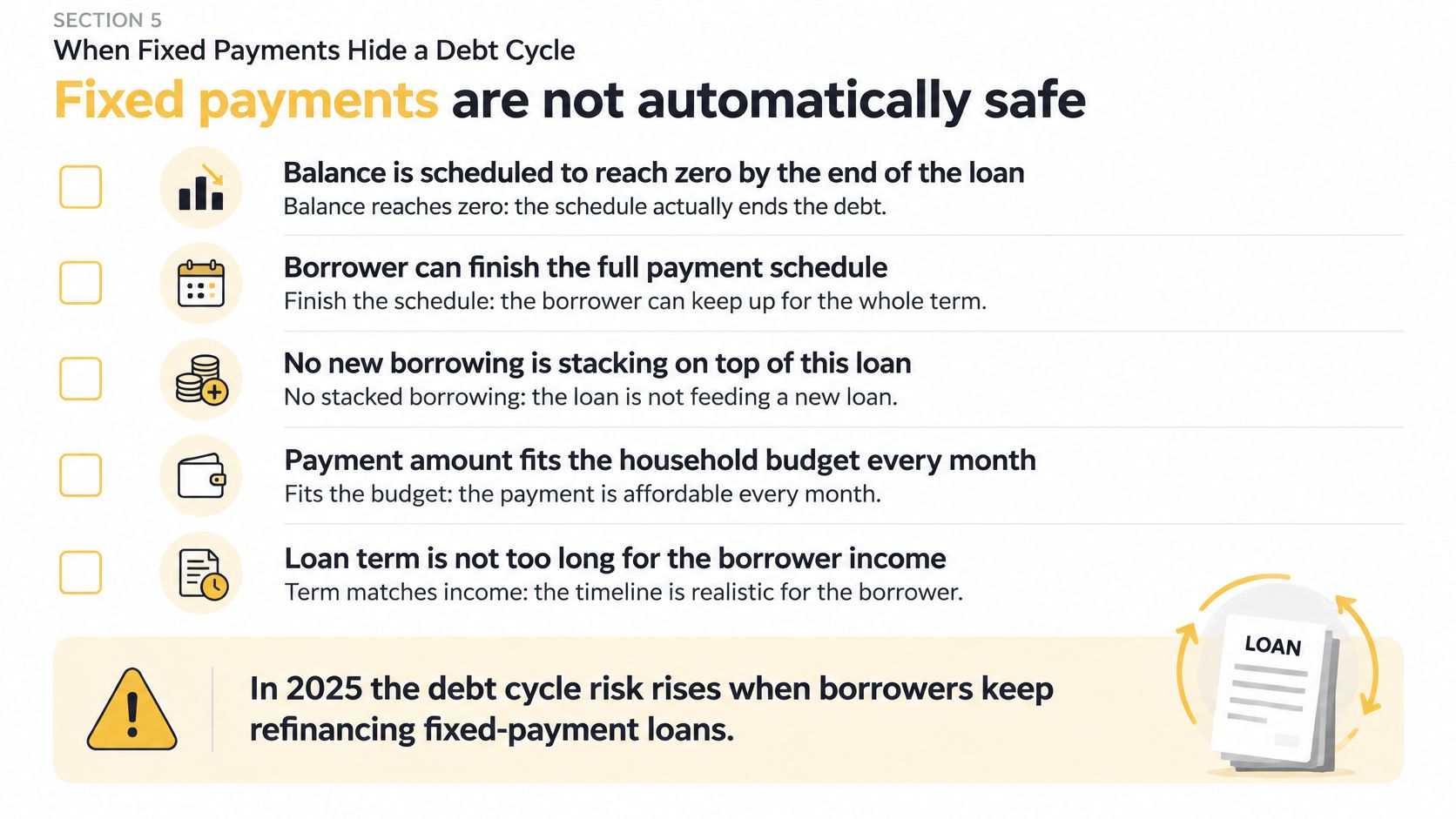
A fixed payment isn't automatically safe. Predictability helps only when you can finish the schedule and the debt ends. A payment can remain familiar while refinancing pushes the payoff date farther away.
The Consumer Financial Protection Bureau's annual complaint report records approximately 13,500 personal-loan complaints in 2025, including recurring concerns about unexpected fees or interest, unclear terms, rates higher than agreed, and growing balances associated with refinancing.
The checklist highlights the difference between predictable payments and a realistic exit from debt.
Test the exit before entering
Refinancing isn't automatically harmful. It can improve a loan when the new terms reduce the remaining cost and fit the borrower's finances. The danger is treating a smaller payment as proof of savings while ignoring added fees or a much later payoff date.
Use these refinance-risk checks before signing:
- Balance after each payment: Obtain an amortization schedule so you can see whether principal declines as expected.
- Payoff on your expected income date: Request a payoff calculation for the date you realistically expect to clear the debt.
- Total if repayment is extended: Compare the remaining dollars under the existing schedule with every dollar required by the replacement.
- New fees and a restarted schedule: Establish whether refinancing adds charges to the balance or starts another full repayment term.
Someone can make every scheduled payment and still spend much more than expected if each replacement loan extends the obligation. Don't count refinancing as the repayment plan before you've even taken the original loan.
Solve the bill without creating another loan
Small-dollar lending can be especially difficult to compare because product structures aren't standardized and origination work is costly relative to the amount advanced. For a temporary cash shortage, start with the party you owe rather than assuming a new lender is necessary.
For example, a $240 overdue electric bill could be divided into four $60 payments added to regular bills under a payment arrangement. That's a possible arrangement, not a promise that every utility will agree; confirm the provider's actual terms and whether service remains protected while you comply.
Nonprofit credit counseling can help organize obligations, while 211 can direct you toward local assistance. A creditor payment plan may also address the immediate deadline without adding a new APR.
Short-term loans are costly and aren't a long-term financial solution. Borrow only what you can repay on time without relying on another loan to finish the job.
Check the Offer Before You Sign
The final decision belongs to you, not the advertisement, comparison website, or lender's approval system. Reject any comparison that stops at the advertised interest rate or treats a commercial-bank average as your expected price.
A sound decision connects the agreement to your actual household cash flow. You need to know what you receive, what you owe, and whether you can complete repayment without creating another shortfall.
Verify the agreement in a practical order
- Confirm authorization and availability. Check that the product can be offered where you live and that the lender has the required license or other applicable authorization.
- Read the disclosure lines together. Place APR beside finance charge, amount financed, total of payments, and payment schedule. Resolve differences between the advertisement and the agreement before accepting.
- Stress-test the payment. Put the due date into your budget alongside rent, utilities, food, transport, and existing debts. Test whether reduced income would force you to miss essentials.
- Confirm a debt-free endpoint. Make sure you can complete the schedule without already assuming an extension, replacement loan, or another lender's approval.
Our guide to comparing loan offers safely provides a practical basis for reviewing competing terms. Keep the comparison focused on offers you could realistically accept, not headline rates reserved for different borrowers.
Use a labeled illustration, then your own figures
As an illustration only, a $1,000 installment loan at 29.99% APR, repaid in 12 monthly payments of $97.48, costs $1,169.76 in total, including a $169.76 finance charge. Those figures illustrate cost disclosure; they aren't an offer, an approval, or a promise of available terms.
Use our loan payment calculator to explore monthly payments and total cost with your own illustrative amount, rate, and term. Then compare the result with the lender's disclosures, especially when fees affect the cash you receive.
BadCreditMD is an information site, not a lender or broker, and we don't rank lenders. A lending network partner may transmit a submitted request to third-party lenders, but submitting a request doesn't guarantee approval, funding, or a particular rate.
Potential referral compensation doesn't change our editorial content. You decide whether to accept any offer.
If the total repayment is too high, essential bills won't fit around the payment, or the refinance-risk checks reveal no realistic exit, decline the offer. An approval isn't a reason to accept debt that your budget can't support.
Visit BadCreditMD for installment-loan explainers, a payment calculator, and state-specific guides that help you compare APR with total repayment. Use those resources to check an offer's assumptions, or explore payment plans and local assistance before taking on new debt.