
The most repeated tip on personal loan length is simple. Take the shortest term you can squeeze into the budget, or stretch the term until the payment feels easy. Both versions treat the calendar as a price tag. It isn't. The months you agree to are a risk decision. They set the payment you must make in a bad month, the interest that keeps accruing, and how much room you have if a paycheck slips.
A personal loan is a lump sum you repay in fixed monthly payments. The length of that schedule varies across the market. Before you sign, you want three things on paper: a lookup of what different lenders offer, a worked payment example at one rate, and a missed-payment stress test. A lower payment is not the same thing as a lower cost, and neither number tells you which term is right for your income.
Table of Contents
- Typical Personal Loan Terms by Lender Type
- How Term Length Changes Your Payment and Total Interest
- Why 24 Months Became the Personal Loan Benchmark
- Choosing a Term by Budget, Total Cost and Buffer
- Term Stress Test for Missed Payments and Hardship Plans
- Confirm Your Term Before You Apply
- How Borrowers Really Repay and Shorten Their Loan
Typical Personal Loan Terms by Lender Type
A lender's type can help explain the repayment schedule, but it does not set the term for every borrower. In data from the New York Fed Consumer Credit Panel and Equifax, analysts found that the median maturity for unsecured personal loans was 2.2 years, about 26 months, across reported sectors in the fourth quarter of 2022. The Federal Reserve analysis reported a median of 2.3 years for FinTech-issued loans, about 28 months, and 2.5 years, or 30 months, for depository-institution loans. Finance-company loans had a shorter median of 1.4 years, roughly 17 months.
Median personal loan maturity by lender type
| Lender type | Median maturity (years) | Approximate months |
|---|---|---|
| All reported sectors | 2.2 | about 26 |
| FinTech-issued loans | 2.3 | about 28 |
| Depository institutions | 2.5 | 30 |
| Banks | 2.9 | about 35 |
| Thrifts | 2.7 | about 32 |
| Credit unions | 2.6 | about 31 |
| Sales-finance companies | 2.4 | about 29 |
| Personal-loan companies | 1.5 | 18 |
| Finance companies | 1.4 | about 17 |
| Miscellaneous companies | 1.25 | about 15 |
These figures are sector medians, not promised terms. They show how reported maturities differed: banks had a median near 2.9 years, compared with 2.7 for thrifts, 2.6 for credit unions, and 2.4 for sales-finance companies. Personal-loan companies and miscellaneous companies had shorter medians, at 1.5 years and 1.25 years, respectively. A borrower's available schedule can vary by provider and offer.
The month counts in the table convert years to months and round the results. Use them as a rough reference, not a term you can expect every lender to offer. The specific offer matters more than the lender category.
Payday and title loans are short-term products, usually due within weeks or in a single payment, rather than multi-year installment loans. A payday loan is generally due in one payment on the borrower's next payday, and it is allowed in fewer states. A title loan is secured by the borrower's car, which is at risk if the loan cannot be repaid.
Check the repayment schedule on each offer. Compare its rate with an explanation of the unsecured loan rate, and confirm whether the loans you are comparing have the same repayment structure.
How Term Length Changes Your Payment and Total Interest
Say you borrow $10,000 at an illustrative 12% APR, with interest charged monthly and the payment fixed. Nothing else changes except the number of months.
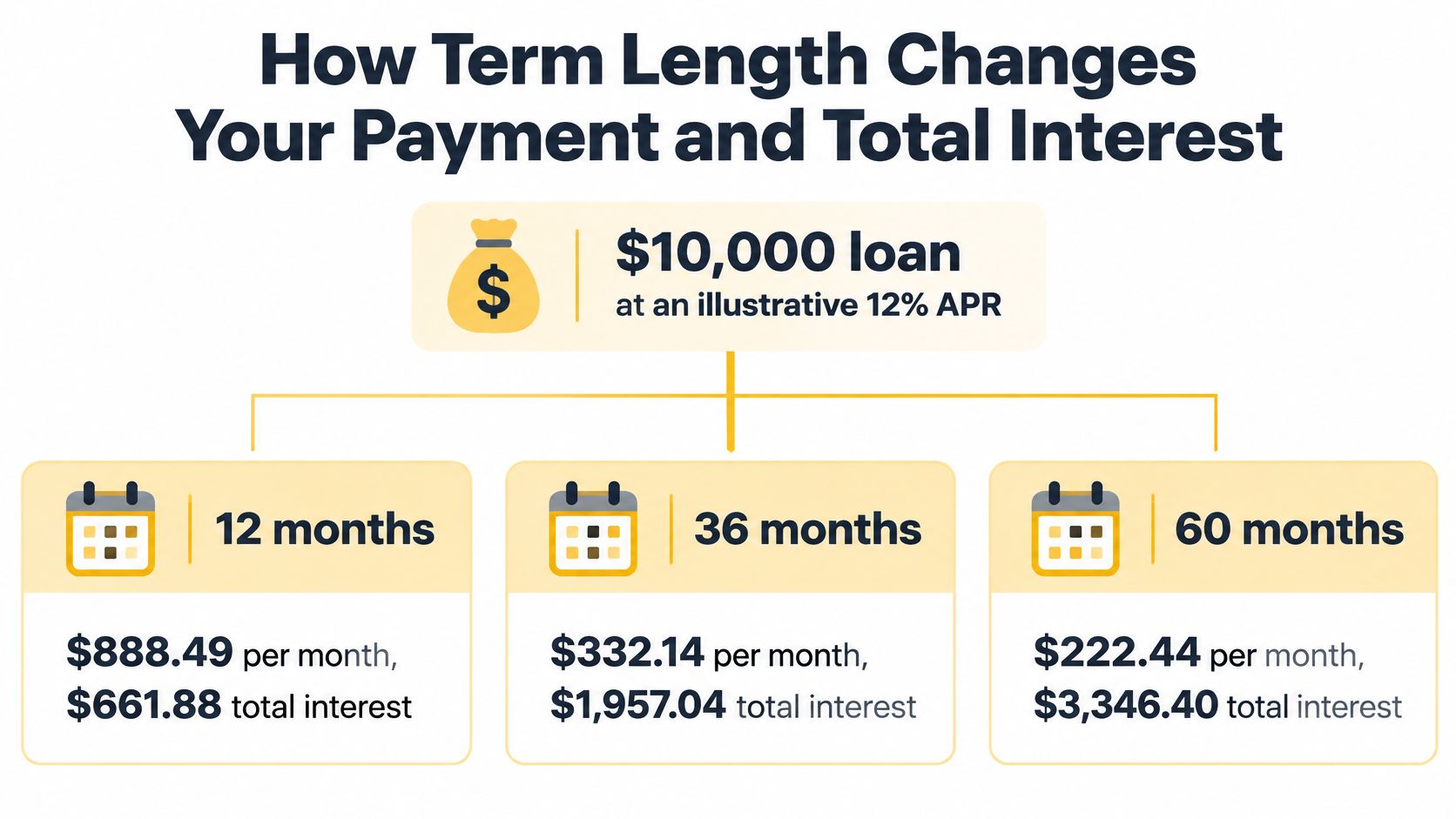
Same $10,000 loan at 12% APR across three terms
| Term | Monthly payment | Total paid | Total interest |
|---|---|---|---|
| 12 months | $888.49 | $10,661.88 | $661.88 |
| 36 months | $332.14 | $11,957.04 | $1,957.04 |
| 60 months | $222.44 | $13,346.40 | $3,346.40 |
Stretch the debt across a longer road and each step gets smaller. The walk takes longer, and interest keeps charging on the balance that hasn't been paid yet. At this rate, moving from 12 months to 60 months cuts the payment by about $666 a month and adds about $2,685 of interest. The rate never moved. The calendar did.
Practical rule: Compare total paid across terms, not the monthly figure alone. A payment you can ignore is still a cost you will write checks for.
A smaller loan makes the same point at a higher rate. As an illustration only, a $1,000 installment loan at 29.99% APR repaid in 12 monthly payments of $97.48 costs $1,169.76 in total, including a finance charge of $169.76. Installment loans use fixed payments over months, not weeks. That $97.48 is the whole story only if you also see the $169.76 sitting on top of the principal.
What to rerun with your own numbers
- Hold the rate still. Change only the term so you can see the calendar's effect.
- Then let the rate move. Lenders often price a longer term higher, so a real offer can cost more than this flat-rate example.
- Write down total paid. Monthly payment, total paid, and total interest belong on the same line.
Use a loan payment calculator with your principal, your APR, and the terms a lender offered. The $10,000 table is a teaching example, not a quote.
Why 24 Months Became the Personal Loan Benchmark
Rate reports have used a two-year personal loan as their yardstick for decades, which is why 24 months shows up so often when people talk about "the" personal loan length.
The Board of Governors' G.19 series starts in February 1972 and records the finance rate on 24-month personal loans at commercial banks. The rate was 12.50% in February 1972. By February 1982 it was about 18.76%, and in August 1982 it was 18.93%, in the high-rate stretch of the early 1980s. The same benchmark was 10.36% in February 2019 and 11.66% in February 2025.
That series prices one term. It does not map every maturity borrowers receive. Federal Reserve figures on outstanding unsecured personal loans put median maturities near two to two-and-a-half years overall, depending on lender sector. Twenty-four months is a reference point, not everyone's typical term.
When a lender quotes a schedule, ask how far it sits from 24 months and what that gap does to the payment. A shorter term normally requires a larger scheduled payment. A longer one spreads repayment over more months and can raise total borrowing costs even when the interest rate is unchanged. The benchmark helps you compare offers. It is not a recommendation for the term you should choose, and it says nothing about where rates go next.
Choosing a Term by Budget, Total Cost and Buffer
For the same principal, line up three numbers before you pick a term: the monthly payment, the total interest, and the cash-flow buffer left after you pay.
Term can change the APR itself, not only the payment. Credible's personal-loan statistics note that shorter repayment periods generally tend to carry lower rates, while longer terms can cost more even when the payment is easier to afford. Mainstream offers may span roughly 24 to 84 months. Eligibility, APR, fees, and collateral requirements vary substantially. Personal loan length is not one product standard.
The shortest term is not automatically best if your income is unstable. A higher required payment can raise the chance you miss one. A moderately longer term, with a plan to pay extra when cash is good, can be safer if there is no prepayment penalty. The reverse mistake is just as common. A low payment can conceal a much higher lifetime cost.
Which term to lean toward by situation
| Situation | Term to lean toward | Why |
|---|---|---|
| Stable income and a cash buffer of at least three months | Shorter term if the payment fits | Lowest total interest and generally a lower APR |
| Variable or seasonal income | Moderate term with a planned payoff | A lower required payment reduces missed-payment risk |
| Tight budget with no buffer | Compare total cost before extending | A low payment can hide a higher lifetime cost |
| Loan with a prepayment penalty | Shorter term or fixed extra payments | Early payoff costs more, so the schedule must be set up front |
Lenders set their own rates and terms and decide whether to lend. Not all lenders can offer the amounts or terms shown on a comparison site, so an advertised range is not a promise.
Choose the term where the payment still works in a bad month. If a short schedule only fits when every paycheck arrives on time, it isn't the safe choice, even if the interest looks smaller.
Term Stress Test for Missed Payments and Hardship Plans
A loan term is also a risk decision. A payment that fits today may become difficult after an income shock, and a missed payment or deferral can push the payoff date farther away. Test what happens before signing, not after a fee appears.
The CFPB's 2025 consumer response annual report recorded approximately 13,500 personal-loan complaints in 2025. Some consumers reported payment plans or deferred interest that increased the amount due and lengthened repayment. Installment-loan complaints were 70% above the prior two-year monthly average.
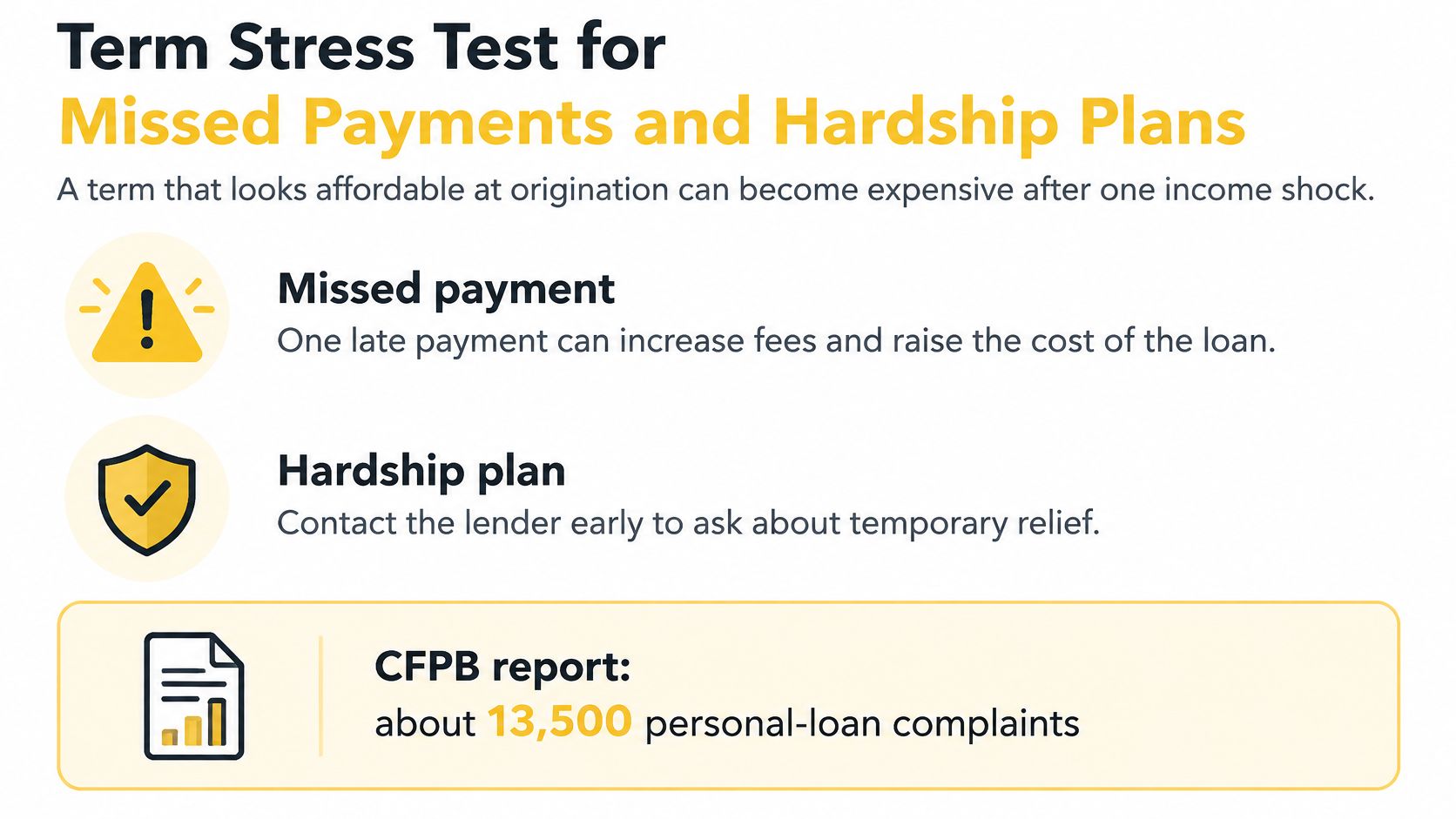
Run the stress test before you sign
- Record the scheduled payoff date and total paid. This is the original schedule, before a missed payment or other change.
- Check what one missed payment triggers. Ask whether a late fee applies and whether the skipped amount moves to the end of the schedule.
- Ask whether interest continues during a hardship plan or deferral. A payment pause may still add to the cost if interest keeps accruing.
- Find out how a payment-plan change affects the end date. Lower payments for a while can mean more months in repayment.
- Consider refinancing only if you cannot meet the current payment. A new loan may add fees or extend repayment.
- Compare the result with your monthly cash buffer. If one missed payment would wipe it out, the schedule leaves little room for a setback.
A hardship payment plan is best discussed with the lender before a payment is missed. Ask for the revised payoff date and total cost in writing, so you can compare the new schedule with the original one.
If one missed payment would break your budget, a longer term may only hide the shortfall. Borrow less, address the budget first, and speak with a nonprofit credit counselor before taking on new debt. A deferral can extend repayment even when the rate stays the same, making a manageable payment lead to a larger amount owed over time.
Confirm Your Term Before You Apply
A term is more than a calendar choice: it affects the payment you must manage each month and how long you remain responsible for the debt. Before applying, check the offer against a leaner-than-usual month, not only your normal budget.
- Budget with a shortfall: Check whether the monthly payment still fits if income comes in light for a month.
- Total paid, not just the payment: Compare the full amount you would repay under each term. A smaller payment can come with a higher total cost.
- APR and every fee: Look at the APR and any origination fee alongside the monthly payment.
- Prepayment in writing: Confirm whether extra payments are allowed without a fee and how the lender applies them.
- Whether the lender can offer it: Lenders set their own rates and terms and decide whether to lend. Not all lenders can offer the amounts or terms shown on a site.
Use this guide to comparing loan offers safely to match quotes line by line, including their repayment schedules. Different calendars can make offers look more alike than they are.
Where to check the rules and the math
The loan payment calculator lets you explore monthly payments and total cost with your own illustrative figures. State guides explain which loan types state law allows, the rules lenders follow, worked cost examples and local help.
If the payment still does not fit, contact 211 for local assistance or speak with a nonprofit credit counselor before borrowing. Short-term loans are costly and are not a long-term financial solution. Borrow only what you can repay on time.
Write down the term that keeps payments manageable in a lean month, then run those figures through the calculator. Compare offers only after checking both the monthly payment and total cost.
How Borrowers Really Repay and Shorten Their Loan
The contract term and the term people use often split. In SoFi's 2025 survey of 1,000 U.S. adults who had taken out a personal loan in the previous five years, 63% said they had repaid their loan within two years. ConsumerAffairs, citing TransUnion's Q1 2025 data, put the average personal-loan length at just under 30 months. Many borrowers do not ride the full schedule.

Paying extra only helps if the lender applies it the way you intend. An Australian guide to tackling debt from Wealth Collective makes the same point for any installment debt: extra money has to hit principal, and the emergency fund stays intact.
Shorten the loan without starving your buffer
- Confirm there is no prepayment penalty. If paying early costs a fee, the savings may disappear. The common mistake is assuming "no penalty" because the ad didn't mention one.
- Find the scheduled payoff date and the interest still left. You need a before picture so a later statement can prove the date moved.
- Pick an extra monthly amount that doesn't touch your cash buffer. A rushed extra payment that leaves you short next month often becomes a missed payment.
- Tell the lender, in writing, to apply extras to principal, not to the next installment. The usual mistake is sending a larger check and letting the servicer push your due date forward while interest keeps running on the same balance.
- Check the new payoff date each quarter. If the date hasn't moved, the extra money isn't hitting principal.
- Keep the original payment as the minimum if income drops. Extra payments are optional. The contracted payment is not.
Success is a payoff date that moved earlier and a lower total interest figure on the recalculated schedule. It is not a feeling that you "paid extra" without a new end date to show for it.
BadCreditMD explains personal and installment loan terms for readers with imperfect credit, including how repayment length changes the payment and the total you owe. State guides and free local-help listings show what your state allows and who to call if a payment plan goes wrong. Visit BadCreditMD to run your own figures and read the rules before you choose a term.