
You have two offers for the same cash, and the one with the smaller payment is the one that can change. Rent is due, the car needs work, and the budget already has almost no slack. One lender locks the rate for the whole contract. The other starts lower and can reset while you still owe the balance.
The year that decides the cost is the worst year you are still paying, when a reset lands, income dips, or a new lender says no. Fixed vs variable interest rate is not a contest over which product sounds smarter. It is a split over who carries that year, you or the lender. Read the rate section of each offer before you compare the monthly figures. If the contract can reprice, the opening payment is only the first chapter.
Table of Contents
- Fixed vs Variable Interest Rates Side by Side
- How Payments and Risk Change Under Each Rate
- Break-Even Math and the True Cost of Each Loan
- Situations Where Each Rate Type Wins
- Lower-Cost Options When Both Rates Are High
- Confirm the Rate Type Before You Sign
Fixed vs Variable Interest Rates Side by Side
A fixed rate is locked for the contract term, so the scheduled principal-and-interest payment does not change. A variable rate follows a reference index plus a lender-set margin, and it can reset up or down at set intervals.
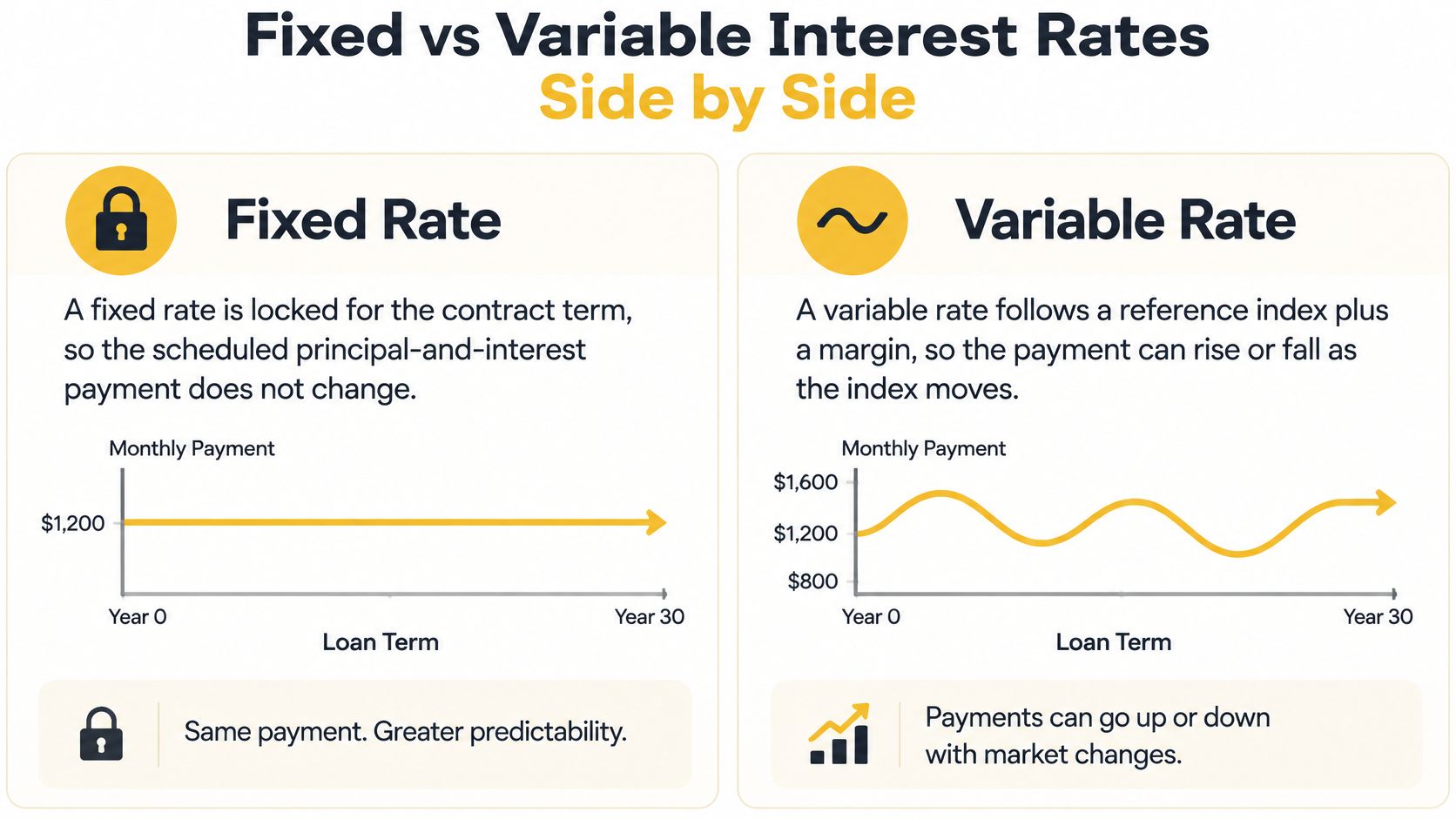
| Feature | Fixed rate | Variable rate |
|---|---|---|
| How the rate is set | Locked at signing for the contract term | Index plus lender margin, reset at set intervals |
| Monthly payment | Same principal-and-interest amount each month | Can rise or fall after each adjustment |
| Starting rate | Often higher than the variable opening rate | Often lower at the start, sometimes only during an introductory period |
| Who carries rate risk | Lender | Borrower |
| Budgeting effort | Easy to forecast for the full term | Needs a worst-case stress test |
| Terms to check | Prepayment charges, origination fees, APR | Index, margin, caps, floors, reset dates, notice period |
| Best fit | Long terms and tight budgets | Short repayment horizon and cash reserves |
A personal loan is a lump sum repaid in fixed monthly payments, so most small-dollar and installment products stay fixed for the term you sign. Variable pricing shows up more often on mortgages and on some credit lines. Credit card and HELOC rates are usually variable, tied to the prime rate plus a lender margin. Plenty of people with damaged credit already carry that kind of debt and never call it variable. Check the rate type on each account you already have, not only on the new offer.
Practical rule: Match the offer to a column by reading the rate section of the loan agreement, not the headline in the ad.
Fixed rates buy payment certainty. Variable rates often start lower, and they move rate risk onto you.
How Payments and Risk Change Under Each Rate
A fixed payment is set at signing. Principal and interest stay the same from the first month to the last, because the rate does not follow the market. You can still lose income, and fees can still stack up, but the interest piece of the bill does not climb when benchmarks rise.
A variable payment is rebuilt at each reset. The lender starts from the index, adds the margin, follows the adjustment schedule, and stops at any cap in the contract. The Consumer Financial Protection Bureau's CHARM booklet says a fixed-rate loan locks the rate at origination so scheduled principal-and-interest payments stay predictable, while a variable-rate loan resets with a reference index plus a lender-defined margin. On an adjustable-rate mortgage, read the initial fixed period, the adjustment frequency, and the initial, periodic, and lifetime caps together. A 5/6 ARM holds its introductory rate for five years and can then reset every six months.
The fully indexed rate
The number to use is the fully indexed rate, index plus margin, not the advertised introductory rate. Price the payment at the offered rate, at one percentage point above it, at three points above it, and at the contractual maximum. If the maximum payment does not fit, the opening rate is not a loan you can keep.
The rows below use a $10,000 balance over 36 months. They are calculated and rounded. Each reset is applied to the full term as a worst-case shape, not a forecast of where an index will go.
| Scenario | Rate | Monthly payment | Total repaid |
|---|---|---|---|
| Fixed rate, unchanged | 12% | $332 | $11,957 |
| Variable, reset and held | 13% | $337 | $12,133 |
| Variable, reset and held | 15% | $347 | $12,479 |
A one-point jump adds about $5 a month on this small balance. Two more points add about $15 versus the fixed payment, and roughly $500 over the full 36 months versus the 12% total. On a larger balance, or a longer term, the same rate gap hits harder.
Rate risk is not the only risk
With a fixed rate, the lender carries rate risk. You still carry affordability risk from a lost job, added fees, or a balance that was too large on day one. With a variable rate, you carry the movement in the index, and that can become payment shock even when the first payment looked easy.
A Federal Reserve study of the 2007–09 mortgage crisis found serious delinquency of approximately 5.6% in mid-2005 for both subprime adjustable-rate mortgages and subprime fixed-rate mortgages. By July 2008, serious delinquencies on those adjustable-rate loans had climbed to more than 29%, while the comparable fixed-rate figure reached about 9%, a gap of over 20 percentage points. Most of those subprime ARMs were fixed for only two or three years, then moved with six-month LIBOR. The fixed label covered the intro period, not the whole loan.
An application can say "fixed" and still reprice before you are halfway through the balance.
Product structure can outweigh the rate label. A title loan is secured by your car title, and the car is at risk if you can't repay. Payday loans, title loans, and some online installment loans can carry very high fees or APRs. A standard installment loan is repaid in fixed payments over months, not weeks, which is a separate question from whether the interest rate itself can reset. Our loan payment calculator lets you try monthly payments and total cost with your own illustrative figures. Swap every sample for the lender's numbers before you treat any row as your bill.
Break-Even Math and the True Cost of Each Loan
A lower starting rate is payment for taking rate risk, not a gift. The Consumer Financial Protection Bureau notes that adjustable-rate mortgages commonly begin below comparable fixed-rate mortgages, while the later payment depends on the index, margin, adjustment schedule, and caps. A lower index does not always cut the payment when a floor or another contract limit applies. Compare APR with the nominal rate, because APR folds in points, broker fees, and other borrowing charges.
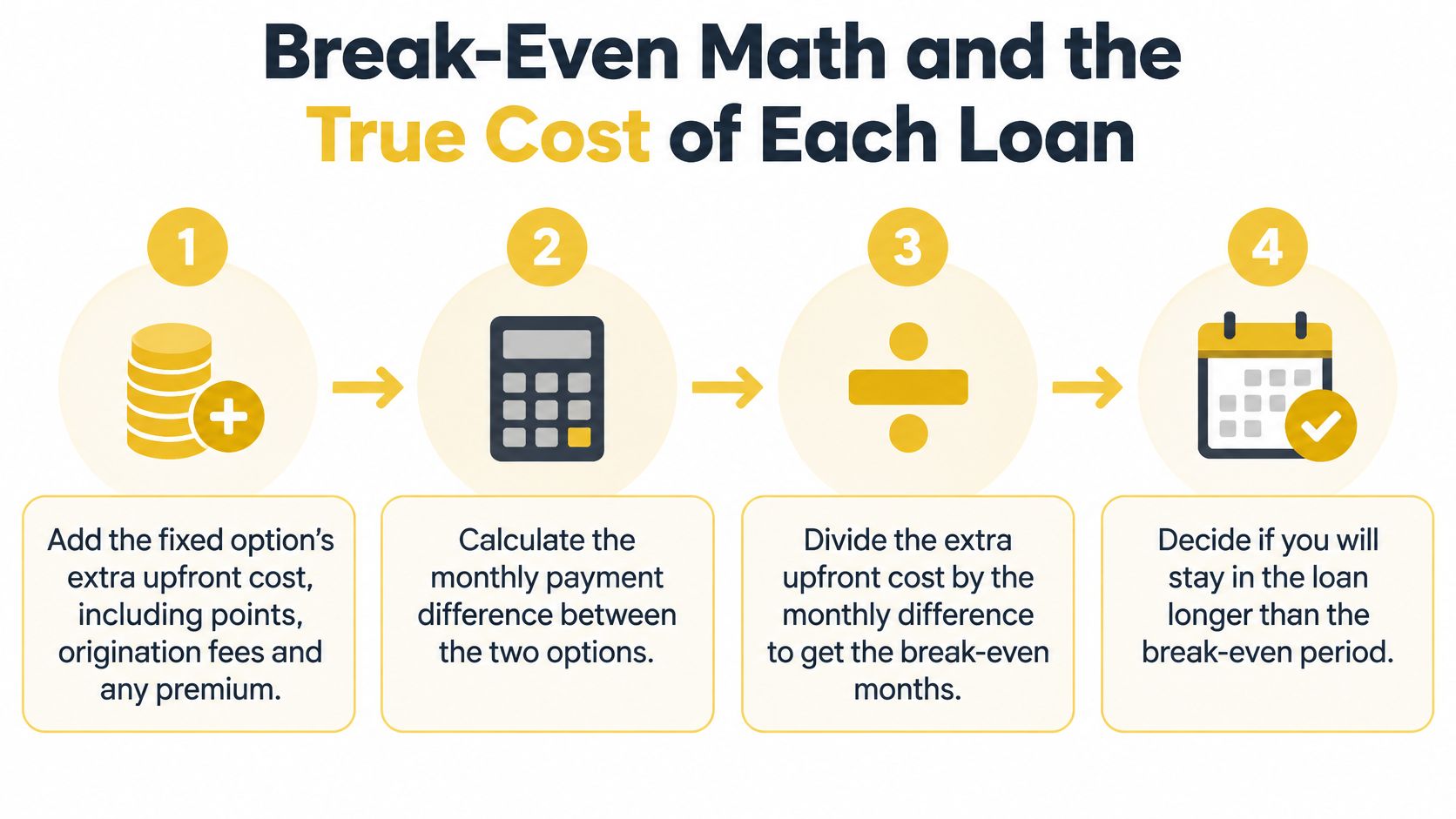
- Add the fixed option's extra upfront cost. Include points, origination fees, and any premium over the variable offer.
- Find the variable option's monthly saving at its starting rate, before any reset.
- Divide extra cost by that monthly saving. The result is the break-even in months.
- Compare that month count with how long you realistically expect to hold the loan.
- Put APR next to the note rate on both offers, since fees change the true price.
- Read the exit terms. Look for a prepayment charge on the fixed offer and the first reset date on the variable offer.
Say the fixed offer costs $300 more up front and the variable offer saves $25 a month at the start. Break-even is 12 months. If you plan to repay in 18 months, you have six months of extra saving after break-even, and that is exactly the window where a reset can wipe the gain out.
A break-even date inside your plan is not a win until you price the months that come after it.
Each lender sets its own rates and terms and must show the APR before you sign. Cost examples stay illustrative until a lender's rate sheet confirms them. You can rerun the split on our loan payment calculator with the fees and payments from the actual offers.
A separate illustration, not a fixed-versus-variable test, shows how finance charges work on a small installment loan. $1,000 at 29.99% APR, repaid in 12 monthly payments of $97.48, totals $1,169.76, including a $169.76 finance charge. Replace that example with your offer. The rate type does not shrink a finance charge that large.
Situations Where Each Rate Type Wins
A fixed rate usually wins when the budget has no room for a higher payment or the term is long. A variable rate can win when you repay quickly, you have cash for a rise, or you have a real exit before the first reset.
| Situation | Better fit | Why |
|---|---|---|
| Monthly budget has no room for a higher payment | Fixed | Payment stays the same if benchmarks rise |
| Repayment period of five years or more | Fixed | Longer exposure gives resets more time to raise the payment |
| Repayment within 6–12 months with savings to absorb a rise | Variable | Short exposure limits reset risk and keeps the lower starting rate |
| Realistic plan to sell or repay before the first reset | Variable | Lower early cost, if the exit is genuinely available |
| Fixed offer carries a steep prepayment charge | Whichever total is lower once the charge is in | Compare total cost with the charge included |
| Credit may weaken before the loan ends | Fixed | Refinancing may be denied when it is needed most |
How to use a row
Take the tight-budget row first if one missed payment would hit rent, a car note, or a utility. The five-year row matters even when today's variable quote looks kind, because more reset dates mean more chances for the payment to rise. The short-horizon row only works if the savings are real and already set aside, not hoped for from a future paycheck.
The sell-or-repay row fails when the exit is a story. A move that might happen, or a refinance you have not been approved for, is not an exit. The prepayment row is the one people skip. A fixed loan that charges a steep fee to leave early can cost more than a variable loan you keep, so add the charge to the fixed total before you call it safer.
The last row is the one that bites borrowers with thin or damaged files. If your score may fall, a new lender may say no at the moment the variable payment jumps. Treat a future refinance as a possibility, not as the plan that makes the cheaper opening rate safe.
A variable rate that is lower today is not a lower cost. The verdict follows your horizon, your cash buffer, and whether you can leave.
Lower-Cost Options When Both Rates Are High
Picking a rate type between two expensive loans is often the wrong move. If both offers would strain the month you get paid, look for a smaller product or a way to avoid new debt.
Credit union payday alternative loans are small loans from federal credit unions, with an APR capped at 28% under NCUA rules. That cap is a ceiling on this specific product, not a promise that you will be approved or that every credit union offers one. A credit-builder loan is a small loan held in savings while you pay it off, which can help build a payment history instead of only covering this month's bill. Secured credit cards, and payment plans with utilities, medical providers, and creditors, can keep you from borrowing at all.
Free help sits outside the rate choice. Call 211 for local assistance, ask a nonprofit credit counselor, look up legal aid, check a public benefits portal, and use the CFPB complaint process if a lender has already treated you unfairly. Our guides on loan options for bad credit walk through these paths next to conventional loan types.
Short-term loans are costly and are not a long-term fix, so borrow only what you can repay on time. Before you treat a payday product as a bridge, read a plain account of payday loan safety risks from Lein Law Offices, including what happens if the due date arrives and the cash does not. BadCreditMD's state guides cover which loan types that state's law allows, the limits lenders must follow, a worked cost example, and who to call if something goes wrong. Legality is a first screen, not a reason to like the rate.
Put the credit union option, the credit-builder option, and any payment plan next to both rate offers. Sign the loan only if it is still the cheaper path you can finish.
Confirm the Rate Type Before You Sign
Start with the worst year, not the first payment. If that payment, plus the fee to leave, does not fit the household, the opening rate does not matter.
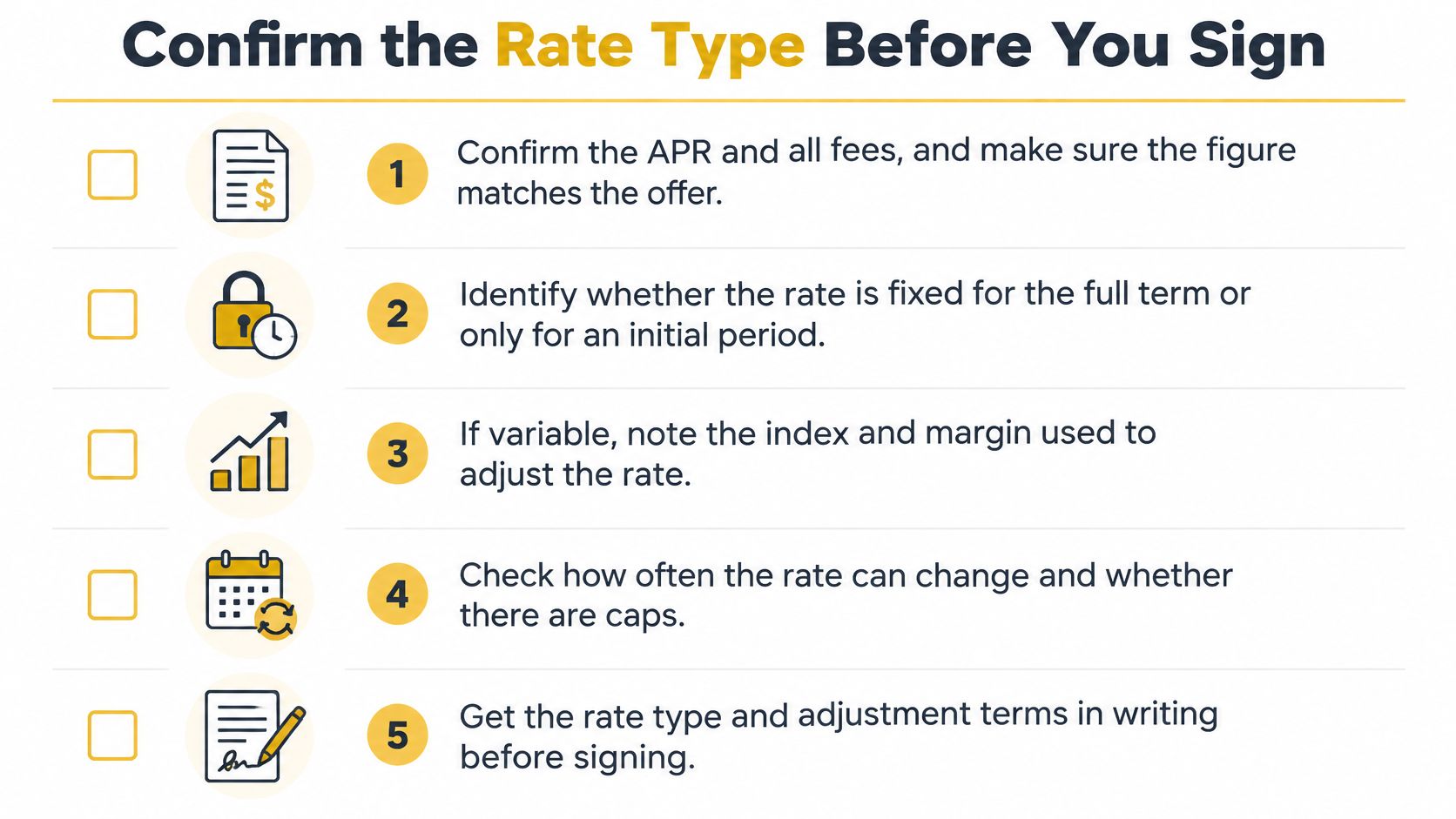
- Confirm the APR and every fee. The figure on the disclosure should match the offer you were shown. Each lender sets its own rates and terms.
- See how long "fixed" lasts. It may be the full term, or only an introductory period.
- Write down the variable mechanics. That means the index, margin, caps, floor, adjustment frequency, and notice period.
- Stress-test four payments. Use the offered rate, one point higher, three points higher, and the contractual maximum.
- Hunt for a prepayment charge on any fixed offer before you assume you can leave.
- Run break-even against the holding period you can defend, not the one you hope for.
- Run a cannot-refinance case. Assume new credit will not be there when the payment rises or the intro period ends.
What you control, and what you don't
You decide whether to accept any offer from a lender. Submitting a request does not mean you will be approved or funded, or that you will receive any particular amount or rate. Lenders set their own rates and terms, and not every lender can offer the amounts or terms shown in a general example. A form is not a commitment, and a soft conversation with a loan officer is not the contract.
Get the rate type and the adjustment terms in writing before you sign. If the paperwork and the sales quote disagree, the paperwork is the offer. Our guide to comparing loan offers safely is built for that document check, including fees that never show up in the teaser rate.
Choose the rate type whose worst-case payment and exit plan the household can survive, not the one with the lowest opening number.
If neither offer survives that test, stop. A smaller loan, a credit union alternative, or a payment plan with the bill you were trying to cover will usually beat a clever rate choice you cannot finish.
BadCreditMD explains personal, installment, payday, and title loans for people whose credit is not perfect, including how a fixed or variable rate changes the payment you still have to make in a bad year. State guides show which products your state allows, what the cost can look like, and where to find free local help if borrowing is the wrong move. Visit BadCreditMD and test your real offer against the worst-case payment before you sign.