
Most advice about installment loans in MS starts with the wrong question. People ask, “What's the rate?” when the key question is, “Which Mississippi law is this lender using, and what total cost am I committing to?” If you skip that step, you can confuse a normal installment product with a 300% APR credit-availability loan and sign a deal you never intended to take. Mississippi's lending rules are layered, and that matters because the same label can hide very different legal lanes.
Table of Contents
- Understanding the Mississippi Installment Loan Landscape
- The Four Legal Lanes for Mississippi Lending
- Worked Cost Examples and Payment Scenarios
- Comparing Installment Loans to Safer Alternatives
- How to Verify Lender Licensing and Statutory Lanes
- Identifying Predatory Red Flags and Borrower Risks
- Where to Find Free Local Assistance and File Complaints
- Quick Reference Glossary and Index
Understanding the Mississippi Installment Loan Landscape
The first mistake borrowers make is treating “installment loan” like a single legal category. In Mississippi, that label can describe products governed by different statutes, different rate caps, and different term rules, so the name on the ad tells you almost nothing by itself. The safest approach is simple: identify the lender's statutory lane before you compare payments or decide whether the offer is acceptable.
Mississippi's framework is especially important for borrowers with bad credit, because the pressure to accept the fastest approval can push people into the most expensive lane. A loan can look like a standard monthly-payment product and still operate under a much harsher cost structure. That's why the legal lane matters more than the marketing language.
Practical rule: If the lender won't clearly explain which Mississippi statute governs the loan, walk away.
For a broader consumer-facing overview of loan types, you can compare how these products are typically presented in this installment-loan explainer, but the legal terms in Mississippi still control the actual deal. That distinction is the whole game. A borrower who understands it can ask sharper questions, reject misleading offers, and avoid paying for a product that doesn't match the way it was sold.
The Four Legal Lanes for Mississippi Lending
Mississippi has four distinct statutory lanes that borrowers commonly run into when shopping for installment-style credit. They are not interchangeable, and the difference between them is not cosmetic. One lane is built for bank and national-bank lenders, two are high-cost non-bank products, and one general installment framework sits in the middle with tiered pricing.
Mississippi Installment Lending Statutory Lanes
| Statutory Lane | Max Loan Amount | APR / Interest Cap | Minimum Term |
|---|---|---|---|
| General installment-loan framework under Mississippi Code § 75-17-21 | Varies by tier, with a separate rule for loans of $25,000 or more | Tiered rates of 36% on the first $1,000, 33% on the portion from $1,000 to $2,500, 24% from $2,500 to $5,000, and 14% above $5,000. Loans of $25,000 or more may use a capped 18% APR method. | Not stated in the verified data |
| Bank loans under § 81-5-79 | $5,000 | Up to 12% per year | Monthly installments |
| Credit Availability Act lane | Up to $3,250 | About 25% interest per month, roughly 300% APR, plus a fee of 1% of the loan amount or $5, whichever is greater | Four to twelve months |
| Consumer Alternative Installment Loan Act lane | Up to about $5,220 | 59% APR | At least 272 days |
The tiered framework is the one many borrowers would consider a more conventional small-loan structure. It still isn't cheap, but it is not the same thing as a triple-digit monthly-interest product. The bank lane is narrower, but its 12% cap and monthly-installment structure make it materially different from the high-cost non-bank lanes.
The two high-cost lanes are where borrowers get burned by sloppy language. A loan advertised as an “installment loan” can be a Credit Availability Act product with monthly interest that works out to roughly 300% APR, plus a fee layered on top. Or it can fall under the Consumer Alternative Installment Loan Act, where the APR is 59% and the term must run at least 272 days. Those are not small differences. They change the entire cost profile.
Mississippi's statute mix also shows why term length matters. A borrower who only focuses on the monthly payment can miss the fact that one product is designed to run much longer than another, while the cost calculation is tied to a different legal lane. If you're comparing offers, compare the lane first, then the payment, then the total cost.
Worked Cost Examples and Payment Scenarios
Numbers cut through marketing fast. If a lender says “affordable monthly payments” but won't show the actual cost under the governing statute, you're dealing with a sales pitch, not a useful offer. The right move is to translate the rate into dollars and then ask whether the loan still makes sense once the full payoff amount is visible.
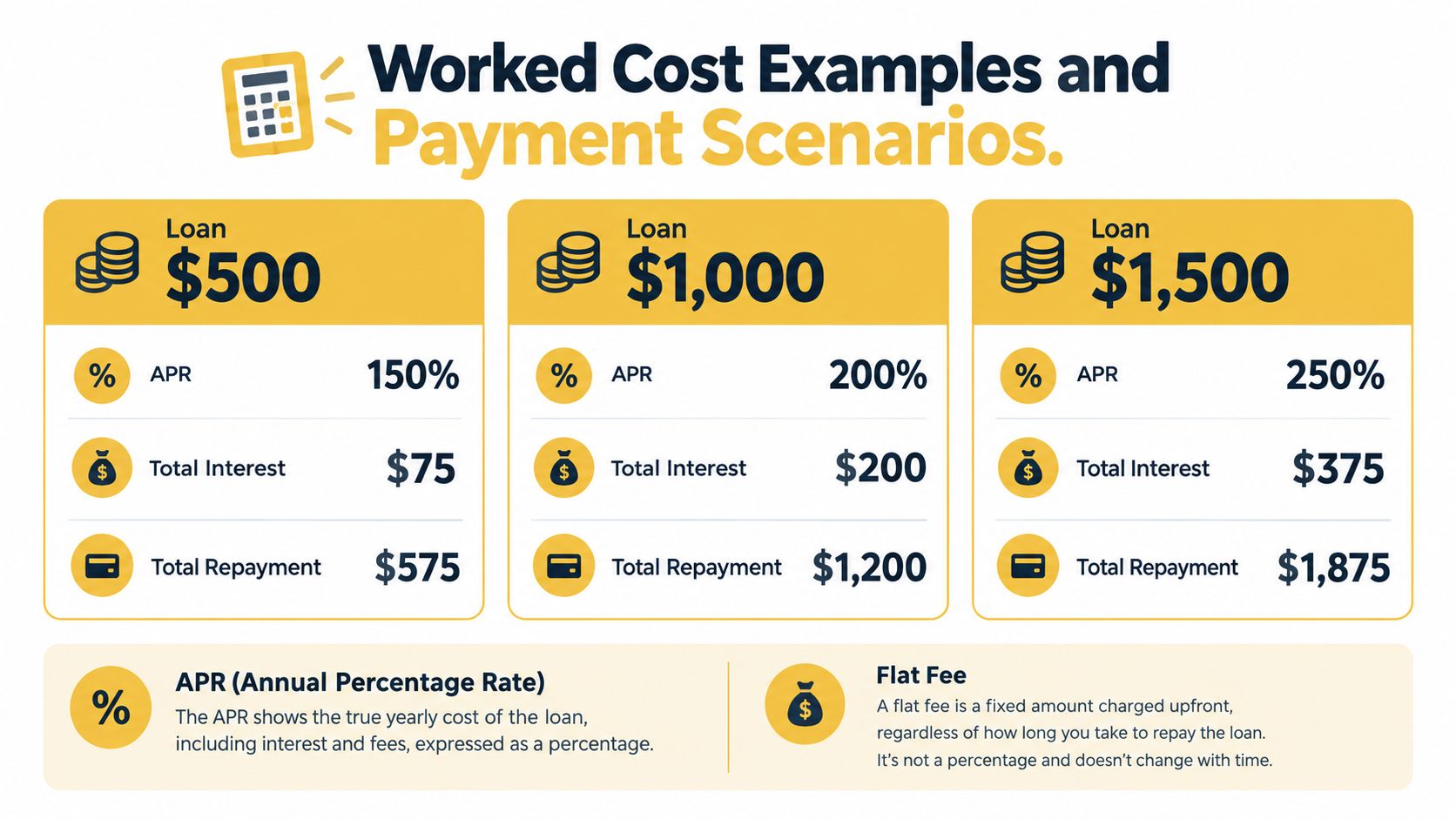
A basic cost check
Under the tiered framework, a $1,000 loan sits in the first pricing band at 36% on that first slice. That doesn't make it cheap, but it gives you a concrete benchmark for what a more traditional Mississippi installment product looks like under the statute. Once you move into the high-cost lanes, the math changes dramatically, because the price structure itself changes.
A $2,500 loan under the Credit Availability Act is the kind of offer borrowers need to inspect carefully. The law allows 25% monthly interest, which works out to roughly 300% APR, plus a fee of 1% of the loan amount or $5, whichever is greater. That means the fee is not the main problem, the monthly-interest structure is. The problem is the loan can stay expensive even if the stated dollar fee looks modest.
What the payment story hides
Here's the part borrowers miss. A monthly payment can look manageable even when the loan is structurally expensive. That's why you should always ask for the total repayment amount, not just the payment due date, and ask which Mississippi law sets the price.
A borrower who needs short-term cash should also be suspicious of loans framed as flexible or easy to renew. Repeated borrowing is where high-cost installment products do the most damage. One loan becomes two, then the borrower is paying fees and interest on a balance that should have been gone already.
A payment that fits your calendar can still be a bad loan if the payoff number is too high.
The smartest habit is to compare the offer against a plain monthly budget and a plain payoff estimate. If the lender can't explain the cost in direct terms, the offer isn't transparent enough for a vulnerable borrower.
Comparing Installment Loans to Safer Alternatives
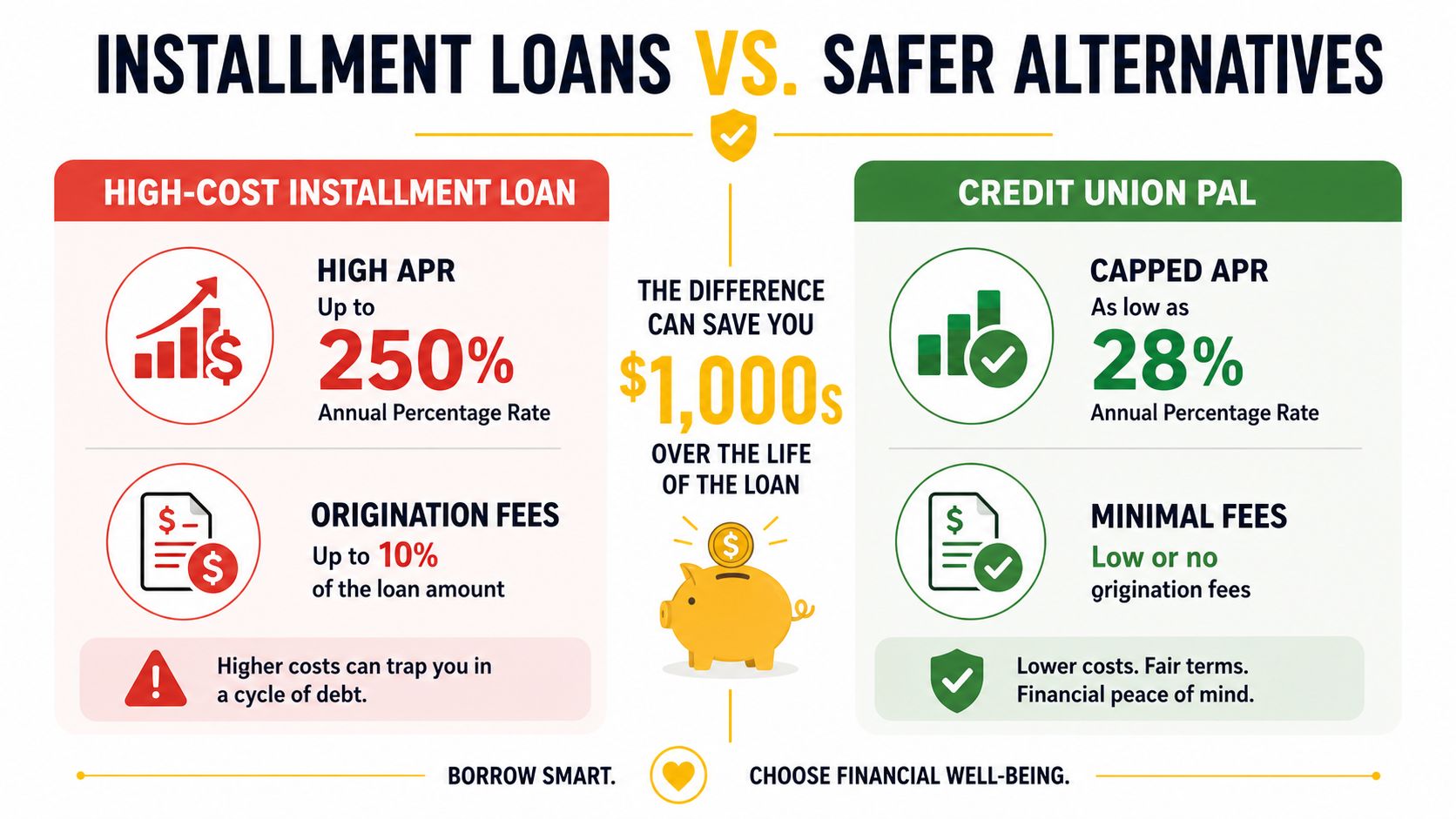
High-cost installment borrowing should not be your default move just because it's available. If you can get a lower-cost option, take it. Borrowing less expensively protects your next month, not just this one.
Better fits for many borrowers
A credit union Payday Alternative Loan is usually the first place I'd look if you qualify. These loans are designed to be lower-cost than the kind of high-APR installment products that dominate bad-credit searches. They're not perfect, but they're far better than signing a loan whose legal lane allows triple-digit annualized pricing.
Payment plans can beat loans outright when the expense is tied to a utility bill, medical bill, or another creditor willing to work with you. A payment plan doesn't add a new lender into the mix, and it usually avoids the cost layering that makes small-dollar borrowing so dangerous. If the creditor will work with you directly, start there.
Credit-builder loans and secured credit cards also belong on the list when your real problem is credit damage, not just emergency liquidity. They won't solve a same-day cash crunch as quickly as a loan, but they can help you avoid using a high-cost product that makes your finances worse next month. The point is not to be clever, it's to avoid paying for urgency with expensive debt.
I'd treat a high-cost installment loan as a last-resort tool, not a first-choice product. If your situation gives you any room to pause, compare all lower-cost options before you sign.
Compare loan types and trade-offs here
How to Verify Lender Licensing and Statutory Lanes
Do not trust a clean website design or a fast approval promise. Verify the lender, then verify the legal lane, then sign nothing until both check out. That order protects you from unlicensed operators and from legal ambiguity that can hide the actual price of the loan.
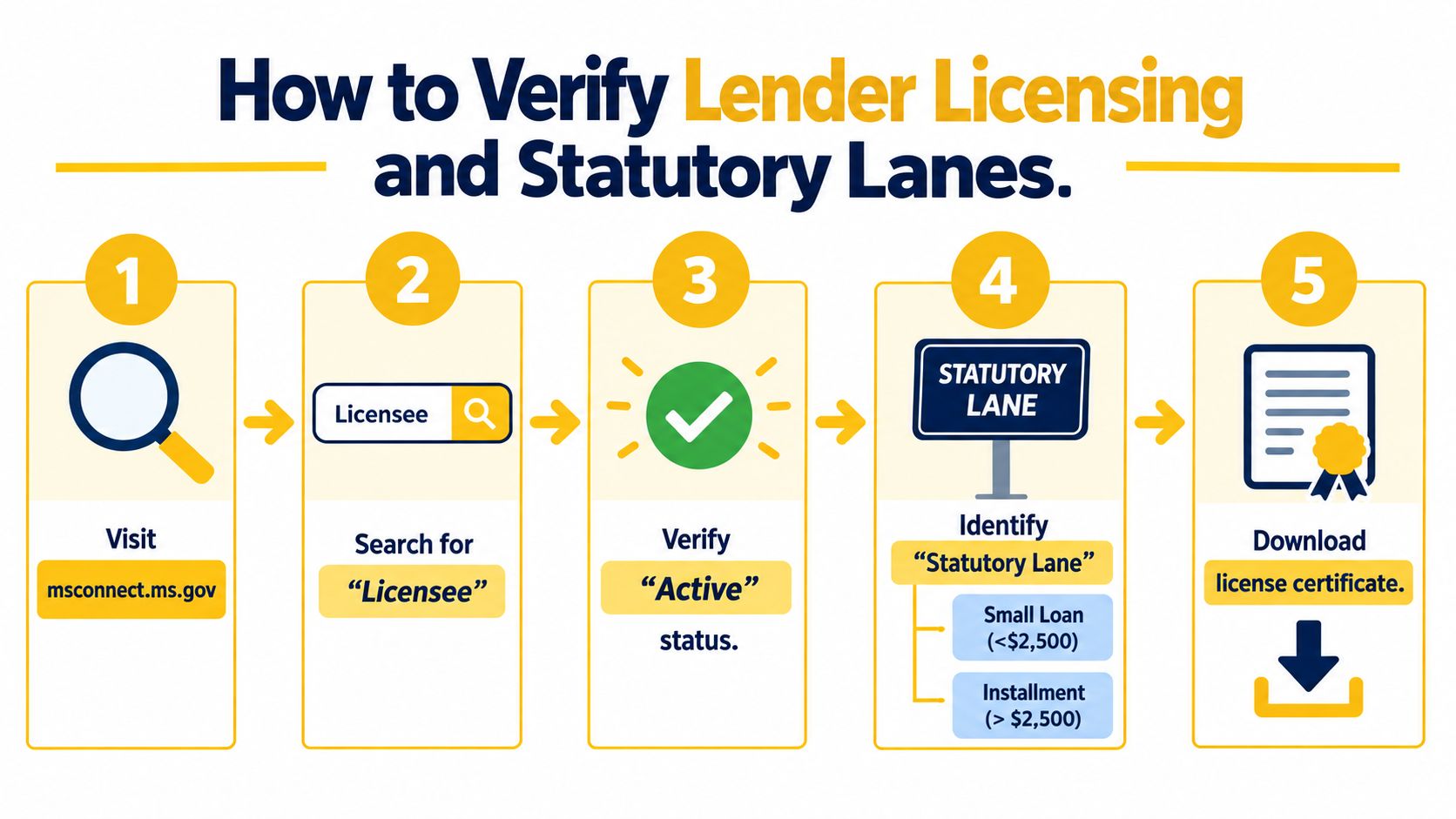
The checklist that actually matters
Start by checking the Mississippi consumer-finance resources for the lender's current status. Use the state's official lookup tools, confirm the business is active, and make sure the company is licensed for the product it's offering. If the lender can't produce a clear license status, that's a problem, not a paperwork issue.
Then identify the statutory lane in writing. A lender should be able to tell you whether the offer falls under the general installment framework, the bank small-loan rule, the Credit Availability Act, or the Consumer Alternative Installment Loan Act. You want the exact lane because the lane controls the price cap and the term rules.
After that, compare the paperwork against the lane. The loan agreement should match the promised structure, including the maximum amount, term length, and cost method. If the contract language looks like it belongs to one product but the salesperson described another, stop there.
Use this Mississippi state guide as a starting point for local rules
What to ask before you sign
- Which Mississippi law governs this loan? Ask for the statute name, not a vague description.
- What is the total repayment amount? Monthly payment alone is not enough.
- What fees are added besides interest? Fees change the overall cost.
- Is this a bank product or a non-bank product? The lane can change the pricing rules.
- Can I take the contract home and review it first? If the answer is no, that's another warning sign.
If a lender dodges the lane question, it's usually because the answer would scare you off.
Identifying Predatory Red Flags and Borrower Risks
The red flags in this market are usually obvious once you know what to look for. The lender talks about “fast cash” and “easy approval” but stays vague about APR, statutory authority, and total payoff. That's not a harmless sales style. It's a way to get borrowers to focus on the payment instead of the debt.
Marketing that blurs the lane
The biggest warning sign is when a lender uses “installment loan” as a catch-all term without naming the legal structure. In Mississippi, that can conceal a 300% APR credit-availability product or a 59% APR alternative-installment product. If the ad is vague, the product may be expensive enough that the lender doesn't want the label to be too precise.
Repeated borrowing is the second major danger. Borrowers who roll from one loan into the next often end up paying for access to cash instead of paying down principal. The loan starts as a short bridge and becomes a recurring expense, which is exactly how a payment problem turns into a debt trap.
Risk markers that should make you pause
- Vague cost language: If the lender won't show the total cost in plain terms, assume the loan is expensive.
- Pressure to act now: Urgency is a sales tactic when the borrower is already in distress.
- No clear statutory lane: If you can't identify the law, you can't judge the deal.
- Refusal to provide documents: A legitimate lender should be able to show you the contract terms before you commit.
- Focus on approval, not affordability: Approval is the easy part. Repayment is the true test.
The safest mindset is defensive, not optimistic. Assume the lender is protecting its own economics, because it is. Your job is to protect your budget, your credit, and your ability to handle next month's bills.
Where to Find Free Local Assistance and File Complaints
If the loan is already causing problems, don't wait until the account spirals. Mississippi's consumer-finance regulator tells borrowers to try resolving the issue with the institution first and then file a complaint if needed, and the CFPB treats installment, advance, and title loans as products that can generate complaints. That makes escalation a normal consumer-rights step, not an extreme move. The Mississippi complaint form and guidance are the first stop when a lender won't resolve a problem directly.
Get free help and referral options here
How to escalate the right way
Start with the lender's customer service or complaint channel and document every contact. Keep the date, the name of the person you spoke with, and what they promised. If the issue stays unresolved, file the state complaint and be ready to explain the problem in plain English, including the loan type, the dates, and the disputed charge or term.
If your budget is already underwater, look for nonprofit credit counseling and local resource directories before taking another loan. A counselor can help you sort out whether a payment plan, debt-management option, or another form of relief makes more sense than adding more high-cost debt. Borrowing more money is not a solution if the underlying issue is that the current loan already broke the budget.
What to keep in your file
- Loan agreement and disclosures
- Payment history and receipts
- Written complaints and responses
- Any texts or emails about extensions, renewals, or fees
That file matters because it turns a vague dispute into a clear record. Regulators respond better when the facts are organized, and lenders tend to back down faster when they know you've kept proof.
Quick Reference Glossary and Index
Credit Availability Act means the Mississippi statute that allows high-cost, short-term installment-style lending with monthly interest that can land around 300% APR, plus a fee structure on loans up to the statutory cap. If you see this lane, do not treat it like an ordinary installment loan.
Consumer Alternative Installment Loan Act refers to the Mississippi law that authorizes 59% APR loans with at least 272 days of term. This is still a high-cost product, so the term length doesn't make it cheap, it just defines the legal lane.
Tiered rate framework is the general Mississippi installment-loan structure in which the rate changes by loan amount. This is the lane most borrowers should understand first, because it's the clearest contrast to the high-cost statutory products.
Amortization means spreading principal and interest across scheduled payments over time. In plain English, it's how a monthly installment plan turns a balance into a series of due dates.
Statutory lane means the specific Mississippi law that authorizes the loan. It's the key idea in this guide because the lane determines the rate cap, term rules, and fee structure.
Total repayment means the full amount you'll hand over over the life of the loan, not just the monthly payment. That number is the one that tells the truth.
Red flag means any sign that the lender is hiding the legal structure, pushing urgency, or refusing to show the true cost. If you spot more than one, stop negotiating.
Complaint escalation means first taking the issue to the institution, then filing with the regulator if the lender won't fix it. That's the right sequence when a loan starts causing harm.
BadCreditMD helps borrowers compare loan types, understand state rules, and find free local assistance when a loan offer looks too costly or too confusing. If you're trying to sort out installment loans in MS, use BadCreditMD to check the legal lane before you sign anything. The right information can keep a bad credit problem from turning into a bad debt problem.