
Installment credit is a closed-end loan where you receive one set amount and repay it through a fixed schedule of two or more payments. A $1,000 loan at 29.99% APR repaid over 12 monthly payments of $97.48 is a plain example: you get $1,000 in hand and pay back $1,169.76 in total, a difference of $169.76 in finance charges.
The offer sitting in your inbox is probably less tidy than that. It says you're approved for $1,200, that payments could run as low as $96 a month, and it ends with a button inviting you to continue. Nothing on that screen shows the term, the APR, or whether the account will ever appear on your credit reports.
So the question isn't whether the product is installment credit. It is. The question is what kind, and whether a comfortable monthly number is covering a cost you'd refuse if you saw it as one figure. That gap between the payment and the price is where most borrowers get surprised.
Table of Contents
- What Installment Credit Means in Plain Terms
- Key Terms Every Installment Loan Offer Uses
- How Each Installment Payment Splits Between Interest and Principal
- Personal, Auto and Student Installment Loans Side by Side
- Installment Credit Versus Revolving Credit and Buy Now Pay Later
- Checks Before You Sign and Next Step
What Installment Credit Means in Plain Terms
Your transmission fails on a Tuesday. The shop quotes $3,000, your savings cover $800, and the rest has to come from somewhere. A lender approves a fixed sum with a fixed monthly payment and a payoff date three years out. The definition of installment credit fits that arrangement exactly.
The Federal Reserve's consumer credit release describes installment credit as closed-end consumer credit in which a borrower receives a specified amount and repays it under a prearranged schedule, usually through two or more payments. Notice what the definition leaves out: a rate, a lender type, a purpose. It describes a structure.

Three features do all the work:
- A fixed or specified principal. You and the lender agree on one number up front. It doesn't grow because you spent more, and it doesn't refill when you pay it down.
- A contractual repayment period. The contract names a term, whether that's 12 months or 72, and the last payment lands on a known date.
- Payments that reduce the balance. Every payment chips at the principal, so the amount owed falls on a schedule rather than hovering near a limit.
Think of a staircase of fixed length. Each payment is one step down, the steps come at even intervals, and the floor arrives on a date you can circle on a calendar today.
When you reach the floor, the account is finished. More money means a new contract and a fresh application, which is the cleanest way to separate installment credit from a credit card that keeps a limit open for you to draw against again and again.
The category is wider than often assumed. Auto loans, education loans, personal loans and many point-of-sale financing plans all fit when repayment is scheduled over time. An auto loan is typically secured by the vehicle, while many personal loans are unsecured and rest on your income alone. The Fed's framework sets aside loans secured by real estate and covers credit used for household and personal spending, and the central bank has published aggregate consumer credit figures since 1942.
Before you sign anything, run one check on the offer in front of you: it should state a fixed amount, a term, and a number of payments. If any of those three is missing from the page, you're looking at a summary, not a deal.
Key Terms Every Installment Loan Offer Uses
An offer page reads like a wall of small print, but it repeats the same seven terms in roughly the same order every time. Learn where each one hides and you can price any installment loan in about five minutes.
| Term | What It Means | Where to Find It |
|---|---|---|
| Principal | Amount borrowed before interest and fees | Loan agreement and disclosure box |
| Term | Total number of months or years to repay | Loan agreement and payment schedule |
| Payment amount | Fixed amount due each period | Payment schedule |
| APR | Yearly cost including interest and certain fees | Truth in Lending disclosure |
| Finance charge | Total dollars paid above the principal | Truth in Lending disclosure |
| Total of payments | Principal plus finance charge over the full term | Truth in Lending disclosure |
| Origination fee | Upfront charge for setting up the loan | Fee section of the agreement |
The APR earns its place at the top of that list. The CFPB's key terms glossary defines it as a yearly measure that links the amount and timing of credit you receive to the amount and timing of payments, using prescribed calculation methods. That's why an offer advertising a 19% rate can carry a 26% APR once an origination fee is folded in.
Two more numbers matter as much as the payment. Amortization is the process of paying a loan off through regular payments, with the balance falling after each one. Total of payments is the sum of every payment you'll make, and it's the only figure that shows the full price of the loan.
A longer term lowers the required payment and raises the cumulative interest, because the principal stays outstanding for more periods. Judge the term by the total, not by the monthly figure.
Term length reshapes everything downstream. If you're deciding between a 24-month and a 60-month payoff window, this walkthrough of how personal loan length changes payments and total cost is worth five minutes before you pick a number.
Two Words the Later Checks Depend On
A prepayment penalty is a fee for paying the balance off early. Confirm the offer has none, because a penalty locks you into the full term even if you come into money.
Default means missing scheduled payments. It brings late fees, collection activity, and on a secured loan such as an auto loan, repossession of the asset.
Write all seven numbers on one page before you decide anything. Then compare offers using the same principal and the same term, so APR and total of payments are measuring the same thing.
How Each Installment Payment Splits Between Interest and Principal
Fixed payments can look flat and still work unevenly underneath. Take a $1,000 installment loan at 29.99% APR repaid in 12 monthly payments of $97.48, which totals $1,169.76 and includes a $169.76 finance charge. These figures are illustrative and labeled that way until a lender's rate sheet confirms the actual ones, but the mechanics hold for any loan.
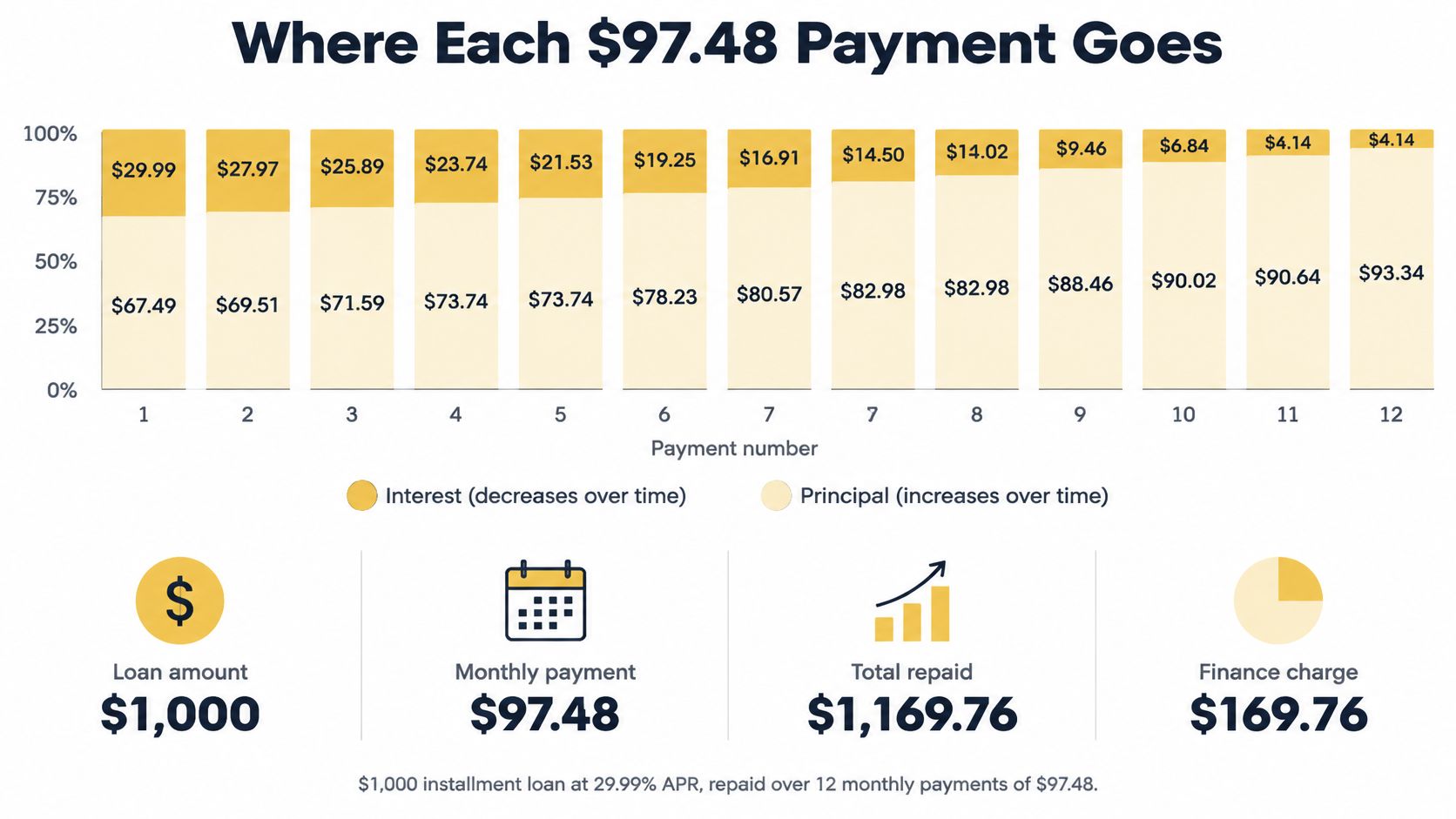
The monthly rate is 29.99% divided by 12, which is about 2.5%. In month one, interest on the $1,000 balance is about $24.99. Subtract that from the $97.48 payment and $72.49 goes to principal, leaving $927.51.
Run it again for month two. Interest on $927.51 is about $23.18, principal is about $74.30, and the balance drops to $853.21. The payment never changes, but its ingredients do.
That's the whole pattern. Interest is charged on the balance that's still outstanding, so early payments carry more interest and later payments carry more principal. By the final months, almost the entire payment is knocking down principal.
You can repeat the math on any loan in five steps:
- Start with the current balance.
- Multiply it by the APR divided by 12.
- Subtract that interest from the payment amount.
- Subtract what's left from the balance.
- Repeat until the balance reaches zero.
Practical rule: interest is charged on the balance, never on the original amount. A payment that feels small in month one is doing less principal damage than it looks.
Putting extra money toward the balance accelerates the process in a way that's worth understanding, and Toya AI's explanation of how principal payments reduce loan balance shows exactly where an extra payment lands on the schedule.
Two forces change the split. A longer term shrinks the required payment while raising total interest, since the principal sits there for more months. A missed payment adds late charges and can push the balance backward.
If you want to see the full sequence of payments laid out, this guide to the installment loan payment schedule maps each period to its interest and principal portions. Then test your own principal, APR and term with a payment calculator before you commit to a number that only looks affordable.
Personal, Auto and Student Installment Loans Side by Side
Three borrowers walk into the same structure from different directions. One consolidates $8,000 of card debt into a personal loan. One finances a $30,000 vehicle. One pays tuition with a federal student loan. Every one of them gets a fixed sum, a fixed term and a fixed payment, and every one of them faces a different kind of risk.
| Loan Type | Typical Term | Collateral | Common Use |
|---|---|---|---|
| Personal loan | 12 to 60 months | Usually unsecured | Debt consolidation, medical bills, home repairs |
| Auto loan | 36 to 84 months | Secured by the vehicle | Buying a car or truck |
| Federal student loan | 10-year standard plan | Usually unsecured | Tuition and education costs |
The personal loan borrower pledges no asset. Approval rests on income, credit history and existing debts, and a missed payment damages credit without costing a possession.
The auto borrower has a car on the line. Miss enough payments and the lender can repossess the vehicle, which usually means losing both the car and the equity already paid into it.
Federal student loans are commonly unsecured and follow a 10-year standard repayment plan, which spreads the balance far beyond the term of a typical personal loan.
Collateral changes the stakes but not the arithmetic. Installment credit has anchored American household finance for decades because the payment structure suits large, one-time purchases you can't cover in a single month. The Federal Reserve's May 11, 1983 consumer credit release, archived at FRASER, recorded a $2.58 billion increase in consumer installment credit outstanding that March, with automobile credit alone up $1.22 billion.
Match the loan type to the purpose before you compare rates. A vehicle belongs on an auto loan, tuition on a student loan, and a one-time expense on an unsecured personal loan. Then confirm whether the product is secured, because that single word decides what happens if your income drops.
Installment Credit Versus Revolving Credit and Buy Now Pay Later
Here's where the definition starts doing real work. Picture a $1,200 purchase: a new laptop, say, or a set of tires. You can finance it three ways, and all three can show the same monthly amount on a calendar.
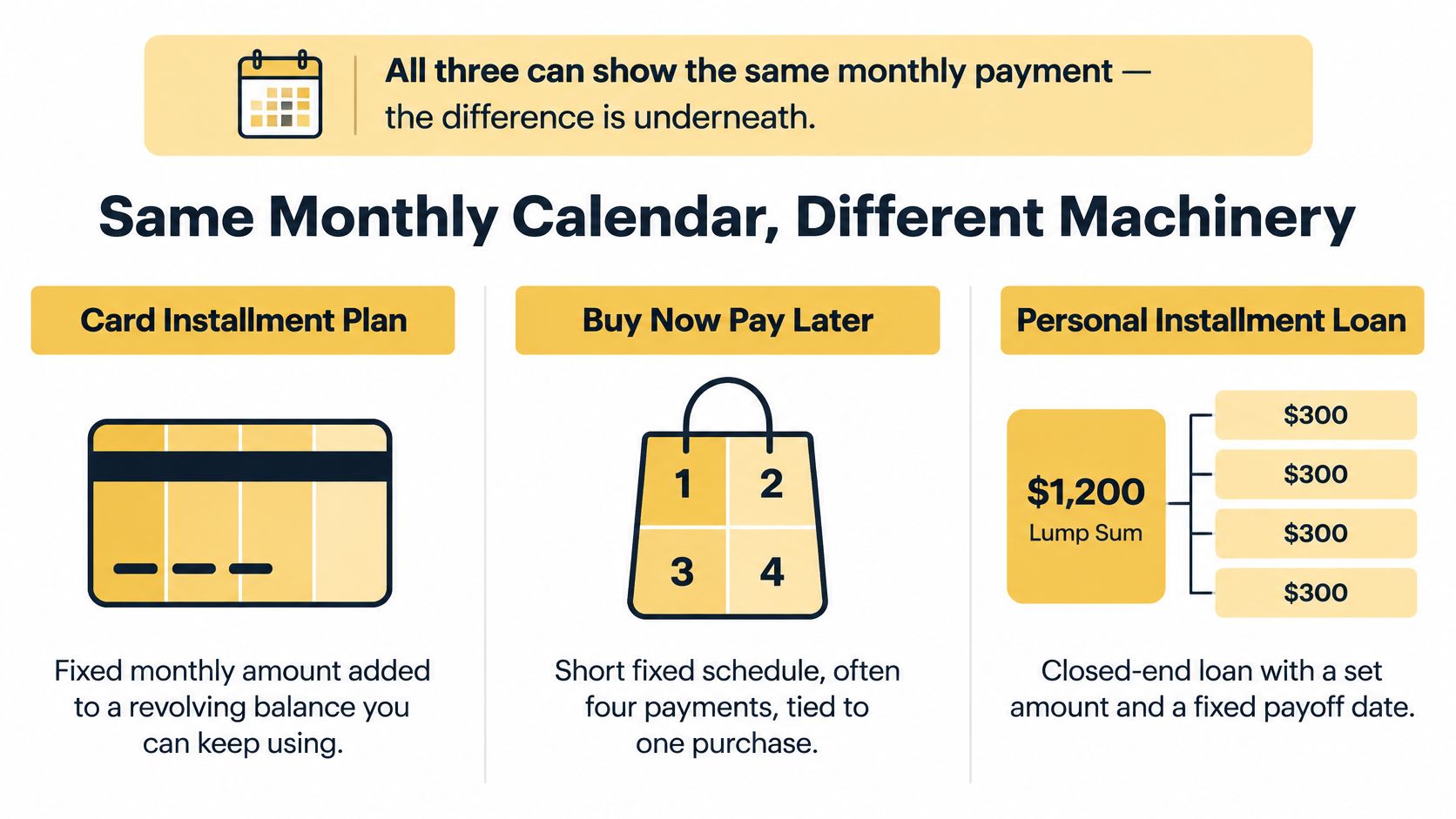
A personal installment loan gives you a lump sum and a fixed payoff date. A card installment plan splits the purchase into fixed monthly amounts, but the CFPB's explanation of personal installment loans notes that these plans remain part of your existing credit-card balance and carry separate terms, rather than becoming a wholly separate loan. A pay-in-four buy now pay later product spreads the same purchase across four scheduled payments, often with no interest but with its own fee and dispute rules.
Reporting is where the three really diverge. The CFPB explainer records that Affirm announced it would begin reporting all pay-over-time products, including Pay in 4 transactions, to Experian from April 1, 2025, while stating the data would not initially affect traditional scores.
| Feature | Installment Loan | Credit Card | BNPL Pay in 4 |
|---|---|---|---|
| Balance reusable after payoff | No, a new contract is needed | Yes, up to the credit limit | Usually no |
| Payment schedule | Fixed installments | Minimum payment varies with balance | Fixed installments |
| Fees and APR | Stated APR plus certain fees | APR on any carried balance | Varies by provider, late fees possible |
| Credit reporting | Often reported, verify which bureaus | Reported to the bureaus | Varies by provider and product |
The word installment describes a repayment pattern. It doesn't describe a consumer-protection level, an affordability test, or a guarantee that the account will help your credit.
That distinction matters most when you're choosing between an unsecured personal loan and a revolving line of credit, since the revolving version keeps a limit available after payoff while the closed-end version doesn't.
So classify a product twice, once by repayment structure and once by account structure, before you assume it behaves like a conventional loan.
Checks Before You Sign and Next Step
A common assumption is that any installment loan will help a thin credit file. Payment history can only help when the lender furnishes your account to the credit bureaus, and not every lender reports to all three. Experian's guidance on payment history tells borrowers to confirm reporting to all three major bureaus for exactly that reason.
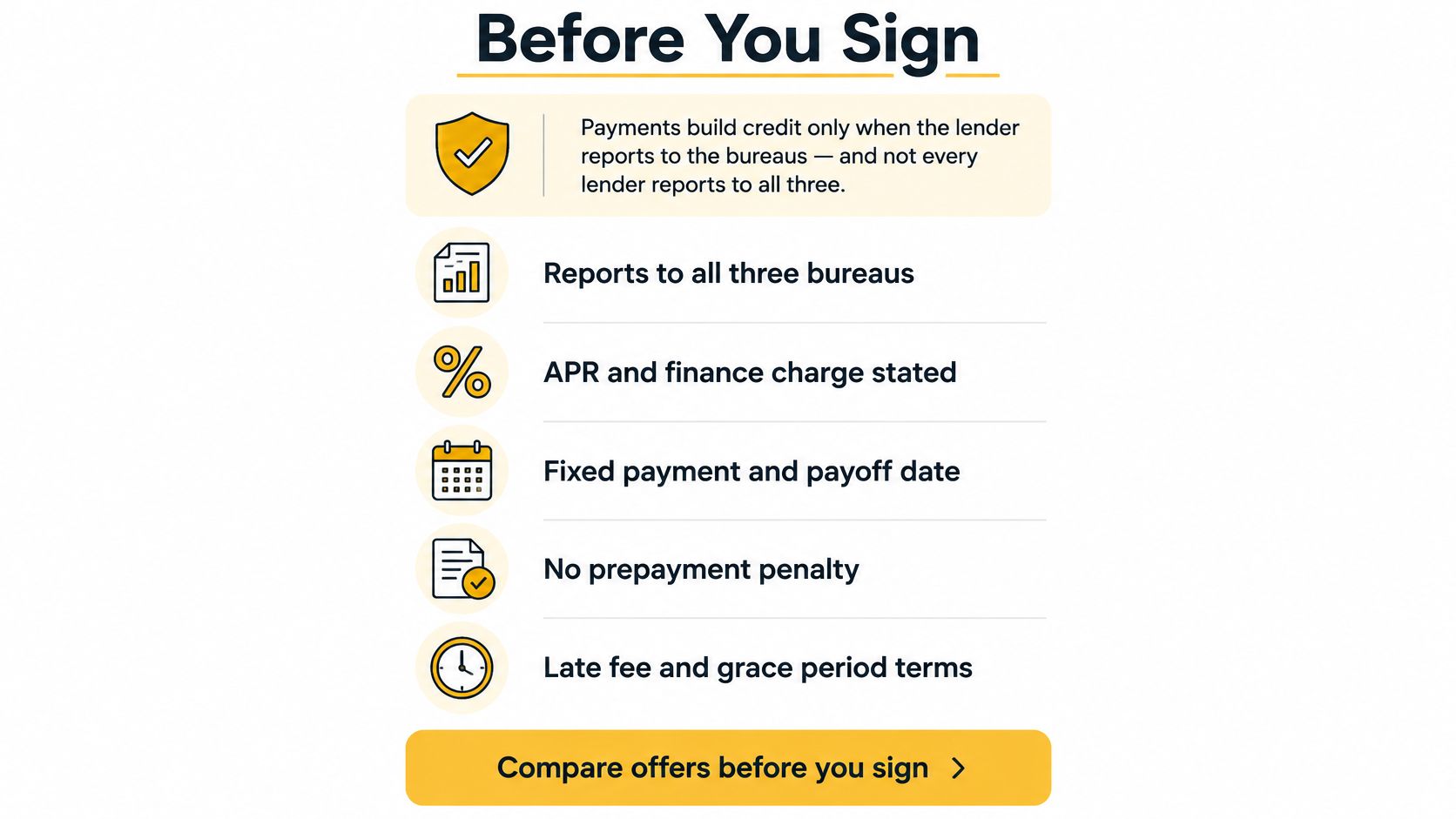
Before you sign, ask what the account will do to your score. Will it improve, stay flat, or hurt you the first time a payment slips? Then work through these six checks:
- Reporting coverage. Confirm which of the three bureaus will receive the account.
- Reporting start date. Ask when furnishing begins, not whether it happens eventually.
- Late fees and grace period. Get the dollar amount of the late fee and what happens after a missed payment.
- Collateral exposure. On a secured loan, confirm what the lender can take and when.
- Prepayment penalty. Verify the offer lets you pay the balance off early at no charge.
- Total of payments. Compare it against the same amount borrowed elsewhere for the same term.
Installment structure doesn't guarantee a low cost. CFPB supervisory findings on high-cost installment vehicle-title loans put the median APR at 259%, with the 10th-to-90th-percentile range spanning 120% to 361%. At those rates, spreading repayment across installments raises total finance charges even when each individual payment looks manageable.
A low monthly payment is a term decision, not a discount. The four numbers that decide the deal are the payment, the total of payments, the APR and the term.
Borrow only what you can repay on time, and treat short-term, high-cost loans as a stopgap rather than a fix. When you're ready to compare, the guidance on comparing loan offers safely walks through the order to check things in.
Then take one action. Write the monthly payment, the total of payments, the APR and the term on a single page, and sign only if all four fit your budget without borrowing again next month.
BadCreditMD is an information resource for borrowers with imperfect or thin credit, and it explains how installment loans, personal loans and other options work before you commit. You can run your own principal, APR and term through the site's free loan payment calculator, then check the state guides for the rates and rules that apply where you live. Visit BadCreditMD to put your four numbers on one page and compare offers with the full cost in view.