
One hard inquiry typically lowers a FICO Score by fewer than 5 points. Repayment, not the application, decides whether a loan produces a lasting improvement or lasting damage.
That distinction matters if you're worried that borrowing will undo your credit-building work. An application is a brief event; a loan creates a payment obligation that stays in your budget until you repay it. The useful question isn't just how much does a loan affect your credit score, but whether you can manage everything that happens after approval.
Table of Contents
- How Many Points Each Loan Action Usually Moves
- What the Same Loan Does in Each Score Band
- Why Repayment Decides Whether a Loan Helps
- Check the Offer Before You Sign
- Shop Loans and Limit the Damage
- Confirm the Payment Before You Apply
How Many Points Each Loan Action Usually Moves
For most U.S. borrowers, the application itself is closer to a speed bump than a crash. According to Experian's explanation of personal loans and credit scores, one hard inquiry typically lowers a FICO Score by fewer than 5 points, can remain on your report for up to 2 years, and usually stops affecting scoring within about 12 months.
Those are different clocks. An inquiry can still appear on your credit report after it has stopped influencing your score. Its effect may also ease before it disappears, especially when you continue managing your accounts well.
Match the effect to the action
Applying, accepting the loan, making payments, and paying it off aren't the same credit event. Treating them as one event makes a score change harder to understand.
Typical credit-score effect of common loan actions
| Loan action | Typical FICO effect | How long it lasts | What matters more next |
|---|---|---|---|
| Soft prequalification or rate check | Usually no score change | No scoring effect | Whether you later submit a full application |
| One hard inquiry | Usually a small decline | The scoring effect ends before the inquiry necessarily disappears from the report | On-time payments after the pull |
| New installment account opened | Possible additional small decline | No fixed recovery deadline | Whether the new payment is affordable |
| On-time loan payments | Can strengthen the file over time | Builds with reported repayment history | Keeping every payment current |
| Payment reported delinquent | Can materially damage the score | No universal recovery timeline | Stopping further delinquency |
| Lower remaining balance versus original amount | Generally viewed as less risky | Changes as the reported balance falls | Understanding that installment balances differ from card utilization |
| Loan paid off and account closed | Possible temporary change, especially on a thin file | No guaranteed adjustment period | Avoiding delinquency rather than preserving debt |
The table is a directional guide, not a point calculator. No scoring model promises a universal point total for opening a loan or paying it off. Your existing accounts, balances, and payment record affect how the new information fits into your file.
Why approval can bring another change
A hard inquiry records that you sought credit. Opening the account adds something else: a newly established obligation with a balance and an account-opening date.
That new account can reduce your average account age while increasing outstanding debt. So a borrower who sees a small decline after applying and another after funding hasn't necessarily been scored twice for the same thing. Different information has reached the credit report.
Practical rule: Use the row that matches what you're about to do. Checking an estimated rate isn't the same as accepting a loan.
Don't assume the inquiry estimate caps the loan's entire effect. It describes the application component, not the combined result of a new account, changing balances, and future payment behavior.
What the Same Loan Does in Each Score Band
The same loan can matter differently depending on where your score starts. A small change may leave one borrower's options much the same, while another borrower near a lender's cutoff may notice fewer choices. One hard inquiry is usually worth fewer than five points, but it does not predict the loan's full effect. The payment record that follows matters more.
Score bands aren't approval guarantees. FICO's score-range guidance classifies scores as poor from 300 to 579, fair from 580 to 669, good from 670 to 739, very good from 740 to 799, and exceptional from 800 to 850. Lenders set their own requirements, and the score you see may not be the model a lender uses. A band helps organize expectations, but it cannot determine whether you'll qualify or what a loan will cost.
Different starting points, different concerns
For a borrower with poor credit, the priority is making sure a new payment leaves enough room to keep existing obligations current. Another account alone does not make a credit file stronger. A dependable payment history is more useful than borrowing to add an account.
A borrower with fair credit may be closer to an eligibility boundary. That makes it sensible to compare options carefully before submitting a full application. A hard inquiry is usually a small part of the picture, but even a modest score change can feel more relevant when a borrower is near a cutoff.
With good credit, a new loan may fit into an established record without changing the overall picture much. Still, a strong starting score does not make an unaffordable payment safe. A late payment can weaken an otherwise dependable record.
Borrowers with very good or exceptional credit should consider whether they need to borrow. Taking on interest and a required payment solely to add account variety may offer little benefit. A high score does not make a loan cost-free.
How a loan's credit effect changes by score band
| Score band | Range | One hard inquiry | One reported late payment | Practical read |
|---|---|---|---|---|
| Poor to deep subprime | Poor: 300–579 | Usually a small effect, but does not repair existing weaknesses | Adds another obstacle to rebuilding | Protect room in the budget for existing bills and the new payment |
| Fair | Fair: 580–669 | May matter near an eligibility boundary | Can weaken an already vulnerable application | Compare cautiously and keep the payment affordable |
| Good | Good: 670–739 | Often a smaller concern than the overall file | Can undermine an otherwise dependable record | Don't trade manageable credit for an unmanageable bill |
| Very good to exceptional | Very good: 740–799; exceptional: 800–850 | Does not guarantee approval or predict the full loan effect | Remains a serious negative event | Don't borrow just to diversify credit mix |
Read the risk before the possible benefit
These rows describe decision priorities, not guaranteed score changes or movement between bands. The same inquiry can have different practical importance depending on how close your score is to a lender's cutoff. And the range alone cannot tell you whether a particular payment fits your budget.
Start with the classification attached to your score, then consider what each row means for your situation. If a late payment would threaten the progress you're trying to make, focus on whether you can pay on time before weighing any possible benefit from another account. The inquiry is a brief application mark; repayment is the record that develops as you make payments.
Why Repayment Decides Whether a Loan Helps
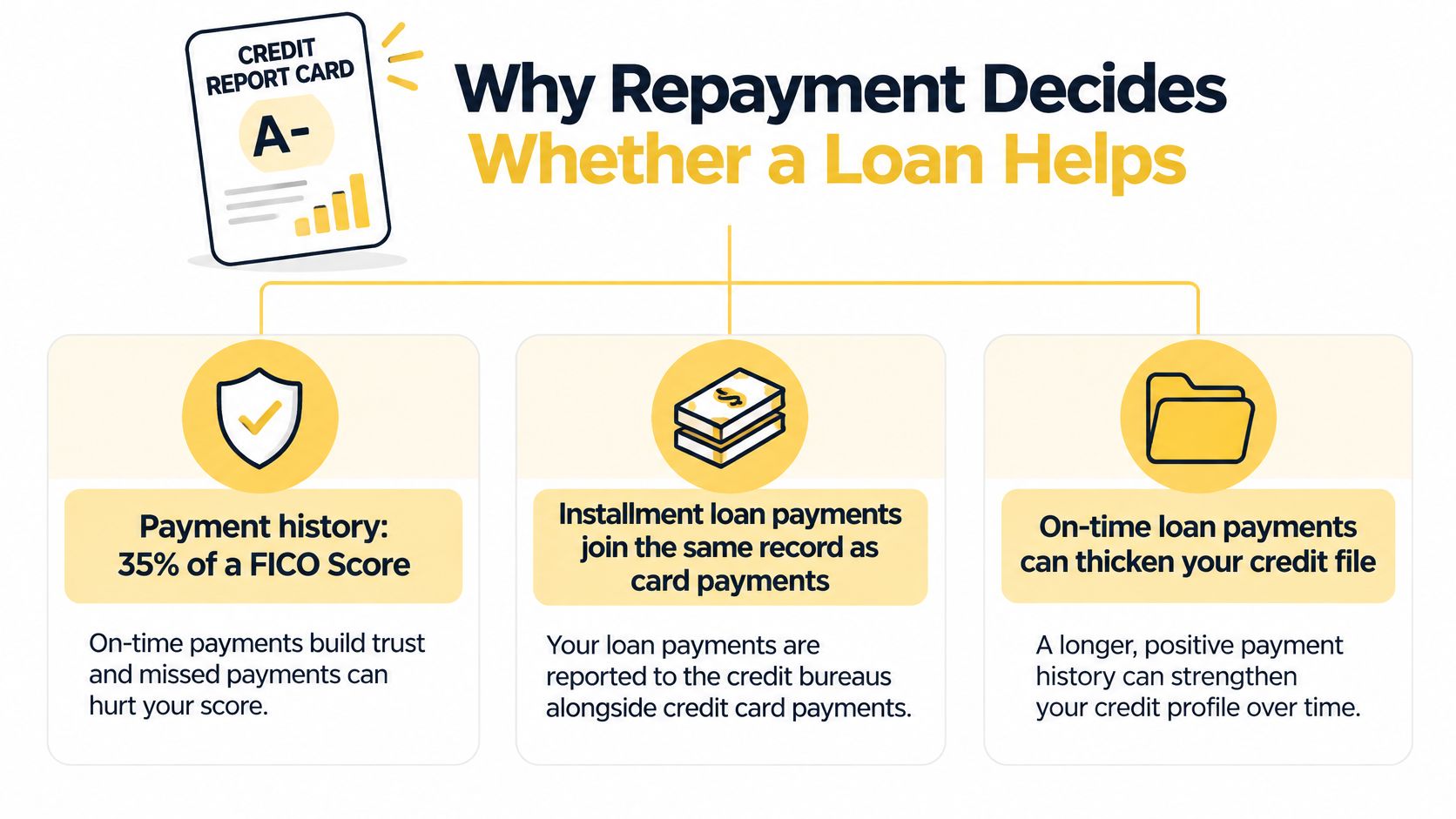
Think of your score as a weighted report card rather than a counter that awards identical points for every good action. In FICO's Understanding FICO Scores guide, payment history represents 35% of a FICO Score, and a payment reported 30 or more days late can materially damage scores.
Installment payments become part of that payment record alongside other reported credit payments. For someone with a thin file, consistent repayment gives a scoring model more evidence of how they handle debt. It doesn't guarantee a particular increase.
The visual below summarizes why repayment deserves the most attention.
Balances and payment history measure different things
Your remaining installment balance tells a different story from your credit-card utilization. Card utilization compares a revolving balance with an available limit. For an installment loan, the relevant comparison includes how much remains relative to the amount originally borrowed.
Say you've only just started repaying a loan. Most of the original debt is still outstanding. Near the end of the repayment schedule, you've demonstrated much more progress toward eliminating that obligation.
A lower remaining balance is generally viewed as less risky, but it doesn't erase missed payments. You need both a manageable balance and a reliable payment record, not a strategy that sacrifices one for the other.
Payoff can also confuse borrowers. Closing an active installment account may produce a temporary score change, particularly when there are few other accounts. That isn't a reason to keep a token balance or pay unnecessary interest.
Weak credit makes affordability more important
Adding installment credit can broaden an account mix, but that possible benefit is conditional. A younger average account age, additional debt, and repayment pressure can outweigh the value of having another account type.
The risk is especially relevant to borrowers already facing difficult terms. In a Federal Reserve Bank of Philadelphia auto-loan analysis, subprime borrowers held 17% of active auto-loan accounts but represented nearly two-thirds of delinquent loans. That finding concerns auto loans, not a forecast for a personal-loan applicant, but it illustrates why access to credit and successful repayment aren't the same outcome.
A loan's potential credit benefit is useful only if you can afford the payments without falling behind elsewhere.
If your goal is rebuilding rather than covering a necessary expense, consider the trade-offs in our guide to building credit with a card. The right comparison is between manageable approaches, not between promised score increases.
Short-term loans are costly and aren't a long-term financial solution. Borrow only what you can repay on time.
Before applying, test the payment against real life:
- Protect essential bills. Leave room for housing, utilities, food, transportation, and existing debt payments.
- Preserve payment cash. Don't count money already committed to another obligation.
- Allow for disruption. A delayed deposit or necessary repair shouldn't immediately make the loan unaffordable.
- Check reporting. Confirm that the lender reports payment history to the major credit bureaus.
For another explanation of the credit considerations, this video provides additional context.
Check the Offer Before You Sign
An affordable-looking monthly payment isn't enough information to accept a loan. You need to know what the lender reports, how much the entire agreement costs, and whether the due date works with your income.
Make these checks before submitting a full application whenever the information is available. If a key term remains unclear, don't treat the missing information as harmless.
Reporting and payment cash
Confirm positive reporting. Ask whether the lender reports on-time installment payments to the major credit bureaus. A loan that doesn't report those payments won't create the positive payment record you're seeking, even if applying involves a credit check.
Set aside the full payment and a buffer. Autopay is useful for remembering a bill, but it can't make an underfunded account sufficient. Schedule the payment around money that has arrived, not an expected deposit that could be delayed.
If one missed paycheck would make the payment late, the loan is more likely to hurt the score than help it.
That's a budgeting rule, not a prediction from a scoring model. Its purpose is to expose a fragile payment plan before you commit to it.
Total cost and the reason for borrowing
Compare the full repayment cost. Read the APR, fees, payment schedule, and total amount repayable together. A lower monthly payment can still mean paying more overall if the repayment period is longer.
Use the unsecured-loan rate guide to understand the terms you're comparing. Then place the proposed payment beside take-home income and scheduled bills, using an ordinary or difficult month rather than your best one.
Check whether the loan solves the right problem. Borrowing for a necessary expense is different from borrowing solely to manufacture credit mix. If improving your score is the only goal, the cost and payment risk deserve particular scrutiny.
For broader budgeting context, you can also browse practical money advice from Prime Journal while you work through income, bills, and repayment choices. Keep that general guidance separate from the actual agreement: the lender's written disclosures determine the offer you're considering.
Passing these checks doesn't guarantee a higher score. It gives you a better chance of managing the account without sacrificing other obligations, which is the outcome that matters financially as well as for credit.
Shop Loans and Limit the Damage
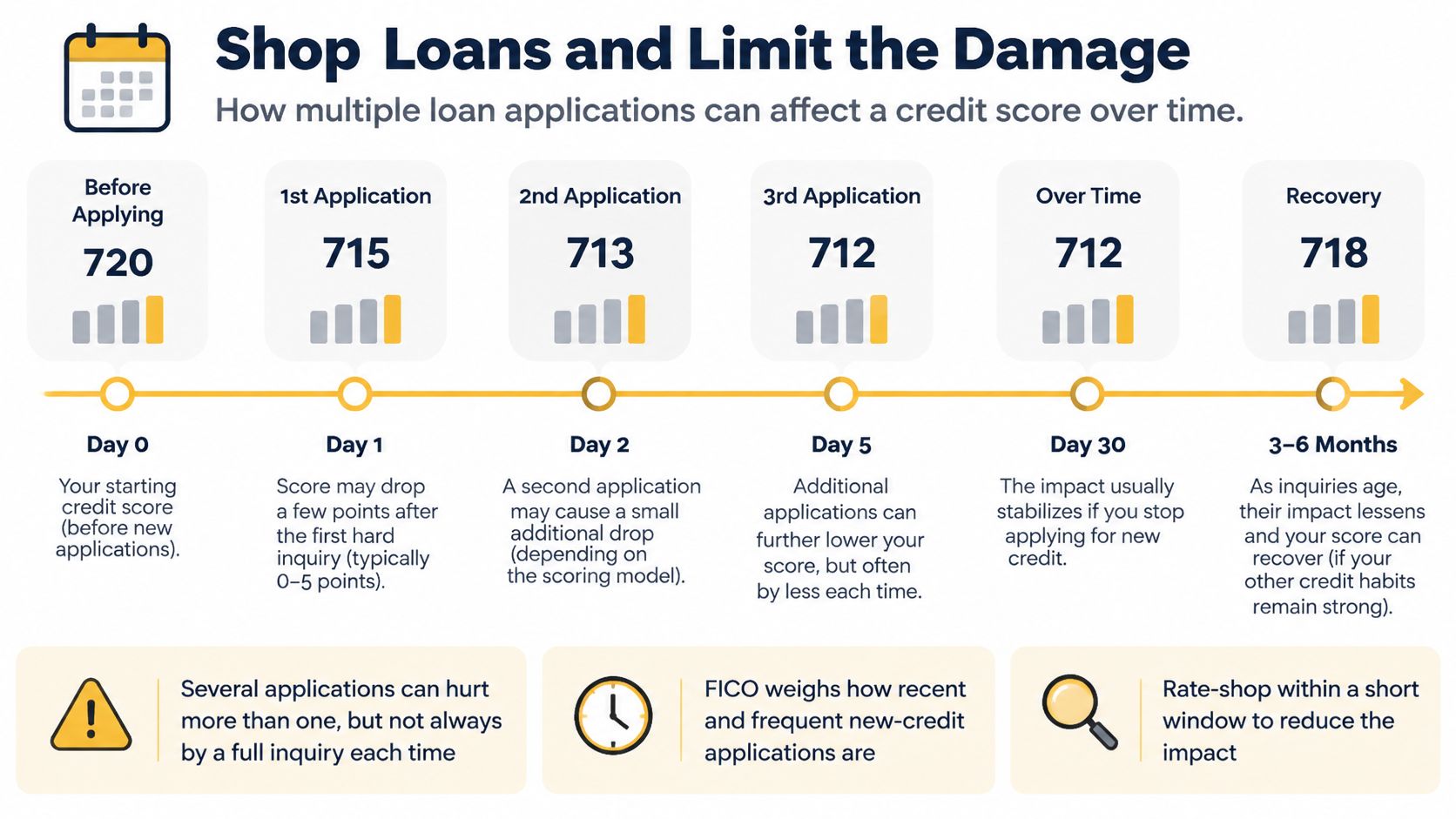
Several applications can hurt more than one, but not always as separate scoring events. The Consumer Financial Protection Bureau's credit-check explanation distinguishes ordinary credit applications from rate shopping for auto, mortgage, and student loans, where inquiries within a designated window are generally treated as one for scoring purposes.
Don't automatically extend that treatment to every personal or small-dollar loan. The product and scoring model matter, so concentrating applications isn't a guarantee that all inquiries will be combined.
Separate comparison from applications
VantageScore's discussion of unsecured lending and credit activity reinforces why inquiry timing needs to be considered alongside the new account and repayment behavior. The useful distinction is between comparing offers and repeatedly seeking new credit.
This timeline illustrates the difference between application activity and the longer repayment period.
Reading loan guides, state guides, and resources on BadCreditMD never affects credit. Use that research stage to eliminate unsuitable loan types before providing permission for a lender's credit check.
Follow a deliberate shopping sequence
Compare without applying. Read eligibility requirements, published terms, and state restrictions. Don't use a formal application merely to discover what kind of product you're viewing.
Review your own credit information. Look for unfamiliar accounts, incorrect balances, and payment-status errors. Resolve meaningful inaccuracies rather than sending more applications against an unchanged file.
Use confirmed soft-check prequalification. Check the disclosure before submitting your details. An estimated offer isn't final approval, but it can help narrow the field.
Keep formal shopping focused. Choose a loan type and a short shopping period. Ask how the lender's inquiry is classified instead of assuming every installment product receives special treatment.
Avoid unrelated applications. Adding a card application or another kind of loan creates a different credit-seeking event, not just another price comparison.
Verify reporting before accepting. Make sure the chosen account can establish the payment history you expect.
Arrange the debit around payday. Leave enough time for income to clear and keep a cushion in the payment account.
Pause unnecessary new borrowing. Give your budget room to absorb the obligation before adding another account.
Stop when the offer meets your needs. More applications won't correct an inaccurate report or make an unaffordable payment safe.
Act early if repayment becomes difficult. Contact the lender before a missed payment becomes a worsening delinquency. Ask about available arrangements without assuming relief is guaranteed.
The first part of that sequence limits unnecessary applications. The later steps protect the account you accept.
If an unfamiliar inquiry appears, use our explanation of hard inquiries and credit-report removal to understand the distinction between an error and a legitimate credit check. Don't build your borrowing plan around having accurate application history deleted.
Confirm the Payment Before You Apply
Your decision should be yes or not yet, not an attempt to guess an exact score movement. Apply only when the payment survives your budget test and you can name the date the money will be available.
Use our loan payment calculator with your own illustrative figures to examine the monthly obligation and total cost. At BadCreditMD, you can compare personal and installment loan information by score band and loan amount, alongside alternatives that may better fit a credit-building goal.
Choose a workable obligation
A credit-builder loan is a small loan held in savings while you pay it off, which can help establish payment history. It isn't immediate spending money, so it serves a different purpose from financing an urgent expense.
Federal credit union payday alternative loans are another option to investigate, with an APR capped at 28% under NCUA rules. Compare actual availability, eligibility, and repayment terms rather than assuming an alternative automatically fits your circumstances.
If the payment works only by skipping another bill, consider nonprofit credit counseling or assistance through 211 before adding debt. A payment arrangement with an existing creditor may address the immediate problem without another loan.
Know what submitting a request means
Reading our guides doesn't affect credit. Submitting a request is different: you consent to lenders checking your credit, which may affect your score, and to your information being shared with lenders through a lending network partner.
BadCreditMD is an informational resource, not a lender or broker. Lenders set their rates and terms and decide whether to lend; submitting a request doesn't guarantee approval, and you decide whether to accept an offer.
Write down the payment, the due date, and the buffer amount. Apply only when all are covered.
Visit BadCreditMD to compare loan-type explanations, state-specific guidance, and alternatives before authorizing a credit check. Use that no-pull research time to complete your payment, due-date, and buffer check, and submit a request only when your budget supports the obligation.