
A short-term payday loan can carry an effective annual rate of 500% or more once fees and interest are annualized, according to an April 8, 2013 warning from the New Jersey Department of Banking and Insurance. That figure changes how to think about a loan for bad credit in New Jersey: a quick approval isn't necessarily affordable, and a low monthly payment doesn't tell you what you'll repay in total.
Your credit score matters to lenders, but it isn't a legal approval rule or a verdict on your finances. Your options also depend on who's lending, how the loan is structured, its cost and whether the lender follows New Jersey requirements. Compare the written APR and total repayment, then consider whether a payment plan, overdraft or paycheck advance could bridge the gap at lower cost.
Table of Contents
- Which Bad-Credit Loan Types Are Legal in New Jersey
- New Jersey Interest Rate Caps and Usury Limits
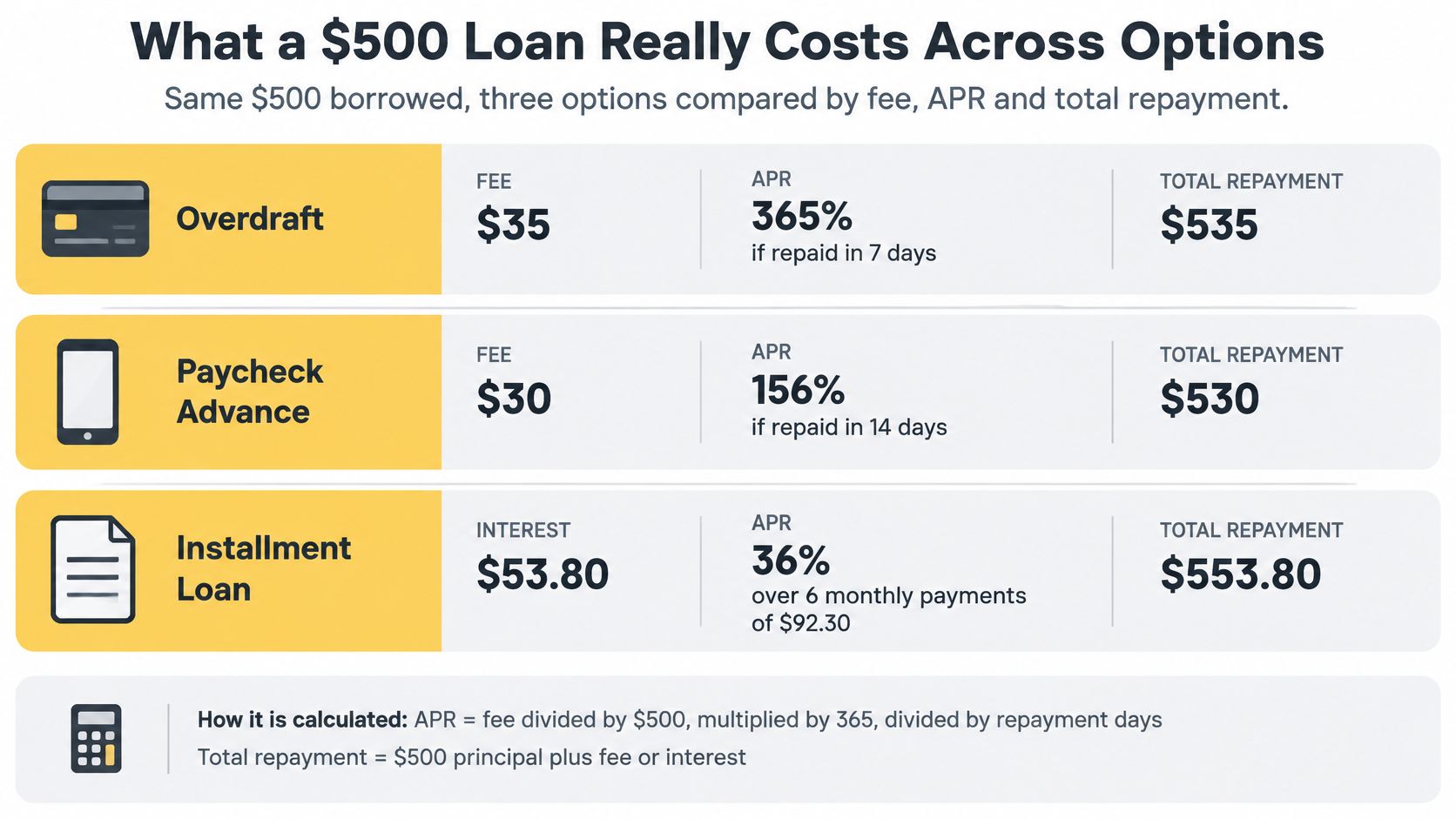
- What a $500 Loan Really Costs Across Options
- Choosing Between Overdraft, Paycheck Advance and Installment Loan
- Rollovers, Renewals and Stacked Loans
- Free New Jersey Help Before You Borrow
- How to Screen a Lender Before You Apply
- Cash-Flow Data and What Lenders Can See
- Confirm the Lender and Total Cost Before You Apply
Which Bad-Credit Loan Types Are Legal in New Jersey
Three questions sort most offers quickly: who is lending, how the loan is structured, and whether the lender holds the required New Jersey license. Borrowers with poor credit can consider licensed installment loans, credit-union payday alternative loans, credit-builder loans and bank overdraft features, and the product label alone tells you little about legality.
| Loan type | Who may offer it in NJ | Legal status for bad-credit borrowers | Typical term |
|---|---|---|---|
| Licensed installment loan | Consumer lender licensed by the New Jersey Department of Banking and Insurance | Permitted; principal up to $50,000 | Several months to several years |
| Payday loan | Often an out-of-state or unlicensed lender | High-rate offers may violate New Jersey rules | Usually repaid in one lump sum on the next payday |
| Title loan | Lender using a vehicle title as security | Treat any vehicle-title offer as high risk and confirm the lender's New Jersey license with the Department of Banking and Insurance before considering it | Often short term; read the contract |
| Credit-union PAL I | Federal credit union | Available through participating federal credit unions under federal rules | Read the credit union's written terms |
| Credit-union PAL II | Federal credit union | Permitted under NCUA rules, with a maximum loan amount stated in the product rules | Read the credit union's written terms |
| Credit-builder loan | Credit union or community lender | Permitted; funds may be held in savings while you repay | Set by the lender |
| Overdraft protection | Your bank | Bank account feature; may involve fees rather than loan interest | Repaid from a later deposit |
Read the status, not just the product name
A product name works like a store label: two offers with the same name can hold very different contracts. A New Jersey licensed consumer lender is not interchangeable with an out-of-state website that has not obtained the required license, so start by identifying the lender's full legal name and confirming its licensing with the state Department of Banking and Insurance.
Licensed consumer lenders may make installment loans of up to $50,000 under N.J.S.A. 17:11C-32. That figure caps principal. It says nothing about how much you should borrow or whether you will qualify, because approval remains a lender decision, not a verdict on your credit score.
Repayment format matters as much as the label. A lump-sum due date can create a sharp cash-flow squeeze, while installments spread repayment across scheduled payments. Neither format is automatically cheaper, so compare the APR, payment count and total repayment in writing before choosing.
An overdraft or paycheck advance sits outside the loan rules in this table, yet for a small shortfall its fees can still undercut a loan's total cost. Compare the dollar amounts either way.
If you want a broader overview of financing options for imperfect credit, this 2026 guide to bad credit financing can help you understand the kinds of products lenders may offer. Use any general guide as a starting point, then weigh New Jersey rules against the specific contract in front of you.
In practice, your shortlist may be a licensed installment loan for a larger expense, a credit-union PAL for a smaller gap, or a credit-builder loan if you do not need the money immediately.
New Jersey Interest Rate Caps and Usury Limits
A rate cap is a boundary for the contract, not a promise that a lender will approve you or offer the lowest allowed rate. In New Jersey, start with three questions: who is lending, whether the loan is written under a licensing statute or judged under usury rules, and whether the borrower is an individual or a corporation. That order matters because an overdraft fee, a paycheck-advance charge and an installment payment can sit outside the same box even when all three touch the same paycheck.
| Rule | Threshold | What it means in practice |
|---|---|---|
| Civil usury, written contract specifying interest | Set by current New Jersey usury law | A written rate outside the permitted category raises a legality question unless an exception applies |
| Criminal usury, noncorporate borrower | Set by current New Jersey usury law | An individual borrower is in the category regulators usually mean for personal loans |
| Criminal usury, corporate borrower | Separate corporate treatment | A business entity can be treated differently from a consumer borrowing for personal needs |
| Licensed installment loan, maximum principal | Set by the consumer-lender licensing statute | License status and loan size must match the authority the lender is using |
| Variable-rate increase over the full term | Capped by statute | The initial rate cannot be raised without limit during the loan's life |
| Variable-rate increase in any 12 months | Capped by statute | A shorter window limits how fast a variable rate can move |
| Payday loan, annualized cost cited by the state | High enough to trigger enforcement concern | State warnings treated short-term payday pricing as a usury and licensing problem, not a normal consumer-loan cost |
How to interpret the thresholds
Treat a low advertised payment as marketing until the contract shows the rate basis, repayment schedule and lender status. If a written rate appears to fall outside the lawful category, do not explain it away because approval was fast or the lender is online.
The licensed-consumer-loan statute, N.J.S.A. 17:11C-32, permits agreed rates on installment contracts and caps variable-rate movement at 6 percentage points above the initial rate over the term and 3 percentage points in any 12-month period. It also bars using multiple simultaneous contracts to obtain a higher rate than otherwise permitted.
Use usury thresholds as a screening tool before comparing total dollars across an installment loan, overdraft and paycheck advance. If an offer relies on an out-of-state entity, a vague rate or a renewal pattern, verify the license with the Department of Banking and Insurance. A state-by-state overview of payday loan laws can add context, but the New Jersey regulator and the written contract decide the offer in front of you.
What a $500 Loan Really Costs Across Options
The same $500 can cost a $75 fee over two weeks or about $42 in interest over six months, depending on the product. Compare the dollars paid, the APR and the total repayment for the same amount, then check how quickly the balance comes due. The examples below are illustrative calculations, not New Jersey rate caps or promises about what a lender will offer.
| Loan example | Amount borrowed | Repayment schedule |
|---|---|---|
| Two-week payday loan at $15 per $100 | $500 | $75 fee; roughly 391% annualized APR; $575 due at once |
| Credit-union PAL I, six months | $500 | About $42 interest; six payments near $90, plus any application fee |
| Licensed installment loan, 12 months, illustrative | $500 | About $103 interest; payments near $50 |
| Same installment loan at 80% APR, illustrative | $500 | About $242 interest; payments near $62 |
The first row shows why the fee and the APR tell different stories. A $75 fee on a $500 advance may sound manageable until you see that it's due with the principal in a single payment. Annualizing a short borrowing period produces a much higher rate figure than looking at the one-time fee alone.
Three ways to read a quote
A smaller payment can mean more interest overall. In the two installment examples, the monthly payment rises only from about $50 to about $62, while total interest more than doubles, from about $103 to about $242. Compare the amount paid over the full term, not just what leaves your account each month.
A one-time fee can hide a costly short-term loan. When the entire balance is due on payday, ask whether you can repay without borrowing again or missing another bill. If you can't, a rollover or new advance can add expense without resolving the shortfall.
Add every fee to the comparison. A credit-union PAL may carry a small application fee, so include it alongside interest when you total the cost. Then ask each lender for the exact payment and total repayment in writing, since an illustrative rate may not match your offer. Approval and pricing are the lender's decision, not a verdict on your credit score, so a declined quote from one source says little about what another will offer.
To rerun the comparison, use the amount you'll really receive, the written APR, each payment amount and the number of payments. If the term is shorter or the APR is lower, the total may fall, but don't estimate from the monthly payment alone. This guide to getting $500 quickly with bad credit may help you consider alternatives before accepting an offer.
Choosing Between Overdraft, Paycheck Advance and Installment Loan
Start with one question: When does your next paycheck arrive, and can you repay the shortfall without taking another advance? The answer helps distinguish a brief timing gap from a recurring cash-flow problem.
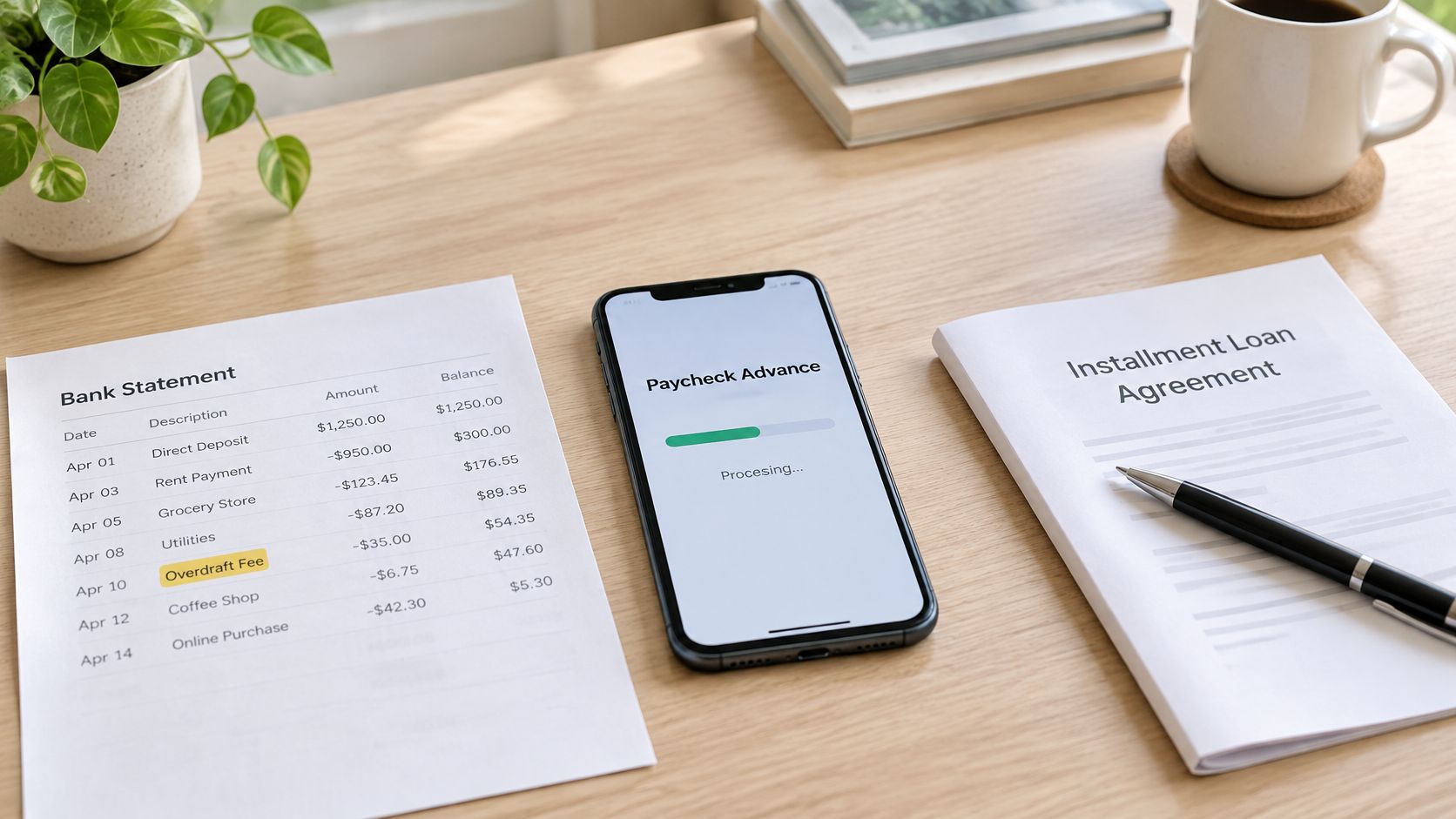
The Congressional Research Service's overview of overdraft fees reports that many financial institutions charge about $35 for overdraft protection. Congress overturned the CFPB's 2024 overdraft rule in 2025, so your bank's actual terms matter. The CFPB advisory material cited in the same source reports research finding a 56% increase in overdrafts among regular earned-wage-access users. An advance tied to your paycheck can therefore leave you short when the next bills arrive.
| Situation | Next pay date | Likely cheaper step | Main risk |
|---|---|---|---|
| Shortfall under about $50 | Within two days | One overdraft or small advance, only if it won't become a habit | A fee for each item and repeat use |
| Shortfall of $300 to $1,000 | More than two weeks away | PAL I or licensed installment loan with APR disclosed | A longer term can increase total interest |
| Shortfall recurs each pay period | Any | Neither product solves the pattern; review the budget or seek credit counseling | Repeated fees and worsening account balance |
| Bill can be delayed | Any | Ask the creditor or utility for a payment plan first | Late fees if the agreement isn't confirmed in writing |
Is a small installment loan cheaper than overdrafting?
Sometimes. A single overdraft fee may cost less than paying interest across an installment loan, especially if your next deposit will clear the shortfall. If the gap won't clear within one pay period, an installment loan or PAL may be a more manageable option, provided you understand its APR, total cost, repayment timing and automatic-debit authorization.
Compare the actual dollars paid, not just whether a product is called an advance or a loan. Check when repayment occurs, whether the lender can debit your account automatically, and whether the offer states an APR or another clear measure of its cost. For a wider comparison of repayment structures, see this guide to installment loans versus payday loans.
Here's a simple final test: if repaying the product would require another advance in the next pay period, it's the wrong choice for this shortfall. Pause and review the budget, ask the creditor for a payment plan, or contact a nonprofit credit counselor.
Rollovers, Renewals and Stacked Loans
A short loan becomes more costly when the due date arrives and the borrower can't repay the principal. In a rollover, the borrower pays a fee while the original balance carries forward, often with another fee due later. For example, a hypothetical $500 payday loan with a $75 fee would leave the borrower owing the original $500 after two rollovers, even after paying $225 in fees.
A renewal or refinancing can add new charges, such as origination or documentation fees. Stacking happens when a borrower takes a second loan, sometimes from another lender, to make a payment on the first. That can leave two repayment obligations running at once, making it harder to see the full cost and harder to make the next payment.
New Jersey law prohibits structuring multiple simultaneous consumer-loan contracts to obtain a higher rate than otherwise permitted. If you're considering another loan while one is still open, assess both contracts together rather than treating the new offer as a separate decision. A guide to what can happen if you default on a payday loan may help you prepare questions about missed payments and collection. Borrowers in bankruptcy should also get advice about whether they need court approval for Chapter 13 borrowing.
Before you accept or renew an offer:
- Ask whether payments roll the balance forward. Get the answer in writing, including any fee charged each time the balance continues.
- Count every open loan. Include the loan you're considering and check whether the combined repayment schedule fits your income.
- Seek another route if rollover is the only way out. Ask the creditor for a payment plan, then contact the Department of Banking and Insurance or Legal Services of New Jersey if the lender may be unlicensed or operating from out of state.
Free New Jersey Help Before You Borrow
If you're short on cash, start with help that might reduce or delay the bill without adding a loan payment. Call 211 New Jersey for emergency help with bills, food and rent, and ask the utility, medical provider or creditor whether it offers a payment plan.
| Resource | What it provides | When to contact |
|---|---|---|
| 211 New Jersey | Referrals for emergency help with bills, food and rent | When you're at risk of missing a basic expense |
| Utility, medical and creditor payment plans | Hardship arrangements that may cost less than borrowing | Before taking a loan to pay a bill |
| Nonprofit credit counseling | Budget review and debt management plans | When multiple debts or a recurring monthly gap are hard to manage |
| Legal Services of New Jersey and county legal aid | Help with collection, repossession and lender disputes | When you face a collection threat or suspect an unlicensed lender |
| New Jersey Department of Banking and Insurance | Licensing checks and lender complaints | Before signing, or after a suspicious offer |
| CFPB complaint portal | A way to submit complaints about banks and lenders | When you have a problem with lender conduct or fees |
| State public-benefits screening tools | Eligibility checks for assistance programs | After an income drop or when household costs rise |
Match the resource to the problem
When you need money for a bill soon, contact 211 and ask the creditor about a payment plan before applying for a loan. A credit counselor can also review the budget if you're facing several bills or the same shortage each pay period. Ask for the terms of any arrangement in writing, including due dates and any fees.
If a lender's identity, license or conduct is the concern, contact the New Jersey Department of Banking and Insurance. For problems involving a bank or lender, the CFPB complaint portal is another route. Legal Services of New Jersey or county legal aid can help you understand a collection, repossession or dispute with a lender.
A new expense or lower income may also make you eligible for public assistance. Check state benefits-screening tools before borrowing to cover the gap. You don't need to wait until a loan application is declined to ask for help.
How to Screen a Lender Before You Apply
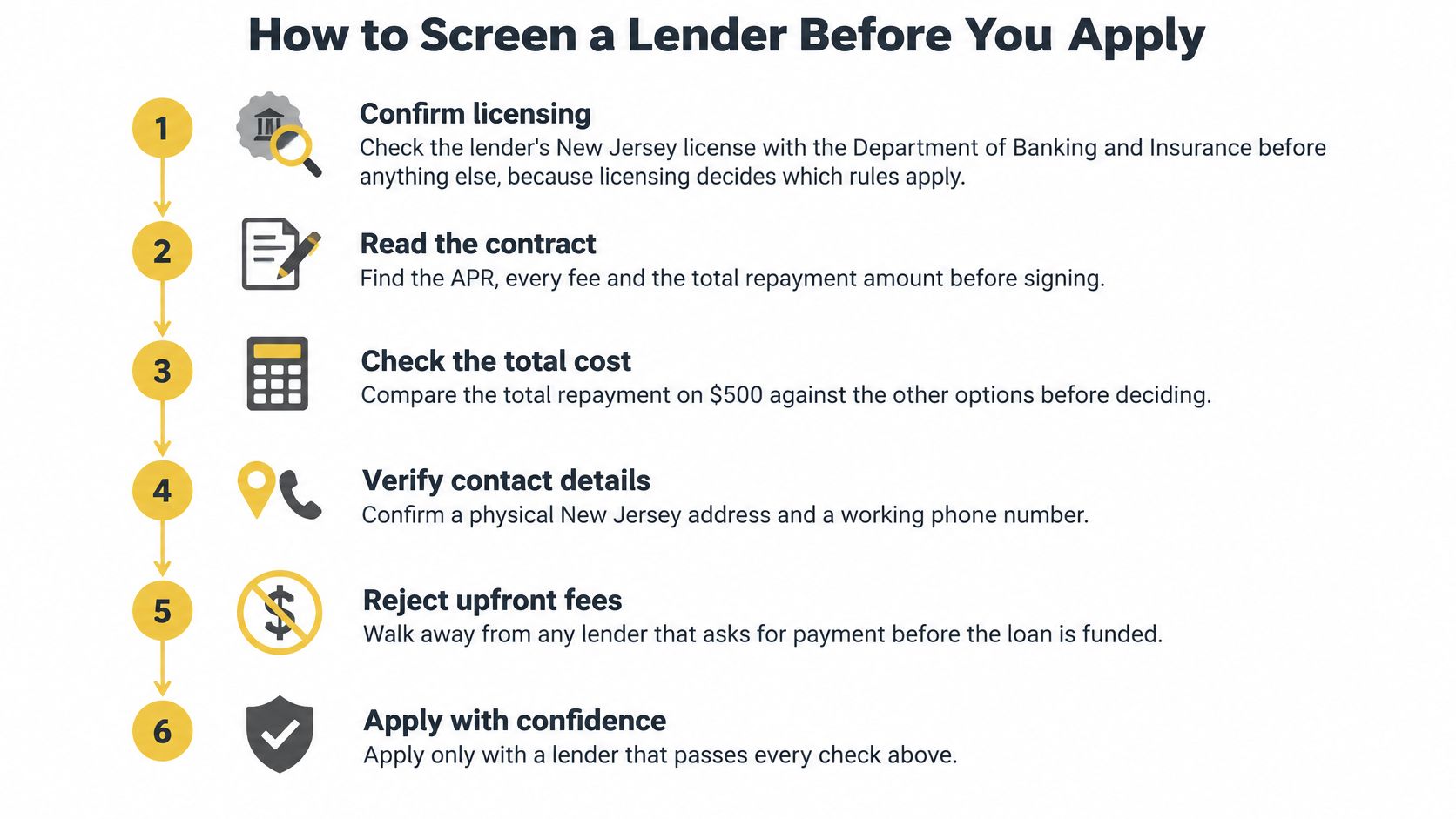
Approval isn't guaranteed, even if you have steady income or a lender advertises loans for borrowers with damaged credit. First identify who's lending and what rules apply; then compare the written cost.
The New Jersey Department of Banking and Insurance's consumer finance guidance explains that civil-usury rules, criminal-usury limits and federal preemption can affect how an offer is evaluated. Use this checklist before sharing personal or bank-account information.
Confirm the lender's New Jersey license. Check with the Department of Banking and Insurance before comparing rates. Licensing helps you identify which rules may apply to the lender and contract.
Read the contract's identity and governing-law terms. Find the lender's legal entity name, licensing statement and governing law. A federally regulated or out-of-state institution may raise federal-preemption questions, so don't assume a quoted APR is enforceable simply because it appears in an online offer.
Write down every cost and term. Record the principal, nominal rate, APR, origination or documentation fees, late charges, payment frequency, loan term, prepayment terms and total scheduled repayment. APR is generally more useful than a periodic rate because it includes interest and certain fees.
Ask how interest is calculated. Find out whether the lender uses simple interest on the declining balance or precomputed interest. The answer helps you understand how payments reduce what you owe.
Check the cash you'll really receive. Ask whether any fee will be deducted from the proceeds before the money reaches you. A stated loan amount can be larger than the cash available for the expense you need to cover.
Compare total repayment, not the payment alone. A smaller payment may come from a longer term, which can increase the amount paid over the life of the loan. Put competing offers side by side using the same borrowing amount.
Stop if the lender won't disclose the terms. Don't proceed if it promises guaranteed approval, asks for payment before underwriting or refuses to state the APR and total repayment in writing. Report a suspicious offer to the Department of Banking and Insurance.
Cash-Flow Data and What Lenders Can See
A low credit score doesn't tell a lender everything about whether you can repay. The Federal Reserve identifies cash-flow information as a promising input for underwriting small-dollar credit and potentially expanding access, while also recognizing the need for safeguards in its discussion of consumer and community context.
Regular direct deposits or a history of rent and utility payments may give a lender additional information to consider. But alternative underwriting doesn't guarantee approval or a lower rate. The lender still sets its own eligibility rules and terms, and sharing more data can create privacy and account-access risks.
Consider the trade-off: A lender's ability to see more of your cash flow may help explain your finances, but it can also expose account details you'd prefer to keep private.
If you're preparing documents to verify income, this guide on how to prepare bank statements for income verification can help you understand what lenders may request. Before submitting anything, ask the lender:
- What data can you see, and how long will you keep it? Ask whether you're sharing transactions, balances, deposits or other account details.
- Will the credit check be hard or soft? Confirm what kind of inquiry the application involves before authorizing it.
- Will you debit my account automatically? Ask what authorization you'd be giving and how you can revoke it.
- Can I turn off account access before applying? Find out whether an application requires continued access or only a one-time review.
- Will you share the information with third parties? Ask who may receive it and for what purpose.
Write down the answers and compare them across lenders before submitting a request. If the lender can't explain its data practices clearly, pause the application.
Confirm the Lender and Total Cost Before You Apply
Build your shortlist in four passes. First, write down the amount you need and your next pay date, then reject any option you couldn't repay without borrowing again. Second, remove offers that fail the licensing and contract checks or raise unresolved legal concerns.
Third, compare total repayment across the remaining offers and check whether a payment plan, 211 referral or credit counselor could cover the gap. Finally, keep only one or two options with the APR, fees and total repayment confirmed in writing.
BadCreditMD offers state-specific explainers about loan types, rules, costs and local help. It isn't a lender or broker, and it doesn't make approval decisions. If an optional request form is available for a lawful product, a lending-network partner may share the request with third-party lenders, which may run a credit check. Reading a guide doesn't affect your credit.
Finish with a shortlist of one or two legal options and the total repayment for each. Apply only after you understand what you'll receive, what you'll owe and when payments are due.
Use BadCreditMD to review New Jersey borrowing rules, compare loan costs and find local assistance before you apply. Check the written APR and total repayment for any offer, then choose only an option you can repay without taking another advance.