
A $500 emergency is hard to cover quickly even without severely damaged credit. The Federal Reserve found that 37% of U.S. adults could not cover a hypothetical $400 expense entirely with cash, savings, or a credit card paid off at the next statement, according to the Federal Reserve Survey of Household Economics and Decisionmaking. That's the core issue with how to get 500 dollars fast with bad credit. You're often solving a liquidity and timing problem, not just a credit score problem, and speed is where lenders charge you most.
Table of Contents
- Which Routes Deliver $500 Fastest
- Free Steps to Take Before You Borrow
- State Rules That Decide Your Options
- What $500 Costs and How to Apply for a Credit Union Loan
- Choose Your First Move Before You Sign
Which Routes Deliver $500 Fastest
Don't start with a loan application. Start with the fastest route that creates no new debt. A payment extension, help from family, an employer advance, or selling something you don't use can solve the same problem without interest, fees, or a repayment date that collides with rent.
Bad credit mainly blocks routes that run a full credit check. It doesn't block a biller from moving a due date, an employer from advancing pay it already owes you, or a buyer from paying cash for electronics or furniture. That's why non-loan routes belong at the top of your list even when you're in a hurry.
Speed, Credit Checks and Access for Each $500 Route
| Option | Typical speed | Credit check | Access requirement |
|---|---|---|---|
| Payment plan or bill extension | 1-3 days to agree | Usually none | You must owe a bill the provider will restructure |
| Employer paycheck advance | 1-2 days | Usually none | Only if your employer offers the benefit |
| Sell items online or to a local shop | 1 day to 2 weeks | None | Items that resell well |
| Borrow from friends or family | Same day | None | A lender you trust |
| Credit card cash advance | Minutes to 1 day | No new check if you already hold the card | Existing card with available cash limit |
| Credit union Payday Alternative Loan | About 1-2 weeks | Varies by credit union | At least one month of membership |
| Online installment loan | 1 day to 1 week | Often a hard credit pull | Income and an active bank account |
| Payday loan | Same day to 1 business day | Often bank verification instead of a score | Regular income; legal in some states only |
Read the table by access first, speed second. A same-day option you can't actually use helps nobody. If you don't hold a credit card with an available cash limit, that row is irrelevant. If your employer doesn't offer paycheck advances, cross that row off and move on.
Watch the membership trap on credit union loans. A Payday Alternative Loan, or PAL, requires at least one month of membership, so joining a credit union today won't put a PAL in your account this week. It's a strong option for existing members and a smart account to open for next time, but it isn't an instant fix for new members.
How Credit Checks Differ by Route
Online installment lenders usually run a hard credit pull, which can matter if you're applying in several places at once. Payday lenders often focus instead on income and bank account verification, which is why they approve people with thin or damaged files. You can read more about that trade-off in this guide to payday loans and credit checks.
Treat every speed above as a typical range, not a guarantee. Weekends, bank cut-off times, document requests, and state rules all slow funding down. A lender promising instant money before it has verified anything is selling you something.
Practical rule: If a route needs no new debt, check it first. Borrow only for the shortfall that remains.
Free Steps to Take Before You Borrow
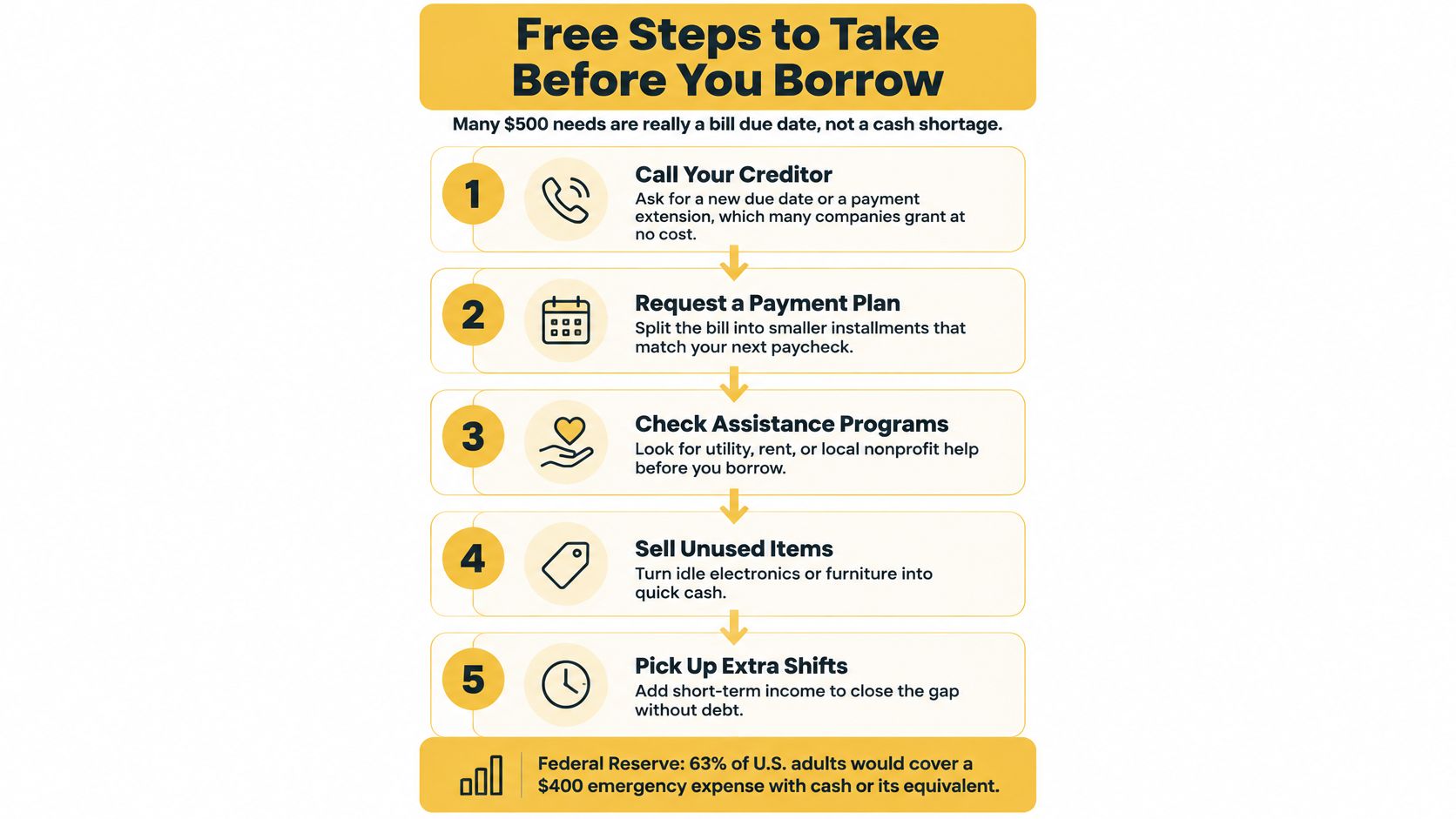
Before you borrow $500, check whether you can move the bill or reduce what you owe. A loan may deliver cash quickly, but its repayment cost starts immediately. A payment arrangement can buy time without adding a new loan, though the terms still matter.
In 2024, 63% of U.S. adults said they could cover a hypothetical $400 emergency expense using cash or its equivalent, according to the Federal Reserve Board press release. That figure measures ability to cover the expense, not whether the money arrives before a bill is due. If your shortfall is temporary, call the biller before paying to borrow.
Five Calls and Checks That Cost Nothing
Call the biller before the due date. Ask for an extension or hardship plan and give the exact date you can pay. Try: “I can pay in full on my next payday. Can you move the due date to that day?” Confirm whether the change triggers a late fee, interest, or another charge.
Ask about installment options. Some utility companies and medical providers offer no-interest payment plans; others may charge fees or interest. Ask for the terms before agreeing: “Can I split this balance into monthly payments? Are there fees or interest?”
Dial 211 or visit 211.org. Local programs may help with rent, utilities, or food, freeing your cash for bills that do not qualify. Ask: “I need emergency help with a utility bill this month. What programs serve my county?”
Check LIHEAP for heating or cooling bills. State energy assistance may help with utility costs. Ask your state program or utility which local office accepts applications.
Contact a nonprofit credit counselor. An NFCC member agency can review hardship options with your creditors. Ask: “I have a short-term shortfall. Can you help me review hardship options with my creditors?”
Keep a written record. Note the representative's name, call date, amount discussed, proposed due date, and any reference number. Save email confirmations with your log. Written terms make it easier to challenge a fee or clarify what you agreed to if another representative handles your account.
A payment extension can buy time without a loan, but it is not automatically free. Get the new due date and any fees or interest confirmed in writing before you rely on it.
State Rules That Decide Your Options
The same $500 request can be routine in one state and blocked in another. New York's criminal usury threshold effectively bars payday lending, while Texas permits payday loans without a statutory rate ceiling. Your zip code, not just your credit score, decides which products a lender may legally offer you.
Payday loans are banned or tightly capped in a number of states and allowed with fee caps in others. Car-secured title loans face restrictions in many states too, because the loan puts your vehicle at risk. PAL availability works differently, since it depends on your credit union's program rather than your state.
A Four-Part State Check
- Find what's permitted: Look up the loan types your state allows in the state payday loan laws guide before you compare offers.
- Confirm the ceiling: Check the maximum fee or APR in your state statute or on your regulator's website, so you can spot a quote that exceeds it.
- Ask about repayment protections: Some states require an extended payment plan or grace period for payday loans, which changes what happens if you can't pay on the due date.
- Record the complaint route: Note your state regulator and the CFPB complaint process before you borrow, not after a lender acts like the rules don't apply.
State and county assistance programs vary just as much. Emergency rental aid or utility help that's open in one county may be closed or waitlisted in the next. Dialing 211 confirms which programs operate near you right now.
Laws change, and summaries go stale. Check the last-checked date on any state page before you rely on it, and verify anything decisive against the regulator's own site. A lender operating where its product is prohibited isn't offering you an opportunity, it's creating a problem you'll have to report.
What $500 Costs and How to Apply for a Credit Union Loan
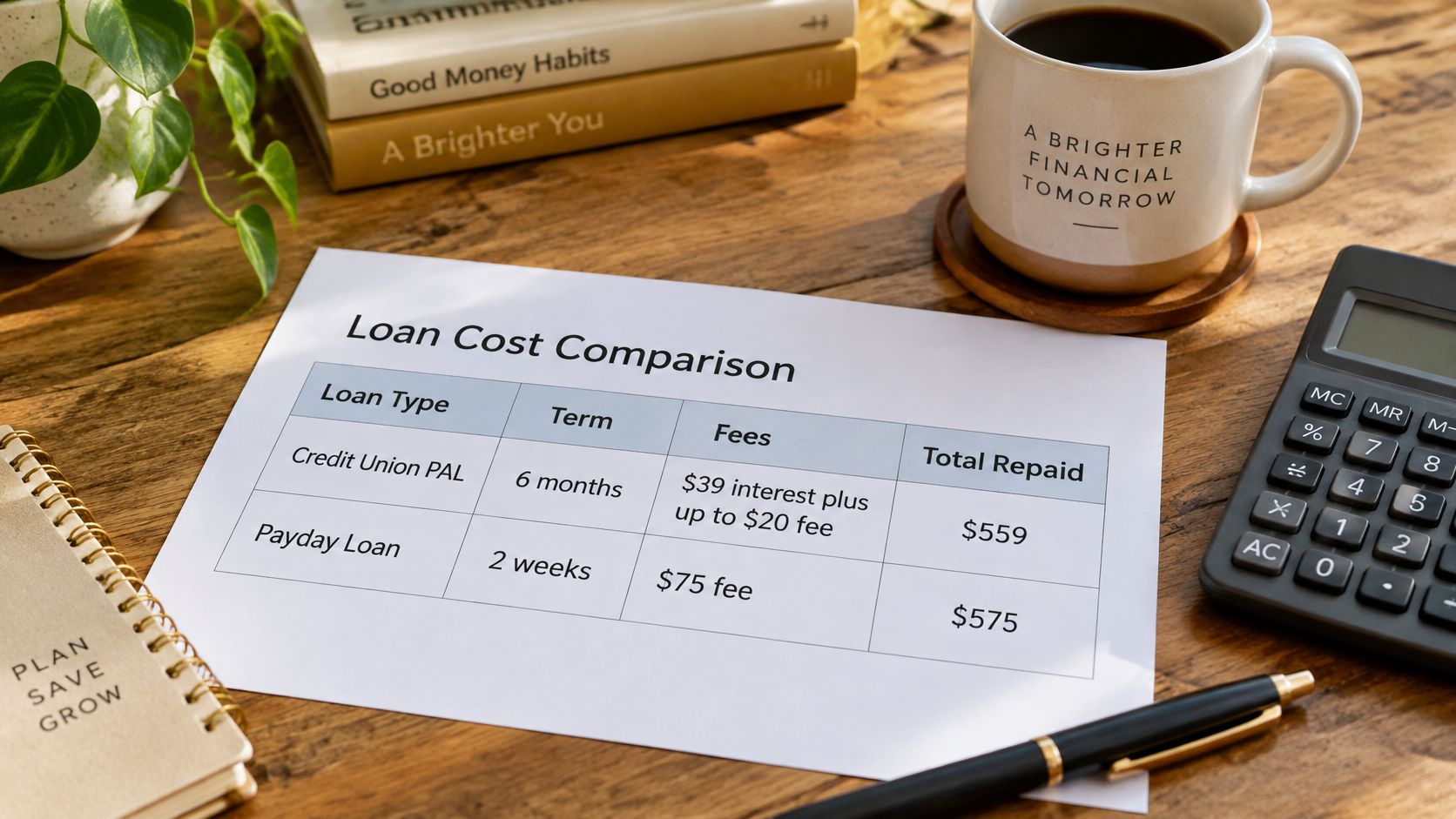
A two-week payday loan can put $575 on your calendar, while a credit union PAL spreads repayment across six monthly payments. Compare the total dollars repaid and days to repay before choosing: speed can cost more than the loan's fee alone.
The comparison below shows what $500 costs under different borrowing options.
Total Repayment on a $500 Loan by Option
| Option | Cost on $500 | Total repaid | Repayment period |
|---|---|---|---|
| Credit union PAL at 28% APR | About $39 interest plus up to $20 fee | About $559 | Six monthly payments |
| Payday loan at $15 per $100 | $75 fee | $575 | One lump sum in two weeks |
| Payday loan rolled over once | $75 more in fees, principal still owed | $650 | Two 2-week cycles |
| Credit card cash advance | Fee and cash-advance APR set by card agreement | Set by your card agreement and payoff speed | Until the card balance is repaid |
| Personal installment loan | Varies by lender | Set by the loan agreement | Set by the loan agreement |
NCUA guidance says PAL I loans range from $200 to $1,000, have terms of one to six months, and carry a maximum rate of 28% (NCUA access guidance). At that rate, borrowing $500 for six months costs about $39 in interest, plus an application fee of up to $20. The monthly payments reduce the balance, giving you more time to repay than a payday loan does.
The Consumer Financial Protection Bureau says many states cap payday loan fees at $10 to $30 per $100 borrowed. It also describes a typical two-week loan charging $15 per $100 as having an APR of nearly 400% (CFPB payday loan cost information). For a $500 loan at that fee, you owe $575 in two weeks. Check the CFPB's explanation of what bad credit loans really cost before accepting a high-cost offer.
A rollover adds another $75 fee while leaving the original $500 principal unpaid. If you cannot repay the payday loan on its due date, that structure can keep the debt open across repeated two-week cycles. The CFPB has also reported that 80% of payday loans are rolled over or reborrowed within 14 days (CFPB payday loan data). Treat the risk of needing a rollover as a reason to choose a payment arrangement or a longer repayment term instead.
The video below walks through the repayment comparison.
Six Steps to Apply for a PAL
- Confirm membership first. Ask whether you meet the one-month membership requirement before applying. Otherwise, you may wait for a decision only to learn you are not yet eligible.
- Borrow only the shortfall. PAL loans range from $200 to $1,000. Subtract any amount you can cover by selling items or arranging a payment plan.
- Gather your documents. Bring identification, recent pay stubs, and a bank statement. Be prepared to link your account if the credit union uses that method for verification.
- Request the full amortization schedule. Check payment dates against your paydays. Ask for the PAL application fee, up to $20, to be itemized in writing, along with the decision date.
- Test the payment against essentials. Set aside rent, food, and medicine first. If a payment leaves you short on any of them, borrow less or decline the offer.
- Reject bad structures. Do not accept automatic renewal, collateral requirements, or a payment plan that would force you to take out another loan.
The cheapest loan is still a poor choice if its payment does not fit your budget. Confirm the full repayment schedule and fee in writing before signing.
Choose Your First Move Before You Sign
Match the move to your situation instead of chasing the fastest approval. If a bill is due within a week, start with the payment plan and 211 steps covered earlier, because moving the due date solves the problem at no cost. Credit checks and loan documents are the wrong tools for a deadline problem.
If you're bridging a short gap until a known paycheck, use an employer advance or a small loan you can repay in full on that exact date. Run the payment through a loan payment calculator and check it against what's left after essentials. The loan fits only if the paycheck covers it without squeezing rent or food.
If the shortfall is ongoing, a payday loan won't fix it. Choose a credit union PAL with months to repay, or sit down with a nonprofit counselor who can address the underlying gap. Borrowing on a two-week schedule against a problem that lasts all month guarantees a rollover.
Red Flags That End the Conversation
- Upfront fees before funding: Legitimate lenders disclose costs in the agreement, they don't collect payment before you've received anything.
- Guaranteed approval: Every real lender checks something, whether that's credit, income, or bank activity.
- Gift cards or wire transfers: Requests to pay fees this way are a hallmark of scams, not lending.
- No stated APR: A lender that won't put the rate and total repayment in writing is hiding the price.
- A payment you can't make: If repaying on schedule requires borrowing again, decline the loan today rather than rolling it over later.
If a lender appears to break the rules, file a complaint with your state regulator or through the CFPB complaint process. Keep copies of every document, message, and payment confirmation to support it.
Your next step is concrete. Check your state's rules, pick the one route that fits your situation, and make the first call today while you still have options to choose from.
BadCreditMD explains small-dollar borrowing options for people with imperfect credit, including state-by-state rules, worked cost examples, and lower-cost alternatives such as credit union PALs and local assistance through 211. Before you apply anywhere, compare the total repayment on your $500 options and confirm what's legal in your state at BadCreditMD.