
Just under one-third of U.S. adults who applied for credit in 2023 were denied or approved for less than they requested, according to the Federal Reserve's household financial well-being report. That's a useful starting point when you're considering an unsecured line of credit for bad credit: approval isn't guaranteed, and an approved limit may not solve the expense you're facing.
The more important question is whether each withdrawal leaves you able to pay your bills from your take-home income. An open credit line is borrowing capacity, not extra pay. Treat every draw as a commitment against future paychecks.
Table of Contents
- What an Unsecured Line of Credit Is and Why Bad Credit Changes It
- Typical APRs and Terms for Each Borrowing Option
- How Lenders Decide Who Qualifies Beyond Your Score
- How to Measure the True Cost and Whether Payments Fit
- Risks of Revolving Debt and Hidden Balances
- Safer Alternatives to Compare Before You Borrow
- Check Your State Rules Before You Apply
What an Unsecured Line of Credit Is and Why Bad Credit Changes It
Think of a personal loan as a container that pours out a fixed amount. A line of credit works more like a tap with a borrowing limit: you draw what you need, repay the balance, and generally regain access to the principal you've repaid while the account remains open.
Unsecured means you haven't pledged a home, car, or savings account as collateral. It doesn't mean repayment is optional or that missed payments have no consequences. The lender relies on your credit history, income, existing obligations, and ability to repay rather than a pledged asset.
The comparison below shows the difference between flexible access and a fixed loan.
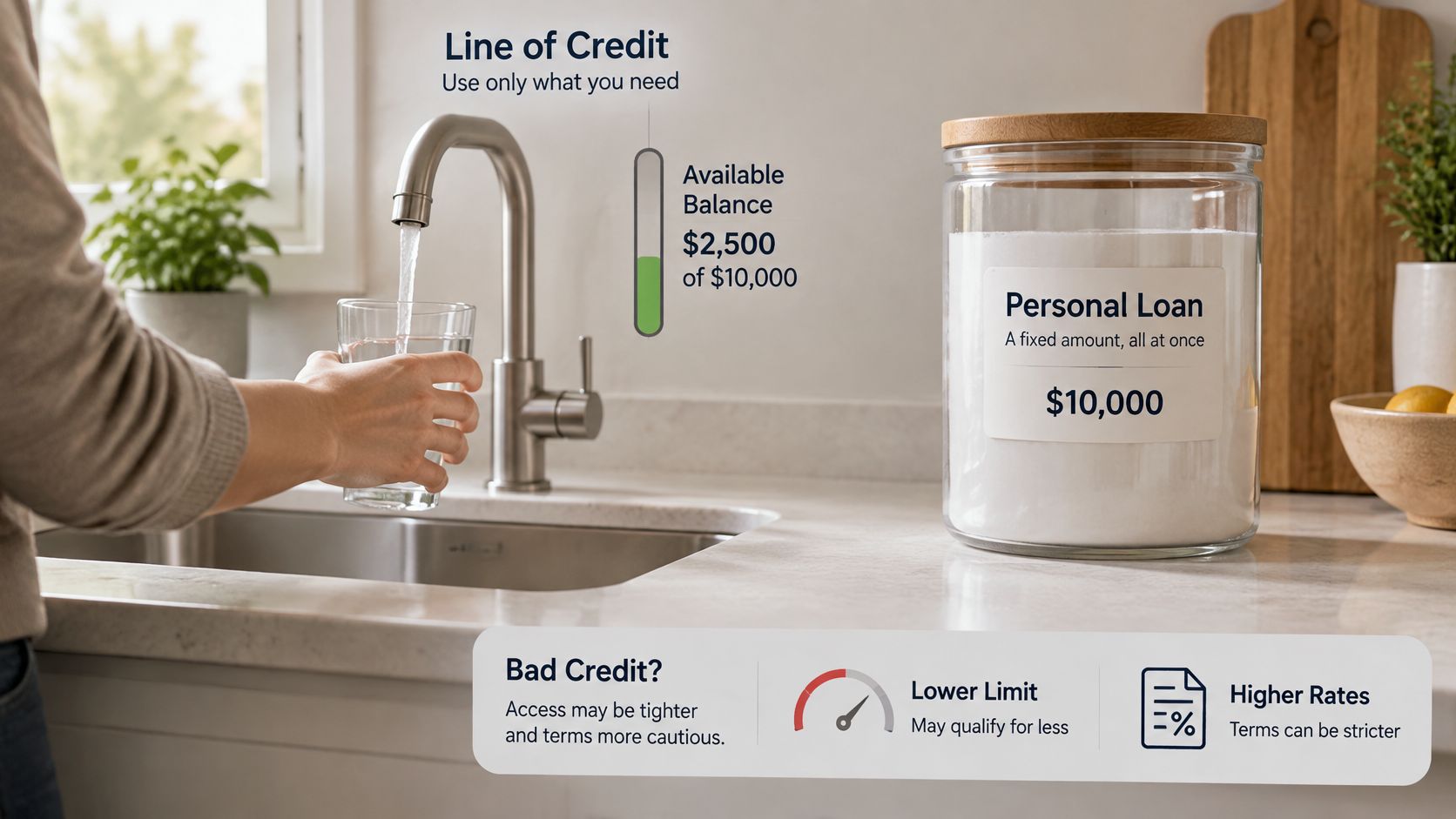
What poor credit changes
Unsecured borrowing isn't a niche product. A Federal Reserve Bank of Richmond analysis identified it as the fastest-growing component of nonmortgage consumer credit, particularly from the 1990s onward.
But access isn't equal. With poor or limited credit, you may receive a smaller limit, a higher interest rate, or a denial because the lender has less reassuring evidence of repayment. A signature loan for bad credit is another unsecured structure to compare if you need a defined amount rather than ongoing access.
What happens after a draw
Your agreement sets the minimum payment, interest calculation, fees, and conditions for continued borrowing. You'll generally owe a monthly payment when you carry a balance, and interest adds to the cost. The lender may also have the right to reduce or freeze access under the agreement.
Before applying, answer these questions:
- What kind of expense is this? A temporary repair bill and a recurring grocery shortfall need different solutions.
- Where will repayment come from? This month's income must cover the proposed payment without another loan or draw.
Typical APRs and Terms for Each Borrowing Option
Treat each draw like a new bill against take-home pay. The line stays open, the payment stays due while a balance remains.
Typical APR, collateral and best use by borrowing option
| Product | Typical APR | Collateral | Best Suited For |
|---|---|---|---|
| Credit card (unsecured revolving) | Obtain the purchase APR and any separate cash-advance APR | None | Purchases you can repay without carrying persistent debt |
| Bank small-dollar credit benchmark | FDIC example range of 12% to 32%, with low or no fees | None for an unsecured product | Affordable small-dollar borrowing |
| Credit union payday alternative loan | Capped at 28% under NCUA rules | None | Small short-term needs |
| Unsecured personal line of credit for bad credit | Lender sets the APR in the written offer | None | Irregular expenses with an identified repayment source |
| Payday loan | Obtain the fee expressed as an annual percentage rate | None, repayment generally tied to incoming pay | Emergency borrowing with substantial repayment risk |
| Title loan | Obtain the written APR and all fees | Car title | Urgent cash, with the vehicle at risk |
The FDIC's small-dollar lending guidance gives 12% to 32% APR as an example range for affordable bank small-dollar credit and encourages APRs no higher than 36% where state law permits. Those figures describe bank benchmarks. They do not set the price for every personal line. Federal credit union payday alternative loans follow separate product rules, including the cap shown in the table.
Read the offer, not just the product name
There is no supported market-wide APR range for an unsecured personal line aimed at bad-credit applicants. A credit card rate, a bank benchmark, or an advertised starting rate cannot stand in for your written offer.
Start with APR for comparison. Then calculate total repayment for your planned draw and repayment schedule. A low monthly minimum can hide a high total cost. Check whether the rate is fixed or variable, whether pricing reflects your credit profile, and which fees apply to draws, late payments, or cash access. A guide to unsecured loan rates compared by credit tier explains how advertised rates differ from final offers.
Subtract the estimated payment from take-home pay after housing, food, transport, and existing debt. Little remains for error.
Match the financing to the project
Flexible borrowing does not fit every large project. A personal line rarely suits construction costs, repayment timelines, or disbursement schedules. If you are considering an accessory dwelling unit, CozyCube's resource on how to fund your backyard cottage provides context for evaluating construction financing instead of assuming a personal credit line fits.
Use product benchmarks as a reason to question an expensive offer. An offer below a benchmark still must fit your budget.
How Lenders Decide Who Qualifies Beyond Your Score
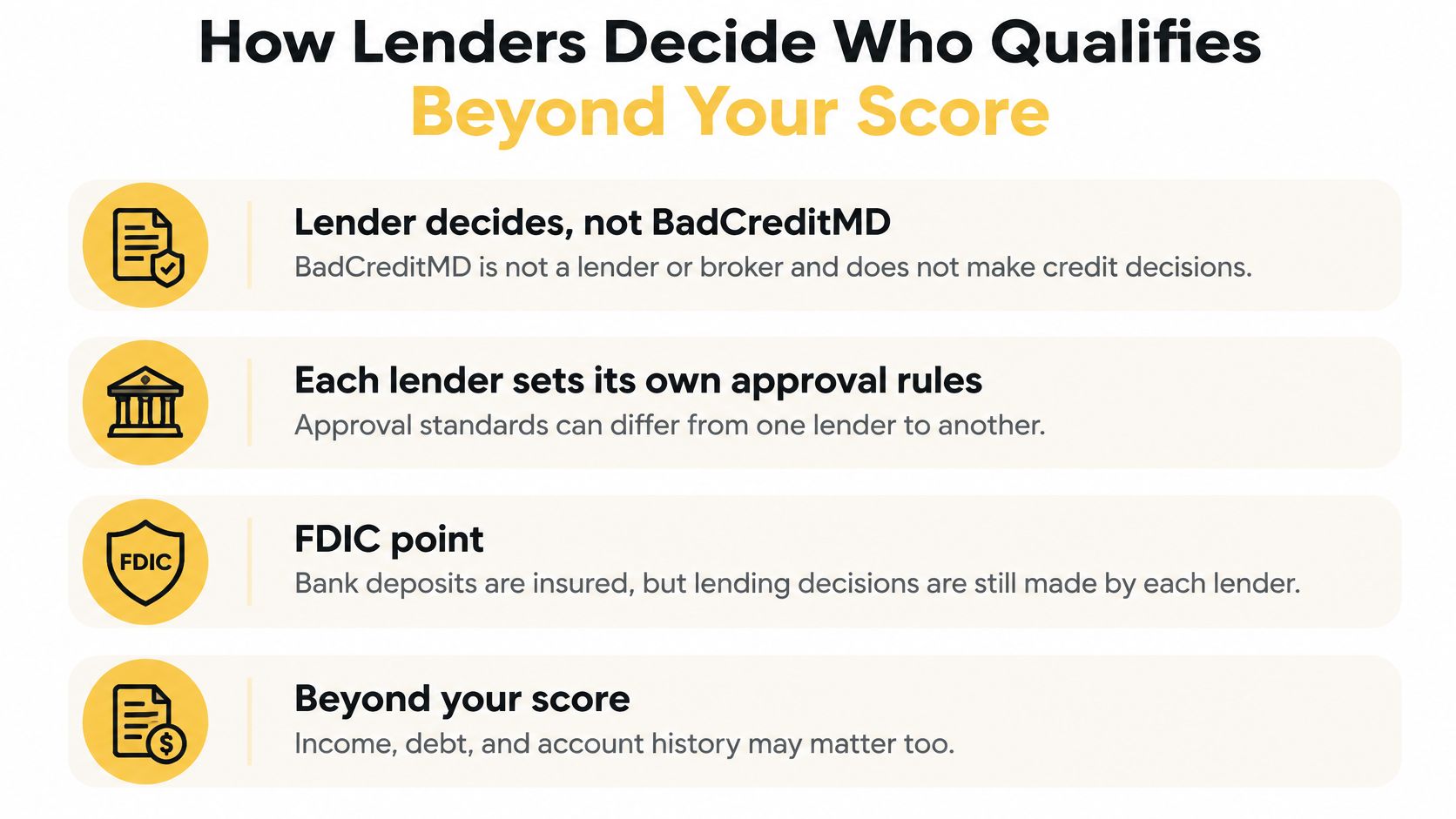
The lender decides whether you qualify, not BadCreditMD. We're not a lender or broker, and we don't make loans or credit decisions. We also don't pick, vet, or rank lenders; each lender sets its own approval rules.
Your score matters, but it isn't the entire application. The FDIC's small-dollar lending guidance emphasizes income, recurring obligations, loan size, payment frequency, and expected repayment. For applicants with limited credit-bureau information, deposit activity and recurring income can supplement traditional scoring.
This checklist separates the lender's decision from the information you can prepare.
Prepare evidence of repayment capacity
Calculate disposable monthly cash flow. Start with take-home income, then subtract housing, utilities, food, transportation, insurance, existing debt payments, and other necessary expenses. Include money you need to set aside for irregular bills. What remains is your starting repayment capacity, not a target to spend completely.
Review your credit reports. Check reports from Equifax, Experian, and TransUnion for unfamiliar accounts, incorrect balances, or payment errors. Dispute inaccuracies before applying when possible. Accurate information matters more than guessing which score a lender might use.
Gather income records. Have recent bank statements and documentation of wages, benefits, or other recurring income ready. If earnings fluctuate, show that pattern rather than building your budget around your strongest month.
Request the full-draw payment calculation. Ask the lender to show the minimum payment if you use the entire proposed limit. Add that obligation to your existing payments, and ask how the payment changes when the balance changes.
Clarify checks and account restrictions. Ask whether prequalification uses a soft inquiry, when a hard inquiry occurs, and whether later draws require another review. Confirm credit-bureau reporting, account fees, and circumstances that allow the lender to suspend borrowing.
Plan for a smaller approval
A lender may offer less than you requested. Decide beforehand whether a partial amount would resolve the expense or leave you searching for another loan.
Approval isn't an affordability verdict. A workable payment leaves room for essential expenses and unexpected costs without requiring new borrowing.
Verified income can strengthen an application, but it doesn't guarantee approval. The useful outcome is an obligation you can successfully repay under its original terms.
How to Measure the True Cost and Whether Payments Fit
Compare the disclosed APR and total dollars paid, not just the periodic interest rate. Then test the payment against your take-home income at the time it will leave your account.
Check how the agreement calculates interest, including whether it uses an average daily balance and a daily periodic rate. List origination, membership, annual, draw, cash-advance, and late fees separately. Don't assume every fee is included in every advertised APR presentation.
Build a payoff estimate
Use the lender's written terms to model your intended withdrawal and payoff date. For a simple illustration, annual interest divided into monthly portions can help explain the scale of borrowing costs, but it won't reproduce a daily-balance statement when payment dates, fees, or rates change.
A loan payment calculator can help compare a fixed-payment alternative. For a revolving line, get the lender's minimum-payment formula and account for future draws separately; a standard installment calculation won't automatically capture them.
Paycheck amounts and the 5% payment threshold
The following hypothetical paycheck amounts illustrate a cautious screening calculation, not a lender approval rule or a guarantee of affordability.
| Take-home paycheck | 5% threshold per paycheck | Check before drawing |
|---|---|---|
| $1,000 | $50 | Does the payment allocated to this paycheck stay under $50 after a full draw? |
| $2,000 | $100 | Does a missed-payment scenario still fit the budget? |
Treat that percentage as a prompt to inspect your budget, not permission to borrow up to it. A household with high essential expenses may have no room for another payment even below the screening amount.
Match the time periods. A monthly minimum payment and a per-paycheck threshold aren't directly interchangeable. Allocate the payment to the paychecks that will fund it, while keeping rent, food, and other bills covered on their actual due dates.
Stress-test a difficult month
Ask the lender for a written illustration of what happens if a payment arrives late. Include any late charge, continuing interest, past-due amount, and change in borrowing access.
- Normal repayment: Record the total interest and fees through your intended payoff date.
- Reduced income: Recalculate using a weaker earnings month rather than assuming overtime or extra shifts.
- Delayed repayment: Check whether postponing principal repayment makes the total cost unacceptable.
A payment fits only if you can make it while keeping essential bills paid. Available credit elsewhere doesn't count as repayment income.
Before drawing, write down the repayment source. If the answer is another withdrawal to cover the minimum, don't make the draw.
Risks of Revolving Debt and Hidden Balances
A lower minimum payment doesn't necessarily mean cheaper borrowing. It may mean you're repaying principal more slowly while interest continues.
The Federal Reserve's report on household economic well-being in 2025 found that average credit-card balances rose 37% among people finding it difficult to get by, compared with 1% among financially comfortable respondents. That finding concerns credit cards, not personal credit lines, but it highlights the danger of using revolving debt while household finances are strained.
A small payment can leave a large commitment
Say you draw for a repair, begin repayment, and then use the newly available credit for groceries. You may keep the account current without making durable progress toward eliminating the debt. The relevant question is whether your balance is shrinking after interest, fees, and new spending.
An unsecured line of credit for bad credit isn't automatically safer than an installment loan. A smaller fixed-payment loan may provide a clearer ending date and lower total cost, even if its required payment is higher.
Compare the alternatives using the same expense and intended payoff date. For a variable-rate line, also consider whether a rate increase would disrupt that plan. Annual maintenance fees deserve attention even during periods when you aren't actively borrowing.
Count obligations that don't appear together
A credit report may not show your whole repayment burden. The CFPB's study of buy now, pay later borrowing found that more than three-fifths of BNPL borrowers held multiple simultaneous BNPL loans, while those loans typically weren't reported to nationwide credit bureaus.
That creates a practical budgeting problem: a lender might not see every obligation you must pay. You still have to fund them all.
- Keep one balance inventory. Include credit lines, cards, installment loans, BNPL purchases, and overdue bills. Record each due date and automatic withdrawal.
- Don't stack borrowing for the same need. Using another product to cover a payment can turn a temporary shortage into ongoing repayment pressure.
- Get reporting details. Ask which bureaus receive account information and whether the provider reports balances, on-time payments, and delinquencies.
Opening an account, undergoing a hard inquiry, and drawing on an existing account are different events. Don't assume each has the same credit effect or that an unreported account helps build credit.
Invisible debt still uses real income. Put every obligation into your monthly cash-flow calculation, whether or not it appears on a credit report.
Safer Alternatives to Compare Before You Borrow
A $15 fee on $100 for two weeks sounds small until you convert it to yearly cost. The Consumer Financial Protection Bureau explains in its payday-loan description that a typical two-week loan charging $15 per $100 borrowed carries an APR of almost 400%.
That math is the right test for an open line too. Treat each draw as a standing claim on take-home pay. Ask whether the monthly minimum, plus interest on the balance you carry, still leaves room for rent, food, transport and the rest of the repayment inventory you already fund.
These alternatives give you different ways to address a bill or strengthen your borrowing position.
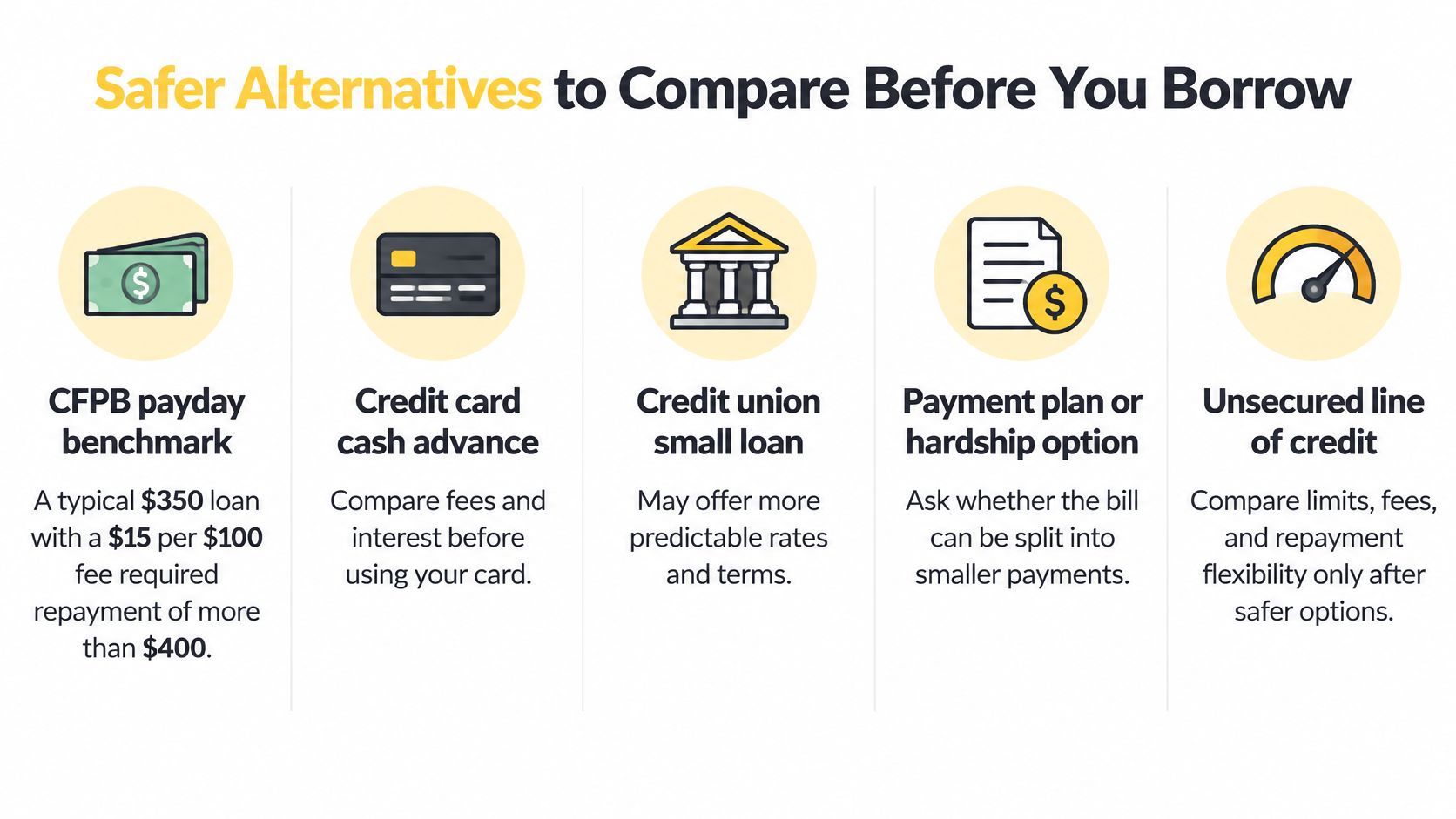
Match the alternative to the need
Safer alternatives by APR and credit effect
| Option | Typical APR | Credit-building effect |
|---|---|---|
| Credit union payday alternative loan | APR capped at 28% under NCUA rules | Can support payment history if reported |
| Credit-builder loan | Set by the lender and disclosed with fees | Can build payment history while loan funds are held in savings |
| Secured credit card | Set by the card issuer, check purchase APR and fees | Can build credit with on-time payments when reported |
| Payment plan with utilities, medical providers, or creditors | Often no interest when arranged before the due date | Confirm whether the creditor reports the arrangement |
A credit union payday alternative loan works like a small installment loan with a capped rate. Because federal credit unions cap PAL APRs at 28%, the monthly payment is easier to test against take-home pay than a revolving balance that can be redrawn. Ask about membership, application requirements, and when funds would become available.
A credit-builder loan serves a different purpose. Funds are generally held in savings while you repay, so it is primarily a payment-history tool, not cash for today's emergency. A secured credit card requires your own deposit. That deposit makes it unsuitable when you have no spare cash, even though on-time payments may help establish credit when the card reports to the bureaus.
Try changing the bill before borrowing
Contact the utility, medical billing office, or existing creditor before the due date. Ask for a hardship arrangement, a due-date adjustment, or installments, and get the agreed terms in writing. Check whether interest, fees, or collection activity will continue. A written plan lets you place each payment next to the paycheck that will fund it.
If you are also preparing for a mortgage, Home Ready Calculator's guide to consolidating debt before buying a home offers context for evaluating consolidation rather than opening another account without a broader plan. Consolidation still requires a repayment strategy and restraint about taking on replacement balances.
For an additional overview of borrowing choices, watch the following video.
Compare loan options for bad credit by the amount you need, access timing, total repayment, and consequences of falling behind. Borrow only what you can repay on time, not the largest amount offered.
Check Your State Rules Before You Apply
Check legality and availability before submitting an application. A product advertised online isn't automatically permitted where you live, and a lender's ability to offer it may depend on its licensing and the product structure.
Our state guides cover all states and the District of Columbia, but the BadCreditMD service isn't available in every state. Geographic coverage of information doesn't mean every borrowing option or request service is offered everywhere.
Make the state check practical
- Identify the exact product. Find out whether the agreement is for revolving credit, an installment loan, a payday loan, or a title-secured loan. The marketing name may not settle which rules apply.
- Confirm the applicable rules. Use the state guide and state regulator's information to check permission, licensing, and any relevant cost limits. Keep the regulator's complaint contact.
- Request only what resolves the need. A smaller requested limit can help you avoid building a plan around money you don't need.
- Schedule repayment in writing. Put each payment beside the paycheck that will fund it, and assign a realistic payoff date. Leave room for essential bills and irregular expenses.
Don't rely on a lender's willingness to approve you as proof that the terms are appropriate. Save the offer, disclosures, fee schedule, and payment authorization so you can review what you're accepting.
Use free help when repayment doesn't work
Contact 211 for local assistance, look into public benefits, or speak with a nonprofit credit counselor about a broader debt plan. Legal aid may help when a collection dispute or legal problem is involved. State regulators and the CFPB complaint process provide routes for raising problems with financial providers.
Our information is general guidance, not individual legal or financial advice. If your written payoff plan doesn't fit your take-home income, choose assistance, a payment arrangement, or another suitable alternative instead of opening the line.
BadCreditMD offers free guidance on bad-credit borrowing options, state rules, and local assistance. Visit BadCreditMD to check your state's information and compare alternatives before committing future paychecks to an unsecured line of credit.