Right after a Chapter 7 discharge posts, the pressure is real. You want a card that will approve, but you also don't want fees, a tiny limit, or a product that sets you back when you're trying to rebuild. The best credit cards after Chapter 7 discharge are usually the ones that match your current access level, whether that means no-credit-check secured access, a small refundable deposit, a membership-based card, or a rewards card that still keeps costs under control. Approval is never guaranteed, and the right choice depends on what you can reach today, not on a glossy feature list.
Table of Contents
- 1. OpenSky Secured Visa
- 2. Capital One Platinum Secured Credit Card
- 3. Navy Federal cashRewards Secured
- 4. Discover It Secured Cash Back Credit Card
- 5. Bank of America Customized Cash Rewards Secured
- 6. Citi Secured Mastercard
- 7. Bad Credit Loan Types Compared Side by Side
- Top 7 Credit Cards After Chapter 7 Discharge
- Choosing Your First Card After Chapter 7
1. OpenSky Secured Visa
OpenSky is the clearest starting point if a no-credit-check route matters most. Its secured Visa family includes Launch, Secured, and Plus versions, so the decision is less about whether you can apply and more about which fee structure fits your budget. Start here if you want a straightforward deposit-based product and you don't want your fresh discharge to be the thing that blocks the application.
The practical upside is simple. OpenSky says you can apply without a credit check, and it reports to all three bureaus, which is the core rebuilding function many individuals need after bankruptcy. You still need to compare the annual or monthly fee on the specific version you're looking at, because one version can cost more than another even though the approval path feels easier.
Practical rule: if you're choosing between accessibility and polish, pick accessibility first only when the fees still leave room for you to use the card responsibly.
The best use case is someone who needs a clean on-ramp now and can handle a deposit without depending on instant upgrade features. If you want to compare this approach with broader rebuilding options, the BadCreditMD credit card guide gives a useful starting point. Use the OpenSky Secured Visa page to check the current deposit and fee setup before you apply.
2. Capital One Platinum Secured Credit Card
If you need a secured card after Chapter 7 and cash is tight, this one sits in the lower-deposit lane. The core question is whether you can post a small refundable deposit and still get a straightforward rebuilding card with no annual fee.
The Capital One Platinum Secured Credit Card starts with deposit tiers as low as $49, $99, or $200, while the credit line begins at $200. That setup matters for post-discharge budgeting because the deposit is the main barrier, not a heavy fee load. It also keeps the account simpler than many secured cards that add extra costs just to open the door.
Why this one works for careful rebuilders
This card suits a borrower who wants a basic secured account and is willing to let payment history do the work. Capital One also includes CreditWise tools and reports to all three bureaus, so the account still serves the core job of rebuilding. If you are still explaining the bankruptcy on other applications, the letter of explanation guide can help you keep that message consistent.
The trade-off is rate risk. If you carry a balance, the purchase APR matters more than the low entry deposit, so this card works best when you plan to pay in full and keep utilization low.
A secured card earns its place when you use it for small purchases, pay on time, and avoid interest.
That makes this a practical fit for someone who can post a modest refundable deposit and wants a known issuer with a clear path to maintain the account. Check the current terms on the Capital One secured card page before you rely on the deposit tier.
3. Navy Federal cashRewards Secured
If you already qualify for Navy Federal membership, this card gives you a clear secured-card path with rewards attached. If you do not, it is off the table, and that eligibility gate matters more than the feature list.
The setup is straightforward. Navy Federal offers unlimited 1% cash back, no annual fee, and a refundable deposit that can start as low as $200 held in a Navy Federal savings account. For someone rebuilding after Chapter 7, that combination can make everyday spending do a little work instead of sitting idle.
Where the review cycle matters
The timing is part of the appeal. Navy Federal says it does an automatic 3-month review for possible credit line increases and a 6-month review for upgrade consideration. That gives this card a real use case for borrowers who care about graduation potential, not just opening a secured account and waiting.
The trade-off is reach. The deposit sets the starting line, and the account only becomes more useful if those reviews turn in your favor. If you qualify for membership, confirm the current deposit rules and review cadence on the Navy Federal cashRewards Secured page before you decide.
4. Discover It Secured Cash Back Credit Card
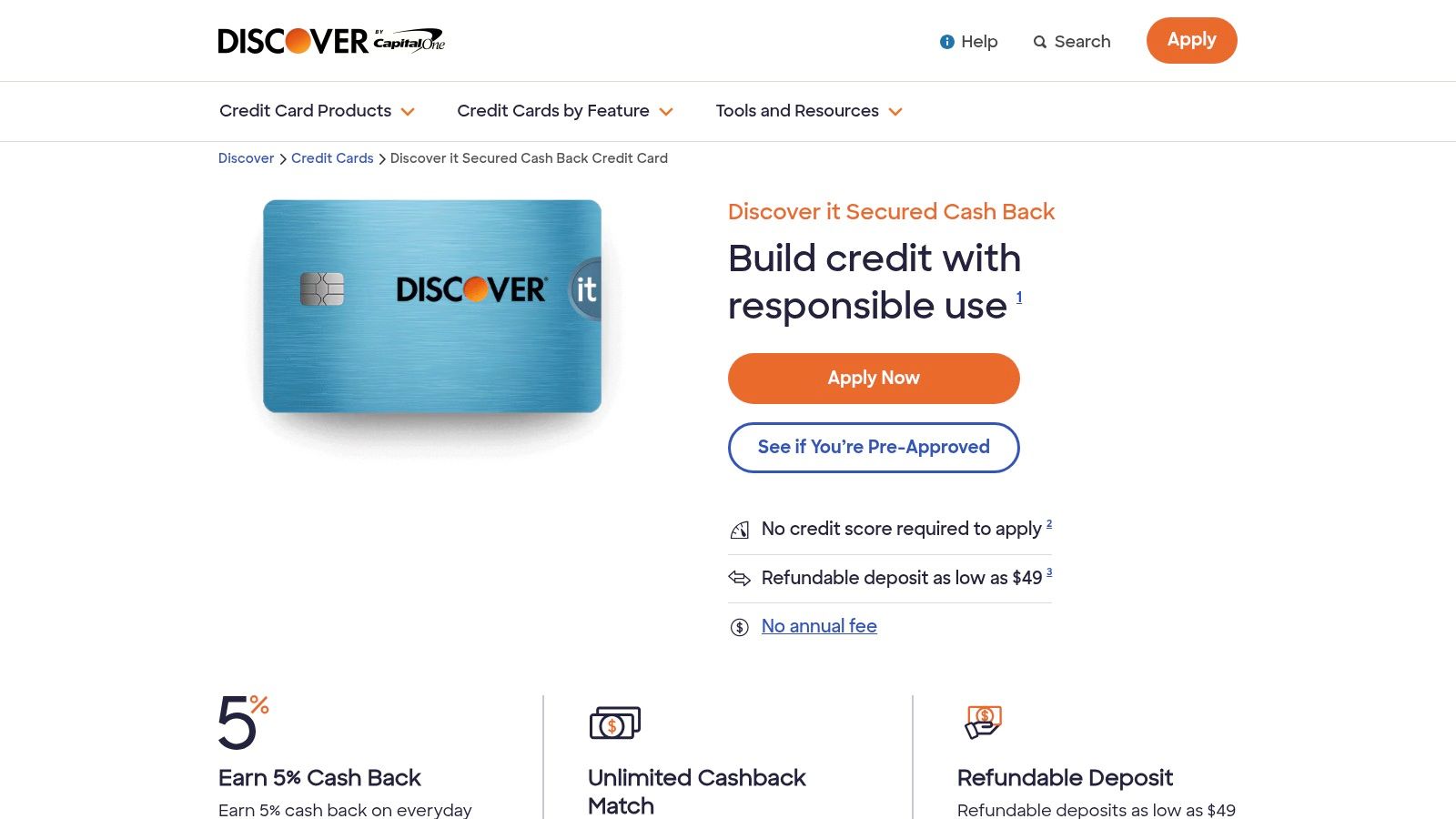
If you want a secured card that still returns cash back, Discover's option is one of the cleaner choices after Chapter 7 discharge. The trade-off is simple: you get rewards and no annual fee, but you still need to watch the deposit terms and the way the rewards are capped.
Discover markets lower deposit tiers that can start at $49, $99, or $200 depending on its review. That gives it more flexibility than many secured cards with a single flat deposit. It also reports to all three bureaus, so the account can support rebuilding if you keep balances low and payments on time.
The reward angle has limits
The card earns cash back, including higher rates on gas stations and restaurants within category caps, plus 1% on other purchases. That works well if your normal spending already fits those categories. It is a weaker fit if you would need to change your habits just to chase rewards, because interest charges can wipe out the gain quickly.
Rebuilding credit still depends on reported on-time payments and low utilization. A reward card only helps when the balance stays manageable.
Rewards should be a side effect of rebuilding, not the reason you overspend.
This card suits someone who wants a no-annual-fee secured card and is willing to accept category limits in exchange for cash back. Before applying, confirm on Discover's own page how the deposit tier is set and which category caps currently apply. If you also want to see how a new account should show up on your file, use the BadCreditMD credit report guide as a reference.
5. Bank of America Customized Cash Rewards Secured
This card suits someone who wants a secured account but refuses to give up useful cash back. It is a better fit for a shopper with a repeatable spending pattern than for someone who just wants the simplest possible rebuild card. The question here is whether the rewards categories line up with what you already buy.
Bank of America's secured card has no annual fee and uses a refundable security deposit, with a typical minimum of $200 and higher deposit room if you need it. The card earns 3% cash back in one chosen category, plus 2% at grocery and wholesale clubs and 1% on other purchases, subject to terms and caps. That makes it a more precise tool than a plain secured starter card.
Where the reward structure helps
The card is strongest for someone whose spending is predictable. If your monthly purchases already cluster around one category, the chosen-category design can be more efficient than a flat-rate rewards card. Bank of America also says it runs periodic reviews for possible graduation and deposit return, which gives the account a path beyond the starter stage.
The risk is the usual one. Rewards don't cancel out a balance if you carry debt at secured-card interest rates. The card only makes sense if the cash back fits your real spending and you can keep the balance low enough that the math still works.
Use the Bank of America secured card page to verify the current category terms before you apply. If your score is still in the rebuilding zone, the BadCreditMD 580 to 669 guide can help you think through whether this kind of rewards-heavy secured card matches your current profile.
6. Citi Secured Mastercard
Citi's secured card only makes sense if you are far enough past discharge to meet the issuer's timing rule. That filter matters more than the card's feature list. If you are not at least two years past bankruptcy, this option is likely out of reach.
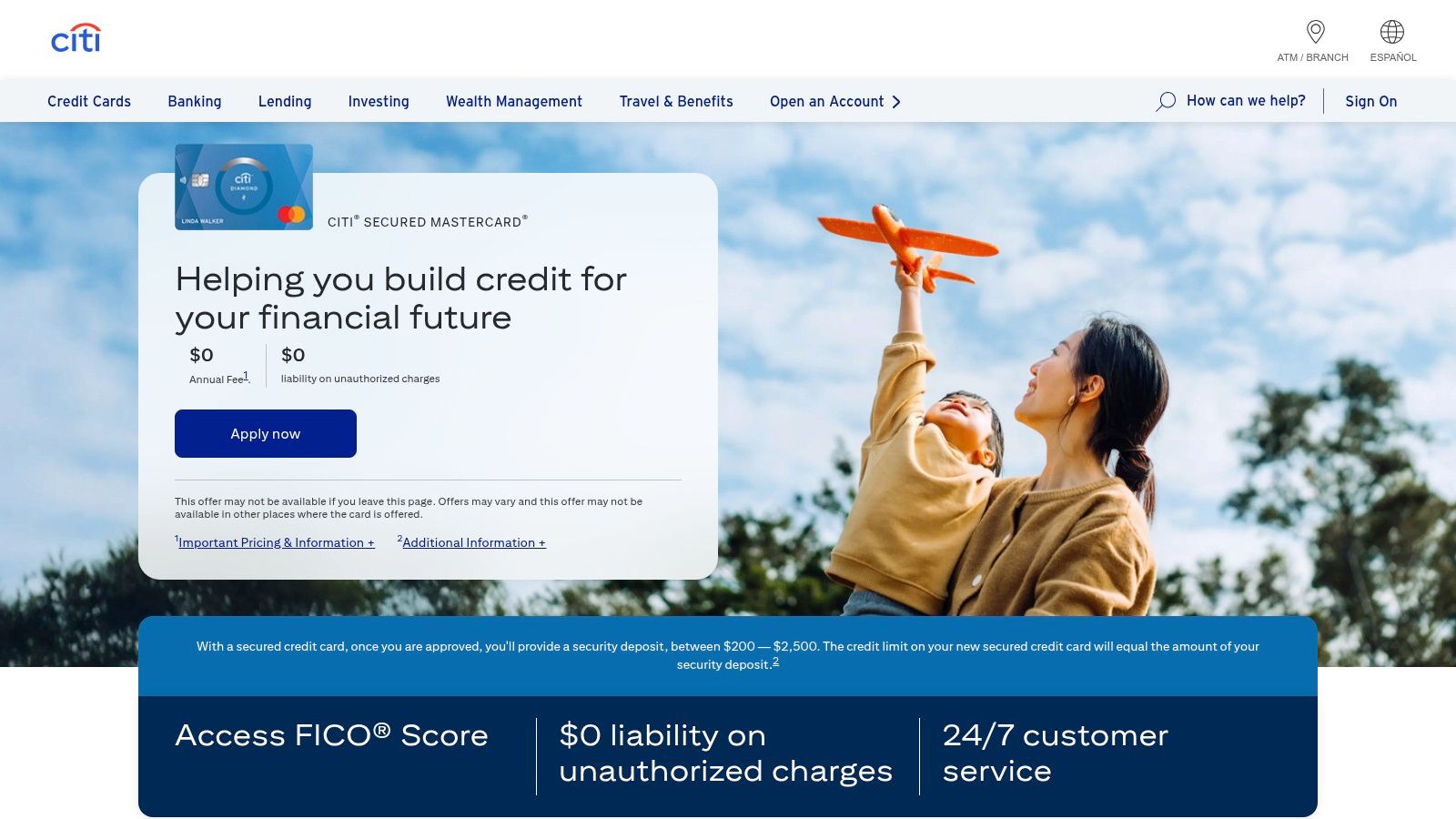
The card has no annual fee, and the refundable security deposit starts at $200 and can go up to $2,500. The deposit sets the credit limit, so the higher end can help if you want more room than many starter secured cards give you. That matters when you are trying to keep utilization low.
Who should look here
This card fits a reader who wants a plain rebuilding tool, not a rewards card, and who is no longer in the immediate post-discharge window. Citi also offers account alerts, autopay, and free FICO Score access, which are useful if you want to track progress without adding extra services. The trade-off is simple, no rewards, just a straightforward path for credit repair.
The decision point is timing. Recent discharge usually rules it out, so there is no reason to force the fit too early. If you are eligible, the larger deposit range can make the account easier to use than a very low-limit starter card, especially if you need a little more breathing room.
If you are at least two years past discharge, confirm the current deposit range on the Citi Secured Mastercard page before you apply.
7. Bad Credit Loan Types Compared Side by Side
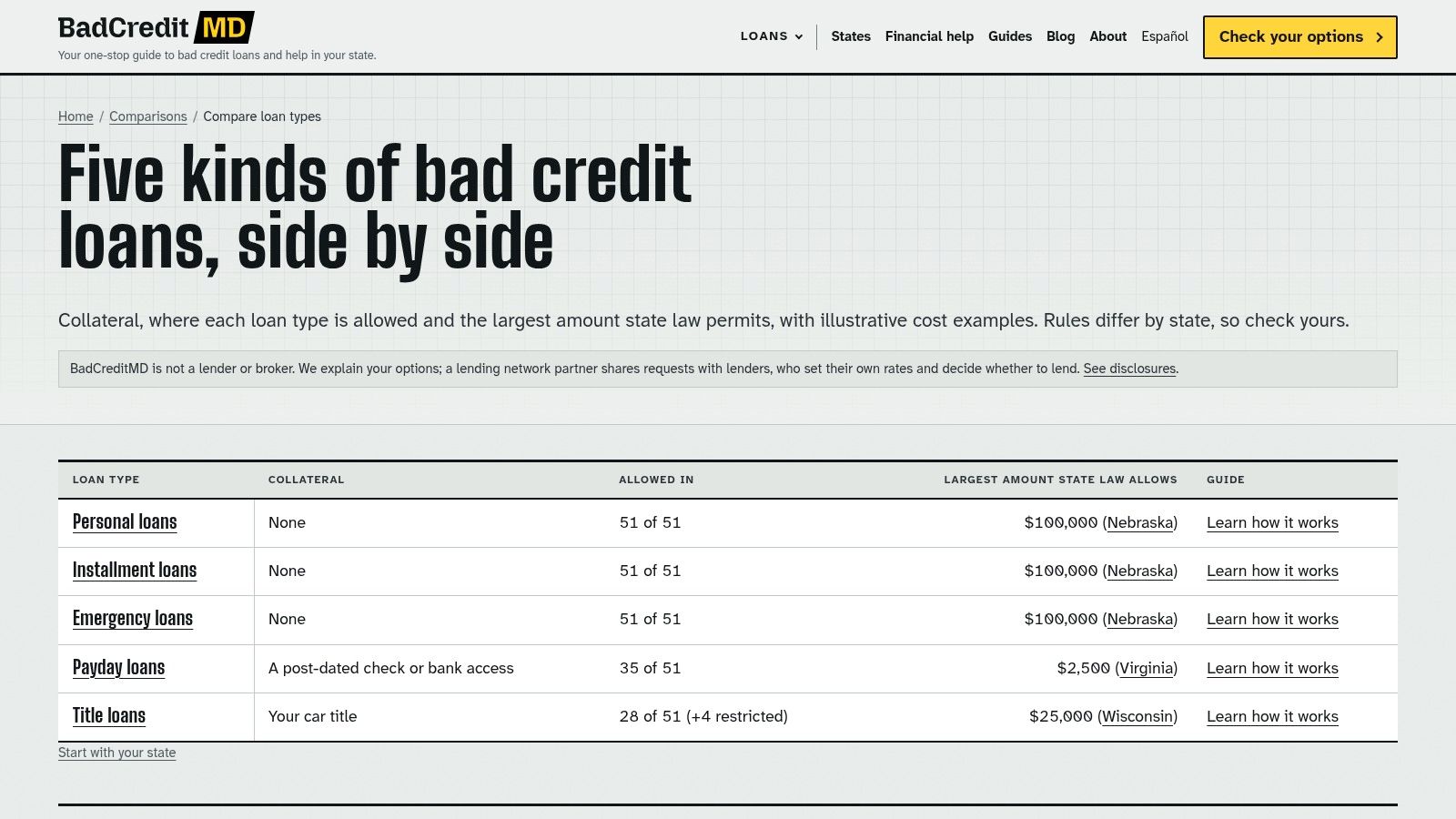
If your discharge left you choosing between a secured card, a loan, or no new credit at all, the comparison page is useful because it shows the trade-offs side by side. Cash flow matters here. A product that looks harmless on paper can be the wrong fit if the upfront cost or repayment schedule strains your budget.
The BadCreditMD comparison page is most helpful when you want to compare secured cards with credit-builder loans, credit-union PALs, installment loans, payday loans, and payment plans in one place. That matters because the right choice depends on timing and cost, not just approval odds. A secured card can help with revolving credit, but a loan or payment plan may be the better call if you need a fixed payoff path or want to avoid tying up money in a deposit.
Why compare before you apply
The page also points to state-specific guides, legal limits, regulator contacts, and worked cost examples. That gives you a clearer view of what is allowed where you live and what each option may cost in practice. For someone right after Chapter 7, that is more useful than a simple approval checklist.
It is also an editorial resource, not a lender or broker, so the framing stays on comparison instead of sales pressure. If your discharge left you with a $300 deposit budget and a utility deposit due the same month, those worked examples can show whether a $200 secured deposit, a payment plan, or a different borrowing option leaves more breathing room. That is the question to answer before you apply.
Use the BadCreditMD comparison page when you want a broader view of your options and need to judge a secured card against a loan or a payment plan. It helps when approval is only part of the decision.
Top 7 Credit Cards After Chapter 7 Discharge
| Product | 🔄 Implementation complexity | ⚡ Resource requirements | ⭐ Expected outcomes / 📊 Impact | 💡 Ideal use cases | Key advantages |
|---|---|---|---|---|---|
| OpenSky Secured Visa (Launch, Secured, Plus) | Low, no credit check; straightforward deposit-based approval | Variable refundable deposit by variant; some versions charge annual/monthly fees (e.g., $35/ $2/mo) | ⭐⭐⭐, reports to all three bureaus; predictable limits; higher APRs on some variants 📊 | Immediate post‑Chapter 7 when you want to avoid a hard inquiry | No‑credit‑check option; predictable approvals; variant with no annual fee |
| Capital One Platinum Secured Credit Card | Low–Moderate, income/debt review required; approval not guaranteed after bankruptcy | Refundable deposit tiers $49 / $99 / $200; no annual fee; variable APR | ⭐⭐⭐, reports to bureaus; upgrade reviews (~6 months) and path to unsecured 📊 | Rebuilders who can post a small refundable deposit and want quick graduation path | Very low minimum deposits; no annual fee; frequent upgrade reviews |
| Navy Federal cashRewards Secured (NFCU) | Moderate, membership required (military/DoD/veterans/family); automatic review cadence | Typical deposit ≈ $200 held in NFCU savings; $0 annual fee | ⭐⭐⭐⭐, reports to bureaus; automatic early reviews speed graduation; competitive APR examples 📊 | Eligible military/DoD/veterans rebuilding credit and seeking rewards | Unlimited 1% cash back; no annual fee; early automatic reviews; competitive APR |
| Discover it Secured Cash Back | Low–Moderate, issuer determines deposit tier; standard application review | Refundable deposit as low as $49/$99/$200 (issuer‑determined); no annual fee; category caps apply | ⭐⭐⭐⭐, earns cash back while reporting to bureaus; history of graduation to unsecured 📊 | Rebuilders who want rewards with no annual fee and a chance to graduate | Rewards with no annual fee; low deposit options; fraud tools (Freeze It) |
| Bank of America Customized Cash Rewards Secured | Moderate, periodic reviews; promotional terms to verify; deposit range flexible | Refundable deposit typically ~$200 min (up to $5,000); no annual fee; reward category caps/promos | ⭐⭐⭐, rewards-forward rebuilding; periodic reviews may return deposit and graduate account 📊 | Bank of America customers who want tailored cash-back while rebuilding | Selectable high‑cash category; no annual fee; integrates with BofA rewards |
| Citi Secured Mastercard | Higher, Citi excludes applicants with bankruptcy within last 2 years (eligibility restriction) | Refundable deposit $200–$2,500; $0 annual fee | ⭐⭐⭐, solid credit‑building via bureau reporting; no rewards (focused on rebuilding) 📊 | Rebuilders ≥2 years post‑Chapter 7 seeking straightforward credit building with higher limit options | No annual fee; flexible deposit caps; free FICO Score access |
| BadCreditMD “Bad credit loan types compared side by side” (hub) | Low, informational resource (not a lender); no application required | No deposit/fees to use site; links to lenders may trigger checks if you apply | ⭐⭐⭐, helps identify lawful, lower‑cost options and real costs by state; not an approval channel 📊 | Consumers seeking jurisdiction‑aware comparisons, cost examples, and safer alternatives post‑bankruptcy | Side‑by‑side standardized comparisons, state‑by‑state rules, worked cost examples, transparent editorial model |
Choosing Your First Card After Chapter 7
Start by confirming your discharge date and each issuer's current bankruptcy rules, because at least one option in this list asks applicants to be at least two years past a bankruptcy. Then compare the refundable deposit, annual fee, purchase APR, and whether the card reports to all three credit bureaus, using each issuer's own page rather than a summary. That's the cleanest way to avoid a card that looks easy but costs too much to keep open.
For most readers, the best first move is a secured card with clear reporting, a manageable deposit, and a fee structure that doesn't eat the account alive. If membership gets you into a better product, like Navy Federal's secured card, that can be worth pursuing. If you're focused on the smallest possible barrier to entry, OpenSky and Capital One's secured options are stronger starting points, while Discover and Bank of America make more sense if rewards matter and you can keep balances low.
Once a card is open, pay the balance in full when possible and watch for periodic reviews that may return the deposit or allow graduation. That's the true rebuild path, because the credit-building value comes from reported on-time payments and low utilization, not from carrying interest. If you need help beyond a card, BadCreditMD's directories point to 211, nonprofit credit counseling, legal aid, and the CFPB complaint process. Reading those guides has no effect on your credit.
BadCreditMD explains credit-building tools, debt options, and state-level borrowing rules in plain language so you can compare choices without guessing. If you're sorting through the best credit cards after Chapter 7 discharge, visit BadCreditMD for practical guides, safer alternatives, and free local help when you need a next step.