A borrower with bad credit should expect roughly 20% to 36% APR on many installment and personal loans, a ceiling of 28% on a federal credit union payday alternative loan, and about 391% on a typical two-week payday loan. The Consumer Financial Protection Bureau's payday figures and the National Credit Union Administration's small-loan ceiling are the two landmarks that turn that spread from a slogan into something you can check.
APR for bad credit is not one price. It is a yearly yardstick, and the yardstick changes with the product, the state, the lender, and how many days you keep the money. On identical $1,000 offers, a longer term can outweigh a lower headline rate, so the gentler monthly bill can still be the more expensive loan. A payday APR looks extreme because a flat fee is squeezed into about two weeks. You still have to set that dollar repayment next to the installment total before you decide which offer you can live with.
Table of Contents
- Typical APR Ranges for Bad Credit Loans
- What APR Measures and Why It Matters
- How Fees and Short Terms Push APR Higher
- Comparing Real Offers on Total Repayment
- Hidden Costs and Misconceptions About APR
- Confirm the Total Cost Before You Sign
Typical APR Ranges for Bad Credit Loans
Someone with bad credit can see an APR near 20% on some subprime installment and revolving credit, a band of 24% to 36% where state law caps storefront installment loans, and several hundred percent on a single-payment payday loan. Treat the rows below as a map of markets, not as the rate a lender has already approved for you.
| Loan type | Typical APR | Why the number differs |
|---|---|---|
| Credit union Payday Alternative Loan (PAL) | Up to 28% | NCUA interest-rate ceiling for federal credit union small loans |
| Subprime and deep-subprime borrowers, average effective rate (2018) | About 21% | Mix of installment and revolving credit at higher risk pricing |
| Credit card interest, average (2019) | 16.04% | Revolving credit, a prime-market benchmark, not a bad-credit product |
| Storefront installment loans in states with rate caps | 24% to 36% | Set by state law for near-prime and subprime borrowers |
| Storefront installment loans in states without rate caps | 50% to 90% | No state ceiling, so the lender and the state set the price |
| Payday loan at $15 per $100 for 14 days | About 391% | Fixed fee compressed into one short repayment period |
Why the bands sit so far apart
Product type, repayment length, state law, and the lender's reading of risk all move the number. In a 2021 research brief, the Consumer Financial Protection Bureau reported that the average effective interest rate for subprime and deep-subprime borrowers was approximately 21% in 2018, while the average APR on revolving credit cards that assessed interest was 16.04% in 2019. The same brief set those figures against a typical payday fee of $15 per $100 for two weeks, an APR equivalent of nearly 400%, and a representative $350 payday loan at a 391% APR.
Storefront installment pricing is a different market again. A Federal Reserve overview of consumer credit found reported APRs of 24% to 36% for near-prime and subprime borrowers in states with caps, and 50% to 90% at storefronts in states without installment-loan rate caps. A federal credit union PAL sits under its own ceiling, up to 28%, which is why it belongs on this map even when a payday shop on the same street does not.
If a bankruptcy is part of the file, the rate bands still apply, but the paperwork and waiting periods change. The steps to financing after Chapter 7 from LifeBack Law Firm, P.A. walk through what lenders usually ask for once a case is discharged. Pair that with a clear look at installment loan interest rates before you treat any row here as your offer.
These bands are a starting map. The APR on your disclosure is the only number that belongs to your loan, and the rest of this walk-through turns each percentage into dollars you would actually repay.
What APR Measures and Why It Matters
APR works a lot like miles per gallon. It puts two loans on the same yearly scale so you can compare them, and it says nothing about how long you will keep the money or how many dollars will leave your account.
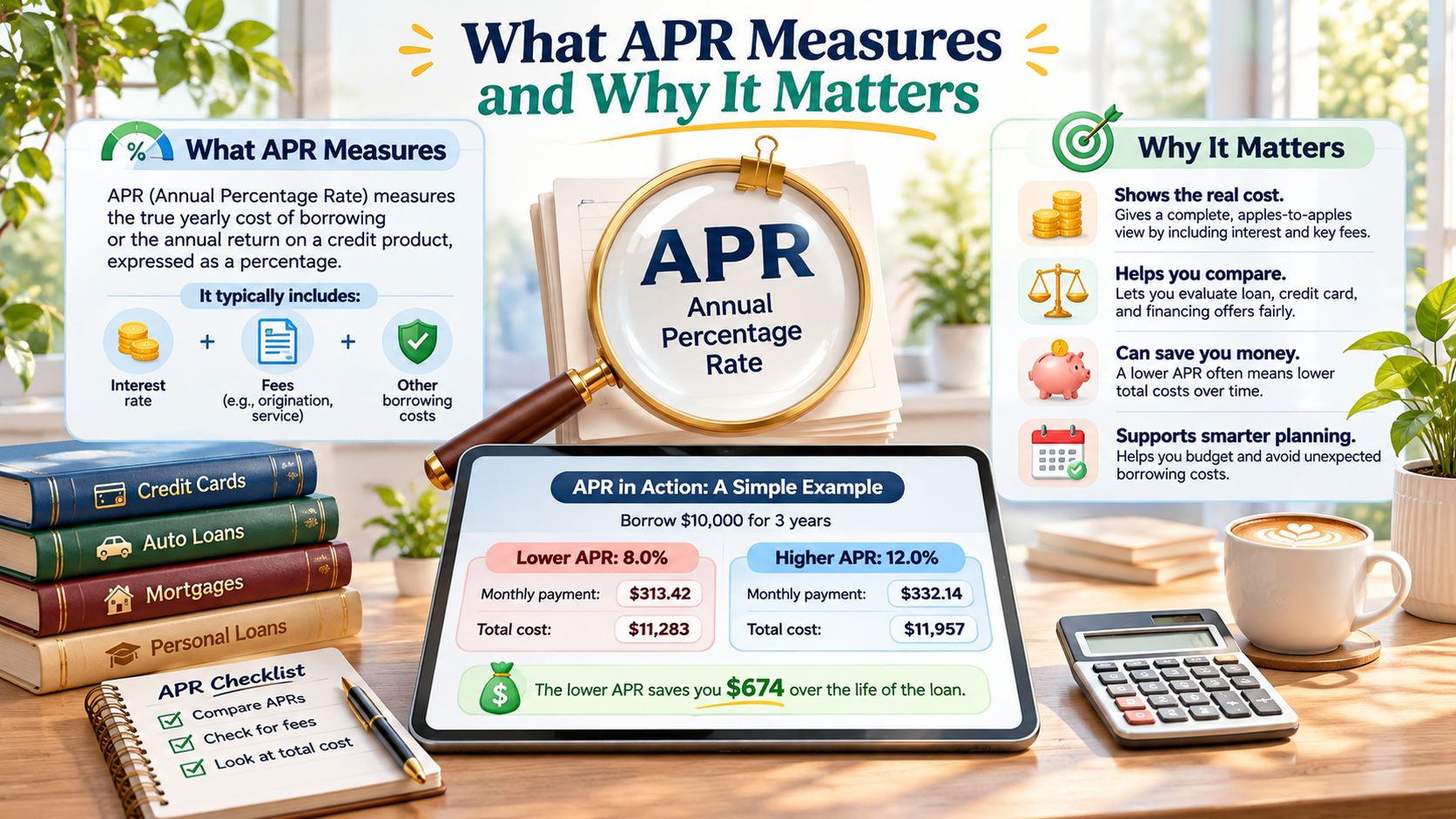
APR is the yearly cost of borrowing, written as a percentage of the amount borrowed, and it folds in interest plus mandatory finance charges. The nominal interest rate is only the interest piece. Lenders sometimes quote that rate in the ad and leave the fee for the paperwork.
A fee that the interest rate hides
Say you are offered $1,000 at 24% interest, and the lender takes a 5% origination fee, which is $50, before you ever see the cash. You pay interest on the note, and you also pay that $50 for the privilege of borrowing. Because APR counts mandatory fees as part of the price of the money, the APR lands above 24% even though the interest line on the contract still says 24%. If the disclosure shows only the interest rate, ask which charges were left out.
APR prices the money for a year. It does not price the whole loan. A high APR on a couple of hundred dollars for two months can cost fewer dollars than a lower APR on a large balance held for several years, because the second loan keeps charging interest on a big balance for a long time. That is the gap people miss when they shop by the percentage alone.
Bad credit often changes both the price and the shape of the loan. Lenders who see more risk tend to charge more, and they often stretch the schedule so the monthly bill still fits a paycheck. You can end up with a higher rate and more months of that rate at the same time. The useful habit is to separate three numbers every time: the interest rate, the APR, and the total of all payments.
Practical rule: If two offers name the same APR, check the cash you receive, the fee taken up front, and the number of payments before you call them equal.
How Fees and Short Terms Push APR Higher
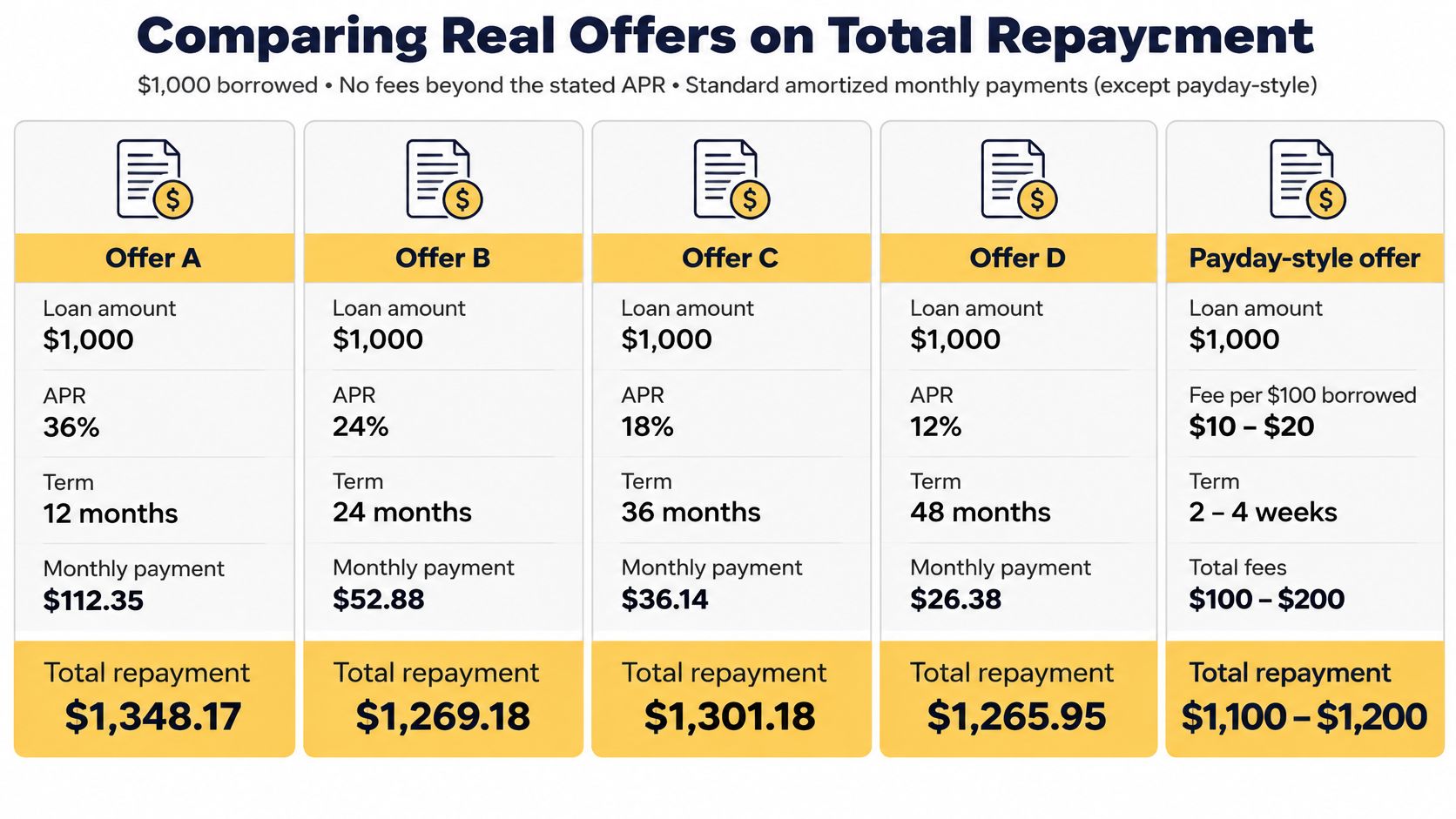
A payday-style fee looks small until you stretch it across a year. The picture below sets short, fee-based borrowing next to installment offers so the yearly rate and the cash you repay are visible at once.
Turn the fee into a yearly rate
The CFPB payday white paper is the worksheet for this arithmetic. Follow it in order.
- Start with the fee per $100. Payday lenders commonly charge $10 to $20 per $100 borrowed. The median in that sample is $15 per $100 on a typical 14-day, single-payment loan.
- Turn the fee into dollars on a real check. On a representative $350 loan, $15 per $100 is $52.50. You would owe $402.50 after 14 days, before any rollover or late charge.
- Annualize it. Divide the fee by the amount borrowed ($15 / $100 = 0.15), then multiply by how many 14-day periods fit in a year, about 26. That is 0.15 times 26, or roughly 3.91, which is a 391% APR. The same $15 fee, repeated on that short clock, is what produces the huge percentage.
The duration is the whole trick. Fifteen dollars on a hundred does not look like a 391% price until you pretend the borrower pays that toll every two weeks for a year. The APR assumes that pattern so loans of different lengths can share one scale. Your actual cost is whatever you pay on the dates in your contract.
What makes the dollars climb after that
A rollover or renewal usually charges the fee again while the principal stays put. Two cycles on that $350 example are two fees, not one, and the amount you owe the lender grows even though you did not borrow more cash. A missed payment can add a late charge and can start collection activity. Short-term loans are costly and are not a long-term financial solution, so borrow only what you can repay on time.
An installment loan reads differently because each scheduled payment reduces principal. A fee, if there is one, is spread across those payments instead of being due in one balloon two weeks out. That is the practical split in installment loans versus payday loans. The 391% figure describes the CFPB's payday sample. It is not the rate on every personal or installment loan offered to someone with bad credit.
If you want the same idea in a short walk-through, this video shows how a finance charge becomes an annual percentage.
Compare total dollars, the day the money is due, and whether a renewal is even allowed. APR is the translator. It is not the bill.
Comparing Real Offers on Total Repayment
The trap is the smaller monthly payment. Stretch a 36% loan from one year to two and the bill drops by about forty dollars a month, while the interest you pay roughly doubles. The four installment rows below use the same $1,000, no extra fees, and standard amortized monthly payments. Figures are rounded. A fifth row is a payday-style fee so you can see a short balloon next to a year or two of installments.
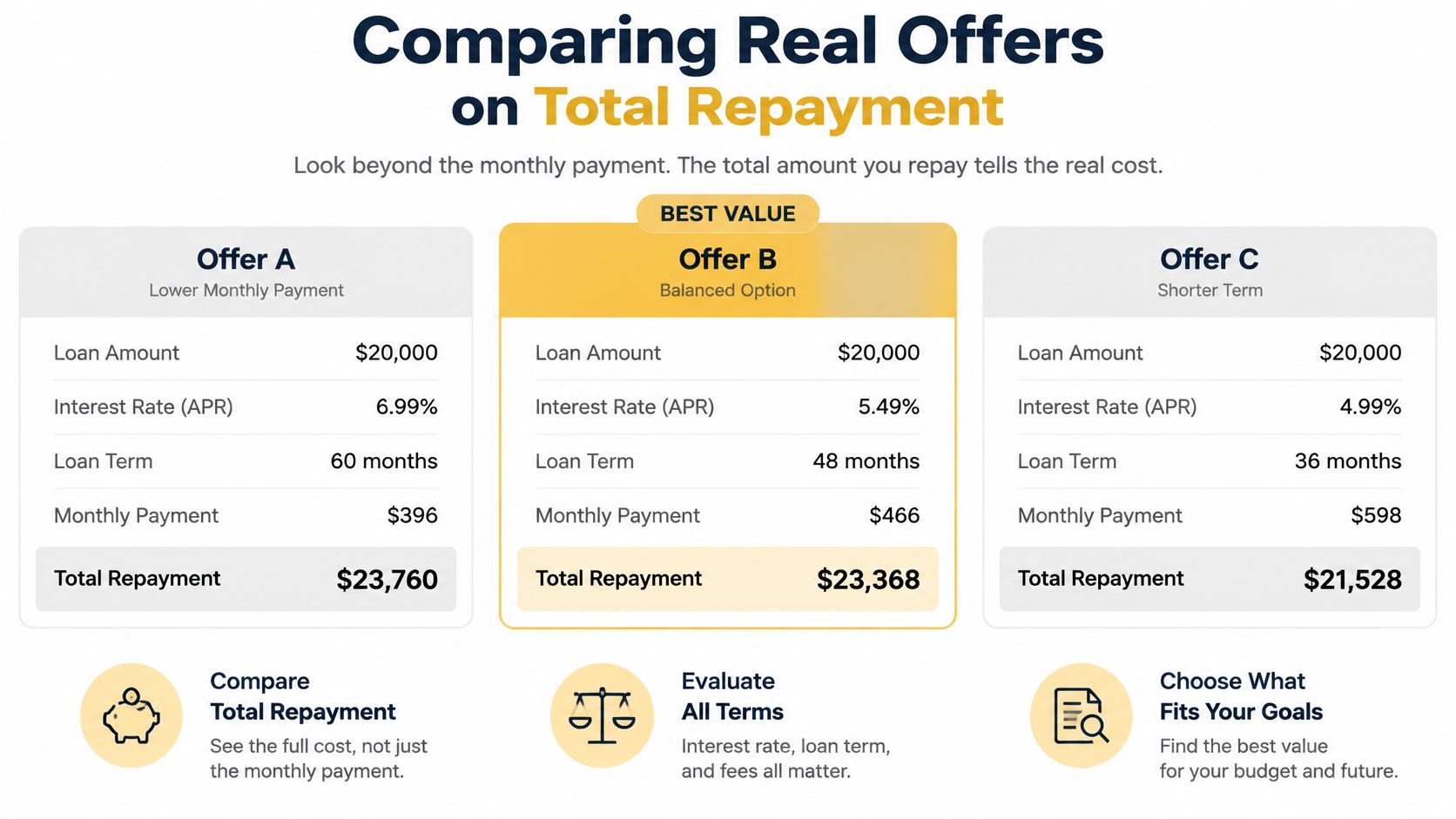
| Offer | APR | Term | Monthly payment | Total repaid | Interest or fee |
|---|---|---|---|---|---|
| A | 36% | 12 months | about $100.46 | $1,205.52 | $205.52 |
| B | 24% | 12 months | about $94.56 | $1,134.72 | $134.72 |
| C | 36% | 24 months | about $59.05 | $1,417.20 | $417.20 |
| D | 24% | 24 months | about $52.88 | $1,269.12 | $269.12 |
| Payday-style | About 391% | 14 days | one payment of $1,150 | $1,150 | $150 fee |
What the rows actually prove
Offer A and Offer C share a 36% APR. Offer C's payment is easier to clear on a tight week, and it also costs $417.20 in interest, about twice Offer A's $205.52. Offer D beats Offer C on both the rate and the total, yet Offer D still costs more interest than Offer A, even though 24% sounds kinder than 36%. The term did more work than the headline.
The payday-style row is a $15 per $100 fee on the same $1,000, due on day 14, for $1,150 back. That single fee is less than Offer A's interest and far less than Offer C's. It is also due all at once, with no principal paid down along the way. If you cannot produce $1,150 on that date, the cheap-looking fee is the start of another fee, not the end of the loan.
A lower-cost benchmark is a federal credit union PAL. The NCUA interest-rate ceiling guidance states an applicable ceiling of 28%. At that nominal annual rate, $500 outstanding for 90 days generates about $34.52 in simple interest before any permitted fees. A 15%-per-$100 payday fee on the same $500 would be $75, due much sooner. Installment payments chip away at principal. A payday product usually wants one balloon and prices the access with a flat fee. Not every credit union offers a PAL, so confirm the program before you count on it.
A three-step screen
Match the amount and the term first, or you will praise a payment that only looks small because it lasts longer. Then compare total repaid, including every mandatory fee. Only after those two match do you use APR to break a tie. Our page on how to compare loan offers safely keeps that order in one place.
Some people use collateral instead of an unsecured note when the cash has to arrive the same day. The Boise guide to fast collateral cash from Idaho Pawn & Gold Exchange shows how a pawn differs from a personal loan, including what you leave at the counter and what happens if you do not redeem it. Run that choice through the same total-repayment test. A fast payout is not a cheap payout unless the dollars say so.
Hidden Costs and Misconceptions About APR
The charge most likely to undermine a “low APR” offer is an origination or processing fee deducted from the proceeds. You might sign for $1,000, receive $900, and still owe interest on the full $1,000. The missing $100 is part of the cost of borrowing even when the lender calls it a processing charge. APR works like a receipt for mandatory finance charges: a quoted percentage that leaves one out understates the actual cost.
Other charges sit beside the APR or become due only when something goes wrong:
- Late fees and returned-payment fees: A single missed draft can cost more than a week of interest on a small loan. Some contracts add another fee when the bank sends the payment back.
- Rollover or renewal fees: Renewing a short-term product can mean paying the fee again without reducing the principal already borrowed.
- Prepayment penalties: A penalty for paying early can erase the interest you expected to save with a tax refund or extra income.
- Add-on products: Credit insurance, roadside clubs, and similar bundles can be financed into the note. An unwanted add-on increases the amount financed.
State law sets the ceiling
Crossing a state line can change whether the same small loan is capped. For a six-month $500 installment loan, a Federal Reserve community-context note reports that 45 states and DC impose caps, the median cap is 39.5%, and 13 states allow caps above 60%. An APR quoted online therefore may not describe the range legally available where you live. Payday loans, title loans, and some online installment loans can carry very high fees or APRs, making the applicable state rule especially important.
Four ideas that cost people money
- A lower monthly payment always means a cheaper loan. On identical $1,000 offers, stretching the term can lower each draft while increasing the total repaid. Payment fit protects your budget; total repayment measures the price.
- APR and the interest rate are interchangeable. They match only when no mandatory fee applies. A 24% rate with a prepaid fee produces an APR above 24%.
- A two-week term makes a payday loan manageable. A flat fee squeezed into a short term creates an extreme annualized figure. The practical comparison is still the dollar fee and the full balloon due; a renewal repeats the fee without retiring principal.
- An “around” APR is precise enough. “Around 36%” can conceal a fee, a longer term, or an add-on. The disclosed APR and attached payment schedule provide the figures a lender can be held to.
Confirm the Total Cost Before You Sign
Bring a pen and the lender's own numbers. A verbal quote is not a cost.
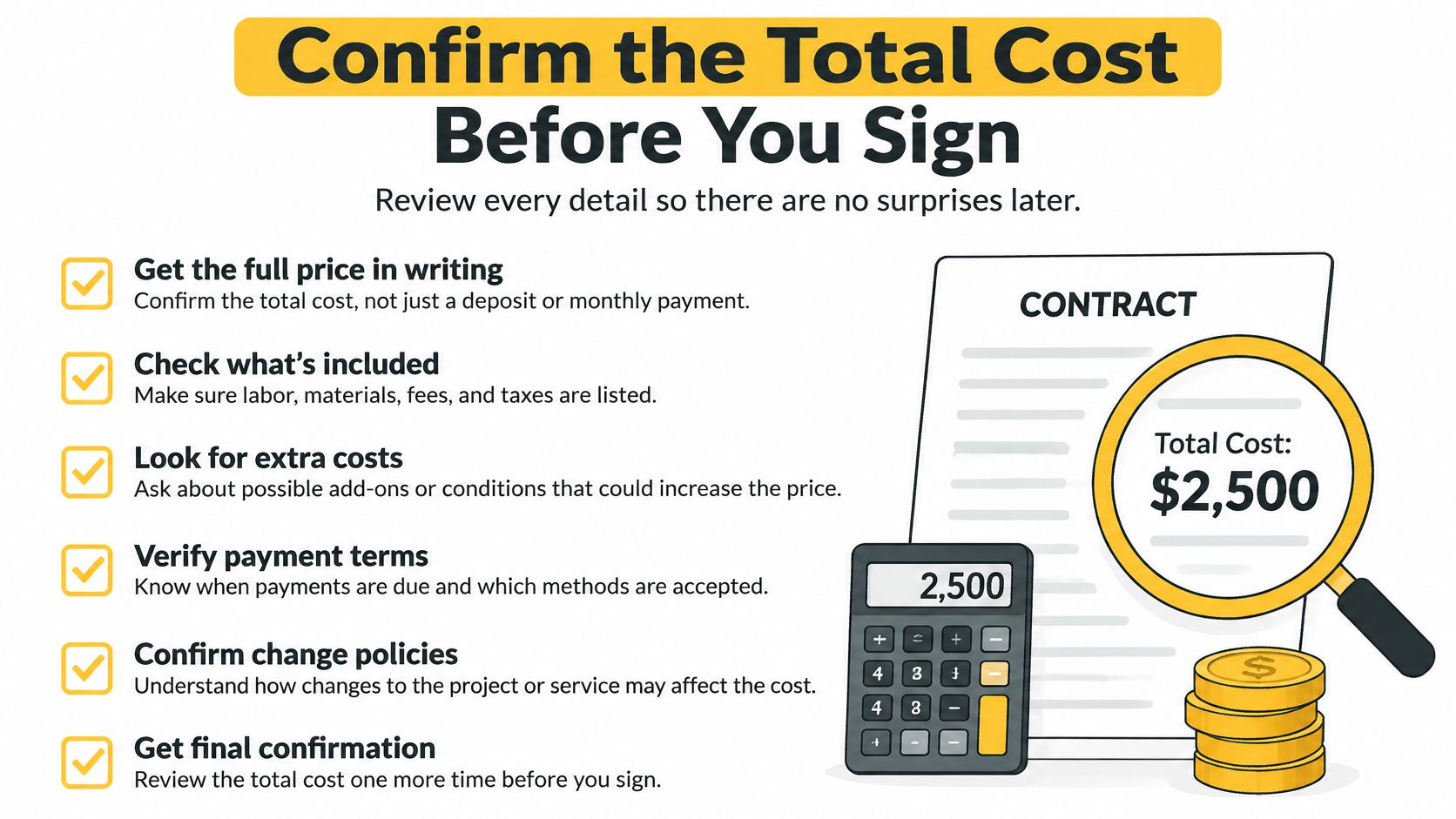
Run this list on the paperwork
- Ask for the total of all payments in writing, not just the APR or the monthly draft.
- Confirm the APR includes every mandatory fee, and that the cash you receive matches the amount you meant to borrow.
- Read the payment schedule and due dates, including what happens on a holiday or if payday falls on a weekend.
- Compare at least three offers at the same amount and the same term, using total repaid first.
- Verify the loan type is allowed where you live and whether your state caps the price.
- Borrow only an amount you can repay on time without another loan to cover the first one.
The same checks belong on our loan agreement checklist if you want them on one page while you are on the phone with a lender.
If the totals do not fit, stop. A credit union PAL or a credit-builder loan is often a better next call than a renewal. Dial 211 for local assistance with rent, utilities, and other bills that might remove the need to borrow at all. Nonprofit credit counseling, which we list for help with a budget or a debt management plan, can also put the monthly numbers in order before you sign. If a lender will not give you the figures, or the contract does not match the quote, legal aid and the CFPB complaint process are the routes for that problem.
Reading loan guides, state guides, and resources on BadCreditMD never affects your credit. Any credit check happens only if you submit a request, and that request is what allows lenders to look at your file.
What you read here is general information about loans and state rules. It is not legal or financial advice. Confirm the APR, the fees, and the schedule with the lender, and confirm the cap with your state regulator, before any money moves.
BadCreditMD is a free guide to bad-credit loan options, state rules, and local help, including how APR turns into a real repayment on installment, payday, and credit union alternatives. You can look up the loan types we explain and the caps that apply in your state before you sign anything. Start with the comparisons on BadCreditMD and match them against the disclosure a lender hands you.