
A $5,000 card balance at a 24% APR can feel hard to get ahead of, especially if your credit score is around 540 and ads promise a quick “balance credit loan.” The name sounds like one product, but lenders and debt helpers may use it to describe several very different options. Before applying, identify what the offer does, what it costs in total, and whether its payment fits your budget.
“Balance credit loan” is an umbrella term for borrowing or credit tools that may help you manage existing debt, or build credit for future borrowing.
The three products most often confused are balance-transfer cards, debt-consolidation personal loans, and credit-builder loans. A balance transfer is like moving a box to a shelf with a rent-free period. A consolidation loan is like signing one new lease to clear several old ones. A credit-builder loan is more like saving money while building a rental reference: it can help create a payment history, but it doesn't pay off your existing card.
“Balance credit loan” isn't a standard product that every lender must offer. Ask which mechanism you're being offered, who makes the credit decision, and what you'll owe if you don't repay on schedule. The right choice depends on both all-in payoff cost and whether your credit file can qualify. BadCreditMD is an information resource, not a lender, and doesn't make credit decisions.
Table of Contents
- Three Balance Credit Loans Compared at a Glance
- Pricing a Balance Transfer Before You Apply
- Consolidation and Credit-Builder Loans for Low Scores
- Repayment Traps That Turn Balance Loans Into More Debt
- How to Verify a Lender or Debt Helper Before Paying
- Non-Loan Routes When Payments Are Unaffordable
- Choose the Balance Loan Your Credit Can Support
Three Balance Credit Loans Compared at a Glance
| Product | What It Does | Typical Cost | Credit Needed | Fit for Bad or Thin Credit |
|---|---|---|---|---|
| Balance-transfer credit card | Moves card debt to a new card | Transfer fee; temporary promotional APR, followed by the card's regular APR | Usually good credit; approval isn't assured | Low; approval is uncertain |
| Debt-consolidation personal loan | One fixed-payment loan pays several balances | Interest and possibly an origination fee; compare the total repayment with current card costs | Lender-specific; a low score may limit approval or worsen the rate | Moderate; worthwhile only if the APR and fees beat your current card costs |
| Credit-builder loan | A lender holds the loan funds while you make payments that build credit history | Interest or fees may apply; check the agreement and the amount released at the end | Little or no prior credit may be needed | High for thin files; doesn't reduce existing debt |
| Payday-style loan, for contrast | Provides short-term cash due on your next payday | The fee and repayment date are set by the lender and applicable state rules; check the full cost | Usually requires income and a bank account | Not a balance solution; avoid using it to pay off debt |
Start with the credit-needed column. A product that looks inexpensive on paper won't help if you can't qualify, or if the offer you receive has a much higher rate than the one advertised. For a thin or damaged credit file, approval, credit limit, and pricing can be lender-specific, so don't treat a promotional offer as guaranteed.
Then compare the product's purpose with your goal. A transfer card or consolidation loan may move existing debt, but each has costs that can reduce or erase the benefit. A credit-builder loan serves a different purpose: it may help establish a payment record, but you'll still need a separate plan to pay the card balance. A payday-style loan can add a short deadline and high costs without changing the underlying repayment problem.
Pricing a Balance Transfer Before You Apply
Think of the transfer fee as a toll for moving onto a faster road. A promotional rate can help you make progress, but only if you keep paying down the balance before the promotion ends. The new issuer sets a credit limit, uses it to pay the old card, and adds any transfer fee to the new balance.
| Amount Transferred | Fee at 3% | Fee at 4.3% | Fee at 5% |
|---|---|---|---|
| $2,000 | $60 | $86 | $100 |
| $5,000 | $150 | $215 | $250 |
The monthly payoff targets below include the transfer fee and divide the total equally across 15 months. They assume no new purchases, no other fees, and no interest during the promotional period.
| Amount Transferred | Total at 4.3% Fee | Monthly Target Over 15 Months |
|---|---|---|
| $2,000 | $2,086 | $139.07 |
| $5,000 | $5,215 | $347.67 |
The Consumer Financial Protection Bureau's credit card market report found that the average balance-transfer fee among the 25 largest card issuers was 4.3% in the second half of 2024. At that rate, a $5,000 transfer brings an upfront fee of $215. That charge matters even if the promotional APR is 0%, because it increases the amount you have to repay.
Use this six-step test before you apply:
- Add the balance and fee. With a $5,000 transfer and a 3% fee, you'd start with $5,150 to repay.
- Divide by the promotional months. Paying off $5,150 over 15 months takes about $343.33 a month. At the 4.3% average fee in the example above, the target is about $347.67.
- Check your budget. Can you make that payment after housing, food, utilities, transport, and other essentials, without relying on new purchases?
- Estimate the interest you could avoid. For a simple estimate, multiply the current balance by its APR and the promotional period in years. A $5,000 balance at 24% over 15 months gives a rough estimate of $1,500 in interest before accounting for payments reducing the balance. Your actual savings will generally be lower as you pay down the principal.
- Subtract the costs. Compare the interest avoided with the transfer fee and other charges. The CFPB's explanation of APR and credit-card terms explains that APR is an annualized measure that includes interest and applicable fees. A promotional APR alone doesn't tell you the all-in cost.
- Check the end date and late-payment terms. Find the regular APR that applies when the offer ends, and read the terms for missed payments. A payment more than 60 days late may trigger a higher rate on balances, including a transferred balance.
If you're unsure how the transfer works in practice, this guide to how to transfer credit card balances can help you understand the steps to confirm with the issuer. For a wider view of how borrowing costs affect repayment, compare the offer with this explanation of what bad-credit loans really cost.
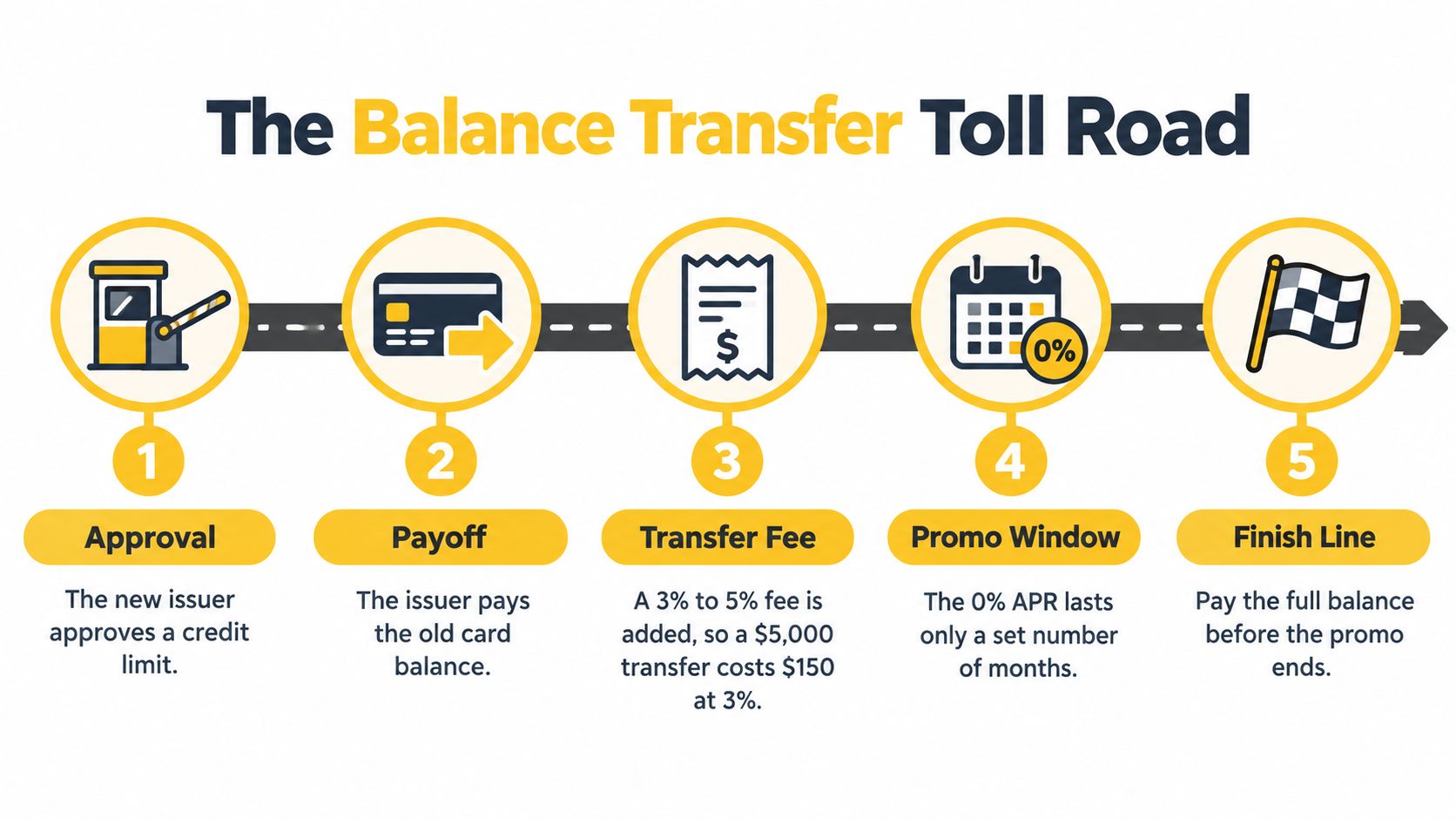
A 0% promotion is never zero cost if the issuer charges a fee up front. A transfer may still be useful when the interest avoided exceeds the fee and you can afford the payoff target. If the required payment would strain your budget, the promotional rate may only postpone the problem.
Consolidation and Credit-Builder Loans for Low Scores
Debt-consolidation personal loans
A consolidation loan pays off several card balances and replaces them with one installment loan, usually with a fixed payment and a defined end date. That can make budgeting easier, but it doesn't automatically make the debt cheaper. For a borrower with a low score, the offered APR may be higher, and an origination fee can add to the amount borrowed.
Analogy: It's like replacing several bills with one new lease. The paperwork gets simpler, but the new deal only helps if the total cost is lower.
Compare the loan's full repayment amount, including fees, with what you'd pay on the cards under a realistic payoff plan. Don't compare only the new monthly payment with your current minimums: a smaller payment can result from a longer repayment period and more interest overall. For ideas about reducing card debt without taking out another loan, see this guide to DIY credit-card strategies.
Low-score test: A consolidation loan is worth considering only if you qualify for terms that lower the total cost and the fixed payment is affordable.

Credit-builder loans
A credit-builder loan doesn't pay off a card. A credit union or community lender holds the loan proceeds while you make scheduled payments, and the lender may report those payments to credit bureaus. When the term ends, you receive the money held for you, minus any applicable costs. Think of it as a savings goal that can also create a record of on-time payments.
The trade-off is that you're making payments while still carrying your existing debt. Use this product alongside a realistic card payoff plan, not as a substitute for one. A credit-builder loan fits a low score only when the payment is already affordable and building payment history is part of your goal.
A credit union may also offer a payday alternative loan, or PAL, to eligible members facing a short-term expense. Check the credit union's membership rules, fees, repayment schedule, and loan terms. It's a separate borrowing option, not a way to lower card interest automatically.
The video below discusses credit-card repayment choices and the decisions to weigh before taking on another loan.
Repayment Traps That Turn Balance Loans Into More Debt
A transfer changes the lender and the terms, but it doesn't erase the debt. The balance still needs to be paid, and a card can make the problem worse if you use it as usual while trying to repay the transfer.
Trap one: Separate balances
A card can track purchases, cash advances, and balance transfers separately, with different APRs. The CFPB's guide to credit-card contract definitions explains that these balances may have different rates and payment rules. If you transfer a balance at 0% but keep charging everyday expenses, you may add a second balance that accrues interest at the purchase rate.
Example: You transfer a card balance, then use the new card for groceries and fuel. The transfer balance may stay under the promotion while new purchases accumulate at a higher APR.
Trap two: A grace period that doesn't apply
A card's grace period depends on its terms and the balance involved. When you're carrying a balance, new purchases may start accruing interest from the transaction date instead of receiving the grace period you're used to. Don't assume that a 0% transfer makes new spending on the card interest-free.
Trap three: Losing the promotional terms
The agreement may allow the rate to rise after a late payment. The CFPB says a payment more than 60 days late may trigger a higher rate on balances, including the transferred amount. Set reminders or automate at least the minimum payment, then direct extra cash toward clearing the transfer before the promotion ends.
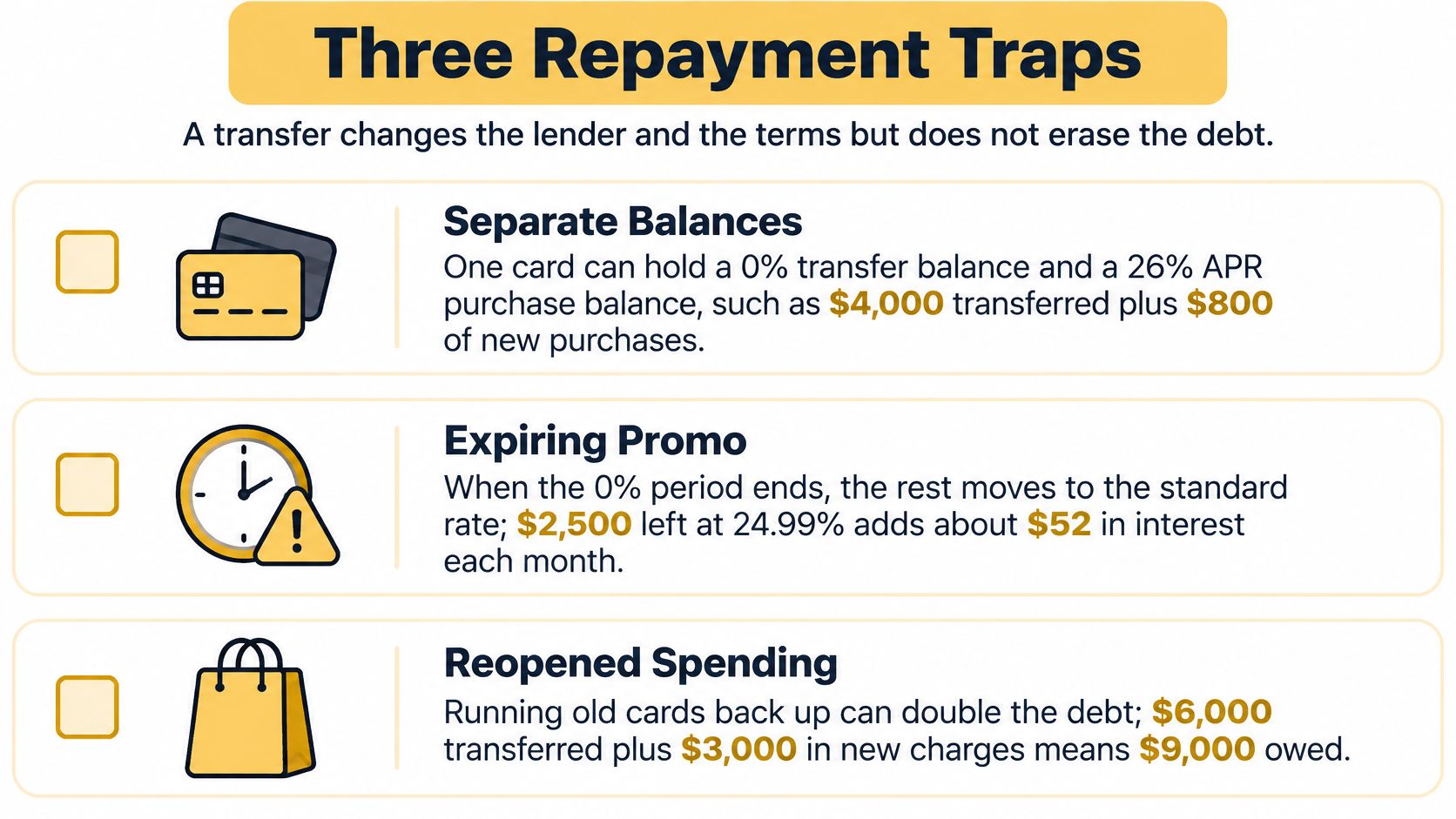
Use a disciplined sequence: keep paying the old account until the transfer is confirmed, stop using the new card for purchases, automate at least the minimum, and pay enough each month to clear the balance before the promotional deadline. A declined application can also leave you without the planned option, so check whether pre-qualification is available and consider a creditor payment plan or nonprofit counseling before applying to multiple lenders.
How to Verify a Lender or Debt Helper Before Paying
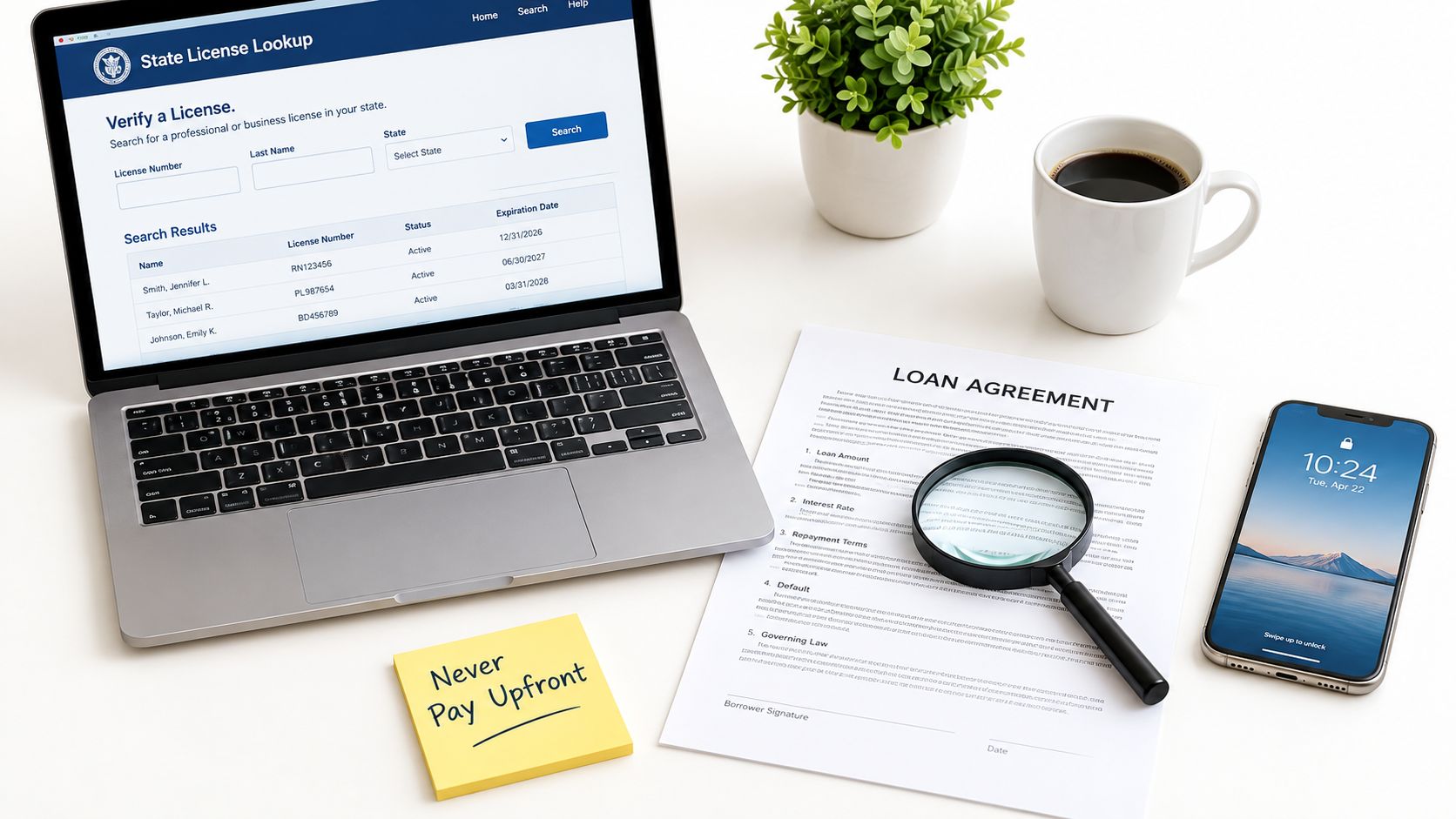
Don't send money before the promised help is delivered. A lender, debt-management provider, settlement company, and referral network are not the same thing. Before sharing personal or financial information, find out who you're dealing with and what the company will do.
- Identify who makes the decision. Ask whether the company is the lender, a debt-management provider, a settlement company, or a referral service that passes your request to other businesses. If someone else will decide whether to lend, ask who that is and how your information will be shared.
- Confirm how creditors get paid. Find out whether the lender pays creditors directly or sends money to you. If an intermediary handles payments, get the schedule and the process for confirming each payment in writing.
- Get every fee in writing. Check for origination, transfer, account, or monthly service charges. Ask what you'll owe in total and what happens if you stop or cancel the service.
- Check state rules. Look up the company and product with your state banking regulator or other relevant state regulator. State rules differ, so don't assume an online offer is allowed or priced the same everywhere.
- Don't pay an intermediary before funds are disbursed or help is delivered. Save copies of the agreement, payment records, and messages.
The FTC's advice on spotting debt-relief scams warns consumers not to pay a debt-relief company before it provides help and to get agreements in writing. It also says a credit-repair company can't legally remove accurate, current negative information from a credit report.
Watch for pressure to act immediately, claims of “guaranteed approval,” or an offer that promises a much lower monthly payment without explaining the repayment term and total cost. A lower payment may mean you'll be paying for longer, not that you'll pay less overall.
If a company misled you or mishandled your request, you can contact the Consumer Financial Protection Bureau, the Federal Trade Commission, or your state attorney general or banking regulator. Keep your agreement and communications available when you file a complaint.
Non-Loan Routes When Payments Are Unaffordable
If your current minimum payments already don't fit your budget, taking on a new loan may not be the cheapest first move. Start with options that can lower pressure or organize repayment without adding another balance.
- Call each creditor. Ask about a hardship program, a reduced payment plan, or other account-specific support. Get the terms in writing before you change what you pay.
- Contact a nonprofit credit counselor. Ask whether a debt-management plan could organize payments to participating creditors without a new loan. Request the full fee schedule and confirm which accounts would be included.
- Look for help with essentials. Contact 211 for local information about assistance with food, utilities, and housing. If support frees up money for bills, you may be able to make a workable debt payment without borrowing.
- Get legal help about collection threats. If a collector threatens a lawsuit or wage garnishment, contact legal aid or another qualified legal service to discuss your options.
- Ask your credit union about short-term alternatives. If you belong to one, ask whether it offers a payday alternative loan and what its terms are before considering a high-cost short-term loan. For a plain-language comparison, read about installment loans versus payday loans.
These routes don't all reduce the amount owed, but they may help you respond without opening another account. A credit-builder loan is a separate choice for building payment history, and it makes sense only if its payment fits after essentials and required debt payments. Some assistance or repayment arrangements may affect your ability to take on new credit, so understand the terms before choosing them over a transfer offer.
Choose the Balance Loan Your Credit Can Support
Good credit, with a balance you can clear during the promotion: A balance-transfer card may reduce interest costs if you qualify, the fee is smaller than the interest you'd otherwise pay, and the payoff target fits your budget. Don't count on paying it off “somehow” later. Choose it only when you have a credible month-by-month plan.
Fair credit and a need for one predictable payment: Compare a consolidation loan with your current card costs. Include any origination fee and the full repayment amount, not just the monthly installment. A lower payment isn't a saving if the loan keeps you in debt longer.
A thin file or low score, with no room for a larger payment: A credit-builder loan may support credit history but won't pay off existing balances. A credit union PAL may help with a separate urgent expense if you qualify. Pair either with a plan for the card debt.
Minimum payments already unaffordable: Start with creditor hardship programs, nonprofit counseling, and local assistance before submitting new credit applications.
Finish this week with four practical actions:
- Write down each card balance, APR, fees you'd pay to transfer or consolidate, and the monthly amount you can afford.
- Check the rules and loan limits that apply in your state before accepting an offer.
- Use soft-check prequalification when a lender offers it, and ask when a full credit check occurs.
- Apply to one lender at a time, and only when your cost comparison shows a realistic benefit. A loan payment calculator can help you test whether a proposed installment fits your budget.
BadCreditMD offers plain-language guides to borrowing options, state-specific rules, and free local assistance for people with imperfect credit. Compare those resources with your balance and budget before applying, then visit BadCreditMD to find the next step that fits your situation.