The CFPB's auto-title-loan benchmark shows a 317% median APR and repossession in roughly one out of five loans, giving boat title loans a serious risk baseline. Boats add complications that cars usually don't, including uncertain valuation, marina or storage costs, registration issues, and a smaller resale market.
You may be searching for a boat title loan because a repair can't wait. The engine needs work before the next trip, a storm damaged the vessel, or another household bill has arrived at the wrong time. Your boat may be worth far more than the cash you need, so pledging its title can look like a practical way to access money quickly.
The legal and financial reality is more complicated. A boat title loan can put the vessel at risk without necessarily ending your debt after repossession. The result depends on the loan agreement, state law, the boat's title or federal documentation, and the price the lender receives when the vessel is sold.
Table of Contents
- Why Borrowers Turn to Boat Title Loans
- What Exactly Is a Boat Title Loan
- The Real Cost and Risk Baseline
- State Laws and Title Requirements
- The Repossession Trap and Deficiency Debt
- Is a Boat Title Loan the Right Choice
Why Borrowers Turn to Boat Title Loans
A boat owner facing an urgent repair often thinks in practical terms: the vessel is sitting in the driveway or marina, the title is available, and the lender promises fast funds. That combination can feel more manageable than an unsecured application that may involve a credit review, income verification, and a slower decision.
The appeal is especially strong for borrowers with imperfect or limited credit. The boat provides collateral, so the lender may focus heavily on the asset rather than relying only on the borrower's credit history. The owner still uses the boat while making payments, which can make the arrangement seem less disruptive than selling it.

The difficulty is that quick access can hide a demanding repayment structure. A lender may calculate the advance from the boat's estimated value, but that estimate doesn't guarantee the vessel will sell for the same amount later. Condition, location, season, maintenance records, and buyer demand can all affect the resale process.
Why the cash can feel easier than the repayment
A small advance may solve the immediate problem while creating a much larger obligation. Short repayment periods can leave little room for an owner whose income is already committed to housing, utilities, insurance, fuel, marina charges, or other debt.
Before applying, compare the offer with other possibilities, such as a payment plan from the repair business, a credit union product, an installment loan, or help from a nonprofit counselor. A guide to emergency loan options can help you identify alternatives without treating the boat as the first source of cash.
The key question isn't just, “How much can I borrow?” It's, “What happens if I can't repay this on time, and will losing the boat still leave me owing money?”
What Exactly Is a Boat Title Loan
A boat title loan is a secured loan. You pledge the vessel as collateral, receive funds, and give the lender a legal claim against the boat until the debt is paid. You generally keep possession while the account is current, but the lender may enforce its rights after a default.
The title is not merely a receipt proving ownership. A lien is a recorded security interest that identifies the lender's claim. Once the lien is properly established, the boat secures the obligation even though it remains with you.
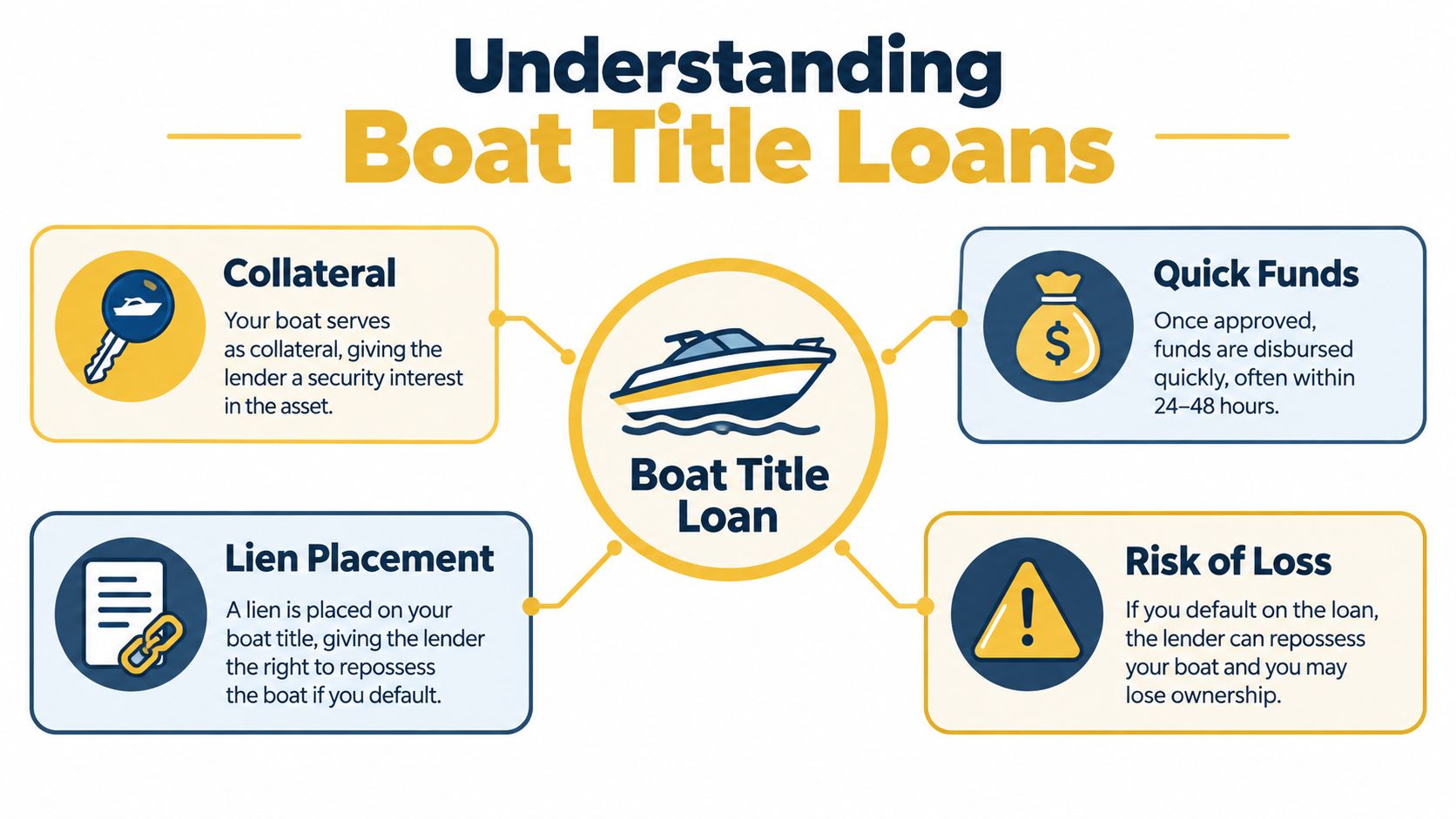
A car title loan uses the same basic idea, but the collateral behaves differently. Cars usually have a broader resale market, easier valuation references, and established repossession channels. A boat may require specialized buyers, transport, storage, inspections, and seasonal marketing. Those factors can affect both the lender's valuation and the amount available after sale.
The loan has two separate parts
The first part is the payment obligation. The contract states how much you must repay, when payments are due, how interest is calculated, and which fees apply.
The second part is the collateral arrangement. The lender records or otherwise perfects its lien and may require insurance, maintenance, storage, or restrictions on transferring the boat. Breaching those requirements can create a default even if the payment history looks acceptable.
You should read the agreement for:
- The total repayment amount: Don't focus only on the cash deposited into your account.
- The payment schedule: Confirm whether the term gives you a realistic path to payoff.
- Default triggers: Look for missed payments, lapsed insurance, unauthorized transfers, or other violations.
- Repossession language: Check who pays recovery, storage, legal, and sale expenses.
- Lien release terms: Confirm how and when the lender will document that the debt has been satisfied.
A general explanation of title loans can help you compare secured borrowing with alternatives, but the boat-specific contract and applicable state law control the actual consequences.
The Real Cost and Risk Baseline
Boat-specific federal data is limited, so the strongest benchmark comes from the Consumer Financial Protection Bureau's study of automobile title lending. The study covered nearly 3.5 million single-payment auto-title loans made from 2010 through 2013. It found a median loan of approximately $694, a typical term of 30 days, and a median APR of 317%. About one-third of loan sequences ended in default, and roughly one in five resulted in vehicle repossession, according to the CFPB title-lending study.
These figures are not boat-specific averages. They are a risk baseline for a similar collateral structure. The important lesson is that the presence of collateral doesn't make expensive credit inexpensive. Instead, it gives the lender an asset to pursue when repayment fails.
Title loan risk comparison
| Factor | Auto title loans | Boat title loans |
|---|---|---|
| Collateral | A titled automobile secures the debt. | A titled or documented vessel secures the debt. |
| Valuation | Cars often have more readily available resale references. | Boats can be harder to value because condition, equipment, location, and season affect demand. |
| Repayment risk | A borrower can lose the vehicle after default. | A borrower can lose the boat and may still face a remaining balance. |
| Recovery costs | Recovery and sale costs reduce proceeds. | Recovery may also involve transport, marina storage, maintenance, and specialized liquidation. |
| Market liquidity | Vehicles generally serve a wider everyday market. | Boats may appeal to a narrower pool of buyers. |
The boat's apparent value can therefore be misleading. A vessel listed at a certain amount may not sell quickly at that amount, particularly if the buyer must pay for transport, repairs, documentation work, or storage.
Look past the advertised advance
Calculate the full obligation before signing. Include principal, interest, origination charges, late fees, recovery costs described in the contract, and any required insurance or storage expenses. Then compare that total with the boat's realistic resale value, not an optimistic listing price.
Practical rule: If the repayment plan only works when every paycheck arrives on time and no other expense occurs, the collateral is carrying more risk than the cash advance is worth.
A short term can also create a payment shock. Even if the initial amount appears manageable, the deadline may arrive before the repair improves your income or before you can sell another asset. Ask the lender for a written payoff figure and a clear explanation of what happens if you need more time.
State Laws and Title Requirements
A boat title loan depends on documentation that other people can verify. A paper title in a drawer or glovebox doesn't, by itself, prove that the lender has an enforceable priority claim. The lien usually needs to be recorded through the proper state or federal process.
Florida provides a useful example of why this matters. Under Florida's vessel lien statute, a lien used to secure a debt, including a chattel mortgage or similar security interest, must be recorded to be enforceable against creditors or later purchasers without notice. After payoff, the lienholder must file a satisfaction of lien.
Rules differ by jurisdiction, so borrowers shouldn't assume that Florida's process applies everywhere. The vessel may be state-titled, or it may be documented with the U.S. Coast Guard. That classification affects the records a lender checks, the lien instrument used, and the enforcement process available after default.
Documents to verify before signing
Use the following checklist with the lender, the state titling office, or a qualified maritime attorney:
- Confirm the vessel identification number. Make sure the number on the boat, title, registration, and loan documents matches.
- Verify the registered owner. The borrower, seller, and title records should identify the same ownership interest.
- Search for existing liens. An earlier lien can affect the lender's priority and your ability to transfer the vessel.
- Ask where the new lien will be recorded. Get the filing agency, filing method, and expected completion date in writing.
- Review the payoff release. Find out what document removes the lien and how quickly the lender will file it after payment.
- Identify the vessel's status. Ask whether the boat is state-titled or federally documented and which rules govern enforcement.
- Read operational requirements. Check insurance, storage, maintenance, navigation, and notice provisions.
A lender's failure to complete a required filing can create problems for the lender, later purchasers, and the borrower. It doesn't automatically make the debt disappear. You may still owe under the contract while the parties dispute the lien's priority or release.
State-specific resources, including information about Colorado title loans, can illustrate why location matters. For a boat, use the appropriate vessel authority rather than relying on a general car-title process.
The Repossession Trap and Deficiency Debt
Many borrowers assume repossession ends the account. Often, it doesn't. The lender may take the boat, sell it, apply the proceeds to the outstanding debt, and then seek a deficiency balance if the sale produces less than the amount owed.
For a state-titled vessel, a secured creditor may generally repossess without a court order if it can do so without breaching the peace. The creditor must then dispose of the boat in a commercially reasonable manner. The sale proceeds are applied to the debt, but the borrower may remain liable for the deficiency and permitted repossession or sale costs.
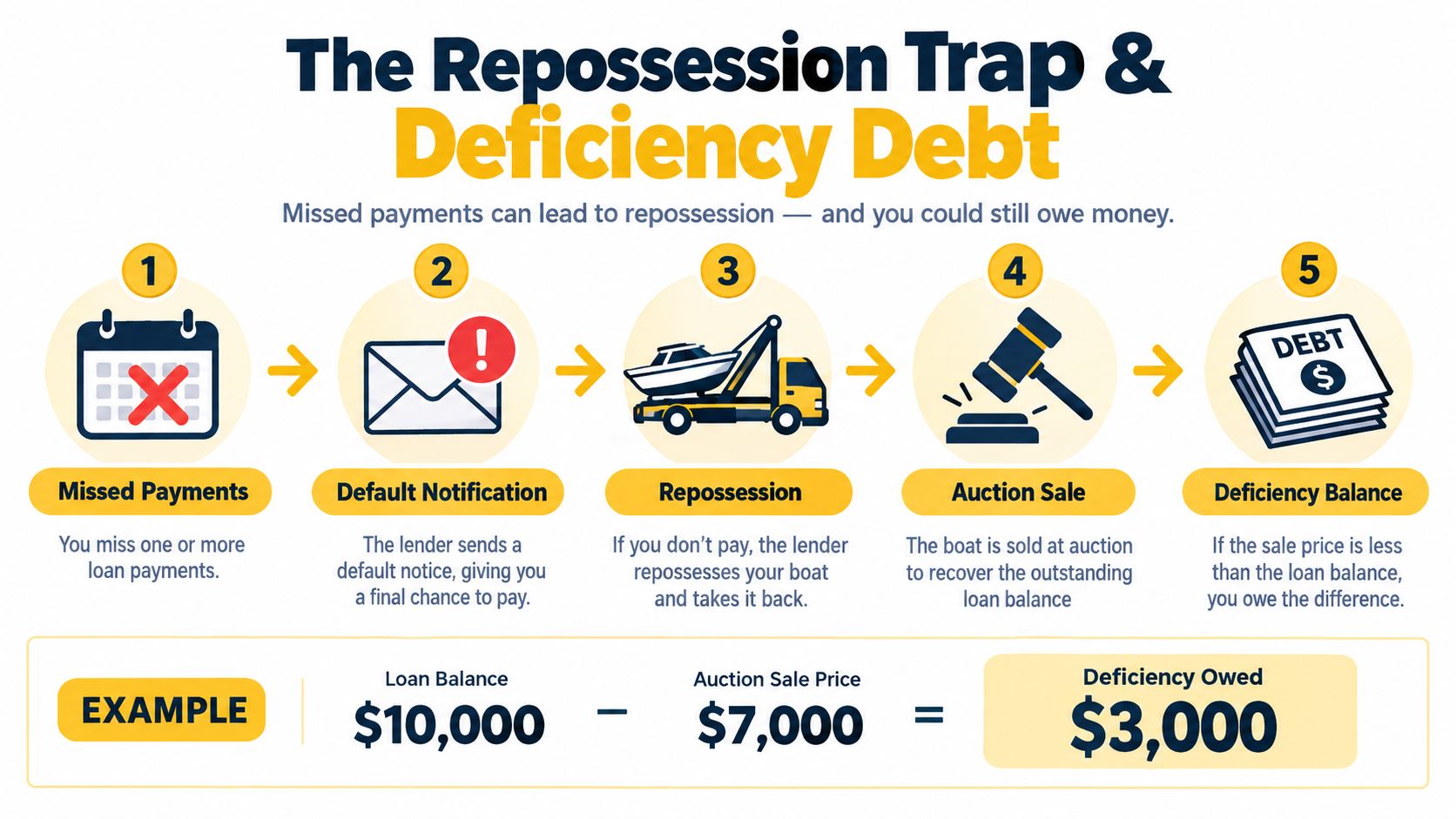
Consider a simple example. If the outstanding balance and allowed costs exceed the net sale proceeds, the difference can remain a personal obligation. The exact calculation depends on the contract, state law, sale expenses, notices, and whether the sale met commercial-reasonableness requirements.
State-titled and federally documented boats
A state-titled boat usually follows the state's secured-transactions and vessel-title rules. The lender may need to provide default notices, honor redemption rights, and account for surplus proceeds if the sale brings in more than the debt and permitted expenses.
A federally documented vessel can follow a different path. A Preferred Ship Mortgage covering the entire vessel may qualify under federal requirements when the state titling system meets the applicable conditions. Foreclosure can proceed in federal court against the vessel itself, while a personal deficiency claim may still be possible.
That difference makes the boat's documentation status more than a paperwork detail. It can affect the forum, notices, foreclosure method, lien priority, and the borrower's continuing personal exposure.
A borrower should request a complete post-sale accounting showing the starting balance, interest, fees, recovery costs, sale price, sale expenses, and remaining amount. Keep every notice, photograph, repair record, valuation, and communication. If the lender's sale appears unreasonable or the balance is disputed, consult a consumer attorney or maritime lawyer promptly.
Industry practice also matters. A recent industry report states that third-party liquidators were used by 79% of participating marine lenders for repossessed boats in 2025, as described in the marine collateral survey. That figure doesn't determine your legal rights, but it shows why resale valuation and post-sale accounting deserve careful attention.
The same basic warning applies to other secured debts, but each product has its own rules. A discussion of what happens after a payday-loan default shouldn't be used as a substitute for reviewing the boat contract and vessel law.
Is a Boat Title Loan the Right Choice
A boat title loan can provide speed when conventional credit is unavailable, but speed is the main benefit. Against it, you must weigh high borrowing costs, a short or demanding repayment schedule, lien complications, uncertain resale value, and the possibility of owing a deficiency after losing the vessel.
Exhaust alternatives first. Ask the repair business whether it offers a written payment arrangement. Compare personal installment loans from banks or credit unions. Check whether a nonprofit counselor can help you prioritize bills, negotiate with creditors, or identify local assistance. Selling unused equipment or postponing nonessential work may also reduce the amount you need to borrow.
If you still consider a title loan, make the decision from documents rather than urgency. Confirm the total payoff, every fee, the default timeline, the lien filing, insurance requirements, repossession procedure, sale rules, and whether the lender can pursue a deficiency. Don't sign until you understand what happens to both the boat and the remaining balance.
The most useful question is not whether the lender will approve you. It's whether your budget can repay the debt without putting an important asset and your future income at risk.
BadCreditMD offers plain-language guides to borrowing options, state-specific rules, alternatives, and local assistance for people with imperfect credit, but it isn't a lender or broker. Visit BadCreditMD to compare information before you pledge a boat or respond to an urgent cash need.