A typical title loan percentage rate is about 300% APR, which equals a 25% monthly finance charge on the amount borrowed. That monthly framing is the source of most confusion. A charge that sounds like a quarter of the loan for a few weeks becomes three times the loan over a year, before added fees and before renewals turn a short due date into a sequence of new charges.
The rate also carries a different kind of risk than the rate on an unsecured loan. Your car title secures the debt, so falling behind doesn't just raise the balance. It can cost you the vehicle you use to get to work, school, or medical appointments. Reading the title loan percentage rate correctly means converting it to APR, converting APR to dollars over the time you'll carry the loan, and then asking whether your state even permits that price.
Table of Contents
- Typical Title Loan Rates at a Glance
- How Monthly Fees Convert to APR
- What a $1,000 Title Loan Costs, Rollovers Included
- State Caps and Cross-State Enforcement
- Reading the Loan Disclosure Line by Line
- Compare Cheaper Options Before You Sign
Typical Title Loan Rates at a Glance
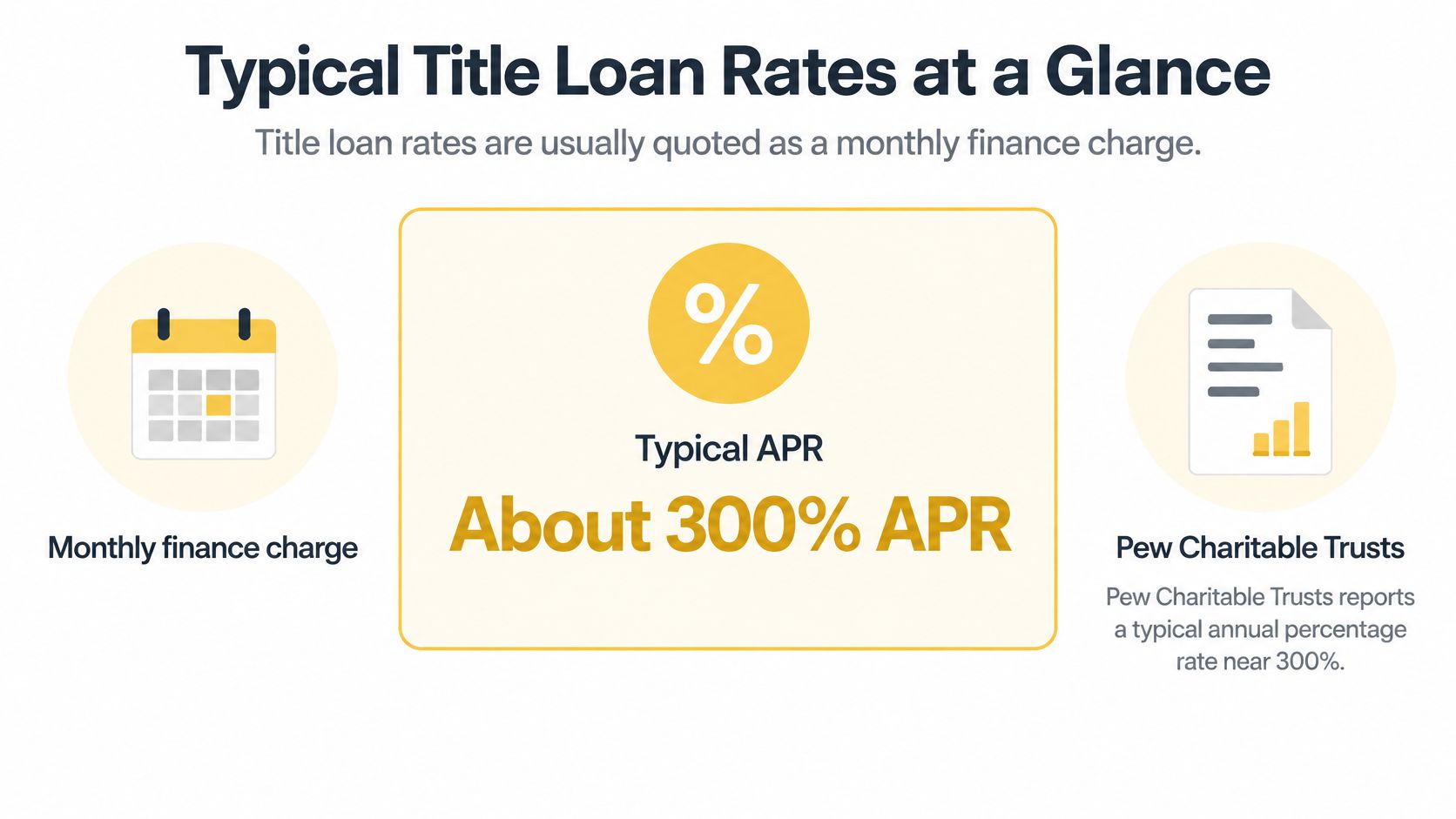
Title loan prices are usually printed as a monthly finance charge. The yearly rate behind that quote still clusters near 300% APR. The Pew Charitable Trusts report on auto title loans puts the typical annual rate at about 300% APR, equivalent to a monthly finance charge of approximately 25% of the amount borrowed.
Benchmarks Worth Comparing Against Your Offer
| Benchmark | Reported APR | Context |
|---|---|---|
| Typical title loan (Pew) | About 300% | Equivalent to a 25% monthly finance charge |
| CFPB average, 2010 to 2013 single-payment loans | 291% | Average across nearly 3.5 million records |
| CFPB median loan | 317% | Median APR for the median loan |
| Idaho | 310% | Pew state data |
| Illinois | 212% | Pew state data |
| New Mexico, lump-sum loans | 270% | Pew state data |
| New Mexico, installment loans | 314% | Pew state data |
| Oregon | 149% | Pew state data |
| Tennessee | About 264% | Pew state data |
| Texas, lump-sum loans | 306% | Pew state data |
| Texas, installment loans | 223% | Pew state data |
The median in that older single-payment sample sits above the average, at 317% versus 291%. A large share of those loans priced higher than the mean, so an "average" title loan was not the expensive tail. It was close to the center of the market.
State rules and loan structure move the number more than a single lender's sales pitch. Oregon's benchmark is roughly half the national figure and still deep in triple digits. New Mexico and Texas produce different averages for lump-sum and installment loans inside the same state. Idaho's 310% and Texas lump-sum loans at 306% sit on the national figure. Illinois at 212% and Texas installment loans at 223% are lower, and both remain far above ordinary consumer credit.
Treat every row as a historical or state-reported average, not as your offer. Lenders set their own rates, fees, and terms. Payday loans, title loans, and some online installment loans can carry very high fees or APRs. Compare the APR on your disclosure with these benchmarks, not the monthly percentage in the ad.
A lender quoting 20% or 25% per month is usually stating a loan near 300% APR in smaller units. The monthly figure is the annual price broken into pieces, not a discount against it.
How Monthly Fees Convert to APR
A 25% monthly finance charge on a $1,000 loan is $250 for one month. Multiply that same charge by twelve and the simple annual equivalent is 300%, or $3,000 in finance charges if the fee is paid every month for a year. That total excludes compounding and ancillary fees.
The Federal Trade Commission guidance on payday and car title loans reports that title-loan finance fees can reach 25% per month, equivalent to approximately 300% APR before considering additional charges.
| Monthly finance charge | Simple annual equivalent | Charge on $1,000 for one month | Annual finance charges on $1,000 |
|---|---|---|---|
| 10% | 120% | $100 | $1,200 |
| 15% | 180% | $150 | $1,800 |
| 20% | 240% | $200 | $2,400 |
| 25% | 300% | $250 | $3,000 |
APR is the standardized measure because it combines the finance charge, loan amount, applicable fees, and repayment period. A monthly percentage alone leaves out that yearly total, which is why APR is the figure to compare across lenders and credit types. Processing, document, and origination fees may be added separately and push the true annual rate higher than the simple conversion in the table.
One month at 25% takes $250. Twelve of those months take $3,000 from a $1,000 balance, before the extra fees. The payday loan fee chart showing how periodic charges annualize uses the same conversion for another high-cost product when you are lining up offers.
Two details change the arithmetic further. The simple math above excludes compounding, so an unpaid balance usually costs more than the table shows. You also need to confirm whether the fee is calculated on the original principal or on a renewed balance, because a renewal can change the base the percentage applies to.
Run these three checks on any offer:
- Multiply the monthly charge by twelve. That gives you the simple annual equivalent before added fees.
- Add the listed fees. Processing, document, and origination charges belong in the true cost.
- Compare the result with the disclosed APR. If the numbers do not line up, ask the lender to explain the difference before you sign.
What a $1,000 Title Loan Costs, Rollovers Included
A 25% monthly fee on $1,000 is $250. Charge that fee twelve times on an unpaid principal and the household has paid $3,000 to keep using the same $1,000. The advertised month looks small. The year does not.
The 2016 CFPB analysis summarized in the Consumer Financial Services Law Monitor examined nearly 3.5 million anonymous single-payment vehicle-title-loan records from about 400,000 borrowers, covering loans originated from 2010 through 2013, and reported a median loan just under $700, an average amount of $959, an average APR of 291%, and a typical term of about one month. Those loans were built as one large payment, not as a slow paydown of principal.
One Borrower and One Renewal Path
A driver borrows $1,000 at a 25% monthly fee to cover a repair and a rent shortfall. On the first due date the contract calls for $1,250, but the paycheck only covers the $250 fee. The driver pays that fee, renews the loan, and keeps the car. A month later another $250 is due, and the $1,000 principal has not moved.
Each renewal buys another month at the same price as the first, while the cash required to exit stays $1,250. The loan is asking for one lump payment from a budget that was already short, so the fee repeats instead of the balance falling.
| Months outstanding | Finance charges | Finance charges as share of loan |
|---|---|---|
| 1 | $250 | 25% |
| 2 | $500 | 50% |
| 3 | $750 | 75% |
| 6 | $1,500 | 150% |
| 12 | $3,000 | 300% |
The table assumes the fee is charged on the original $1,000, the balance is not reduced, and no processing, document, or late fees are added. Change any of those and the cost usually rises. By month three the driver has paid $750 for the use of $1,000 and still owes the full $1,000. By month six the fees alone are $1,500, half again the amount borrowed. At twelve months the fees are triple the loan, which is the dollar form of a 300% simple annual charge on principal that never declined.
Why Rollovers Are the Main Event
A rollover, or a same-day replacement loan, keeps the cash available and charges the monthly fee again, so total cost rises even when principal barely falls. The CFPB research brief on consumer use of payday, auto title, and pawn loans found that auto-title loan sequences carried APRs around 300%, about one-third of sequences ended in default, and one in five ended in vehicle repossession. That brief also reports CFPB survey data showing 83% of consumers who had taken an auto-title loan in the prior six months still owed money on an auto-title loan.
If the balance is still open months later, the $250 fee is not a one-time cost. It is the pace at which cash leaves the household, and the car title stays on the line until the principal is paid. Default is not only a credit mark. On a title loan it can mean losing the vehicle.
The stated maturity is not the payoff horizon. Plan for the sequence of fees you may actually pay, not the single month printed on the first contract.
Guidance on avoiding loan rollover traps walks through how that repeat fee locks in across short-term products.
Run Your Own Stress Test
Short-term loans are costly and are not a long-term financial solution, so borrow only what you can repay on time. Before signing, run four checks with your own figures.
- Total the fee after each rollover you expect. Use the table as the starting path, then adjust if the fee applies to a renewed balance.
- Add late, repossession, storage, and document charges. Those sit outside the $250 monthly math and raise the cash you need to get the title back.
- Compare that total with what it would cost to replace the car. Paying $1,500 in fees to hold a vehicle you could replace for less is a poor trade.
- Test whether one payment can clear principal plus the current fee. If $1,250 is out of reach today, name the income or bill change that makes it reachable by the due date.
Weigh the fees already scheduled against the car and the pay that depends on still having it.
State Caps and Cross-State Enforcement
A quoted percentage can be lawful where the lender operates and still conflict with the rules where you live, where the vehicle is registered, or where you sign. Online, those three places often are not the same state. Asking only what the rate is, without asking whose law governs the contract, answers half the question.
A fee quoted by the month can sit under a cap that the statute writes as an annual percentage. Stretch that same monthly charge across a year and the dollars can exceed what your state allows, even though the salesperson never said an annual figure. The statute that applies decides whether that yearly cost is collectible.
Research commissioned by the Center for Responsible Lending on prohibited vehicle title loans surveyed 7,115 Americans in July 2024, including 400 recent vehicle-title borrowers, and reported evidence of vehicle-title loans involving borrowers in 22 states and the District of Columbia where the product was prohibited, including borrowers who took such loans online in 14 prohibited states or the District of Columbia. A prohibition on the books does not automatically stop an online offer from reaching you.
The rules also keep moving. Some states have recently tightened title-loan rules, and other jurisdictions have strengthened anti-evasion rules aimed at out-of-state arrangements. A rate that was collectible last year in a given state may not be collectible now. A national average says nothing about your contract.
Three Checks Before You Accept a Rate
- Find the state guide for your state. Each state guide covers which loan types state law allows, the limits lenders must follow, a worked cost example, and who to call if something goes wrong. The Colorado car title loan guide shows the format and the level of state-specific detail to expect.
- Check whether title loans are prohibited in your state. The service is not available in all states, and not every loan type is available in every state, so an online approval message does not settle legality. The loan is secured by the car title, and the car is at risk if you cannot repay.
- Read the governing-law clause. An online contract may name another state's law. That clause can decide which rate cap applies, and therefore whether the annualized cost of a monthly fee is one you can be held to.
If the rate or fees look unlawful, act on documentation rather than memory. Verify the lender's license with your state regulator, keep copies of advertisements and payment records, and contact the state regulator or the CFPB with that paper trail. Screenshots of the offer screen and the signed disclosure carry more weight in a complaint than a summary written weeks later.
Reading the Loan Disclosure Line by Line
Put the disclosure on the table and work through it in order. Each lender sets its own rates and terms and must show the APR before you sign, so don't sign until the APR and total repayment are visible in writing.
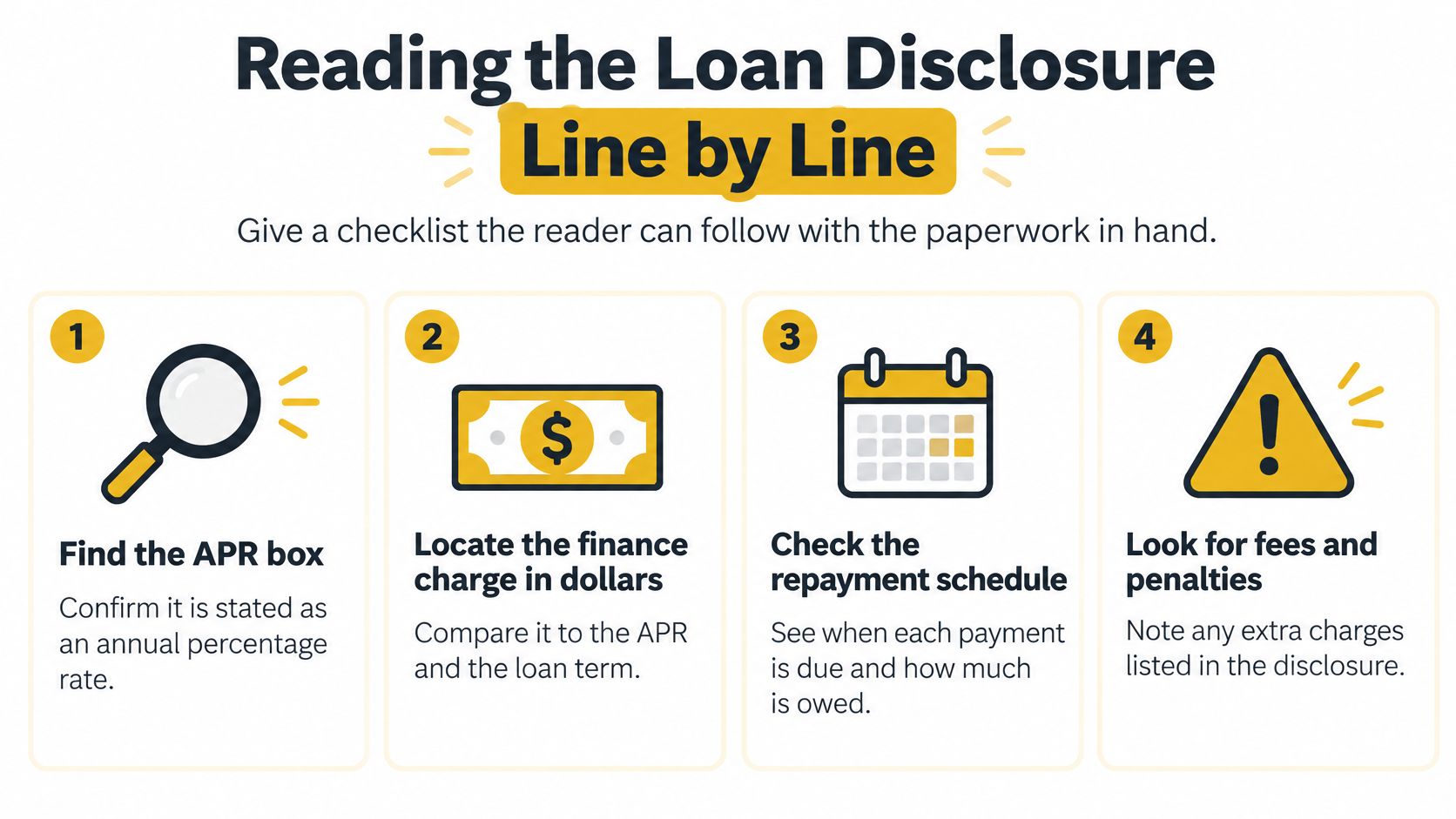
- Find the APR box. Confirm the figure is stated as an annual percentage rate, not a monthly percentage dressed up as one.
- Locate the finance charge in dollars. Compare it with the monthly percentage quoted in conversation. If someone said "25%" and the dollar charge implies more, the dollar figure wins.
- Find the total of payments. This shows the full amount you repay if the loan runs to term, principal included.
- List every fee separately. Write down processing, document, origination, late payment, repossession, and storage charges as individual lines.
- Confirm the due date, the term, and renewal rights. Note whether the loan can be renewed and what a renewal costs.
- Check the fee basis. Confirm whether the fee is calculated on the original principal or on a renewed balance.
- Check prepayment terms. Ask whether paying early reduces the finance charge or whether you owe the full charge regardless.
- Read the default section. Look for what happens on a missed payment, including repossession timing and collection steps.
Watching a disclosure walkthrough before you're in a lender's office helps you spot missing lines under time pressure.
Offers also depend on your credit, income, state of residence, and each lender's criteria, since lenders set their own rates, fees, and terms. Two borrowers in the same office can leave with different disclosures, so compare your document, not someone else's. Keep copies of the disclosure, any advertisements that drew you in, and every payment record.
Compare Cheaper Options Before You Sign
The case against a title loan gets concrete when you price the same $1,000 through other channels. A title loan is secured by your car title, and the car is at risk if you can't repay, so a cheaper unsecured option isn't just cheaper. It also removes the repossession outcome from the table entirely.
| Option | APR | Cost on $1,000 |
|---|---|---|
| Title loan at 25% monthly fee | About 300% | $3,000 finance charge over 12 months, simple |
| Credit union payday alternative loan | Up to 28% | Up to $280 in simple annual interest at the cap |
| Installment loan illustration | 29.99% | $169.76 finance charge over 12 payments of $97.48 |
Credit union payday alternative loans are small loans from federal credit unions with an APR capped at 28% under NCUA rules. That cap sits below every title loan benchmark in this article, including the lowest state average. You generally need to be a member, so if you're not one now, joining before an emergency is the practical move.
The installment loan row is an illustration only, not an offer. A $1,000 installment loan at 29.99% APR repaid in 12 monthly payments of $97.48 costs $1,169.76 in total, including a finance charge of $169.76. Compare that finance charge with a single month of title loan fees. One month at 25% costs $250, which already exceeds a full year of finance charges on the illustrated installment loan.
Options That Do Not Put the Car at Risk
- Payment plans with the original creditor. Utilities, medical providers, and credit card issuers often accept installments directly, and that conversation costs nothing.
- Credit-builder loans and secured credit cards. These build a payment record while keeping amounts small and collateral limited to a deposit you control.
- Free local help through 211 and nonprofit credit counseling. Dialing 211 connects you with assistance programs, and a nonprofit counselor can negotiate with creditors on your behalf.
Use our loan payment calculator to test payments and total cost with your own figures before you commit, and see the wider loan options for bad credit compared by cost and risk. The decision rule is simple. If you can't cover the full repayment by the next payday or paycheck, work through these alternatives first, because that's exactly the situation where renewals begin.
Submitting a request doesn't guarantee approval, and you decide whether to accept any offer a lender makes. Walking away from an offer you've priced against a credit union loan and a payment plan is a decision, not a dead end.
Before you hand over a car title, convert the monthly fee to APR, price the renewals in dollars, and check your state guide for the caps and complaint contacts that apply to you. BadCreditMD publishes loan-type explainers, state-by-state rules, and lower-cost alternatives side by side, so you can compare a title loan against credit union loans, payment plans, and free local help in one place.