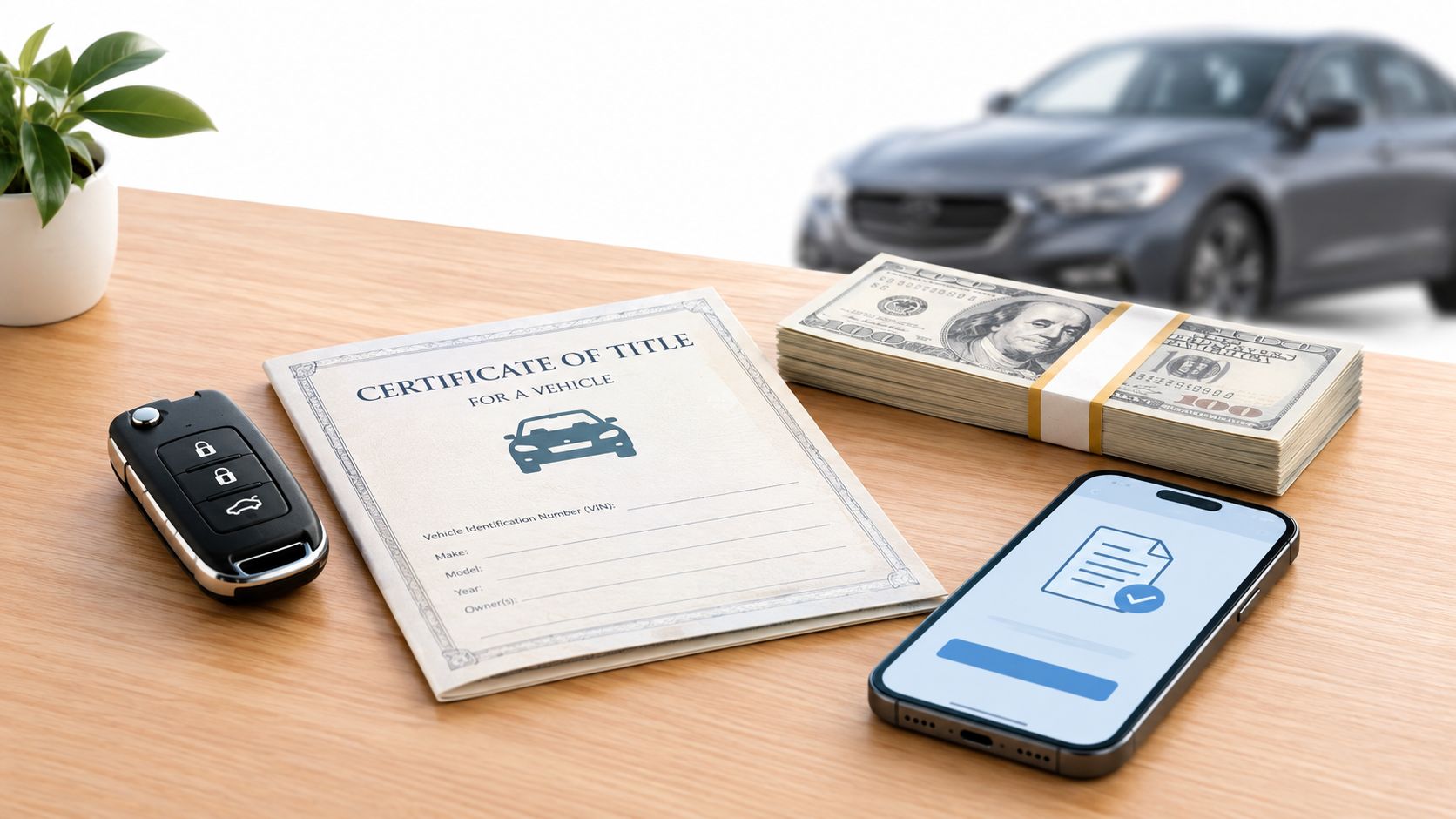
Your car is paid off, a bill is due, and payday isn't close enough. An online title loan can look like a quick fix because you can start the application from home and use your vehicle's title to secure the money. But online access doesn't change the basic bargain: you're borrowing against a car you may depend on, and the cost can be high.
Before applying, look beyond the amount offered. Check the total you'll owe by the payoff date, whether you can make that payment without renewing the loan, and whether the lender can legally offer the product where you live. If losing access to your car would threaten work, medical care, or caregiving, that risk belongs in the calculation too.
Table of Contents
- Who Takes Out Online Title Loans and Why
- How the Online Application and Title Process Works
- The Real Cost of an Online Title Loan
- Why Most Online Title Loans Do Not End After One Month
- State Rules and the Online Legality Gray Zone
- Safer Alternatives Worth Comparing First
- Making the Right Call and Where to Get Free Help
Who Takes Out Online Title Loans and Why
A driver has a paid-off car, a utility bill to cover, and little room in the budget. An online title loan may appear to solve the immediate problem because the application can begin on a phone or computer. Yet the driver isn't just borrowing against the car's value. They're putting an important asset at risk to get cash now.
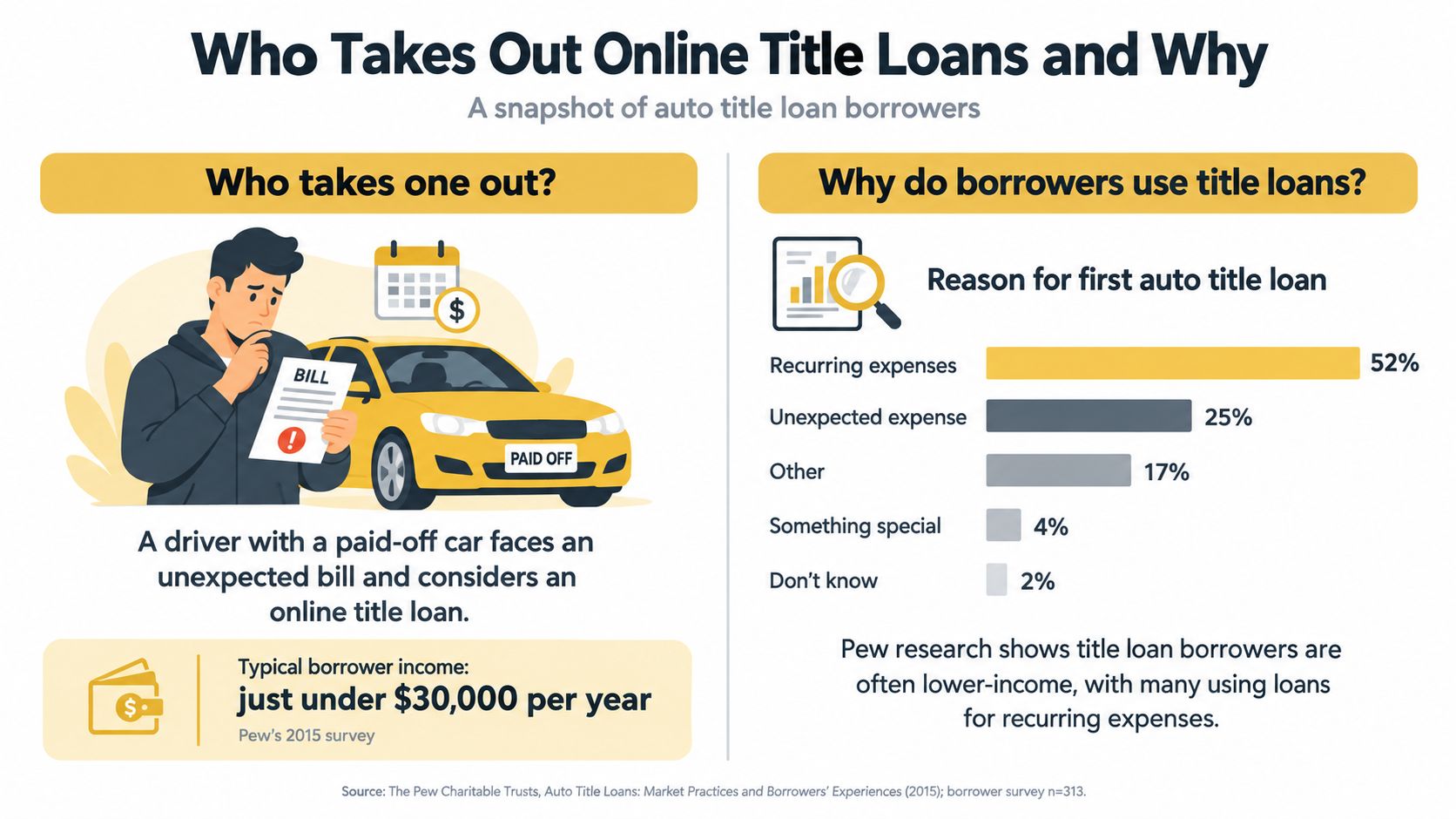
Pew reported that more than 2 million Americans, approximately 1% of U.S. adults, used auto title loans each year. The average loan was about $1,000, and borrowers paid approximately $1,200 per borrower in annual fees. Pew's research on auto title loans also found that borrowing often addressed routine cash-flow gaps: about half of borrowers used the money to pay regular bills, while only about one-quarter said they used it for an unexpected expense. More than 9 in 10 loans were for personal rather than business purposes.
That pattern can surprise people who think of title loans as a one-time response to an emergency. A recurring bill may feel predictable, but if income and expenses remain out of balance, the loan's due date can arrive before the borrower has enough cash to repay it.
Why the online channel matters
A storefront borrower may need to travel with the vehicle and title for an in-person application. Online lenders can collect forms and documents remotely, then arrange an inspection or other verification. That can make it easier to apply when a store is far away, but it doesn't remove the collateral or repayment risks.
| Step | Online title loan | Storefront title loan |
|---|---|---|
| Start | Submit an application and documents online | Visit a physical location |
| Vehicle review | Lender may arrange a remote or in-person inspection | Staff can inspect the vehicle at the location |
| Title paperwork | May be handled by mail or electronic lien processes | Often handled during the in-person transaction |
| Borrower's key concern | Verify the lender and applicable state rules | Verify the lender and applicable state rules |
A car can also affect household costs beyond borrowing. If you're budgeting around vehicle ownership, this guide to how credit affects auto coverage costs offers related context on insurance pricing. And if you're comparing other short-term borrowing options, BadCreditMD's explainer on payday loans with no credit check can help you understand a different product's trade-offs.
How the Online Application and Title Process Works
The online form is only the beginning. The lender needs to assess both the vehicle securing the loan and the borrower's ability to repay, so expect requests for information beyond a name and bank account.
From application to approval
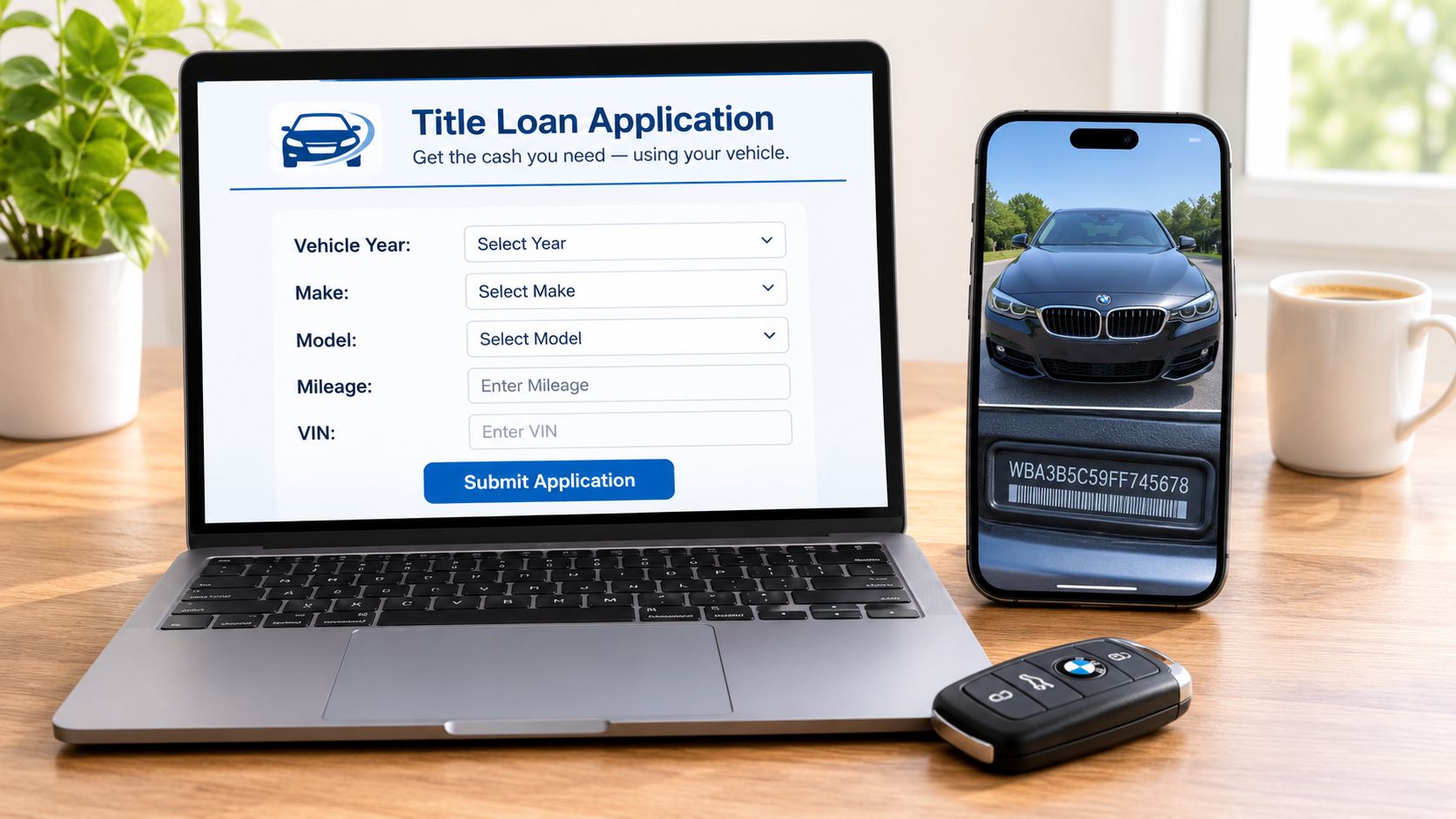
An application may ask for the vehicle's year, make, model, mileage, and VIN. You may also be asked to upload a photo of the title, proof of income, proof of insurance, identification, or registration. Requirements vary by lender and state, so treat a checklist on a lender's site as a starting point, not a guarantee of approval.
Some lenders offer pre-qualification using a soft credit inquiry, which generally doesn't affect a credit score. A later formal application may involve a hard inquiry, depending on the lender. Ask which type of check will occur and at what stage before you authorize one.
The lender will usually need to verify the vehicle, even if you apply online. That may involve an in-person meeting, a curbside photo session, or an appraiser visiting the car. The inspection helps the lender confirm the vehicle's condition and identity; it doesn't mean the loan is safe or affordable.
What happens to the title
The title document or lien record is what secures the loan. Depending on state procedures and the lender's process, you may send the title to the lender or authorize a lien to be recorded. In many arrangements, you keep driving the vehicle and retain your keys while the loan is outstanding. Don't assume that keeping the car means the lender has no enforceable claim against it.
Before signing, find out exactly what documents the lender will hold or file, what happens if you miss a payment, and how the lender can seek repayment. The contract should spell out the payment schedule, charges, and consequences of default. If anything is unclear, get an explanation in writing rather than relying on a verbal assurance.
When you repay
Once you've paid the balance and any contractually owed charges, the lender should release its lien or return the title, as applicable. A state motor-vehicle agency may need time to process a lien release, so ask what proof of payoff you'll receive and when the record should update. Keep payment confirmations and written release documents until the title record is clear.
Renewals deserve special attention. If you can't make the full payment, the lender may offer or require a renewal arrangement, depending on the agreement and state law. Ask whether that means paying another charge, extending the balance, or making a different payment. A low initial payment can conceal a much larger total cost if it doesn't reduce the principal.
The Real Cost of an Online Title Loan
A loan's principal is only the amount you receive. The cost of borrowing includes finance charges and fees, and the repayment structure determines when you must pay them. A lender's headline offer can therefore look manageable while the actual payoff is difficult to cover.
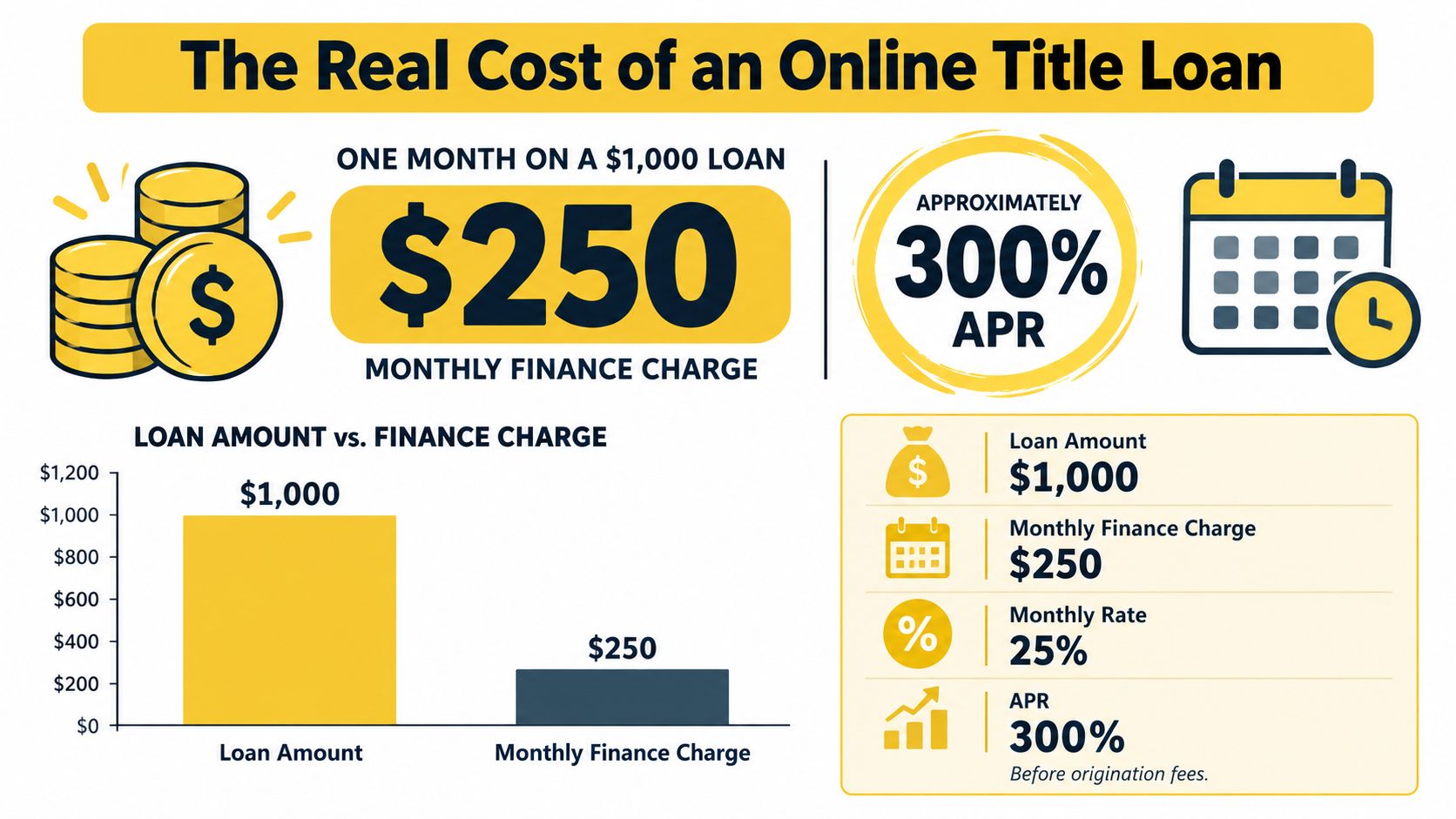
The FTC explains that monthly finance charges on title loans can reach 25%, or roughly 300% APR, before additional fees. For a $1,000 loan, a 25% monthly charge is $250 for one month. On a single-payment structure, that means a $1,250 lump-sum payoff after 30 days, before any added fees. The FTC's title-loan guidance also notes that loan amounts commonly equal roughly 25%–50% of a vehicle's value, though loan terms and costs vary.
Read the charges, not just the rate
The contract may include charges beyond the monthly finance charge. Look for application or origination fees, document-processing fees, lien-recording charges, late fees, and optional add-ons such as roadside assistance. Ask whether each charge is required, when it's due, and whether it's added to the balance or paid upfront.
A lender may also advertise an introductory offer with conditions. The FTC has documented arrangements where failing to meet repayment conditions can trigger retroactive finance charges. Read the full terms before accepting an offer, especially if the advertised rate depends on paying early or meeting another requirement.
Practical rule: Compare the total dollars due through the date you realistically expect to finish paying, not just the amount deposited or the first payment shown.
Use a simple worksheet: write down the cash you'll receive, every required charge, each payment date, and the total owed by the expected payoff date. Separate charges due at origination from those due at renewal. Then check whether the lender can debit your bank account automatically and whether the debit date is one you can control.
An online form doesn't make the loan's cost easier to manage. If you can't make the full payoff without borrowing again, the advertised term may not match your real borrowing period.
The video below is another way to review the mechanics and risks before making a decision.
Why Most Online Title Loans Do Not End After One Month
The assumption that a title loan is a simple, short bridge doesn't match the historical repayment pattern the CFPB measured for single-payment vehicle title loans. In its analysis of nearly 3.5 million loans made to more than 400,000 borrowers in 10 states, the Bureau found that more than 80% were reborrowed on the day the previous loan came due, and nearly 90% were reborrowed within 60 days. Only about 12% of loan sequences ended without quick reborrowing. The CFPB's analysis examined loans made from 2010 through 2013, typically with 30-day terms and APRs of about 300%.
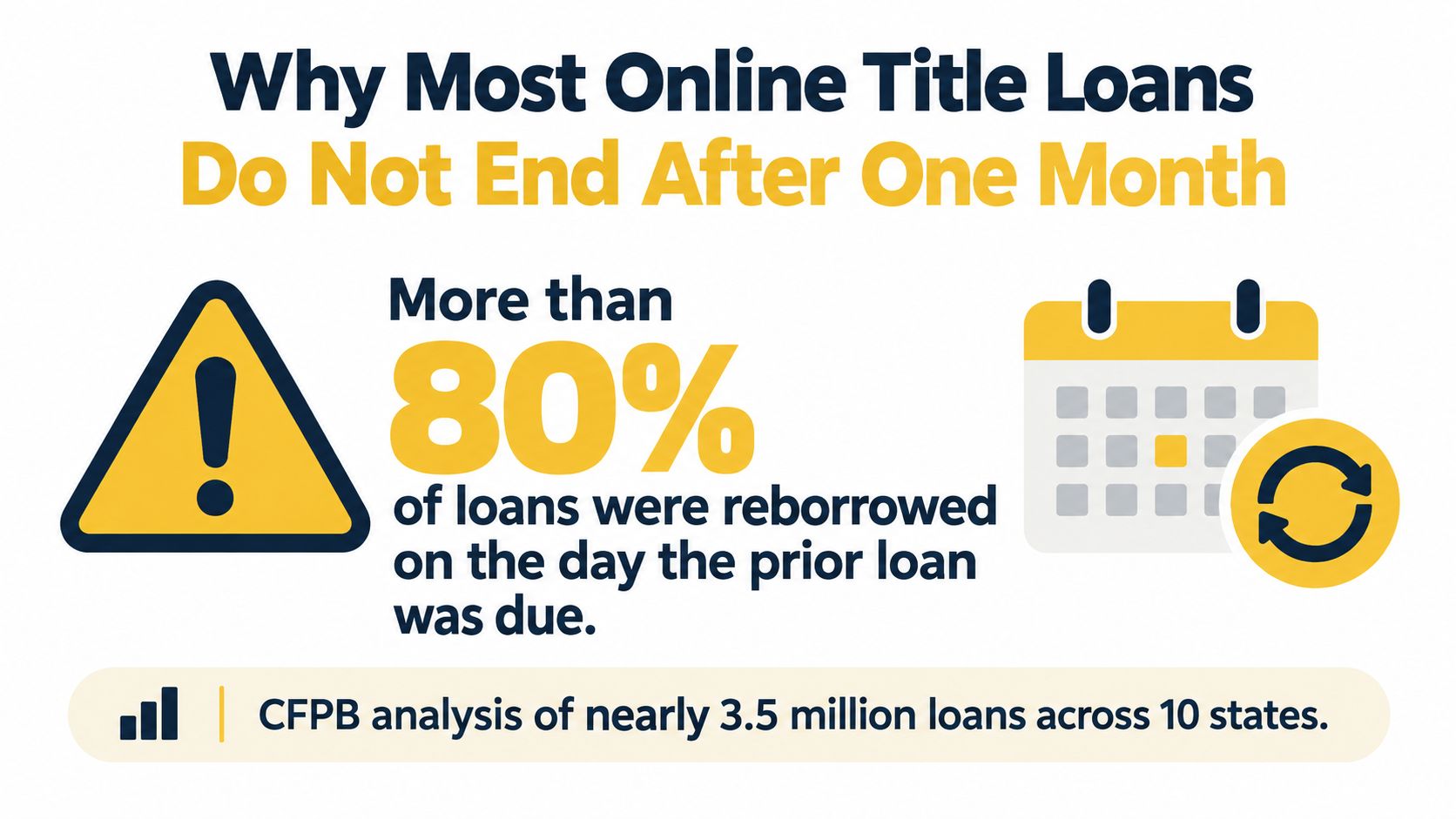
These findings apply to the single-payment loans in the CFPB's analysis. They shouldn't automatically be treated as the outcome for every online installment title loan or every state. Still, they show why the due date matters: when a borrower can't cover the full balance, taking out another loan or renewing can become the practical way to keep the car while delaying payoff.
The cycle has a collateral consequence
The Bureau found that one in five borrowers in the analyzed market ultimately had a vehicle seized or repossessed after failing to repay. It also found that more than half of borrowers reborrowed at least three times after the first payment came due, while about one-third reborrowed six or more times. The CFPB reported that repeat borrowers who reborrowed six or more times generated more than two-thirds of the title-lending business it studied.
Each renewal or reborrowing can mean another period of charges while the vehicle remains tied to the debt. If your car is necessary for work or family responsibilities, losing it could make the original cash-flow problem harder to solve. For an overview of the possible consequences of missed payments on another short-term loan, see BadCreditMD's guide to what happens if you default on a payday loan.
The central question isn't only whether you can handle the first payment. Ask whether you can pay the full amount due without renewing, while keeping enough money for rent, food, utilities, and transportation. If the answer depends on a future paycheck that's already committed to other bills, the loan may not function as a short bridge.
State Rules and the Online Legality Gray Zone
A state's rules can determine whether vehicle-title lending is allowed, restricted, or prohibited, but an online application can make the answer less obvious than a simple map. The lender may be based elsewhere, use a tribal entity, or include a contract term naming another state's law. That doesn't automatically settle whether the loan is lawful or enforceable where you live.
State approaches differ. Some states allow forms of title lending subject to restrictions, while others prohibit it or limit the rates and structures lenders can use. A borrower should verify the rules that apply to their residence and vehicle rather than assuming that a lender's website is proof of authorization.
The jurisdictional issue is more than theoretical. Research by the Center for Responsible Lending found that residents of 14 states or the District of Columbia where vehicle-title lending was prohibited reported obtaining title loans online. The same research found borrowers in 20 states or DC reported active title loans despite state prohibitions. CRL's report on online title lending highlights why “available online” doesn't necessarily mean the lender may legally offer or collect the loan in your state.
Run this check before sending documents
Before sharing your title, VIN, income records, or bank details, get clear answers to these questions:
- State license: Is the lender licensed or registered to offer this loan in your state? Check with the relevant state regulator, not just the lender's own site.
- Legal identity: What is the lender's full legal name and physical business address? Confirm which entity will appear on the agreement.
- Governing law: Which state's law does the contract say applies? Ask how that term affects your protections as a resident of your state.
- Collateral authority: Can this lender legally take a vehicle title or lien as collateral for this type of loan where you live?
- Complaint route: Which state agency handles complaints about this lender, and how can you contact it if the lender appears to bypass local restrictions?
Keep copies of the advertisement, application, agreement, and disclosures. If the lender's answers conflict with your state regulator's guidance, pause rather than submitting more information. BadCreditMD's vehicle repossession laws guide can help you identify the local rules to check, but confirm current requirements directly with your state regulator or a qualified legal aid provider.
Safer Alternatives Worth Comparing First
Before risking a vehicle, compare options that don't put your transportation at stake. The right choice depends on how soon you need the money, whether you can make regular payments, and whether building credit is a goal. No option is guaranteed or right for everyone, but asking a provider for help may cost less than borrowing against a car.
| Option | Typical APR | Collateral | Credit impact | Funding speed |
|---|---|---|---|---|
| Online title loan | Can be very high; FTC guidance says monthly charges can reach 25%, roughly 300% APR before added fees | Vehicle title | Depends on lender reporting and payment history | Lender-dependent |
| Credit union payday alternative loan | Varies by program and lender | Usually no vehicle title | May affect credit depending on reporting | Ask the credit union |
| Credit-builder loan | Set by lender | Often secured by funds held in an account | Designed to support payment history when reported | Usually not an emergency-cash option |
| Secured credit card | Set by issuer | Cash deposit | Can build history when the issuer reports activity | Depends on approval and card setup |
| Utility, hospital, or creditor payment plan | Often no interest, but terms vary | Usually none | Depends on the provider and account status | Ask the billing office |
For a PAL, contact a local credit union and ask about eligibility, fees, repayment terms, and how the loan is reported. A credit-builder loan or secured card may help establish payment history over time, but neither is a substitute for urgent cash if you can't wait for account setup or approval.
If the bill itself is negotiable, call the utility, hospital, landlord, or creditor before borrowing. Ask for a hardship extension, a payment plan, a fee waiver, or a reduced payment schedule. A nonprofit credit counselor can help you review debts and contact creditors, and 211 can direct you to local help with essentials.
People facing broader debt pressure may also want to understand the legal choices available in their situation. This overview of California bankruptcy chapter comparisons provides general context, but a bankruptcy decision calls for advice from a qualified legal professional. For another unsecured borrowing option to compare, see BadCreditMD's guide to signature loans for bad credit.
Making the Right Call and Where to Get Free Help
A title loan may look less risky if the need is urgent, the vehicle is not essential to your daily life, and you can repay the full balance without renewing. It's a poor fit if losing the car would threaten your job, caregiving, or access to medical appointments, or if the amount you need is small enough to address through a payment plan.
For many borrowers, the first call should be to the company or provider that's owed money. Ask for a hardship arrangement before taking on new debt. If that doesn't resolve the problem, contact 211, a nonprofit credit counseling agency, or a local legal aid office to ask about available support. Your state attorney general or financial regulator can explain how to report a lender, and the CFPB accepts complaints about financial products and services.
BadCreditMD provides loan explainers, state-specific borrowing guides, and directories for local assistance. It's an informational resource, not a lender or broker; where an optional request form is available, a lending-network partner may share the request with third-party lenders, which make their own decisions. Reading guidance doesn't require you to apply.
Before sending a title or signing an agreement, use this checklist:
- Verify legality and licensing with your state regulator.
- Calculate the total dollar cost through the expected payoff date.
- Check account access and confirm whether the lender can debit your bank account.
- Write down a payoff plan that doesn't depend on renewing the loan.
Visit BadCreditMD to compare borrowing options, review state-specific rules, and find free local assistance before you decide whether to use your car as collateral. If you're considering a loan request, read the terms and disclosures carefully, and remember that any lender sets its own rates and makes its own approval decision.