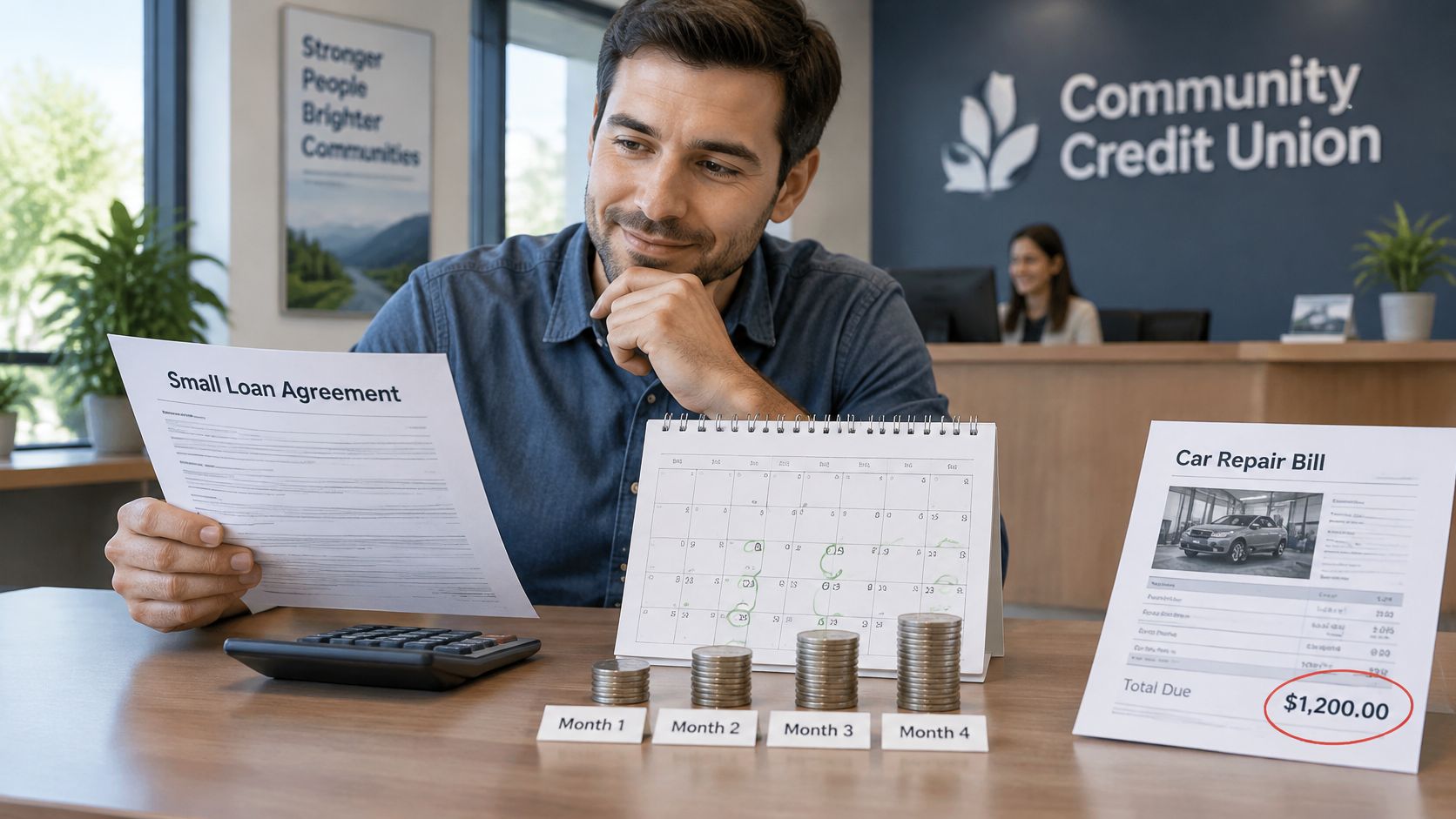
At the end of 2023, about 2.7 million people had a small-dollar loan, with a median balance of $507 and a median monthly payment of $89, according to the Federal Reserve Bank of New York Consumer Credit Panel.
A $500 transmission repair can force a choice: spread the bill across several paychecks or borrow cash due in full on the next payday. Installments can make repayment more manageable, while fees and renewals can quickly change the cost of a payday-style advance.
The lender's name matters as much as the amount. A federal credit union, community bank, CDFI, or city pilot may have different prices, membership rules, and wait times, even when their loans carry the same label. State law also affects whether a two-week loan can be offered.
A safer structure on paper may still be out of reach if few institutions offer it, membership or underwriting rules block access, or the payment does not fit irregular income. And if the lender cannot open the account before the bill is due, a lower-cost loan may not solve the immediate problem.
Table of Contents
- What a Small Dollar Loan Program Is
- Programs Compared by Amount Term and Cost
- Why the Same Loan Changes by State
- How to Check Eligibility and Apply
- What a Few Hundred Dollars Really Costs
- When the Safer Option Is Hard to Get
- Get Local Help Before You Borrow
What a Small Dollar Loan Program Is
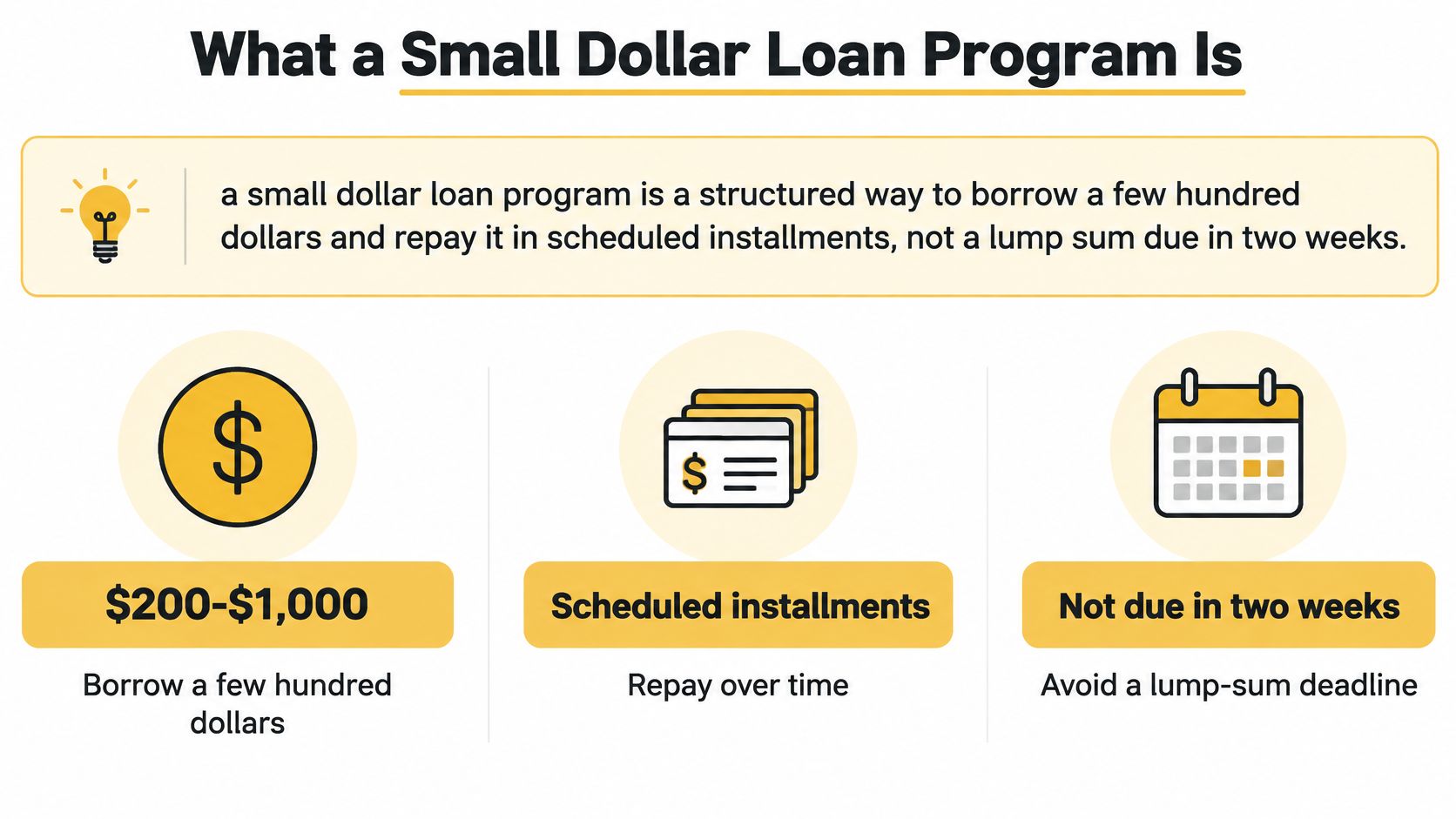
A small-dollar loan program turns a short-term cash need into payments scheduled over time. If a mechanic needs $500 for a repair, installments can spread repayment across several paychecks instead of requiring the full amount in two weeks. The structure can make the bill easier to manage, but only if the payment fits the borrower's income and timing.
Federal credit unions, community banks, community development financial institutions, and municipal or nonprofit pilots commonly offer these loans. Finance companies and payday lenders also make small loans, so the product name alone does not tell you who is lending or what repayment terms apply.
The Federal Reserve Bank of New York Consumer Credit Panel gives a sense of the market's scale. At the end of 2023, approximately 2.7 million people, about 1% of the adults represented in the panel, had a small-dollar loan. The measured sector included approximately 2.7 million accounts totaling $1.4 billion. Its median outstanding balance was $507, and its median monthly payment was $89.
Practical rule: Compare the scheduled payment and total repayment, not just the cash you receive.
These loans are often for several hundred dollars and repaid in monthly installments. Their price and availability depend on the lender and state law. That means a more manageable payment structure does not guarantee access: membership requirements, underwriting, limited program availability, or irregular income can still make a loan hard to get or difficult to repay. A set schedule is useful only when the borrower can qualify and keep up with the payments.
Programs Compared by Amount Term and Cost
A few hundred dollars can come with very different repayment schedules and costs. Compare the rate, fees, number and timing of payments, and total repayment before focusing on the amount offered.
| Program | Who runs it | Amount | Term | Cost or limit to check |
|---|---|---|---|---|
| Payday Alternative Loan | Federal credit unions | $200 to $1,000 | One to six months, at least two equal installments | Application fee capped at $20; no rollovers; up to three loans in six months |
| Bank small-dollar installment | Banks and community banks | Often a few hundred dollars | Monthly installments | APR and fees set by the bank and state law |
| CDFI or nonprofit pilot | CDFIs and nonprofits, sometimes with CDFI Fund support | Set by the local program | Installments set by the program | Limited slots; pricing often meant to be below payday credit |
| Municipal pilot | Cities partnering with lenders or nonprofits | Set locally | Short installment schedule | Local eligibility and funding limits |
| Payday-style advance | Storefront and online payday lenders where state law allows | Often about $100 to $500 | Often about two weeks | Very high cost; check the fee and renewal rules |
How to read each row
A federal credit union Payday Alternative Loan (PAL I) follows specific federal limits. Under NCUA rules for Payday Alternative Loans, the principal must be $200 to $1,000, the maturity one to six months, and repayment must include at least two substantially equal installments that fully amortize the loan. The application fee can cover only actual processing costs and is capped at $20. Rollovers and overlapping PALs are prohibited, and a borrower is limited to three loans in a six-month period. Equal payments spread repayment over a schedule instead of leaving a balloon payment at the end. The restrictions also help prevent repeat borrowing from extending a short-term cash gap. Eligibility generally requires at least one month of credit union membership, so this option may not be available immediately to a new member.
A bank or community-bank installment loan often covers a few hundred dollars and is commonly repaid monthly. Its APR and fees depend on the bank's pricing and the state's lending laws. Check the periodic rate and the number of payments, rather than relying on the product name. A monthly schedule may be easier to plan around than a single due date, but it still has to fit the borrower's income.
CDFI and nonprofit pilots may receive support from the federal CDFI Fund Small Dollar Loan Program. The fund supports the lender; borrowers do not apply to the Treasury for the loan. Program amounts, terms, eligibility, and availability are set locally, and slots may be limited. Pricing is often intended to be below payday credit, but compare the actual offer and total repayment. Municipal pilots also set their terms locally through city partnerships, and funding may be limited.
A payday-style advance, where state law allows it, is often about $100 to $500 and due in about two weeks. Its cost can be very high, so check the fee and whether renewal is allowed before agreeing. The short due date can make repayment difficult if income arrives irregularly. Compare the structure and trade-offs of installment loans versus payday loans before signing. A small principal does not guarantee an affordable payment.
Why the Same Loan Changes by State
There isn't a single national price for a small dollar loan program. State rate caps, licensing rules, and payday restrictions decide whether a two-week advance can be offered at all, and how many renewals a lender may stack. That's why the same $500 request can be an installment loan in one state and a high-fee advance across the state line. State rate caps and federal payday policy are a big part of why the sector looks different from one jurisdiction to the next.
What to look up before you apply
Check these four items for your own state, using the statute or the regulator, not a lender's homepage.
- Permitted products: Confirm whether payday loans and auto-title loans are allowed where you live.
- Price ceiling: Find any maximum fee or APR the statute sets for that product.
- Repeat borrowing: Look for cooling-off periods and limits on renewals or rollovers.
- Complaint agency: Write down which state office takes complaints, plus the CFPB complaint process if a federal consumer-finance issue is involved.
A usable state-by-state summary cites the statute and shows a last-checked date. Guides that already organize permitted loan types, limits, a worked example, and enforcement contacts for all 50 states and the District of Columbia are the practical starting point, including these payday loan laws by state. A request form shouldn't be offered where that product is prohibited.
An online lender advertising one national rate can still be unlawful in your state. The ad doesn't override the statute that applies at your address.
If the two-week product is banned or tightly capped where you live, the remaining question isn't which product looks safest in a national brochure. It's which safer installment a nearby credit union, bank, CDFI, or city partner will open.
How to Check Eligibility and Apply
You can sort this in a week if you write the need down before you call anyone. Reading an explainer doesn't touch your credit score. A credit check happens only if you submit an application.
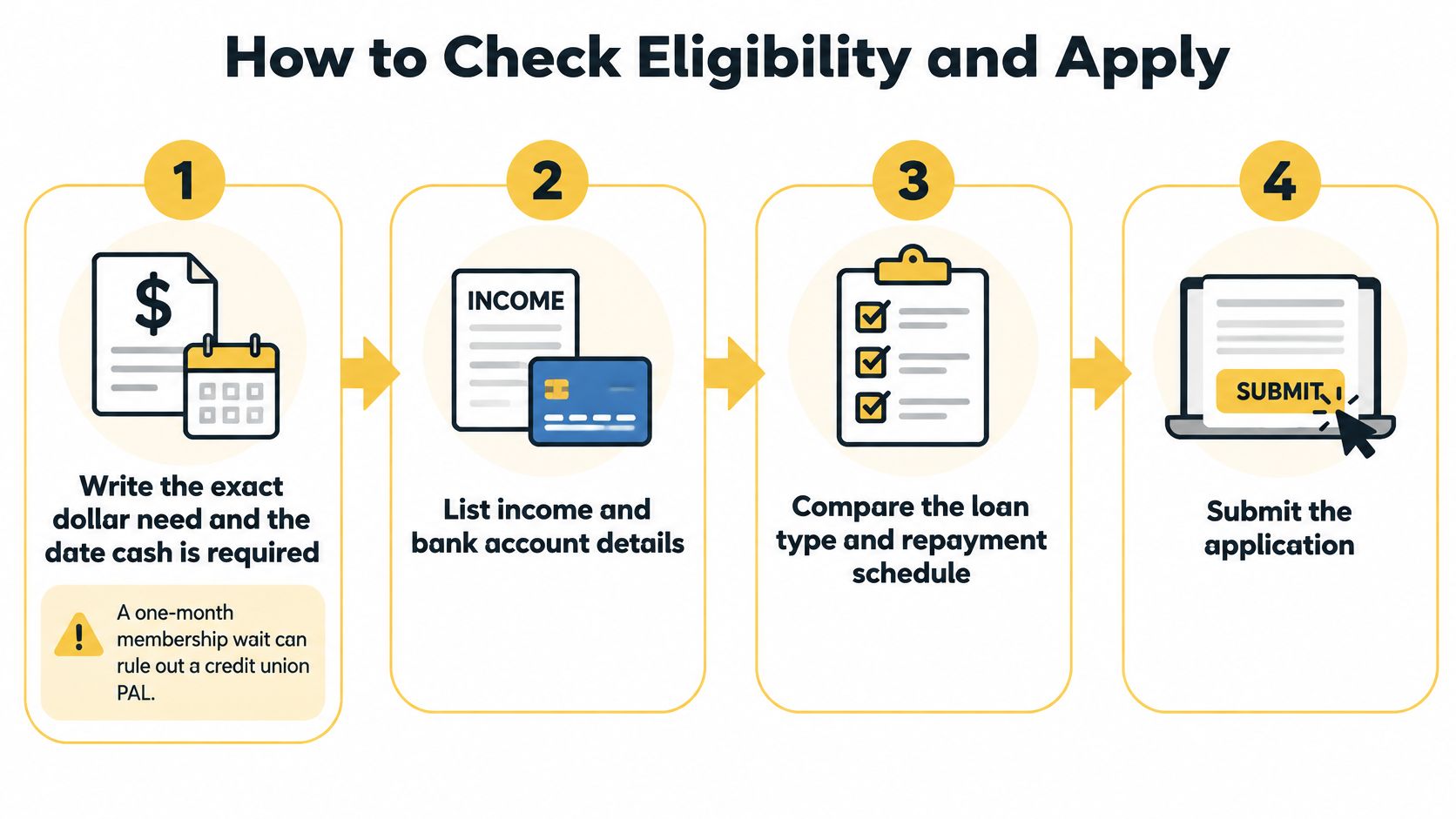
A path you can follow this week
- Write the exact dollar need and the date the cash has to be in hand. A one-month membership wait can rule out a credit union PAL even when the credit union is otherwise a good fit. If rent is due Friday and you aren't a member yet, that row is closed for this bill.
- List income you can document: wages, benefits, or a regular deposit pattern. Mark whether pay is irregular. A lender that underwrites ability to repay needs a number it can see, and a gig deposit that lands twice a month won't look like a weekly paycheck.
- Ask a credit union whether it offers PALs, whether one month of membership is required, and whether an existing member can borrow now. "We have small loans" isn't the same answer as "we can fund a PAL before your due date."
- Ask a local bank, CDFI, or nonprofit whether a small-dollar installment or pilot is open, which credit check it uses, and whether thin or bad credit is accepted. A closed enrollment period is a no for this month, not a hint to keep shopping the same day.
- Read the offer for APR or periodic rate, application fee, number of payments, payment dates, and total amount repaid before you sign. If any of those fields is missing, you don't have an offer yet.
- If the payment is larger than what's left after rent, food, and utilities on a thin paycheck, stop. A payment plan or assistance is the cheaper move. Confirm state-specific legality in a state guide before you fill out any request.
Blockers that aren't a credit score
No credit union nearby, a ChexSystems or unpaid-account block, and a city program that's closed for the year all stop the application before underwriting starts. Military borrowers have separate federal protections on certain consumer credit, so ask the lender to apply those rules before it quotes a fee. None of those blockers gets fixed by agreeing to a shorter term.
What a Few Hundred Dollars Really Costs
A $500 shortfall can lead to very different repayment totals. Paying a payday loan once, renewing it repeatedly, or repaying an installment loan in equal payments changes what happens to the balance, even when the amount borrowed is the same.
| Path | Amount received | Fee or charge shown | Time | What happens to the balance |
|---|---|---|---|---|
| Payday repaid once | $500 | $75 fee ($15 per $100), $575 due | Two weeks | The balance is cleared when you pay the fee and principal |
| Payday renewed in a long sequence | $500 | Another fee each cycle; ten cycles can mean $750 in fees | Sequences of 7 or more loans are common; about half reach at least 10 | More than 80 percent of renewers still owe at least the original principal |
| Amortizing PAL-style loan | $200 to $1,000 | Application fee at most $20 plus the credit union's interest rate | One to six months | Equal installments reduce principal; rollovers are not allowed |
A $15 per $100 fee for a two-week payday loan works out to roughly a 391 percent APR. On a $500 loan, that fee is $75, bringing the amount due to $575 if you repay it in one cycle. The calculation illustrates how a short loan's fee translates to an annual rate; it does not mean every borrower repays after one cycle.
The Consumer Financial Protection Bureau reported that more than 80% of payday loans were rolled over or renewed within 14 days in its 2014 analysis. Only 15% of payday borrowers repaid all payday debt when due without borrowing again within 14 days. 64% renewed at least one loan during the year, and 20% defaulted at some point. More than 60% of loans were issued in sequences of seven or more, and roughly half were in sequences of at least 10. Among borrowers who renewed, more than 80% owed at least as much on their final loan as they had borrowed at the start.
What ten cycles do to $500
At a $75 fee each cycle, ten cycles can add up to $750 in fees while the original $500 principal remains due. You may pay more in fees than you received and still owe the original balance. The key difference is whether each payment reduces what you owe, or only buys more time before another fee is due.
A PAL-style loan works differently: it must fully amortize, so each equal payment reduces principal, and rollovers are not allowed. Its application fee is at most $20, while the credit union sets the interest rate. Rates can differ, so use a loan payment calculator to compare the payment schedule and total repayment amount with a two-week payday fee.
If you need $500 while waiting for a lawsuit settlement, pre-settlement funding is a separate kind of agreement, not another small-dollar installment loan. This guide to pre-settlement funding explains how legal financing is priced and repaid.
Compare the total dollars repaid and check whether each payment reduces the balance. The cash you receive today is only part of the cost.
When the Safer Option Is Hard to Get
A lower-cost loan helps only if you can get it before the bill is due and make the payments without putting rent or another essential expense at risk. NCUA reporting shows that 467 federal credit unions reported offering PALs, with reported balances of about $139 million. That establishes a real source of loans, but the count does not show how many branches offer them, how often applicants are approved, how long decisions take, or whether rural borrowers can reach a participating credit union.
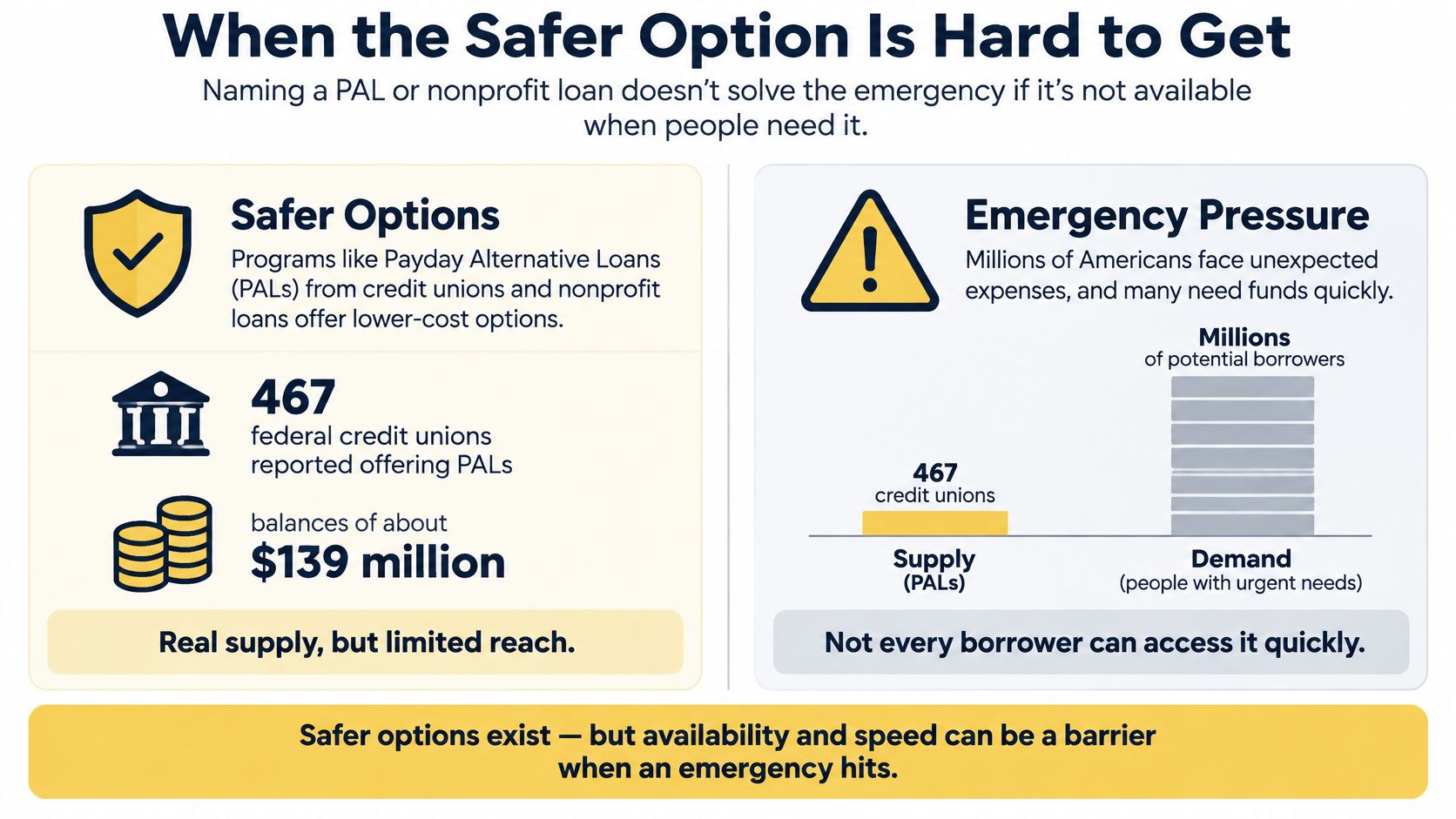
A safer loan can still be out of reach. Membership requirements, underwriting, or a wait for funds can block access. And even an approved payment schedule may not fit income that changes from week to week. The useful question is not only whether a product costs less, but whether it is available in time and its payments fit your actual cash flow.
Can you reach the lower-cost option in time, and keep up with its payments when your income is irregular?
Three paths that are not the same loan
- A PAL you can open: A Payday Alternative Loan helps only if a participating credit union offers it and can fund it before the bill is due. A membership wait or a branch without the product may make it unavailable when you need it.
- A credit-builder or secured small-dollar product: At the beginning of 2024, the Federal Reserve's overview of credit-building products counted more than 3 million credit-building product accounts, with total balances of $845 million. Secured small-dollar loans accounted for $350 million of those balances. Building credit may help over time, but it does not pay an urgent utility bill or mechanic today.
- A payment plan with the original biller: A utility, medical office, or creditor that agrees to spread out a balance is not a new loan. It may avoid adding another lender and due date to an already tight budget.
The options solve different problems. A credit-building product serves a longer-term purpose, while a biller's payment plan addresses an existing balance. If a PAL is unavailable or its payment would crowd out rent, treat that as a reason to look for another path, not as proof that a payday loan is affordable. For a plain list of alternatives to consider, Allied Tax Advisors payday loan alternatives describes several non-loan options.
Get Local Help Before You Borrow
Work the calls in this order. Borrowing is the last step, not the first.
Call 211, or your local equivalent, before you add a new creditor. Ask about emergency assistance, utility aid, and nonprofit credit counseling. A grant or a counselor-negotiated plan can clear the same bill without a finance charge. If rent is the pressure point, keeping a child housed beats adding a loan on top of an eviction notice. The Homeless Engagement Lift Partnership explains why stable housing matters for children and how emergency rent assistance fits that problem.
Ask the biller, landlord, medical office, or creditor for a payment plan next. Spreading an existing balance is usually cheaper than financing it. Utility shutoff rules and medical billing offices often have hardship schedules that never show up in a loan ad. A walkthrough of emergency help paying utility bills is a useful script for that call.
If you still need to borrow, ask a credit union or community lender for an amortizing small-dollar offer. Reject any product that only renews the full balance. You want a payment that retires principal on a schedule you can see.
If a lender or collector has already caused harm, file a complaint and get legal help. Use the state regulator or the CFPB complaint process, and contact legal aid if the debt is in collections or wages are at risk. NCUA sets PAL terms, the CFPB documented payday renewal patterns, and the Federal Reserve measured how large this market is. Those are the rulebooks, not a lender's FAQ.
BadCreditMD is a no-cost information site, not a lender. It publishes loan-type explainers, state rule summaries, and directories for 211, counseling, legal aid, benefits, and complaints. Any partner request form is optional, it's unavailable where the product is prohibited, and a credit check could occur only if you submit that form.
A small dollar loan is worth taking only when the payment fits the next several paychecks and the balance falls on schedule.
BadCreditMD explains small-dollar, installment, payday, and emergency loan costs for people with thin or imperfect credit, and it points you to state rules plus free local help before you apply. You can compare what a few hundred dollars really costs, see which products your state allows, and find 211, counseling, and complaint contacts in one place. Visit BadCreditMD and start with the guide that matches your state and the bill you need to pay.