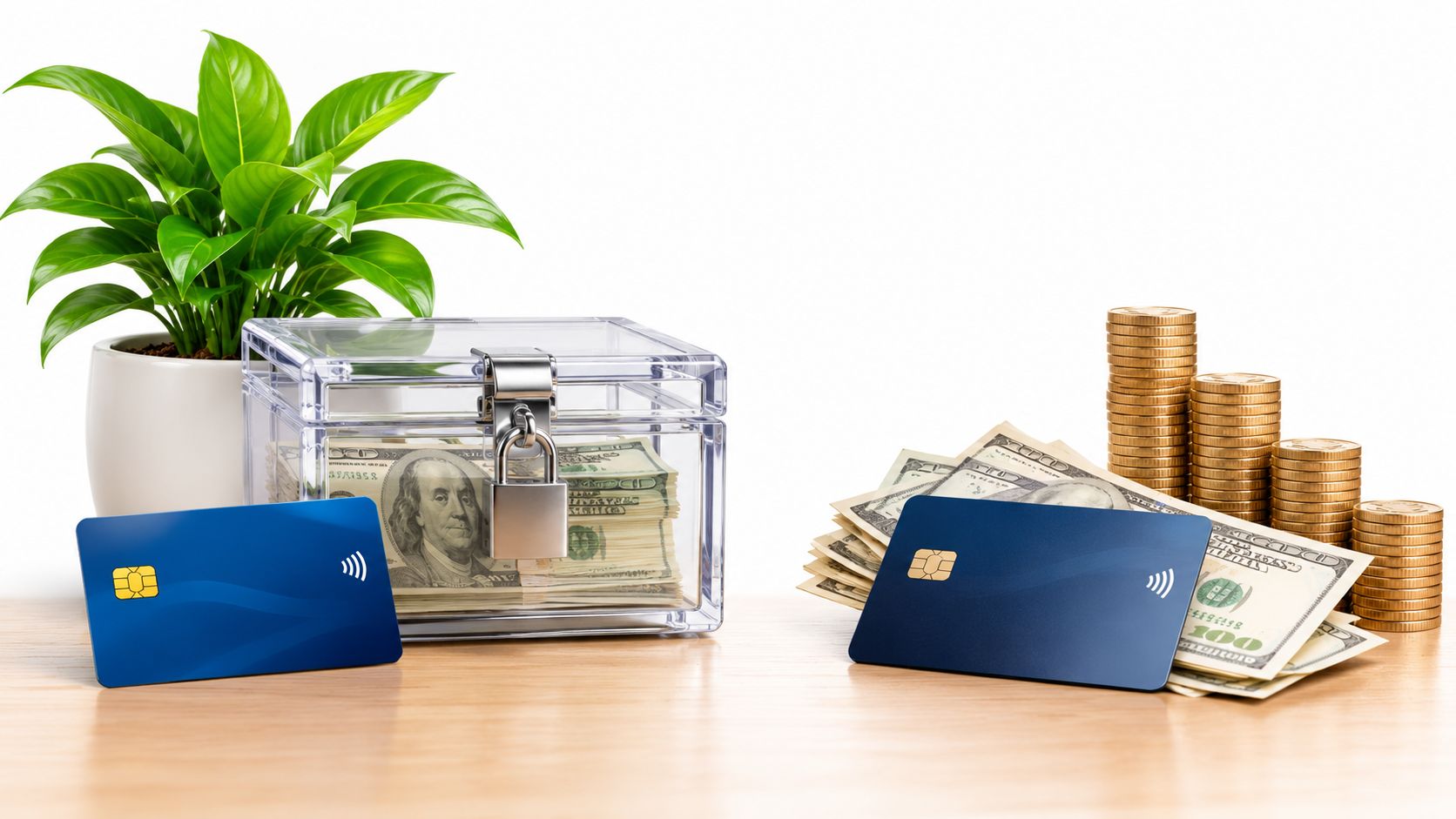
The popular advice says if you need cash and you have credit, just use the credit. That's backwards. Credit with cash can mean two opposite moves, and mixing them up costs people money. In one direction, you put cash down to open credit and build a file over months. In the other, you turn credit you already have into cash today and start paying for that speed right away.
Don't judge either move by the first dollars you receive. Judge it by total repayment, by what gets reported, and by whether the payment still fits after rent, food, utilities and transport. A deposit that builds history and an advance that must be repaid in two weeks aren't versions of the same product. They're different tools with different risks.
Table of Contents
- Two Opposite Meanings of Credit With Cash
- Which Cash Path Matches the Goal
- How a Cash Deposit Becomes Credit
- What Cash From Credit Really Costs
- When Account Cash Flow Helps You Qualify
- Choose a Deposit or Skip the Advance
Two Opposite Meanings of Credit With Cash
Say two people search the same phrase on the same night. One has a few hundred dollars saved and wants a credit file lenders will trust. The other already holds a card, or a storefront loan offer, and needs a bill paid today. They typed the same words. They need opposite answers.
Cash in, or cash out
The first path is cash in. You place a refundable deposit on a secured card, or you make payments while a credit-builder loan sits in a locked savings account. Your cash lowers the lender's risk, and your on-time payments can create the history you don't yet have.
The second path is cash out. You take a credit-card cash advance, a payday advance or a similar short-term product and walk away with bills. Ordinary card purchases are neither path. Purchases often keep a grace period if you pay in full, while cash withdrawals usually lose it.
If cash leaves your account to secure a line, you're building. If cash leaves a credit line to reach your hand, you're borrowing at advance pricing.
This isn't a niche trick. The Federal Reserve financial stability report on household borrowing puts total U.S. household credit at approximately $20.935 trillion in the fourth quarter of 2025, consumer credit at about $5.107 trillion and credit-card balances at roughly $1.324 trillion. Household credit grew 3.2% from the fourth quarter of 2024 to the fourth quarter of 2025, compared with an average annual growth rate of 4.9% from 1997 through 2025.
Cash-access borrowing sits inside that large, longstanding system. It isn't a loophole around it. If you're weighing whether to secure a small line or stretch for an unsecured line of credit for bad credit, start by naming which direction your cash would move. That one answer sorts the table, the deposit steps, the cost math and the underwriting questions that follow.
Which Cash Path Matches the Goal
Read this table before you read any sales page. Each row answers four plain questions. What does the cash do, what cost should you expect, what usually reaches your credit file, and when does the path fit?
Cash and credit paths compared
| Path | What the cash does | Cost signal | Credit-file effect | Fits when |
|---|---|---|---|---|
| Secured credit card | Your deposit sets the limit | Annual fee varies, deposit is collateral | On-time payments can be reported | You can park cash and pay the balance monthly |
| Credit-builder loan | Loan sits in locked savings while you pay installments | Interest and fees on a small installment | Payment history can be reported | You want a closed-end record, not a card |
| Credit-card cash advance | Existing line becomes bills | Fee often about 3% to 5% or a minimum, plus immediate APR | Balance and payment behavior can be reported | You already have a card and can repay fast |
| Storefront payday loan | Short advance due near the next paycheck | Example 15% fee, often renewed | Often not a traditional installment history | Only if repayment does not require another loan |
| Prepaid card | You spend money you already loaded | Load, monthly or ATM fees, no interest | Usually none | You need a spending card, not a credit file |
| Credit union PAL | Small installment from a federal credit union | APR capped at 28% under NCUA rules | Installment history may be reported | You can join a credit union and want a capped rate |
Notice the split in the second column. On the first two rows, your cash comes first and stays locked while you prove you can pay. On the next two rows, cash reaches you first and the bill follows quickly, with fees attached. The last two rows are the common confusions. A prepaid card looks like a credit card in your wallet, but you're spending money you loaded, so there's usually no credit file being built. A credit union payday alternative loan, or PAL, looks like a payday loan in size, but it's an installment loan with a capped rate.
Details readers miss in the fine print
- Deposit is not a fee: On a secured card, your deposit is collateral. It's generally returned after the account is closed in good standing or graduated to unsecured, minus any balance you still owe.
- Address and eligibility come first: Issuers verify identity and mailing details before they open an account, which is why resources on US addresses for nonresident card applicants matter if you're applying without a long U.S. residential history.
- Reporting is the whole point: A building product that doesn't report your payments to the bureaus takes your cash and gives you little file value in return. Ask which bureaus receive reports before you fund anything.
- Access is not approval to spend: A cash advance limit is often lower than your purchase limit, and using most of it raises your reported balance fast.
Apply one rule to the whole table. If your goal is a future score, pick a deposit or installment you can pay without needing another advance later. If your goal is tonight's cash, compare total repayment, not the amount handed over the counter. A product can be fast, easy and still be the wrong match if its due date lands before your money does.
How a Cash Deposit Becomes Credit
Think of a lockbox. You place cash inside, the issuer or lender holds the key for a while, and that held cash makes it safer for them to trust a thin or damaged file. You aren't buying a score. You're renting a chance to show a payment pattern with less risk to the other side.
The steps below show where your money sits while that pattern forms.
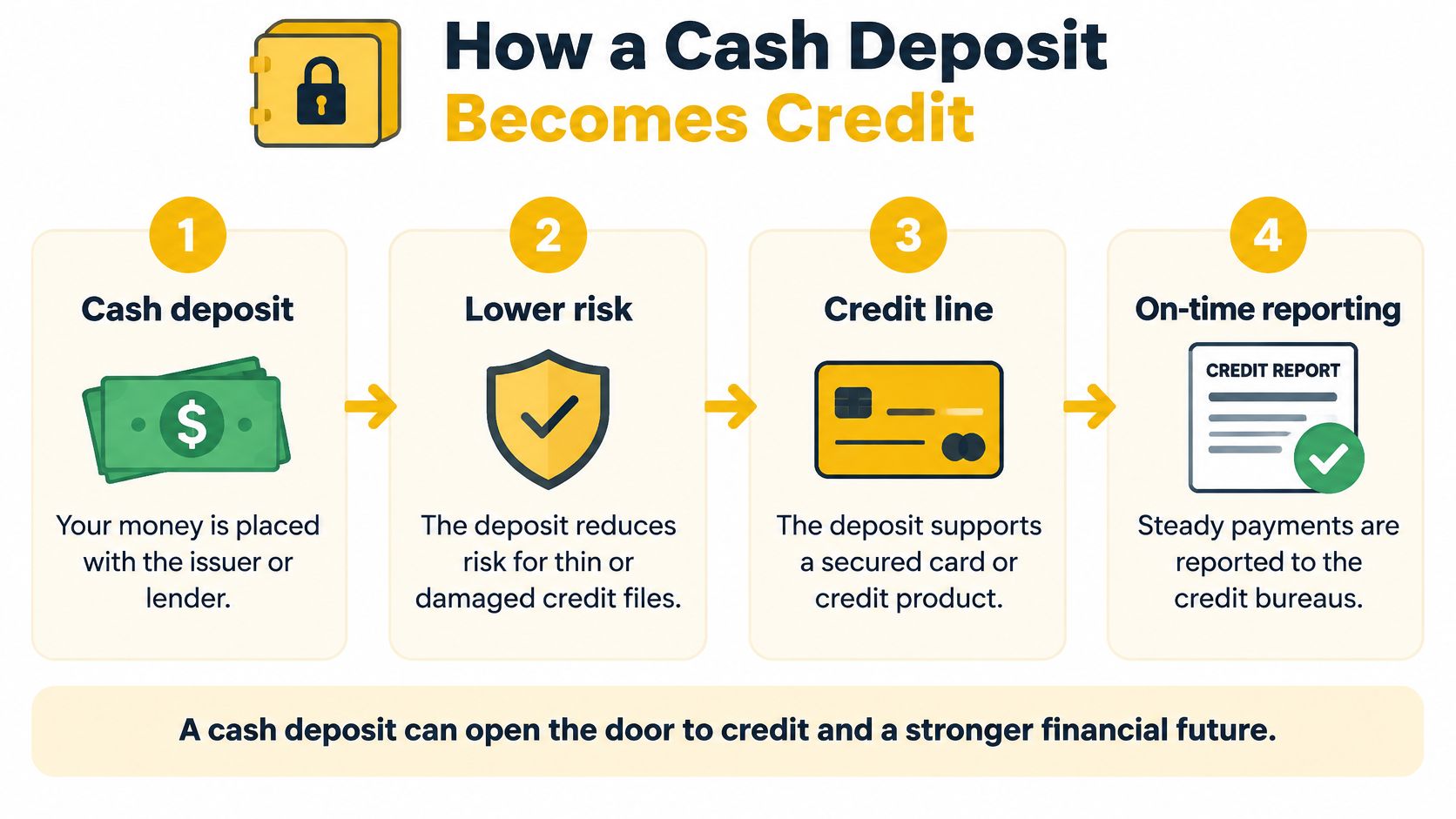
The secured card sequence
- Compare the full terms: Check the required deposit, the credit limit it creates, any annual fee and whether the issuer reports to all three bureaus. A card that reports to only one bureau builds a thinner record.
- Deposit only cash you can leave untouched: This is often a few hundred dollars in a worked example, and it isn't spending money. If losing access to it would break next month's rent, the deposit is too big.
- Charge one small, budgeted purchase: Use the card for something you'd buy anyway, like a phone bill or fuel. Don't take a cash withdrawal, since that changes the pricing and defeats the exercise.
- Pay the statement balance by the due date: Paying in full keeps interest from erasing the value of the deposit. Set autopay for at least the minimum, then pay the rest manually if your income timing is uneven.
- Ask about graduation in writing: Find out when the deposit can be returned and whether the card can move to unsecured while keeping your account history.
A secured credit card is backed by a deposit the cardholder makes, and it can help build credit when paid on time. Readers who want to compare a do-it-yourself route can review the DIY credit card approach before choosing an issuer.
The credit-builder sequence
- The lender locks the proceeds away: The loan amount goes into a savings account you can't freely spend.
- You make fixed installments: You pay on a set schedule, much like any small installment loan.
- Those installments are what can be reported: Your payment record is the product you're really buying.
- You receive the savings at the end: You get the held amount back, minus interest and fees charged along the way.
Watch three edge cases. A high annual fee on a tiny limit eats your available credit before you spend anything. Fees charged to the card can spend down the value your deposit was meant to protect. A missed payment reports just like a miss on any other card, deposit or not.
This path takes months, not an afternoon. It also fails in one predictable way. If the new payment itself forces you to take a cash advance later, you've paid to build credit and borrowed at advance prices to do it.
What Cash From Credit Really Costs
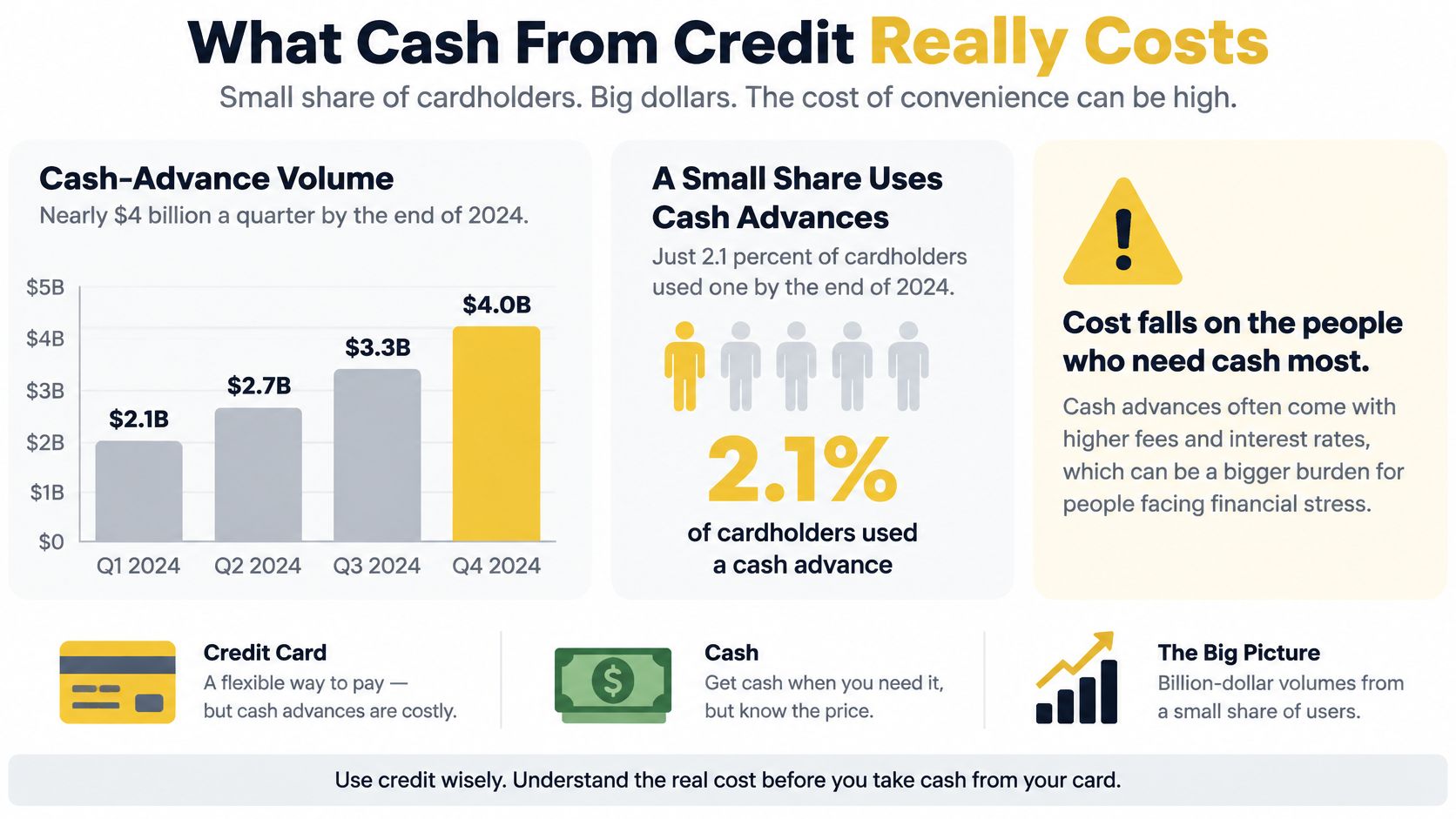
Cash advances aren't a mainstream habit, and that matters. The CFPB consumer credit trends data reports that aggregate credit-card cash-advance volume reached nearly $4 billion per quarter by the end of 2024, above pre-pandemic highs, even though the share of cardholders using cash advances was only about 2.1%. A small group of people who need immediate liquidity carries a large dollar volume.
The chart below puts that concentration in one view.
Run the math on 300 dollars
Use a hypothetical $300 need, because the fee differences show up clearly at small amounts. A card advance with a fee of about 3% to 5% costs $9 to $15 upfront, before interest. Interest usually starts from day one, with no grace period on that amount. Add an ATM or convenience charge, then imagine making only minimum payments, and a 30-day problem becomes a 60 or 90-day balance.
| Way to get $300 | Upfront cost | If repaid in about 30 days | If stretched toward 60-90 days | Grace period |
|---|---|---|---|---|
| Card cash advance at about 3% | $9 | $9 plus about one month of APR interest | Higher, interest accrues while the balance stays open | None, interest usually starts immediately |
| Card cash advance at about 5% or issuer minimum | $15 | $15 plus about one month of APR interest | Higher if only minimum payments are made | None on the advanced amount |
| Payday loan at 15% per two-week cycle | $45 | About $90 over two cycles | About $180 to $270 over four to six cycles | None |
| Debit withdrawal of your own cash | ATM fee only, often a few dollars | No interest | No interest | Not credit |
Read the payday row slowly. The CFPB analysis of storefront payday loans covered more than 12 million storefront payday loans over a 12-month period and found four out of five loans were rolled over or renewed within 14 days. Using that report's representative 15% fee, each fee on a hypothetical $300 advance is $45, and an initial advance followed by six renewals produces seven fee events totaling $315 before principal repayment.
Why the renewal happens
The trap is timing, not arithmetic skill. The due date arrives before the next paycheck, or while rent, utilities, food or transport are still unpaid. Renewing postpones the payment and adds another fee. The borrower isn't careless, the calendar doesn't line up, and each renewal makes the next paycheck smaller in practical terms.
- Add every charge together: Transaction fee, APR, ATM charges and the lost grace period all belong in one total.
- Ignore rewards in this decision: Cash-back rewards on purchases don't offset advance fees and immediate interest.
- Separate look-alike products: A cash advance isn't a balance transfer, a debit withdrawal, an overdraft or a purchase on a cash-back card. Each prices risk differently.
- Compare business products separately: If you're a seller weighing funding against card sales, you can compare merchant cash advance fees on their own terms rather than mixing them with consumer card pricing.
Before you accept any rate, check how pricing works on an unsecured loan rate so you can compare an installment quote against advance pricing on equal footing.
Decision rule: Refuse any product whose payoff requires another advance. Ask for a creditor payment plan, nonprofit counseling or a credit union small-dollar loan first.
Title loans deserve a separate warning. Their fee math can look similar on paper, but they add a risk no table captures, losing the vehicle you may need to get to work.
When Account Cash Flow Helps You Qualify
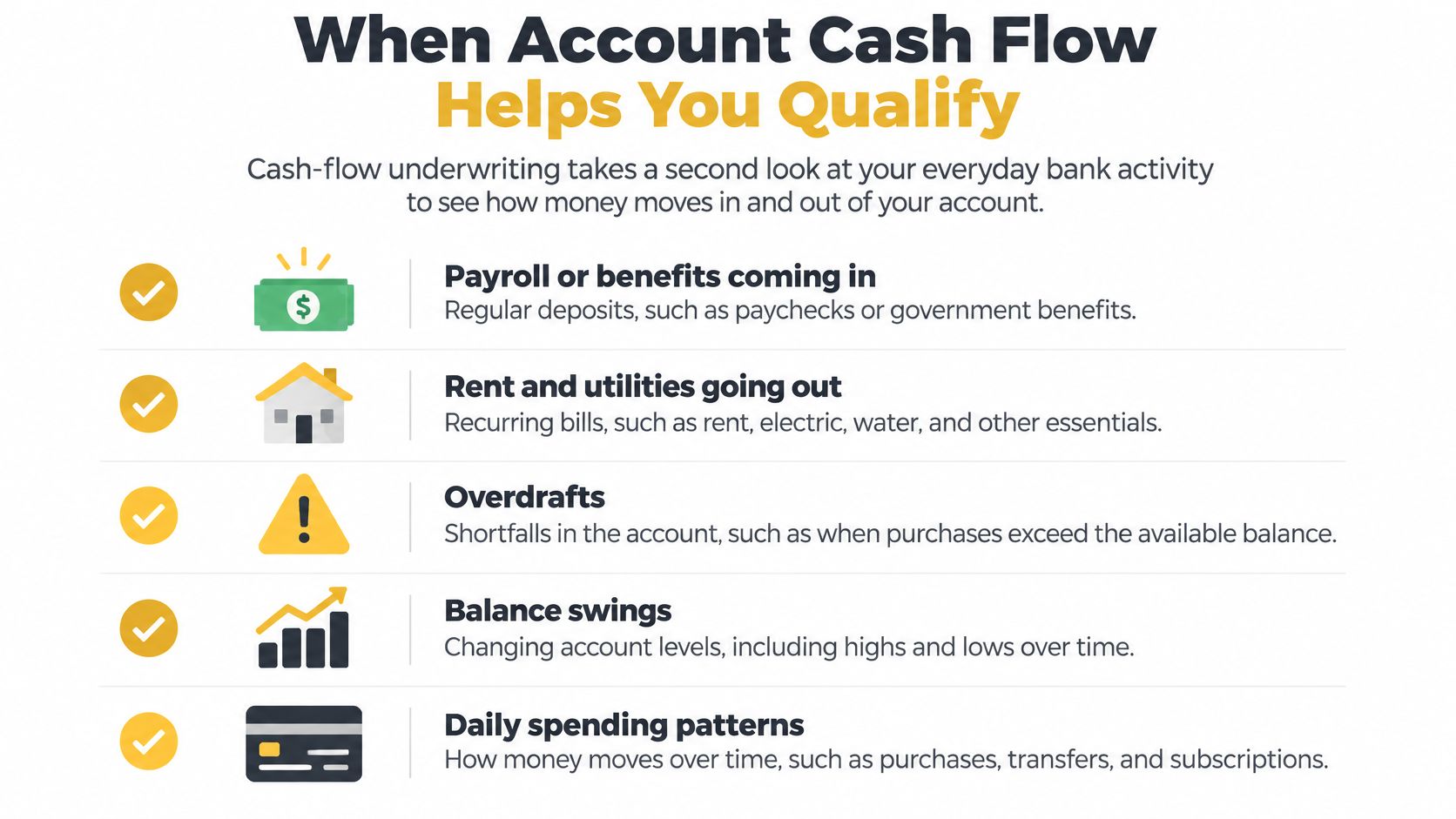
Some lenders now take a second look at the bank activity you already live with. This is cash-flow underwriting. Instead of relying only on a bureau score, the lender reviews deposit-account data you give permission to share, such as payroll or benefits coming in, rent and utilities going out, overdraft frequency, balance swings and what's left after essentials.
The checklist below shows the everyday signals that review can include.
What a second look can and cannot do
Recent analysis described in the CFPB consumer credit trends coverage of credit cards identifies cash-flow data from deposit accounts as a promising underwriting input for small-dollar credit, particularly for "credit invisibles" and borrowers whose conventional scores understate their repayment capacity. In the Federal Reserve's 2024 household survey, 19% of respondents said spending exceeded income in the survey month, 11% struggled to pay bills because income varied, and 37% could not cover a small emergency using cash, savings, or a credit card paid off with the next statement.
That need explains the appeal. A steady deposit pattern can show repayment capacity that a thin file hides, and it can separate two people with the same low score into very different risk pictures. But sharing your deposits doesn't guarantee approval. It also isn't proof that another payment is safe for you.
Apply the residual cash test yourself. After housing, food, utilities, transport and existing debt, does the new payment still leave money in the account? A lender who approves you only because a deposit just landed can restart the overdraft cycle within weeks.
Verify before you connect an account
- Who receives the data: Name the lender, the data aggregator and any partners who can see your transactions.
- How long it's kept: Ask for the retention period and how to revoke access.
- Whether it's used for marketing: Underwriting consent and marketing consent shouldn't be bundled without your knowledge.
- What alternatives exist: Ask whether pay stubs or benefit letters can verify income instead.
- How to challenge a denial: Get the process for correcting errors and requesting a fresh review.
Expect errors when pay is seasonal, gig-based, irregular or split across several accounts. One account may show strong inflows while another carries the rent. Treat cash-flow data as a supplement that can support your case, not as a reason to accept the largest offer you're shown.
Choose a Deposit or Skip the Advance
You don't need a perfect plan this week. You need one branch, chosen.
The photo below captures the pause worth taking before either branch.

Branch one and branch two
Branch one, you have spare cash you can leave untouched. Compare a secured card whose deposit sets the limit and reports on-time payments, or a credit-builder loan that holds the borrowed amount in savings while installments build history. Pick the one whose payment fits without help from future borrowing.
Branch two, you need emergency cash now. Check a federal credit union payday alternative loan first. Credit union payday alternative loans are small loans from federal credit unions with an APR capped at 28% under NCUA rules. Then call the utility, medical provider or creditor and ask for a payment plan. A $240 overdue electric bill could become four $60 additions to your regular bills instead of a new loan.
If the only offer in front of you is a payday, title or high-fee online installment product, stop when repayment would require another advance. Before any new draw, book nonprofit credit counseling for a budget review or a debt-management plan. You can also compare safer structures among loan options for bad credit before you sign anything.
This short video walks through the same deposit-versus-advance choice in plain language.
For score-band context, state rules and free local help, use BadCreditMD as a free guide rather than a lender, plus 211 for local assistance, legal aid and benefits. Free help is pointed to through 211, nonprofit credit counseling, legal aid and benefits programs, each linked to its official source. Reading guides doesn't affect your credit, but submitting a request for offers can trigger credit checks and share your information with lenders.
If you're deciding whether to park cash as a deposit or walk away from an advance, BadCreditMD gives you free state-by-state guides, worked cost examples and lower-cost alternatives to compare before you apply anywhere. Visit today, check the rules and caps where you live, and pick the branch you can repay without borrowing again.