
Loan-to-value ratio is the loan amount divided by the value of the asset securing it, shown as a percentage. A $240,000 loan divided by a $300,000 value equals 80%.
You're probably looking at a loan estimate, a dealer worksheet, or a lender's request for more cash down, and that one percentage is driving the decision. Your down payment hasn't changed, yet the terms have. That's usually because the lender used a different value than the price you agreed to pay, or added charges into the amount financed.
Table of Contents
- What Loan-to-Value Ratio Means in Plain Terms
- How to Calculate Loan-to-Value Ratio Step by Step
- How Lenders Use LTV to Set Approval and Pricing
- How LTV Works on Auto Loans and Other Secured Debt
- How to Lower Your LTV Before You Apply
- Check Current LTV and Each Offer Before You Sign
What Loan-to-Value Ratio Means in Plain Terms
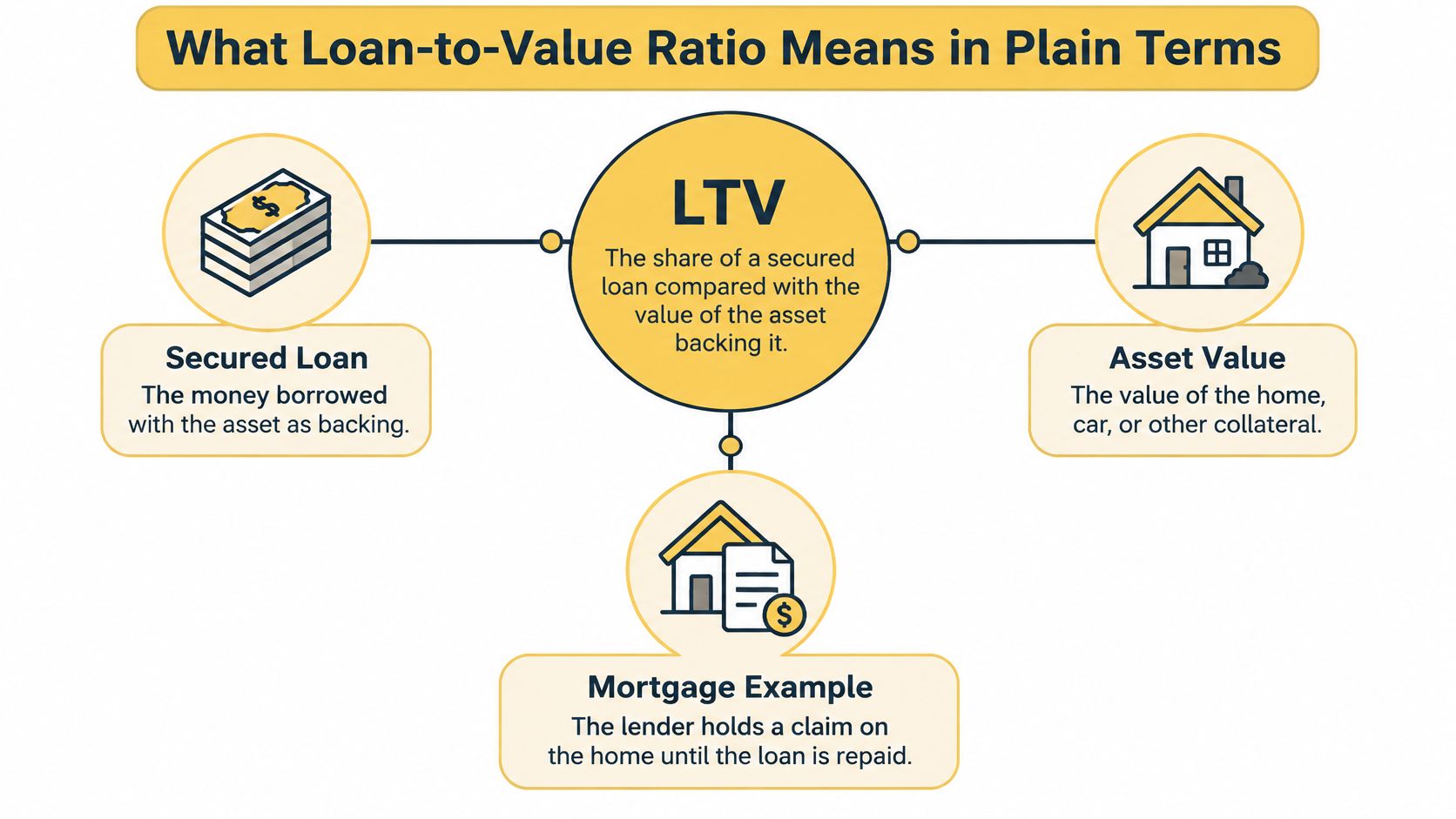
When people ask what is loan to value ratio, the plain answer is that it compares a secured loan with the value of the asset backing it. The Federal Reserve interagency guidelines on real estate lending policies define loan-to-value ratio as the percentage of a secured loan compared with the market value of the collateral, using credit extended at origination and generally including all senior liens. The denominator is the property's appraised or otherwise evaluated market value.
Think of buying a house with a mortgage. The lender holds a claim on the home until you repay the debt. LTV tells you how much of the home is financed and how much you own outright.
What the Percentage Leaves Behind
At 60% LTV, financing equals 60% of the collateral's value and the remaining 40% is an implied equity cushion. That cushion is the lender's buffer if you default and the asset must be sold, because selling costs and a price drop eat into what's recovered. A smaller cushion leaves less room for error.
Lenders apply LTV to first mortgages, home-equity loans, commercial real estate, auto loans, and other secured credit, though valuation methods and acceptable thresholds vary by loan type. If you're weighing a second loan against a home, home equity guidance for California veterans can help you see how much equity you have before you borrow against it. The same logic applies to less common collateral, which is why secured products such as boat title loans explained still turn on what the asset is worth.
What LTV Does Not Measure
LTV isn't your credit score, your income, or your debt-to-income ratio. It says nothing about whether you pay bills on time or whether the payment fits your budget. It measures collateral protection only.
LTV measures how much of an asset is financed, not how strong the borrower is.
How to Calculate Loan-to-Value Ratio Step by Step
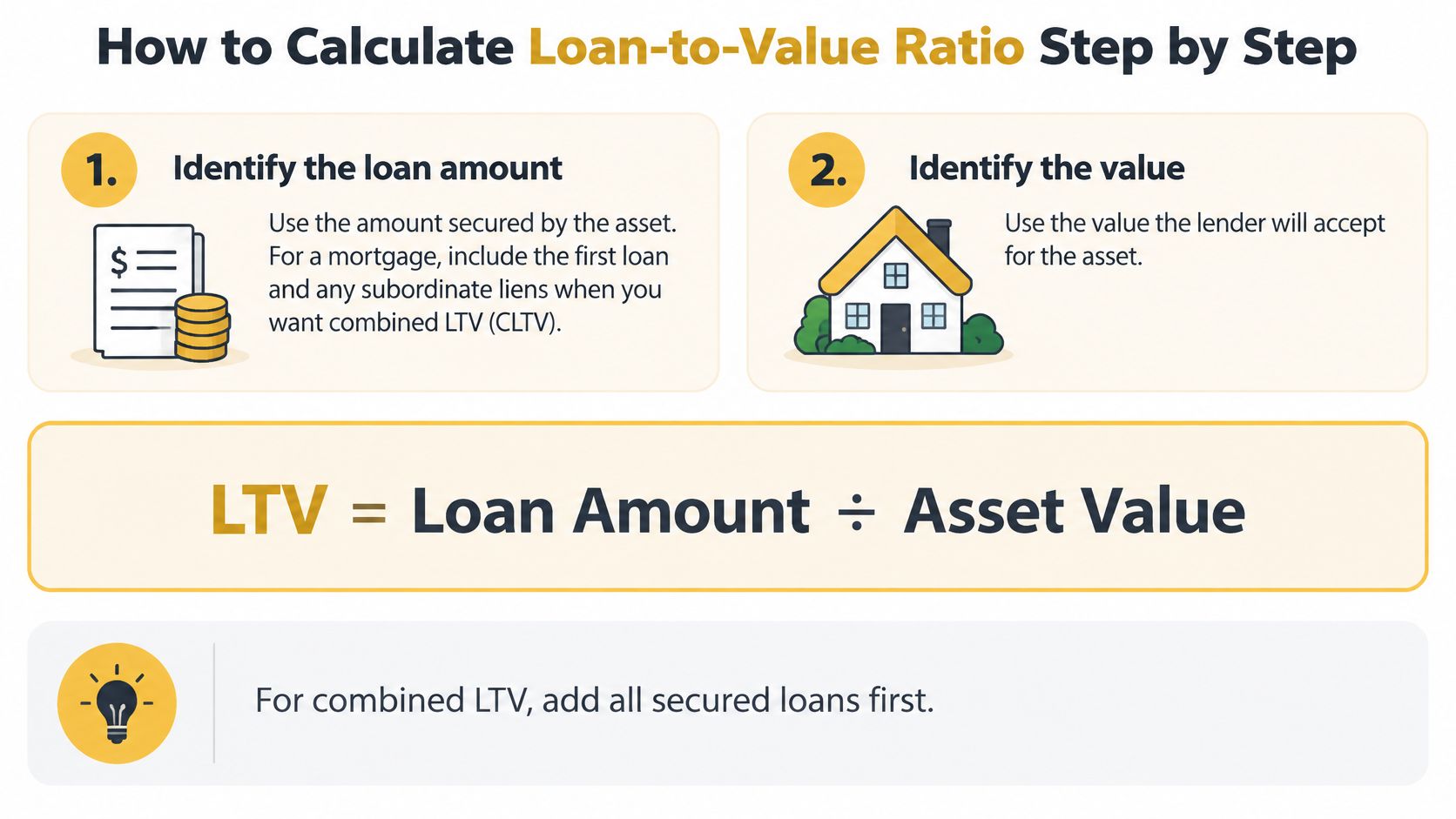
The Consumer Financial Protection Bureau explanation of loan-to-value ratio and costs calculates LTV as the amount financed divided by the property value used in underwriting, expressed as a percentage. A $240,000 mortgage on a $300,000 qualifying value produces an 80% LTV, implying 20% borrower equity. That source also notes lenders may rely on an appraisal, purchase price, or another permitted valuation.
The Five Steps
- Find the loan amount: Use the amount secured by the asset. For combined LTV, or CLTV, add the first mortgage and any subordinate liens so you're measuring total debt secured by the property.
- Find the value the lender will use: Ask whether it's an appraisal, the purchase price, or another permitted valuation. Don't assume it's the contract price.
- Divide and multiply: Loan amount divided by value, times 100. For example, $240,000 divided by $300,000 times 100 gives 80%.
- Check the denominator on a purchase: Say the contract price is $300,000 but the appraisal is $285,000 and the lender caps LTV at 80%. The maximum first mortgage is $228,000, so you need $72,000 toward the price before closing costs, not the $60,000 implied by 80% of the contract price.
- Compare with the lender's ceiling: Subtract the loan from the value to see your equity cushion, then check whether the percentage clears the lender's limit.
Worked LTV Examples for Mortgages
| Scenario | Loan amount | Value used | LTV | Equity cushion |
|---|---|---|---|---|
| Standard mortgage on a $300,000 home | $240,000 | $300,000 | 80% | $60,000 (20%) |
| High-LTV mortgage on a $300,000 home | $270,000 | $300,000 | 90% | $30,000 (10%) |
| Lower-LTV mortgage on a $300,000 home | $150,000 | $300,000 | 50% | $150,000 (50%) |
| Purchase at $300,000, appraised at $285,000, 80% ceiling | $228,000 | $285,000 | 80% | $57,000 (20% of appraised value) |
The last row is where borrowers get caught. Your cash down didn't shrink, but the value in the denominator did, so the loan the lender will approve shrank with it. Run the division yourself on every offer, then ask the lender one question: which valuation did you use?
Practical rule: Divide first, compare second, and never trust an LTV until you know the value underneath it.
How Lenders Use LTV to Set Approval and Pricing
A high LTV is a risk signal, not an automatic denial. It means the lender has less collateral value to fall back on if the borrower cannot repay and the asset must be sold. That thinner cushion can affect approval, pricing, or insurance requirements.
The Federal Reserve's guidance on high-LTV residential real estate lending defines a high-LTV residential real-estate loan as equal to or above 90% of the property's appraised value, unless appropriate credit support exists. For example, a $270,000 loan on a $300,000 home has a 90% LTV, leaving $30,000, or 10% of the home's value, as an equity cushion before selling costs and other expenses. The guidance also says lenders must include senior liens when calculating LTV.
LTV Bands and Typical Lender Responses
| LTV band | Typical lender response | What it means for the borrower |
|---|---|---|
| Up to 80% | Strong collateral cushion; mortgage insurance usually not required on conventional loans | Often the most favorable pricing range |
| Above 80% to below 90% | Mortgage insurance commonly required; documentation and pricing may tighten | Plan for a higher monthly cost or insurance |
| 90% and above | Federal guidance treats residential loans at this level as high-LTV unless credit support exists | More scrutiny and less room if values fall |
| Above 100% (common on auto loans) | Borrower owes more than the collateral is worth | A larger down payment, shorter term, or exception may be needed; there is a gap risk if the asset is lost |
Why a Second Loan Changes the Picture
Lenders consider the debt secured by the property together, not just the new loan. For example, a $300,000 first mortgage plus a $30,000 second lien on a $400,000 home equals $330,000 in secured debt, or 82.5% combined LTV. The second lien is only $30,000, but the combined figure gives the lender a fuller view of the debt against the home.
LTV is one factor alongside credit, income, and the lender's other criteria. Each lender sets its own rates and terms and must show the APR before you sign. To understand another factor lenders may consider for mortgages, see this guide to mortgages for borrowers with bad credit.
Check how your LTV band affects the full cost, not just the monthly payment. A strong credit profile may help offset a high LTV, while a low LTV does not guarantee approval.
How LTV Works on Auto Loans and Other Secured Debt
At a dealership, a car advertised for $25,000 may not be the value an auto lender uses to calculate LTV. The number that matters is the vehicle's value under the lender's valuation method, compared with the full amount being financed.
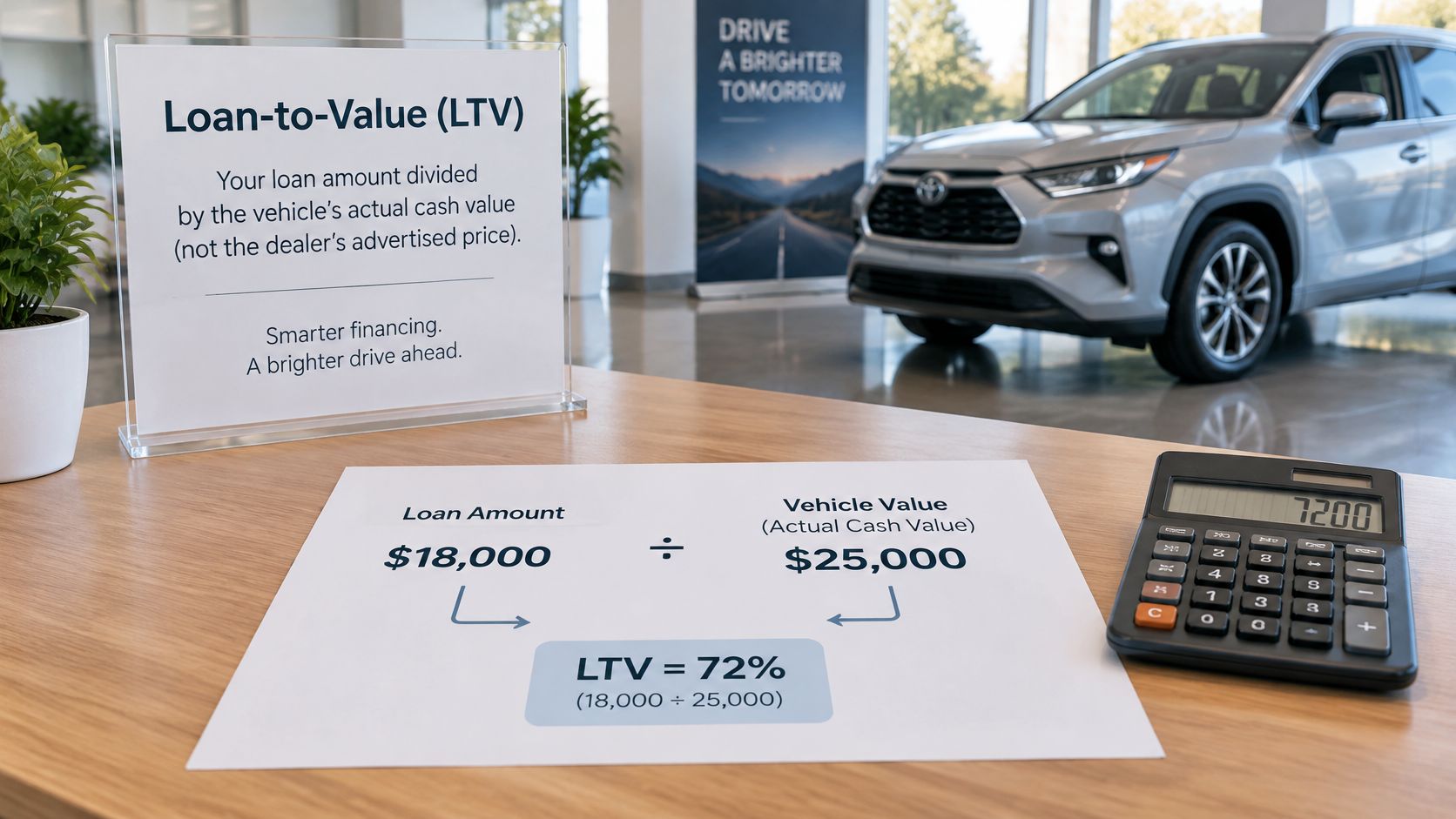
Auto lenders typically measure LTV against the vehicle's actual cash value rather than its advertised price. Taxes, fees, warranties, and negative equity rolled into a new loan can raise the amount borrowed even when the down payment stays the same.
A Trade-In That Starts Underwater
Suppose you trade in a car with an unpaid balance and buy one valued at $25,000. Taxes, fees, a service contract, and the shortfall on the old loan bring the new loan amount to $27,500. The LTV is 110%, leaving you $2,500 above the car's value from the start.
If the car is repossessed or totaled, the sale proceeds or insurance payout may not cover what you owe. That difference can remain your responsibility after the car is gone. Understanding car loan repayment difficulties can help you recognize why the balance matters beyond the monthly payment. The auto loan guide for borrowers with bad credit explains how the amount financed relates to a vehicle's value.
The video below shows how add-ons and the existing loan balance enter the calculation.
The same basic ratio applies to commercial real estate and equipment loans, though lenders may use different valuation methods. A high auto LTV is a risk signal, not an automatic denial. Before signing, ask what value the lender used and which taxes, fees, or add-ons are included in the amount financed.
How to Lower Your LTV Before You Apply
You can move the ratio from either side of the division. Borrow less, or support a higher value. Each option below uses a simple worked scenario so you can see the effect before you commit cash.
Borrow Less Against the Same Value
- Raise the down payment: Say you're buying a $300,000 home. Putting $60,000 down leaves a $240,000 loan at 80% LTV, while $30,000 down leaves you at 90%.
- Pay the balance down before refinancing: A smaller loan against the same value lowers the ratio without any change in the property.
- Keep car add-ons out of the loan: Pay for a service contract separately, or skip it, so it doesn't push an auto loan above 100%.
- Clear negative equity before trading in: Paying down the shortfall on your current car stops it from inflating the next loan.
Challenge a Low Value
If an appraisal comes in below the contract price, ask for an appraisal review and submit comparable sales that support the price. A lower value raises your LTV even when your down payment is unchanged, so the denominator is worth defending. Bring closed sales, not active listings, and point to specific differences the appraiser may have missed.
Weigh the trade-off before you pour cash in. A larger down payment often lowers LTV and helps you avoid conditions such as mortgage insurance, but it also uses money you may need for closing costs or reserves. A lower ratio helps most when it's paired with clean documentation, since lenders still weigh your credit and income alongside the collateral.
Check Current LTV and Each Offer Before You Sign
Your LTV at closing isn't your LTV forever. Say a $240,000 loan on a home bought for $300,000 starts at 80%. If the home is later worth $330,000 and the balance is still $240,000, your current LTV is about 73%. A downturn runs the other way and can push it above where you started.
Recheck the number before you refinance, sell, or ask to remove mortgage insurance. Repayment lowers it, appreciation lowers it, and depreciation raises it. Any of those can change what a lender will offer you next.
Misreadings That Cost Borrowers Money
- High LTV means automatic denial: It doesn't. It's a risk signal that can be offset by credit support, a larger down payment, or different terms.
- Low LTV guarantees approval: It doesn't either, because the ratio ignores your income and credit history entirely.
- One loan tells the whole story: Single-loan LTV differs from combined LTV when other liens are secured by the same property.
- LTV is a trait of the borrower: It isn't. It's a snapshot of one loan against one asset at one moment, and it moves as values and balances move.
The Offer Checklist
- Ask which value the lender uses: Appraisal, purchase price, or, for autos, actual cash value.
- Ask what's inside the loan amount: Other liens, taxes, fees, and service contracts all raise the numerator.
- Divide it yourself: Place the result in the band table so you know what response to expect.
- Compare total cost, not just the payment: The site offers a loan payment calculator for comparing monthly payments and total cost to explore monthly payments and total cost using your own illustrative figures until a lender's rate sheet confirms them.
- Decide for yourself: Lenders must show the APR before you sign, and you decide whether to accept any offer from a lender.
Run the LTV on every offer before you compare monthly payments.
Borrow only what you can repay on time. Short-term loans are costly and are not a long-term financial solution, so treat a high LTV on a short-term secured loan as a warning, not a workaround. The exact number to check before signing is your loan amount, including every add-on and lien, divided by the value the lender used.
BadCreditMD explains borrowing options for people with imperfect credit, including how collateral, credit, and state rules shape the offers you may see, and it doesn't lend or make credit decisions. Before you sign for a mortgage, auto loan, or other secured debt, run your own LTV, compare total cost across offers, and read the guides that match your credit situation. Visit BadCreditMD to explore those explainers and tools before you commit.