
9.7% of U.S. drivers went uninsured for at least part of the prior year because they couldn't keep up with premiums, according to Jerry's 2025 State of the American Driver report. That's a useful warning when you're figuring out how to purchase a car with no credit: getting approved doesn't mean you can afford to keep the car.
A missing credit file is often a documentation problem, not evidence that you've failed to repay debt. Your strongest approach is to show reliable income, borrow against a sensible vehicle and compare the whole transaction, not the payment a salesperson puts in front of you.
Table of Contents
- Buy a Car with No Credit in Seven Steps
- Credit Invisible or Damaged and What Lenders Check
- Budget the Full Cost, Not Just the Payment
- Compare Lenders and Co-Signer Options
- Alternatives and Habits That Protect Your Credit
- Check the Dealer Contract and Six Numbers Before You Sign
Buy a Car with No Credit in Seven Steps
The order of steps saves money because the dealer's numbers are only useful once you have your own. Shop for financing before you become attached to a vehicle. Otherwise, you're negotiating price, borrowing costs and your transportation needs at the same time.
The Federal Trade Commission's financing guide recommends arranging financing before shopping and getting a written out-the-door price before discussing dealer financing. That separates what the car costs from what borrowing costs.
Prepare before visiting a lot
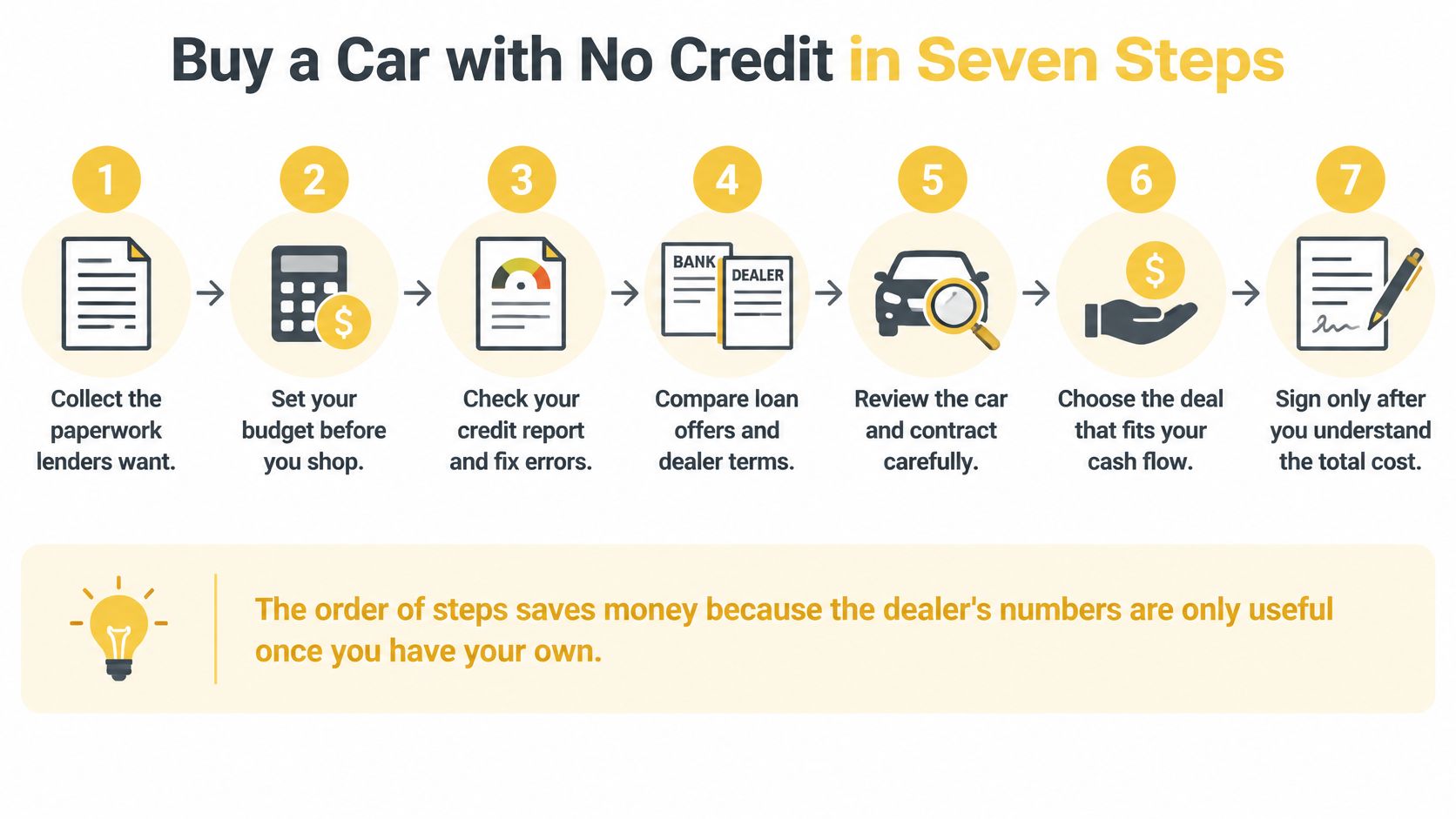
Collect the paperwork lenders want. Gather recent pay stubs, tax returns if you're self-employed, proof of residence, employer contact details and references if requested. Obtain your credit reports, too. Make sure names, addresses and income information agree across your documents, and explain irregular deposits rather than expecting an underwriter to guess.
Choose a down payment you can spare. A larger cash contribution reduces the lender's exposure when there's little repayment history to assess. But don't empty your emergency savings. A vehicle that leaves you unable to pay for an immediate repair isn't affordable, even if the lender approves it.
Set an ownership ceiling. Decide what you can spend after housing, food, existing debts and essential savings. Leave room for insurance, fuel, maintenance and registration before deciding how much of that ceiling can go toward the loan.
Request preapproval from a thin-file lender. Start with a credit union, bank or community lender that considers applicants without established scores. Compare APR, amount financed, term, finance charge and required collateral. Ask about vehicle-age or mileage restrictions before you shop for something the lender won't finance.
Use this visual as a preparation checklist, rather than treating a dealer visit as the starting point.
Buy the vehicle, not the sales pitch
Choose a less expensive vehicle and arrange an inspection. Look for transportation that fits your daily use, not the maximum purchase your lender permits. Pay an independent mechanic to identify safety problems and near-term repairs before you commit.
Negotiate the out-the-door price separately. Request an itemized written price that includes taxes and fees. Don't answer a price question with your preferred monthly payment. That lets the salesperson change the term while leaving the vehicle overpriced.
Compare the dealer's written financing offer with your preapproval. A dealer may find a better offer, but compare equivalent borrowing amounts and terms. Decline optional warranties, GAP products and other add-ons unless their coverage, exclusions and price justify borrowing more.
If no lender approves the application, a qualified co-signer may be a fallback. That person becomes equally responsible for repayment, and missed payments can harm both credit histories.
Reading our loan guides, state guides and resources never affects your credit. Your preapproval gives you a financing benchmark, not an obligation to buy, and walking away remains part of the plan.
Credit Invisible or Damaged and What Lenders Check
About 26 million U.S. adults, roughly one in ten, had no credit history with any nationwide credit-reporting company, and another 19 million had histories too limited or stale to generate a score under a commonly used model, according to the Consumer Financial Protection Bureau's credit-reporting analysis. Those are different underwriting problems from a report showing repeated missed payments.
Credit invisible means a lender lacks a conventional repayment record. Damaged credit means the lender has a record and sees reasons for concern. Don't describe yourself as having bad credit until you know which situation applies.
Identify the file the lender will see
Request your free reports from the nationwide bureaus, including Experian, Equifax and TransUnion. Check account ownership, balances, payment status and unfamiliar entries. Dispute inaccurate information, but don't pay anyone who promises to erase accurate negative history.
| Credit situation | What it means | What lenders weigh | Your next move |
|---|---|---|---|
| Credit invisible, no file at any bureau | No accounts reported to any nationwide bureau | Income, job history, residence and down payment | Document income and ask whether the lender accepts alternative records |
| Unscored thin file | Some accounts, but too few or too old to produce a score | Recent payment record, income and debt-to-income ratio | Check reports for errors and consider a small credit-builder loan |
| Damaged file with late payments or collections | Past missed payments or accounts sent to collections | Down payment, co-signer strength and lower loan amount | Dispute inaccurate entries and compare offers with realistic expectations about subprime pricing |
| Recent repossession or bankruptcy | A serious negative event in the recent past | Current income, debts, discharge status, down payment and lender eligibility rules | Ask a credit union or nonprofit credit counselor about options before applying |
Make your repayment capacity easy to verify
For an unscored applicant, an underwriter may lean more heavily on employment stability, residence history and debt-to-income ratio, meaning existing debt obligations relative to income. Someone with variable earnings should organize records that show what's sustainable, not just the strongest paycheck.
For a damaged file, documentation alone won't remove the lender's concern. A smaller purchase, more cash down and corrected reporting errors are more useful than submitting the same weak application repeatedly.
Before opening another account, understand how a loan can affect your credit score. Borrowing to build history should solve a specific problem, not create another payment you can barely manage.
Budget the Full Cost, Not Just the Payment
A salesperson can lower a monthly payment without lowering the price or interest rate. Extending repayment makes the payment smaller because you're paying for longer, not because you've negotiated a better deal.
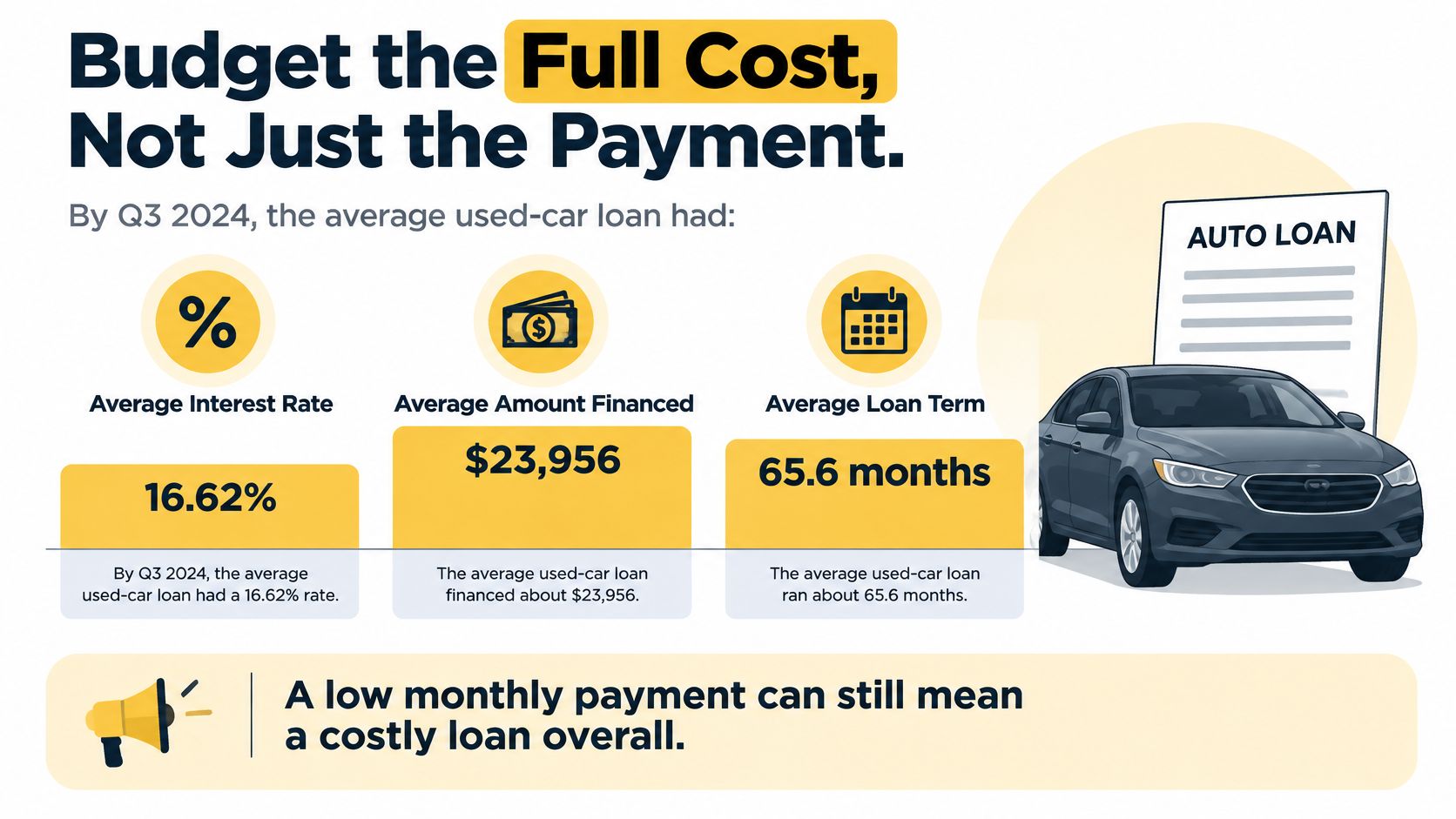
For context, Federal Reserve finance-company loan data show that in the third quarter of 2024, average used-car loans carried a 16.62% interest rate, financed $23,956.37 and ran 65.62 months. That's a historical finance-company benchmark, not a quote or an approval promise.
Compare payment relief with interest expense
The following hypothetical calculations use a $20,000 balance and treat that benchmark rate as a fixed 16.62% APR, with equal monthly payments and no additional fees. Payments are rounded to dollars, and totals to approximately the nearest ten dollars.
| Loan scenario | Monthly payment | Total of payments | Interest paid |
|---|---|---|---|
| 36-month term | About $709 | About $25,530 | About $5,530 |
| 48-month term | About $573 | About $27,520 | About $7,520 |
| 60-month term | About $493 | About $29,580 | About $9,580 |
Use the loan payment calculator to test your actual offer. Keep the amount financed constant when comparing terms, or you won't know whether the difference comes from repayment length or extra borrowing.
The visual summarizes the historical benchmark behind the example.
Price the costs that aren't in the loan
Before signing, obtain insurance quotes using the vehicle identification number, not just a general model description. Policy Quail's guide can help you compare insurance before purchasing a car, including the distinction between state-required coverage and what your lender requires.
Build these expenses into your budget:
- Insurance and deductibles. Check applicable state minimums and the lender's broad-coverage and collision requirements. Liability-only coverage may not satisfy the contract.
- Registration and taxes. Separate upfront charges from recurring ownership expenses so you don't count them twice.
- Fuel and routine maintenance. Use your commute and the vehicle's service schedule, not a best-case estimate.
- Repairs. Keep cash available for the problems your inspection identifies and the ones it can't predict.
An inexpensive older vehicle can still cost more to insure or repair than another car with a higher purchase price.
Affordability test: If you can make the payment only by ignoring insurance, repairs or essential savings, reduce the vehicle budget.
Compare total payments and expected usable life. Don't accept a stretched term that leaves you paying for a vehicle you can't reasonably expect to keep running.
Compare Lenders and Co-Signer Options
Approval isn't a measure of loan quality. A lender can approve a payment that leaves almost no room in your household budget, and a dealer can present that approval as a reason to stop shopping.
Cox Automotive's September 2025 dealer-channel report put overall auto-loan approval at 74.4%, up from 72.1% a year earlier. That describes applications in the reported channel, not your personal approval odds or the affordability of an offer.
Choose the channel before submitting applications
Different lenders have different rules for missing credit history. Ask whether an unscored applicant is eligible before authorizing a full application.
| Lender channel | Approval pattern for thin files | Rate reference | Main watch-out |
|---|---|---|---|
| Credit union | May consider membership history and documented income | Request an individualized written APR | Membership requirements and preapproval timing |
| Bank or online subprime lender | Some accept thin files; others require established history | Use the applicant's actual quote, not a market average | Fees, collateral and total finance charge |
| Dealer-arranged indirect loan | Dealer submits the application to participating lenders | Compare the offered APR with direct financing | Potential dealer rate markup |
| Buy-here-pay-here dealer | May finance applicants without conventional credit | Require the contract's APR and finance charge | Reporting, repossession and payment terms |
Don't assume an online application is less expensive than a branch application. The useful distinction is whether the lender explains eligibility, costs and conditions before you commit.
You can use the auto-loan guide to prepare comparison questions, but the lender's written terms determine what you're being offered.
Know what you're authorizing
Checking your own credit doesn't lower your score. A lender's preliminary eligibility check may use a soft inquiry, while a full application commonly involves a hard inquiry that may affect your score. Ask which applies before submitting; the word prequalification doesn't guarantee a particular inquiry type.
Read consent language and privacy disclosures. By submitting a request through our optional process, you consent to lenders checking your credit, which may affect your score, and to your information being shared with lenders.
A co-signer adds another person's income and credit history to the application. Before anyone agrees, discuss who receives statements, how missed payments will be detected and whether the co-signer could cover the obligation without financial hardship.
A co-signer should understand the loan as a debt they may have to repay, not a character reference.
We don't pick, vet or rank lenders, and you decide whether to accept any offer. Ask every lender for the APR, term and total cost in writing, then compare the same vehicle and borrowing amount.
Alternatives and Habits That Protect Your Credit
The cheapest alternative is usually a less expensive vehicle, not another loan layered onto the purchase. If the available financing doesn't fit, changing the car or postponing the purchase can be more effective than searching for a lender willing to approve a larger obligation.
Options worth considering
- Buy a cheaper vehicle. Focus on safe, serviceable transportation. Compare repair needs before assuming a cash-price bargain is the cheaper choice.
- Save a larger down payment. Waiting while you save can reduce the amount you need to finance. Don't borrow the down payment and hide that obligation from the auto lender.
- Consider a credit union payday alternative loan for a genuine short bridge. Check membership, eligibility and repayment requirements. It isn't a substitute for affordable long-term auto financing.
- Build a reported payment history. A credit-builder loan holds the borrowed money in savings while you repay it. It may help establish history, but it generally won't provide immediate car-buying cash.
- Use a secured card carefully. Your deposit backs the account. Choose one that reports payments, understand its fees and use the secured-card and credit-building guide before applying.
Leasing isn't an automatic workaround for missing credit. Approval rules differ, you don't own the vehicle, and mileage restrictions and end-of-lease charges can change the economics. Compare the complete lease obligation with purchasing, including what you'll own at the end.
Protect the credit you already have
- Pay existing bills on time. Set reminders or automatic payments, while keeping enough in the account to avoid failed withdrawals.
- Keep card balances low. Don't finance accessories or deposits on revolving credit just to make the purchase appear affordable.
- Preserve useful older accounts. Don't close an account solely to tidy up your report; weigh fees and spending risk first.
- Concentrate legitimate rate shopping. Submit comparable auto-loan applications within a short shopping period rather than scattering them over time. Scoring treatment differs, so don't assume every inquiry will be ignored.
Nonprofit credit counseling can help with budgeting or assessing a debt management plan. For transportation assistance or help with a dispute, contact 211 or local legal aid.
Confirm state rules before relying on a borrowing product. Where a loan type isn't allowed, our state guide says so and we don't provide a request form for it.
Check the Dealer Contract and Six Numbers Before You Sign
A buy-here-pay-here dealer finances the vehicle directly and uses it as collateral. That can make financing accessible without a conventional credit history, but access doesn't establish that the contract is reasonable.
Federal Reserve research on buy-here-pay-here lending reports that approximately 78% of lending volume goes to subprime borrowers, compared with 27% for traditional auto lenders. Those figures describe borrower mix, not approval odds or value for money.
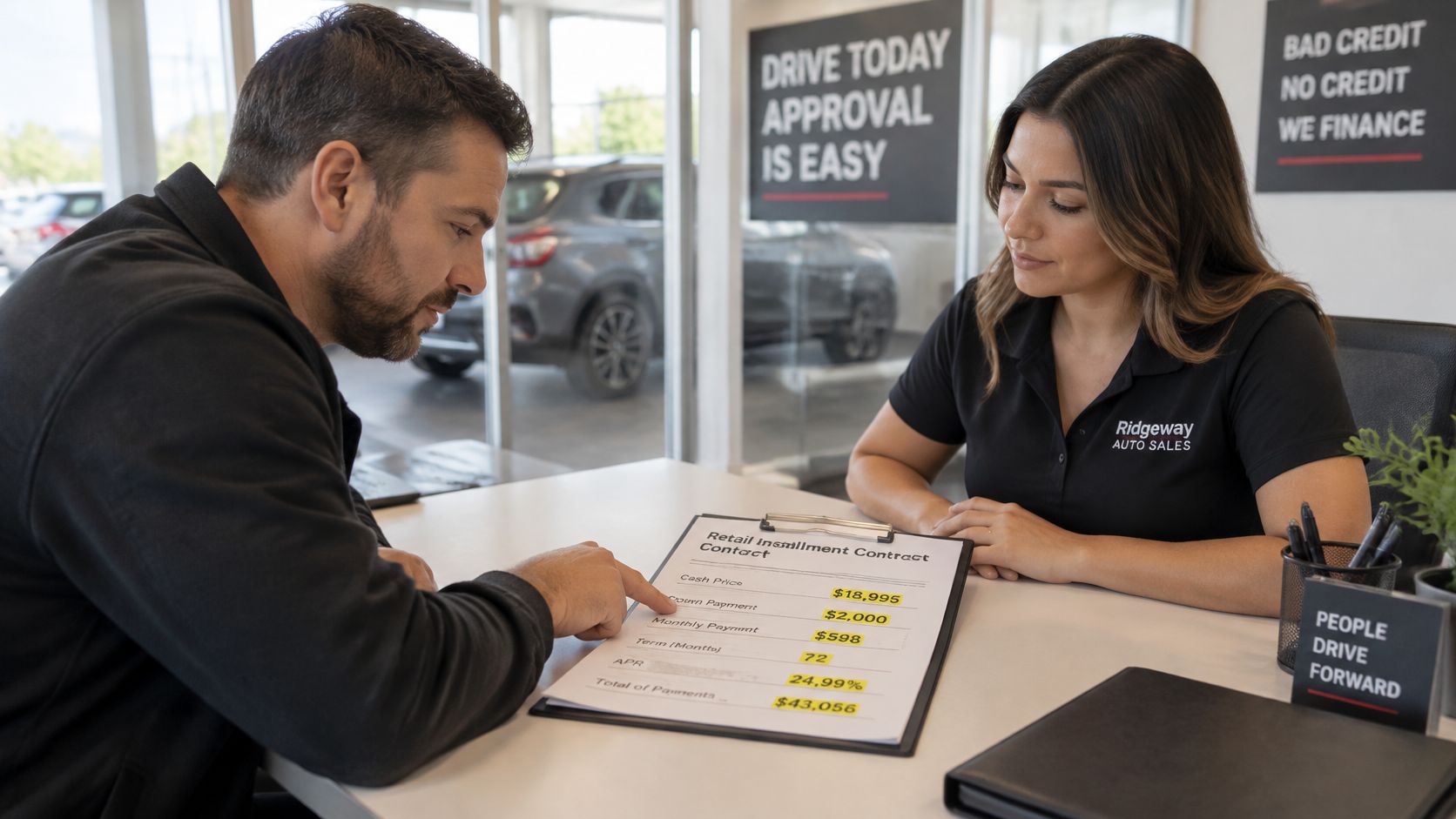
Review the actual retail installment contract, not just a sales worksheet.
Audit the obligations line by line
- Verify the vehicle independently. Obtain the mechanic's findings and review title and accident history. Don't treat a clean-looking car or a salesperson's assurance as a substitute.
- Get the full payment schedule. Check payment frequency, due dates and any unusually large final payment. Calculate your complete cash outlay as the down payment plus scheduled installments and mandatory fees, without counting financed fees twice.
- Confirm credit reporting. Ask whether the account and on-time payments are reported to all the nationwide bureaus. Don't assume a loan will build a conventional credit file because you're making payments.
- Read the enforcement clauses. Identify default triggers, late fees, repossession provisions, payment-location requirements, GPS-device terms and insurance obligations. Ask what happens if coverage lapses or a payment arrives late.
- Resolve conditional financing. Ask whether the sale depends on later lender approval. Obtain the executed contract and copies of every document you sign, rather than relying on a promise that everything is final.
Optional add-ons should be disclosed and accepted, not inserted without notice. Match each product on the contract to something you knowingly chose, and request a revised contract if an unwanted charge appears.
For an additional walkthrough of the buying process, use the video alongside your written checklist.
Apply the six-number walk-away test
Confirm these figures in writing before you sign:
- Out-the-door price, including taxes and fees.
- Down payment, including any trade-in equity credited.
- Amount financed, reconciled against the price and added charges.
- APR, rather than an interest-rate claim alone.
- Loan term, including payment frequency.
- Total of payments, showing what scheduled repayment will cost.
Then check the payment against your actual ownership budget. If the amount financed doesn't reconcile, an explanation stays verbal or the payment works only after an excessive extension, stop the transaction.
Don't patch an unaffordable purchase with payday, title or high-cost online installment borrowing. Those products can carry very high fees or APRs, and a title loan places your vehicle at risk. Returning to a smaller purchase is safer than adding another fragile repayment obligation.
Visit BadCreditMD to browse borrowing guidance by credit score and loan amount, check state rules and find local assistance before committing to car financing. Our information is free, and we're not a lender or broker, so use it to prepare your questions and compare written offers without treating approval as a reason to buy.