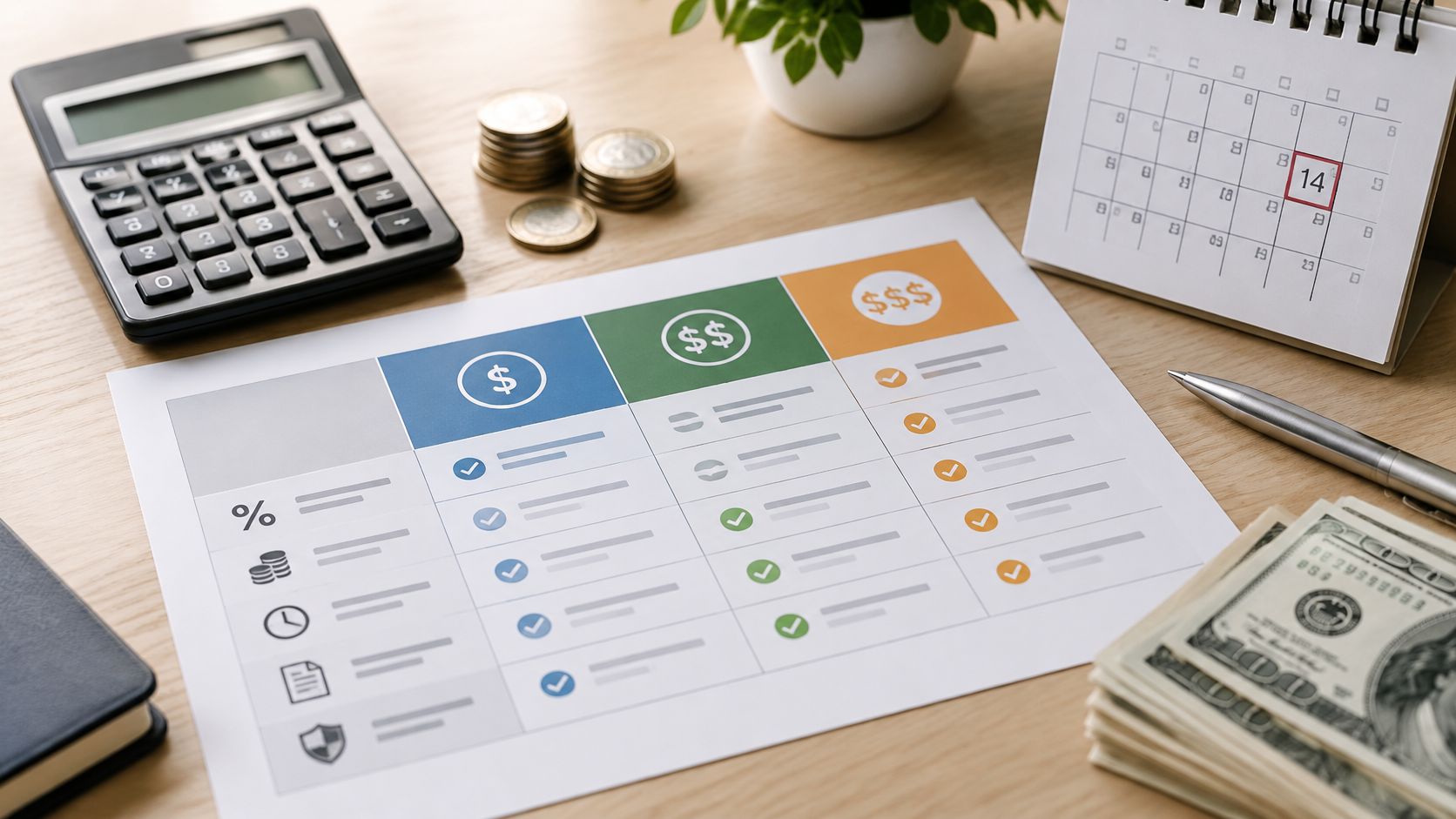
A $15 fee on every $100 borrowed for 14 days works out to about 391% APR. The dollar on the sign is not the cost that matters. The annualized rate is.
That fee looks modest only because the loan is so short. Stretch the same charge across a full year and it repeats about 26 times. Payday loans, title loans, and some online installment loans can carry very high fees or APRs, and a payday loan is usually one lump payment due on the next payday. A usable payday loan chart fees view puts every common fee on that same 14-day, annualized basis, so the row you are offered can be read before you sign.
Table of Contents
- Payday Loan Fees per $100 at a Glance
- Total Repayment for Common Loan Amounts
- How to Read and Build Each Fee Row
- How Renewals and Rollovers Multiply Fees
- State Caps and Permitted Loan Types to Check
- Charges Beyond the Fee That Raise the Total
- How Payday Fees Compare With Other Credit
- Compare Alternatives and Confirm Before You Sign
Payday Loan Fees per $100 at a Glance
Scan one fee level at a time. Every row below uses the same $100 principal and the same 14-day term, which is the only way the rows stay comparable.
| Fee per $100 borrowed | Finance charge on $100 | Total due after 14 days | Approximate APR |
|---|---|---|---|
| $10 per $100 | $10 | $110 | about 261% |
| $15 per $100 | $15 | $115 | about 391% |
| $20 per $100 | $20 | $120 | about 521% |
| $30 per $100 | $30 | $130 | about 782% |
APR here equals the fee rate multiplied by 365 and divided by the term in days. A 14-day term multiplies the fee rate by about 26.1, so a 15% fee for two weeks is not a 15% yearly rate.
Change the term and the whole column moves. A $15 fee on a longer loan is a lower APR than the same $15 fee due in 14 days, even though the cash you hand over on that one loan is identical. That is why a chart that prints only a dollar fee hides the comparison that matters.
Practical rule: Find the fee per $100 on the written disclosure, then locate that row before you compare any offer.
The risk sits in that APR column, not in the size of the first finance charge. A borrower who can repay $115 on the due date is in a different position from one who is counting on extra time. If the disclosure shows a fee between the rows, compute it the same way rather than rounding down to the cheaper line.
Total Repayment for Common Loan Amounts
The rate does not shrink when the loan gets bigger. At $15 per $100 for 14 days, only the dollars grow.
| Amount borrowed | Finance charge at $15 per $100 | Total due after 14 days | Approximate APR |
|---|---|---|---|
| $100 | $15 | $115 | about 391% |
| $350 | $52.50 | $402.50 | about 391% |
| $500 | $75 | $575 | about 391% |
| $1,000 | $150 | $1,150 | about 391% |
The Consumer Financial Protection Bureau reports that many state laws cap payday-loan fees between $10 and $30 per $100, that a typical two-week loan at $15 per $100 annualizes to about 391%, and that in its analysis of more than 15 million storefront payday loans over 12 months the typical amount was about $350. At the table's $15-per-$100 fee, that $350 borrower owes $402.50 after two weeks: $350 principal plus a $52.50 finance charge.
Why the APR column never moves
APR stays near 391% on every row because the fee rate and the term did not change. A larger loan does not buy a lower rate. The $1,000 borrower pays $150 for the same annualized cost that costs the $100 borrower $15. What changes is the cash due at maturity, and that is the number a borrower has to have ready on payday.
Reuse this for any amount. Multiply principal by the fee per $100, then divide by 100. That product is the finance charge. Add the principal and you have the total due. State limits, loan size, late charges and rollover terms can change the final bill, so check the lender's written disclosure for the finance charge and APR. Each renewal adds another finance charge at the same rate, which is why the term count matters as much as the fee row.
Take the amount you need, run the formula, and match the total to the lender's written disclosure before you accept.
How to Read and Build Each Fee Row
A row that shows only a dollar fee can't be compared with anything else. Build each line the same way, then check it against the paper the lender must give you.
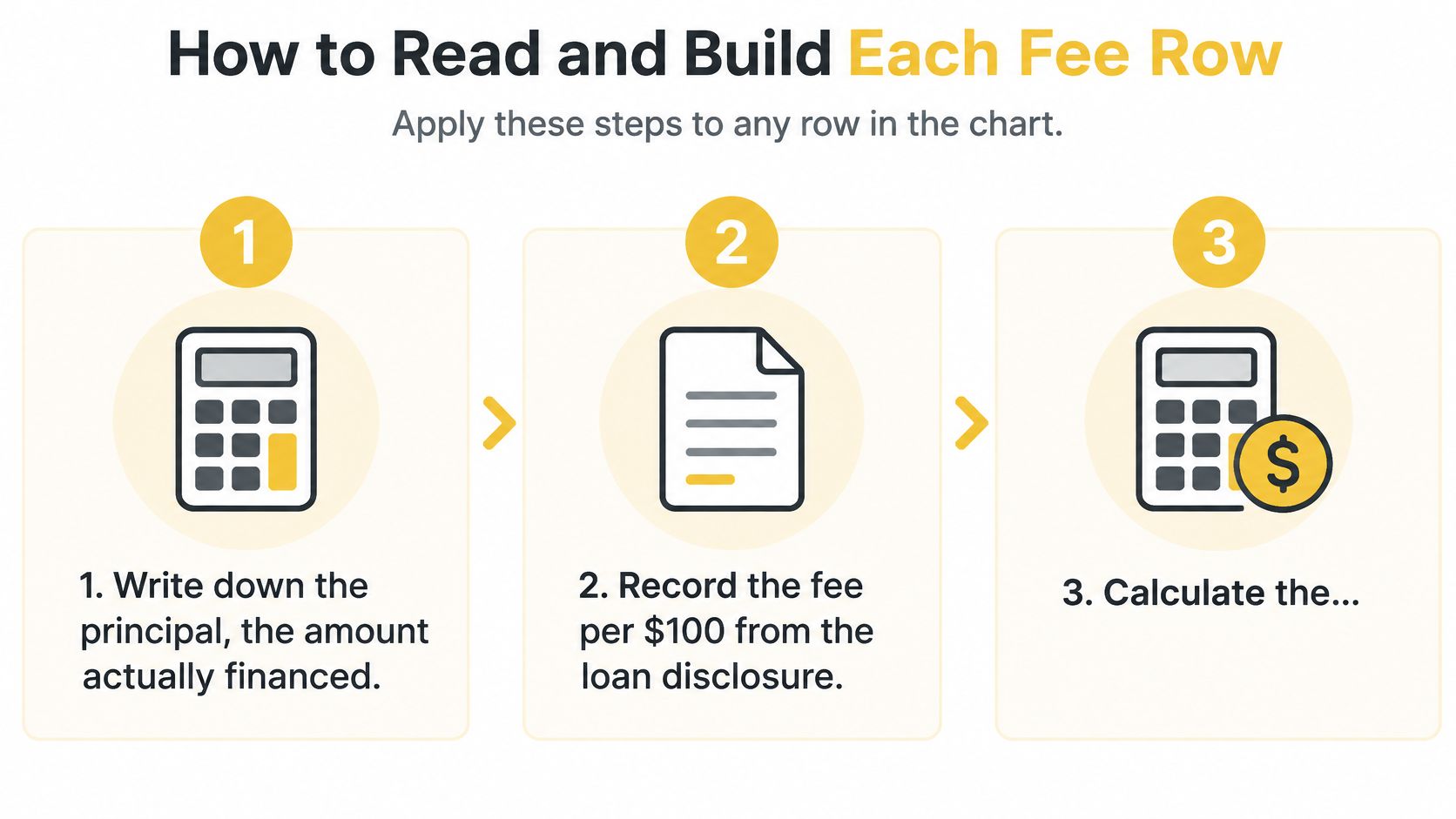
The Federal Trade Commission reports that lenders commonly charge about $10 to $30 per $100, and that $15 per $100 on a typical two-week loan produces an APR of about 391%. Federal disclosure rules require the finance charge in dollars and the APR in writing before you sign.
- Write down the principal, the amount financed. People sometimes write the total due here and then fee it again.
- Record the fee per $100 from the loan disclosure, not from an ad. Ads often print the friendliest dollar figure.
- Calculate the finance charge as principal times the fee, divided by 100. Skipping the division is how a $15 fee becomes a $15 total by mistake.
- Add the charge to principal. That sum is what is due at maturity if nothing else is added.
- Record the term in days and annualize with the 365-day formula. Treating the fee as a yearly rate is the usual slip, because a 14-day fee is charged again on every new term.
- Run the sanity check. $100 plus a $15 two-week fee equals $115 due. The annualized cost is about 391%, not 15%, because the two-week charge is annualized over a full year. Calling that fee "15% interest" understates the cost.
- List what the row excludes: late fees, returned-payment fees, renewal charges, and optional products. A clean row that hides those items will not match the cash that leaves your account.
- Compare the APR printed on the disclosure with your own figure before you sign. APR folds in the amount financed, finance charges, other credit-related fees, and the loan's duration, which is what lets you set the row next to an installment loan.
A complete, comparable row names the principal, fee rate, term, finance charge, total due, APR, and the exclusions. Use the same principal and the same term on every row you compare.
How Renewals and Rollovers Multiply Fees
Four extensions on a $100 loan at $15 per $100 turn a $15 fee into $75 in fees, and the $100 principal is still owed at the end of it.
| Extensions | Days outstanding | Total fees paid | Principal still owed |
|---|---|---|---|
| 0 | 14 | $15 | $100 |
| 1 | 28 | $30 | $100 |
| 2 | 42 | $45 | $100 |
| 3 | 56 | $60 | $100 |
| 4 | 70 | $75 | $100 |
Each extension charges the fee again on the same principal. Fees climb in $15 steps while the balance never falls. The days column assumes each extension adds one more 14-day term, so day 70 is five terms stacked on one $100 advance.
Paying for more time does not retire the debt. It rents the same $100 again.
A 2011 Government Accountability Office comparison used a median payday transaction of $361 and a median fee of $53 on a 14-day loan, an APR of 391%.
Annualize the renewal chain and the rate holds steady while the cash cost does not. $75 in fees over 70 days on $100 annualizes to roughly 391%, the same figure as a single $15 fee over 14 days. The borrower who extends four times pays five times the finance charge for the same $100 of credit and is no closer to clearing the balance than on day one. That is why the first fee tells you the price of one term and almost nothing about the total a repeat borrower pays.
Renewal rules vary by state. Some limit how many times a lender may extend or require part of the principal to be paid down with each extension, and others prohibit renewal outright. Read the renewal rule beside the fee cap, because a permitted rollover converts a capped per-$100 fee into an uncapped total.
Short-term loans are costly and are not a long-term fix, so borrow only what you can repay on the first due date. If that date is already a problem, ask the lender four things: whether an extension is allowed, what that extension costs, whether a repayment plan exists, and what happens if a payment is missed. Missing the payment can move the account toward default, which is a different problem from the fee itself, covered in what happens if you default on a payday loan. Treat a rollover as a warning rather than a fix. Any comparison should name the state, the original principal, the term, the total dollars due, and whether repeat borrowing is included.
State Caps and Permitted Loan Types to Check
The same $15 per $100 can be a lawful finance charge in one state and unavailable in the next. A national chart that prints one fee for every borrower is wrong before the first number is read. Put every state row on the same annualized basis before you compare one with another.
The Consumer Financial Protection Bureau reports that payday finance charges generally run from $10 to $30 per $100, depending partly on state law and permitted amounts, and that $15 per $100 is an APR of nearly 400% on a two-week loan. Federal rules apply a separate cost-of-credit test to covered loans, so a state fee cap and a federal cost test answer different questions. The federal test uses an annualized cost measure, which is why a two-week fee row can look small while the annualized figure is large.
Each state guide covers which loan types state law allows, the limits lenders must follow, a worked cost example, and who to call if something goes wrong. If a loan type is not allowed, the guide says so and there is no request form for it. Read whether payday loans are legal for the legal frame, then open the guide for your state.
Check these items on the statute or regulator page, and write the statute number beside the chart row so the figure can be rechecked:
- Permission: Whether payday loans are allowed at all.
- Cap: The fee or APR cap, if the state sets one.
- Size and term: The maximum loan amount and the permitted term.
- Repeat use: Rules on extensions, rollovers, or a cooling-off period between loans.
- Source line: The statute or regulator URL and a last-checked date.
Do not copy a cap from a general article into your row. Fill the state line only from the current statute or regulator page. A row above your state's cap is not an offer you can take. Complaints go to that state regulator and through the CFPB complaint process. Late or returned-check fees, where state law permits them, sit outside the cap conversation and can raise what you pay even when the finance charge itself is legal. Your bank or credit union can add its own insufficient-funds charge on top.
Charges Beyond the Fee That Raise the Total
Say a finance charge is $52.50 and the lender adds an illustrative $25 returned-payment fee. Those two lines are already $77.50 before any bank charge. The fee chart never showed that second number.
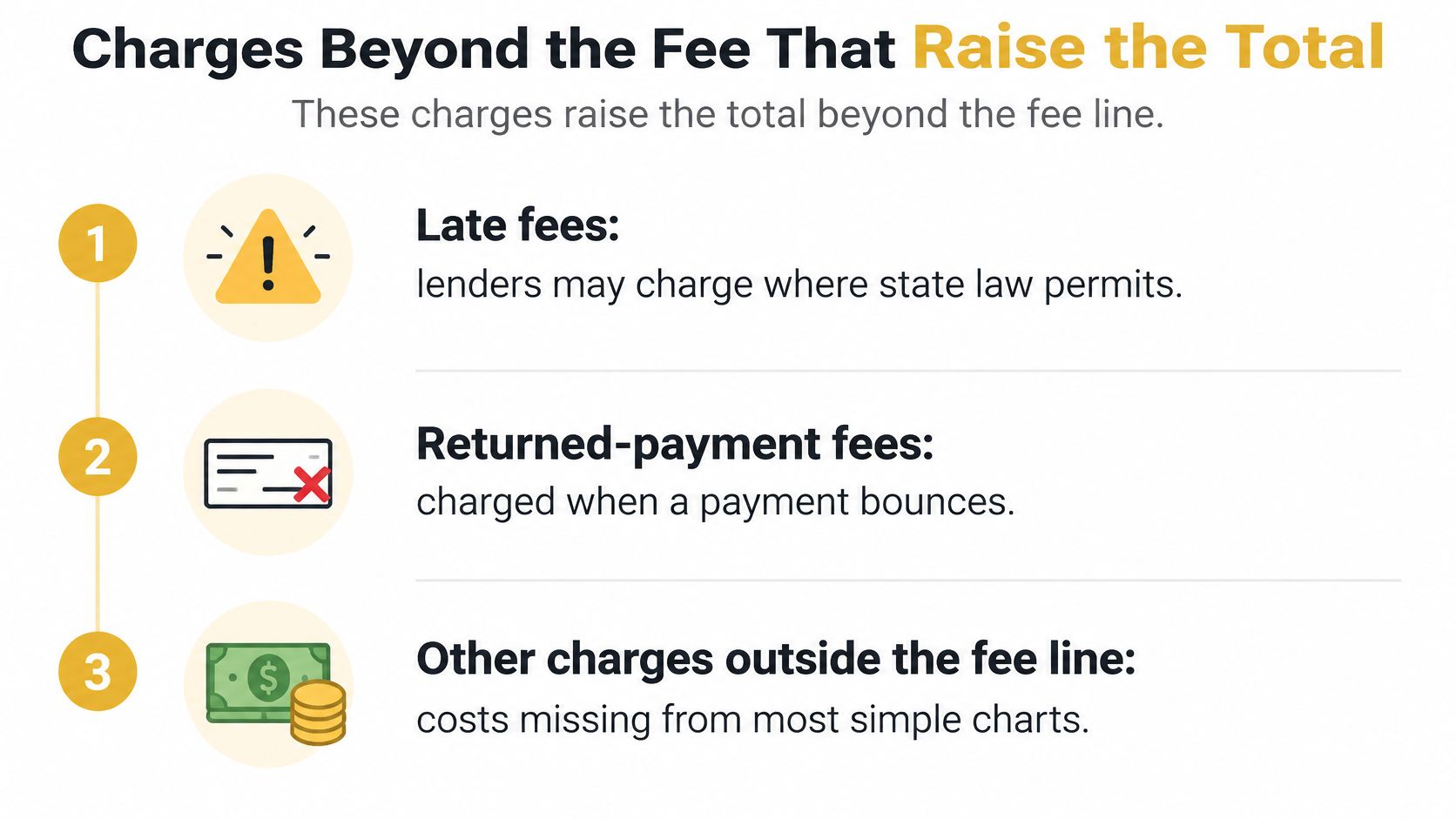
A fee chart describes the finance charge. It does not describe every dollar that can leave the account. Lenders may add a late fee where state law permits. A bounced payment can trigger a returned-payment fee from the lender and a separate insufficient-funds charge from your own bank. If the bank pays the item anyway, an overdraft charge can land on the same day. Extension fees stack the way the renewal table already shows, at $15 per $100 each time the loan is pushed forward.
| Charge type | Amount or formula | When it applies |
|---|---|---|
| Late fee | Set by state law; not disclosed if the lender omits it | After a missed due date, where state law permits |
| Returned-payment fee | Set by the lender; not disclosed if the lender omits it | When a payment bounces |
| Bank insufficient-funds charge | Set by the borrower's own bank | When the bank declines the payment |
| Overdraft charge | Set by the bank | When the bank covers the payment and the account goes negative |
| Extension or renewal fee | $15 per $100 per extension, as in the renewal table | Each time the loan is extended |
If the lender does not state an amount, write not disclosed. Do not write zero. Zero is a guess, and a guess makes the row look cheaper than the contract.
Ask for a written schedule of every charge before you sign, then add each line to the chart row it changes. The finance-charge row and the extra-charge note have to sit together or the total you plan for will be short.
How Payday Fees Compare With Other Credit
Put $100 next to $100 for the same two weeks. The payday row at $15 per $100 costs $15 by day 14. A credit-card balance at a stated 24% APR costs about $0.92 over those same 14 days: $100 times 0.24 times 14, divided by 365. The payday fee is the entire two-week price. The card charge is a slice of a yearly rate.
That gap is why the APR column exists. A $15 fee due in 14 days and a $15 finance charge spread over a year are not the same product, even though both can be described as "fifteen dollars." Installment loans spread fixed payments over months rather than weeks, so set their APR and their total repayment beside the payday row instead of lining up the first fee. Federal rules that require the APR in writing are what make that lineup possible. Our comparison of installment loans and payday loans walks through how the payment schedules differ.
Judge the payday row against credit you can get, not against the smallest dollar fee on the page. A cheaper-looking fee on a shorter term can still be the most expensive way to cover the bill.
Compare Alternatives and Confirm Before You Sign
A $240 overdue electric bill at $15 per $100 adds a $36 fee, so $276 is due in 14 days. A payment arrangement can split that same $240 into four $60 payments added to the regular bills, with no 14-day finance charge on the whole balance.
Other paths are worth pricing the same way: total dollars due, APR where one is stated, term length, and any late or extra fee.
- Credit union payday alternative loans are small loans from federal credit unions, with an APR capped at 28% under NCUA rules. See payday alternative loans from credit unions.
- A payment plan with the utility, a medical provider, or another creditor keeps the debt with the party you already owe.
- Credit-builder loans, nonprofit credit counseling, 211, and legal aid are slower or have eligibility rules, so match them to the date the bill is due.
Our loan payment calculator lets you try monthly payments and total cost with your own illustrative figures. Lenders set their own fees and terms, so every figure in this chart is a reference point, not an offer.
Before you sign, run four checks. Match the loan amount to the chart row and confirm the total due. Check the APR on the disclosure against your own figure. Ask for a written list of late, returned-payment, and renewal fees. Confirm your state permits that loan type and note its fee cap.
Borrow only if the total due fits the next paycheck and the APR is clear in writing. If an alternative's total due is lower than the matching payday row, start there. Short-term loans are costly, and they are not a long-term financial solution.
BadCreditMD explains payday loan costs, state fee limits, and lower-cost alternatives for people comparing small-dollar credit, and the guides are free to read. Use the state pages and the fee chart together so you can see the annualized cost before you agree to a 14-day loan. Visit BadCreditMD to check your state's rules and the other ways to cover a short-term bill.