Traditional payday loans are not authorized in Massachusetts because the state's small-loan rules cap charges at 23% annually for licensed lenders, plus a $20 administrative fee. That means most high-cost short-term payday offers are either unlawful, void, or impossible to enforce under Massachusetts law.
So why do people still search for payday loans Mass? Because online lenders keep pitching products that sound quick and simple, and the legal line between a licensed small loan and a void payday offer is easy to miss. If you need cash fast, the wrong choice can leave you paying fees on a loan that should never have been accepted in the first place.
Table of Contents
- Understanding Payday Lending Legality in Massachusetts
- How Payday Loans Work Nationwide
- Cost Benchmarks Every Borrower Should Know
- Massachusetts Small Loan Limits and Licensing Rules
- Deciding Between Licensed Options and Risky Offers
- How to Verify a Lender Before You Borrow
- What Happens If You Receive an Illegal Loan Offer
- Practical Alternatives to Payday Loans in Massachusetts
- Where to Get Help or File a Complaint
- Common Misconceptions About Massachusetts Payday Lending
Understanding Payday Lending Legality in Massachusetts
Massachusetts does not operate like states that allow classic storefront payday lending. If a loan of $6,000 or less charges more than 12% annually, the lender has to fit within the Commonwealth's small-loan licensing system, and licensed lenders are then capped at 23% per year plus a $20 origination fee. That structure leaves traditional two-week, triple-digit-APR payday products outside the normal legal lane.
What that means in practice
If an offer looks like a payday loan, you should assume it needs careful scrutiny before you hand over bank access, a debit card number, or a signed authorization. Massachusetts regulators say loans originated or purchased by unlicensed entities, or loans that exceed legal limits, are void, and attempts to collect void debt are illegal. That is the key point many people miss.
Practical rule: if a lender won't show you how it fits Massachusetts licensing and rate rules, treat the offer as suspect until proven otherwise.
Online lenders create the most confusion because they can still target Massachusetts residents even when the product doesn't fit state law. Some of those offers are structured to look like legitimate credit while sidestepping the actual legal requirements. Your job is to separate a compliant small loan from a high-cost pitch that can't survive Massachusetts review.
The rest of this guide focuses on that distinction, then shows you how to test cost, verify legitimacy, and choose a safer emergency option before you agree to anything.
How Payday Loans Work Nationwide
What makes payday lending so costly is not just the fee, it is the way the loan is designed to turn a short cash gap into repeated borrowing. Historical national research from according to Pew's 2012 report found that many borrowers used payday loans more than once, often for routine bills, which is exactly why these loans keep showing up as a trap rather than a fix.
The structure drives the cost
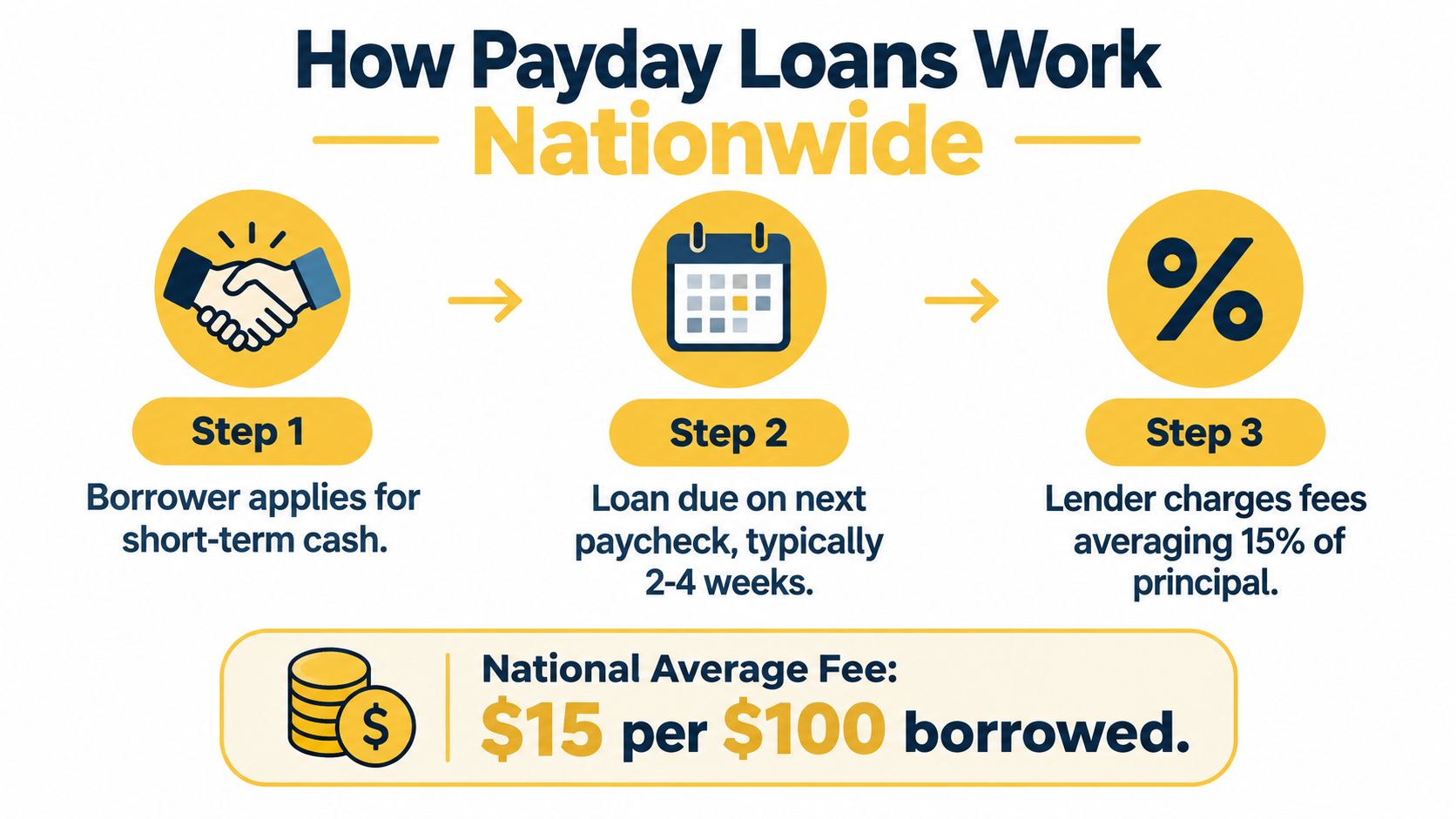
A payday loan is usually priced as a flat fee per $100 borrowed, not as a transparent low-cost installment loan. The Consumer Financial Protection Bureau says a common payday amount is about $500, with fees often running from $10 to $30 per $100 borrowed, and a typical $15 per $100 fee on a two-week loan produces an APR of almost 400% on its consumer guidance page. That structure is the problem. A short due date compresses the cost into a tiny window, then the fee rate looks extreme once you annualize it.
Borrower behavior shows why the model is so risky. Pew found that many first-time users took payday loans to cover recurring obligations like rent, utilities, or credit-card bills, not a one-off surprise expense. The Federal Reserve summary and CFPB analysis show the same pattern of repeat use, with more than 80% of payday loans rolled over or followed by another loan within 14 days per the Federal Reserve summary and CFPB analysis.
Do not treat this as a clean one-time advance. In practice, payday lending is a repeat-fee product built to keep the borrower paying again when the first due date arrives.
Cost Benchmarks Every Borrower Should Know
A payday offer becomes easy to judge once you stop looking at the sticker fee and convert it into total repayment. A $75 fee on a $500 advance means you owe $575 at maturity, and the CFPB's standard example shows that same two-week fee pattern produces an APR of almost 400% on its payday loan guidance. That's the math you should use every time.
Use a calculator before you say yes. A simple payment tool such as this loan payment calculator helps you compare the fee, the due date, and the actual cash you'll have to hand over.
Standard Cost-Screening Benchmarks
| Loan Amount | Typical Fee Range | Approximate APR Equivalent |
|---|---|---|
| $500 | $50 to $150 | Almost 400% at $75 for two weeks |
| Smaller short-term advance | $10 to $30 per $100 borrowed | Very high annualized cost |
| Rolled or renewed loan | Fee repeats while principal remains | Cost rises fast with each renewal |
The table is the right way to think about these offers because the initial fee hides the full burden. A short due date makes the annual rate look extreme, but the actual damage comes when the loan is renewed and the fee recurs while the principal stays outstanding.
Military borrowers need a separate check. The Military Lending Act generally caps the Military Annual Percentage Rate at 36% for covered active-duty servicemembers and dependents as explained by the CFPB. If a lender's structure pushes beyond that, the deal is not acceptable for covered borrowers.
Massachusetts Small Loan Limits and Licensing Rules
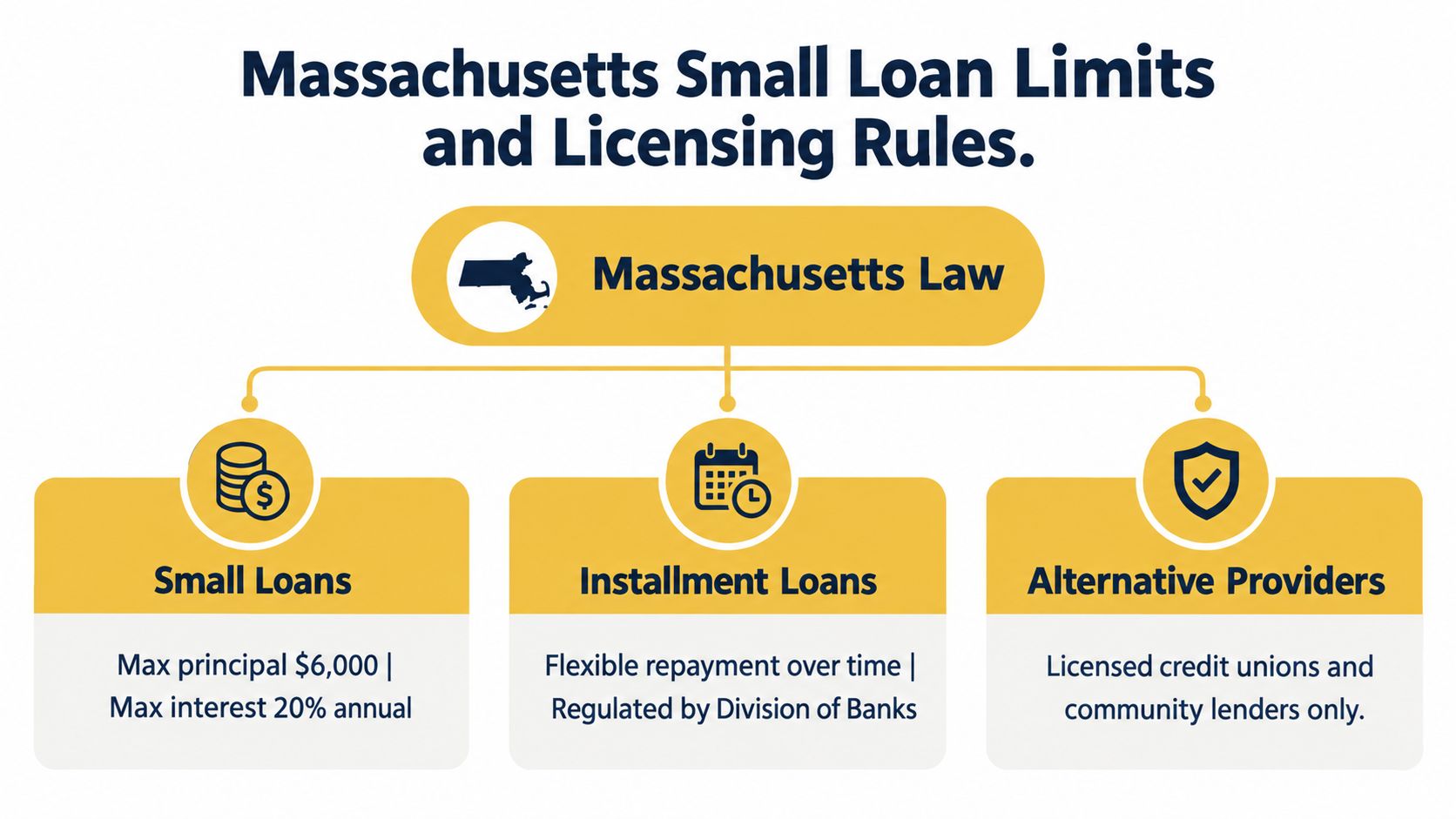
Massachusetts puts licensing first. A lender making a consumer loan of $6,000 or less must follow the Commonwealth's small-loan licensing rules when interest and expenses exceed 12% annually. Once licensed, the lender is capped at 23% per year on unpaid balances, using the actuarial method, plus a maximum $20 administrative fee at origination under the state's consumer alert and licensing guidance.
Why the structure matters
The charge is tied to the declining unpaid balance, so a lawful Massachusetts loan should cost less as you pay it down. That is a real compliance test. If the lender prices the deal off the original principal as if the balance never changes, the structure is wrong. Massachusetts also limits the maximum charge to 6% annually after one year following maturity, which tells you the state expects servicing, not endless rollover pressure.
Use four checks before you accept any offer:
- Is the lender authorized by the Division of Banks? If not, stop.
- Does the disclosure calculate cost on the unpaid balance, not just the original principal? If not, the pricing may be wrong.
- Does the total cost include the $20 fee? If not, the APR presentation is incomplete.
- Does any post-maturity servicing still stay within the 6% ceiling? If not, the lender may be overcharging.
One more practical point: borrowers comparing small-dollar credit across states should also look at installment loan options in other states to see how licensed products are structured elsewhere. Massachusetts is stricter than a typical payday setup, and that is the point. Traditional payday products, built around repeated two-week renewals, generally do not fit these limits. Treat any online offer claiming otherwise with immediate skepticism.
Deciding Between Licensed Options and Risky Offers
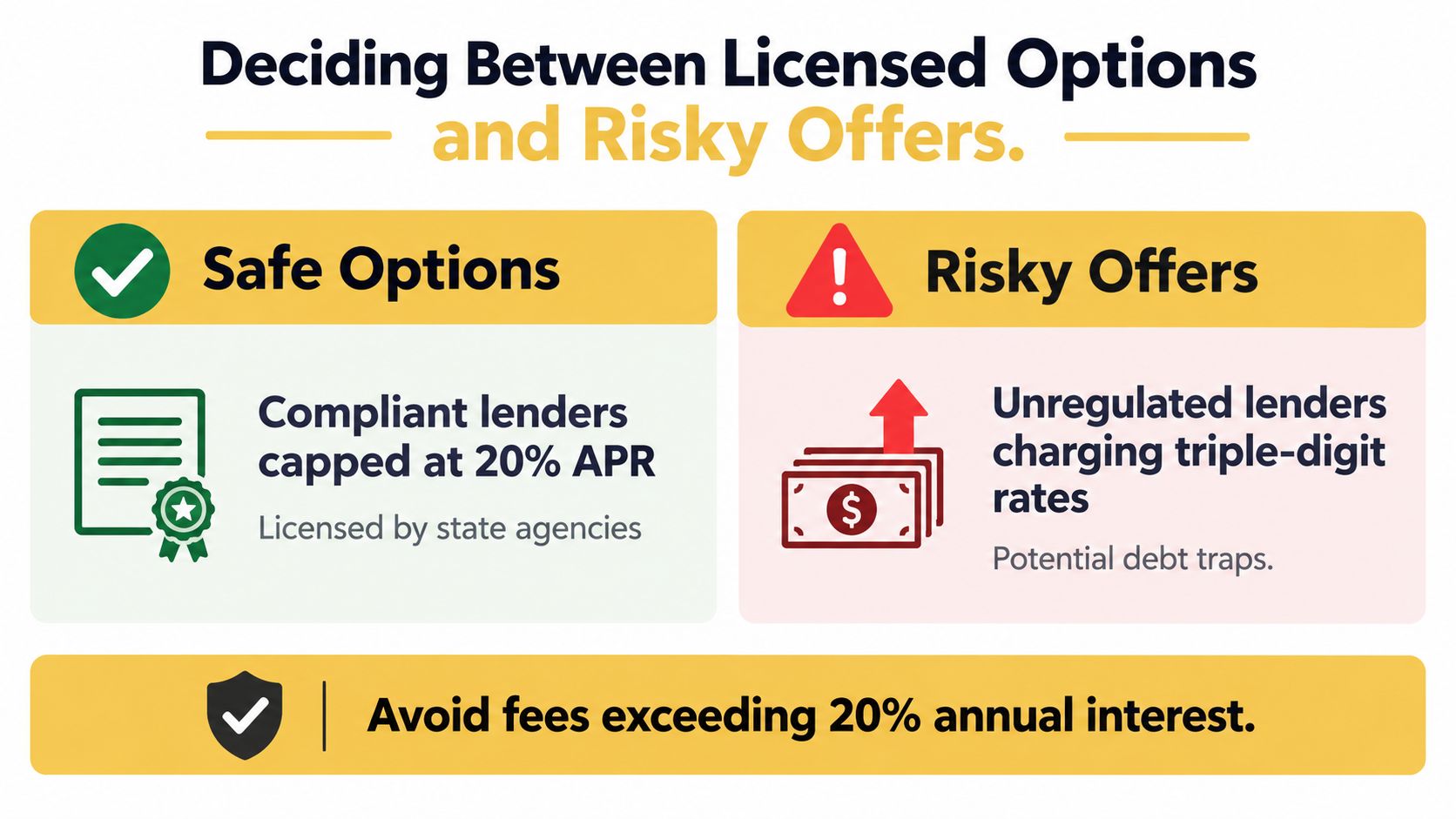
A Massachusetts borrower usually faces three very different products, even when the pitch sounds the same. One is a compliant small loan from a licensed lender. Another is an online high-cost payday offer that does not fit state rules. A third is a tribal or out-of-state product that may reach you, but it still has to survive Massachusetts enforcement if it is made to a resident.
Read the offer like a compliance officer
A licensed lender should state its authorization, explain the fee structure clearly, and show the total repayment in plain English. A risky offer usually avoids those basics. It may refuse to disclose APR, push you to move quickly, or ask for account access before you have time to verify the lender.
A good test is simple. If the lender cannot explain the loan without pressure, the offer deserves a hard pass.
The red flags are easy to spot once you slow down:
- No clear APR disclosure. If the lender only talks about a small fee, the actual cost is being hidden.
- Upfront payment demands. Legitimate short-term credit does not need a mystery fee before funding.
- Pressure to connect a bank account immediately. That is a control tactic, not a courtesy.
- Claims that legality does not matter because the lender is online. That is false.
- Ignoring what happens if you default on a payday loan. A lender that avoids that conversation is selling speed, not a fair deal. See what happens if you default on a payday loan before you agree to anything.
Do not confuse speed with legitimacy. A lender can move fast and still be unlawful.
The comparison that matters is simple. A licensed product follows Massachusetts rules and stays inside a disclosed fee structure. A risky offer tries to normalize a debt that may be void from the start. That is the difference you need to anchor on before you sign anything.
How to Verify a Lender Before You Borrow
Start with the lender's authorization, not the promise of fast money. If a company claims it can make or service a Massachusetts loan, check whether it is allowed to do so under the Division of Banks system. If the company can't show that clearly, don't move forward.
Next, preserve everything. Save the offer page, the fee disclosure, the repayment schedule, the email trail, and any text messages. If a dispute comes later, those records are what show whether the lender sold you a lawful product or a pitch that never fit the rules.
Use a simple verification checklist
- Confirm the company name exactly. Don't rely on branding alone, because trade names can hide the underlying entity.
- Read the total-cost disclosure line by line. The fee, the term, and the repayment date all matter.
- Check for bank-account permissions before funding. Never give access just because the lender says it's “required.”
- Ask whether the company buys or services existing debt. Servicing and collection can trigger different compliance issues.
- Cross-check the business status. If you want a general legitimacy screen, see if a company is legitimate and then verify the financial license separately.
A lender that won't answer basic questions is telling you something. It's usually telling you the offer was designed to move before you could verify it. That's the wrong side of the line.
The safest habit is boring and effective. Do not authorize payments, do not link an account, and do not sign a repayment promise until the lender's legal status is confirmed. Once money leaves your account, the burden shifts onto you to unwind the mess.
What Happens If You Receive an Illegal Loan Offer
Massachusetts treats illegal lending seriously for a reason. If a loan is originated or purchased by an unlicensed entity, or if it exceeds the legal limits, the debt is void, and attempts to collect on void debt are illegal. That's not a technicality. It shifts the borrower's negotiating power immediately.
If a collector contacts you about one of these loans, respond in writing and keep the message short. State that you dispute the debt, ask for the lender's license and the original contract, and do not admit the debt is valid. That keeps the issue where it belongs, on the lender's compliance, not on your fear.
Practical rule: when the law says the debt may be void, don't negotiate as if the balance is obviously valid.
You should also document every call, voicemail, email, and letter. If the lender keeps pressuring you or threatens collection on a loan that should not have been made, contact the Division of Banks and consider legal aid. You don't need to prove the lender was wrong on day one. You need to force the lender to prove it was allowed to lend in the first place.
The bigger mistake is silence. People often assume the collection notice means the debt is legitimate. In Massachusetts, that assumption can cost you money you didn't owe and stress you didn't need.
Practical Alternatives to Payday Loans in Massachusetts
The first question is not “What lender will fund me tonight?” It's “What can stop the problem with the least damage?” If a bill can be delayed, split into installments, or pushed into a payment plan, do that before you take on new debt. That's the cleanest path because it avoids creating a second emergency while solving the first one.
When you do need cash, compare options by total dollars repaid, not by monthly payment alone. A small monthly payment can still hide a painful total cost, and a cheap-feeling offer can become expensive if it forces a rollover or late fees elsewhere. If your cash flow is irregular, budgeting with irregular income can help you build a cushion that reduces the next emergency.
Prioritize these substitutes
- Payment plan with the biller. This is usually the cheapest answer if the creditor will cooperate.
- Nonprofit or community help. Emergency aid can solve a short gap without adding finance charges.
- 211 referral. It can point you to local utility, food, housing, and crisis resources.
- Credit-union small-dollar products. These are often more workable than a high-cost online offer.
- Employer advance. If available, it may be better than debt.
- Regulated installment loan. Use this only if the terms are lawful and the total repayment is manageable.
If you need a broader borrowing comparison, review personal loan basics before you commit to anything with a due date you can't meet. The point is not to borrow more. The point is to avoid the kind of credit that turns a temporary shortage into a repeating fee cycle.
Where to Get Help or File a Complaint
If a lender is pressuring you, stop treating the situation like a private negotiation. Start treating it like a consumer-protection problem. Contact the Massachusetts Division of Banks, file a CFPB complaint if the lender crosses state lines or uses unfair servicing tactics, and keep copies of every document you send.
Local legal aid can help if a collector says you owe a loan that may be void. Nonprofit credit counseling can also help you sort through the next move without steering you into another expensive product. If you need emergency services, 211 can route you to local programs that might reduce the need to borrow at all.
A good complaint package includes the offer, the repayment terms, the communication history, and a clear statement that you dispute the debt or the lender's authority. Don't overload the file with emotion. Facts matter more than frustration.
Common Misconceptions About Massachusetts Payday Lending
One myth says payday lending is completely banned in every form. That's too simple. Massachusetts does not allow traditional payday products to operate outside its licensing and rate rules, but it does permit certain small loans under the state's regulatory framework. The law is restrictive, not vague.
Another myth says an online lender can do whatever it wants because it isn't based in Massachusetts. That is wrong. Online access doesn't erase state lending limits, and Massachusetts says unlicensed or over-limit loans are void. If the lender can't satisfy the legal test, the internet doesn't save it.
A third myth says high fees are unavoidable because no better option exists. That's lazy advice, and it hurts borrowers. Some offers are cheaper than payday debt, especially when you compare total repayment instead of just the first payment due. The legal cap exists to protect you from exactly the kind of pressure that makes bad credit feel like a dead end.
What matters is evidence, not salesmanship. Ask for the license, the APR, the fee schedule, and the total repayment in writing. If the lender hesitates, walk away.
BadCreditMD publishes state-by-state borrowing guides, cost explainers, and local help resources for people who need a clearer path than a high-cost short-term loan. If you want a practical way to compare legal options, emergency alternatives, and complaint routes in one place, visit BadCreditMD and use the Massachusetts guide as your starting point.