
The usual advice about store credit card easy approval starts with a list of retailers and ends with an application button. That's backward. The easiest card to get can still be the wrong card to open, especially when you need financing because cash is already tight.
My recommendation: choose the purchase and repayment plan before you choose the credit application. A checkout discount isn't a reason to borrow, and a cashier's invitation isn't an assessment of what you can afford.
Table of Contents
- What Easy Approval Actually Means in 2026
- Check Your Setup Before You Apply
- The Four Possible Outcomes and What Each Costs You
- Running the Numbers on a Deferred Interest Promotion
- What to Do When You Are Still Denied
- Your Next Decision at the Register
What Easy Approval Actually Means in 2026
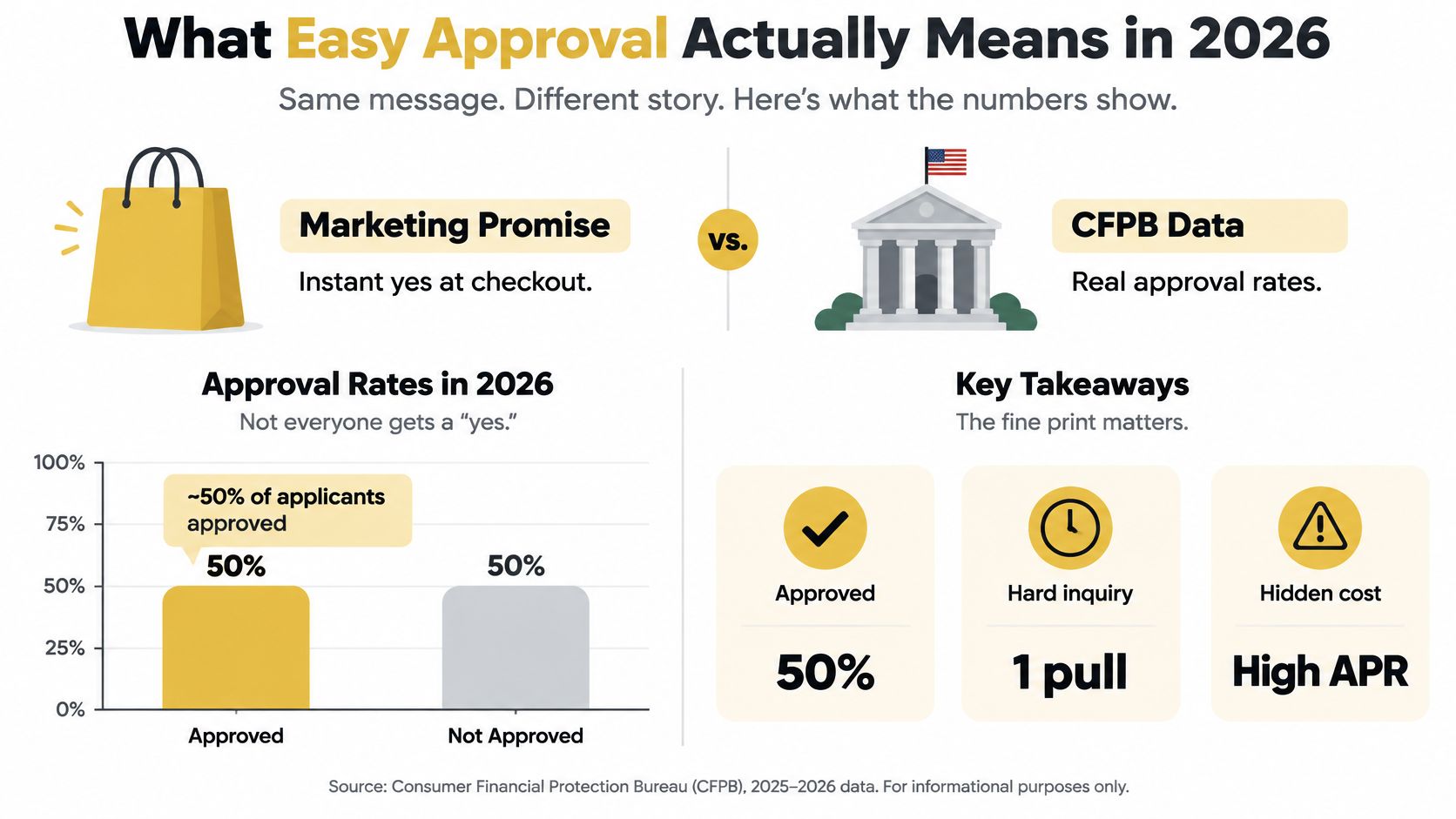
Easy approval means relatively more accessible underwriting, not guaranteed acceptance. It doesn't promise a useful spending limit, an affordable interest rate, or a good outcome for your credit.
The historical comparison is meaningful, but narrower than checkout marketing suggests. In its analysis of retail credit-card applications and balances, the CFPB reported approval rates of approximately 50% for retail cards versus 44% for general-purpose cards, a gap of six percentage points; applicants scoring 620 to 720 had retail-card approval rates roughly 20 percentage points higher, nearly half of retail applications came from subprime, deep-subprime, or no-score consumers, and more than 60% of retail-card balances belonged to consumers scoring below 720.
Those are historical findings, not a current approval forecast for a particular retailer. They explain why store cards attract borrowers with imperfect credit, but they don't tell you what an issuer will decide about your application today.
Accessibility isn't a recommendation
Retailers can market financing to people who struggle to qualify elsewhere without offering those people a good deal. You should evaluate the agreement, not the welcoming language around the application.
I'd usually reject a high-interest store card when the main attraction is a checkout discount and the balance won't be paid in full before interest applies. I'd also reject an offer that encourages you to increase the purchase just to qualify for financing.
Practical rule: A card should make an already affordable purchase easier to manage. It shouldn't be the explanation for why the purchase suddenly seems affordable.
For a furniture purchase, use Miller Waldrop Furniture & Decor's guide to furniture financing for bad credit as a starting point for identifying questions to ask. Then get the actual lender's terms rather than treating a retailer's financing overview as an approval promise.
Watch for pressure to apply before you've seen the APR, the promotional deadline, and the repayment conditions. If the salesperson can explain the discount but can't show you the credit agreement, pause the transaction.
Check Your Setup Before You Apply
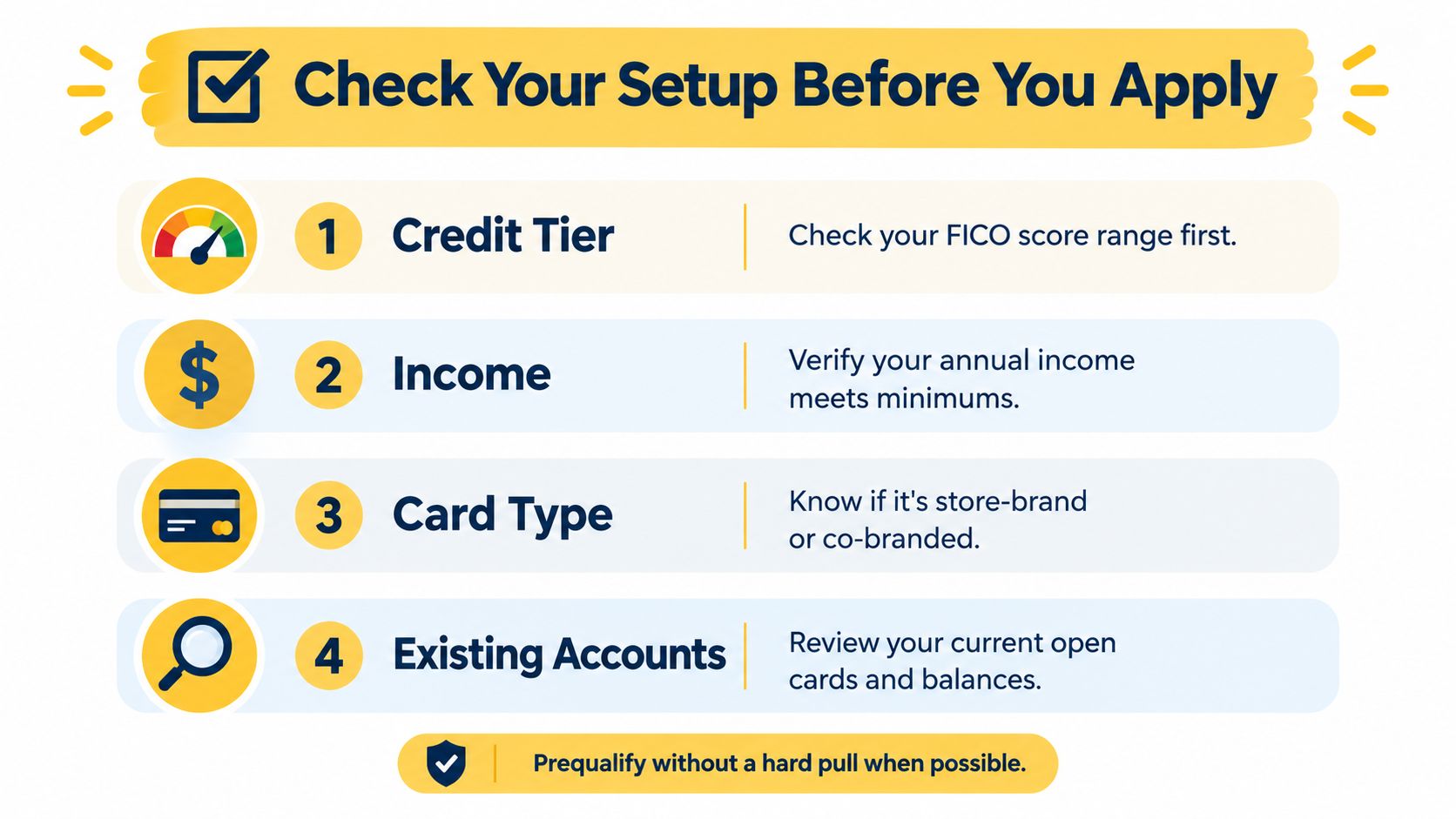
Don't apply at the register while someone waits behind you. Take the offer home, identify the issuer, and compare the application with your actual finances.
Start with the product itself. A private-label store card and a co-branded general-purpose card aren't interchangeable applications. Confirm where the card can be used and which bank makes the credit decision before interpreting any eligibility language.
Build your application file
Use a short written checklist rather than guessing from a score alone:
- Credit profile: Review your score range alongside recent payment problems and the information in your credit reports. The guide to fair-credit score profiles can help you frame that review without treating a score band as an approval guarantee.
- Income: Read the application's income instructions and report qualifying income accurately. Don't inflate it to make the purchase work.
- Existing debt: List your revolving balances, required payments, and available room in your budget after essentials.
- Recent applications: Note which accounts you've recently requested and whether those applications produced inquiries.
- Issuer requirements: Find the bank's stated eligibility language, application disclosures, and any verification requirements.
Then calculate the planned purchase balance relative to the potential credit limit. You may not know the offered limit yet, so decide in advance what outcome would make you decline the purchase.
Protect your next application
A retail-card application normally produces a hard inquiry. According to FICO's explanation of retail cards and credit inquiries, an individual inquiry often has a minimal effect, commonly fewer than five points, but unrelated card applications aren't grouped under the rate-shopping treatment available for mortgages, auto loans, and student loans.
That makes applying at several retailers a poor approval strategy. You're not comparing firm offers through a protected shopping process; you're submitting separate requests for revolving credit.
Apply because the account fits your plan, not because you want to test whether a retailer will say yes.
If prequalification is available, read its credit-check disclosure before proceeding. Don't assume a button labeled “check eligibility” is harmless, and don't treat a preliminary result as permission to skip the final terms.
My submission standard is straightforward: accurate information, a manageable purchase, understandable terms, and no need to gamble on a generous limit. If those conditions aren't in place, wait.
The Four Possible Outcomes and What Each Costs You
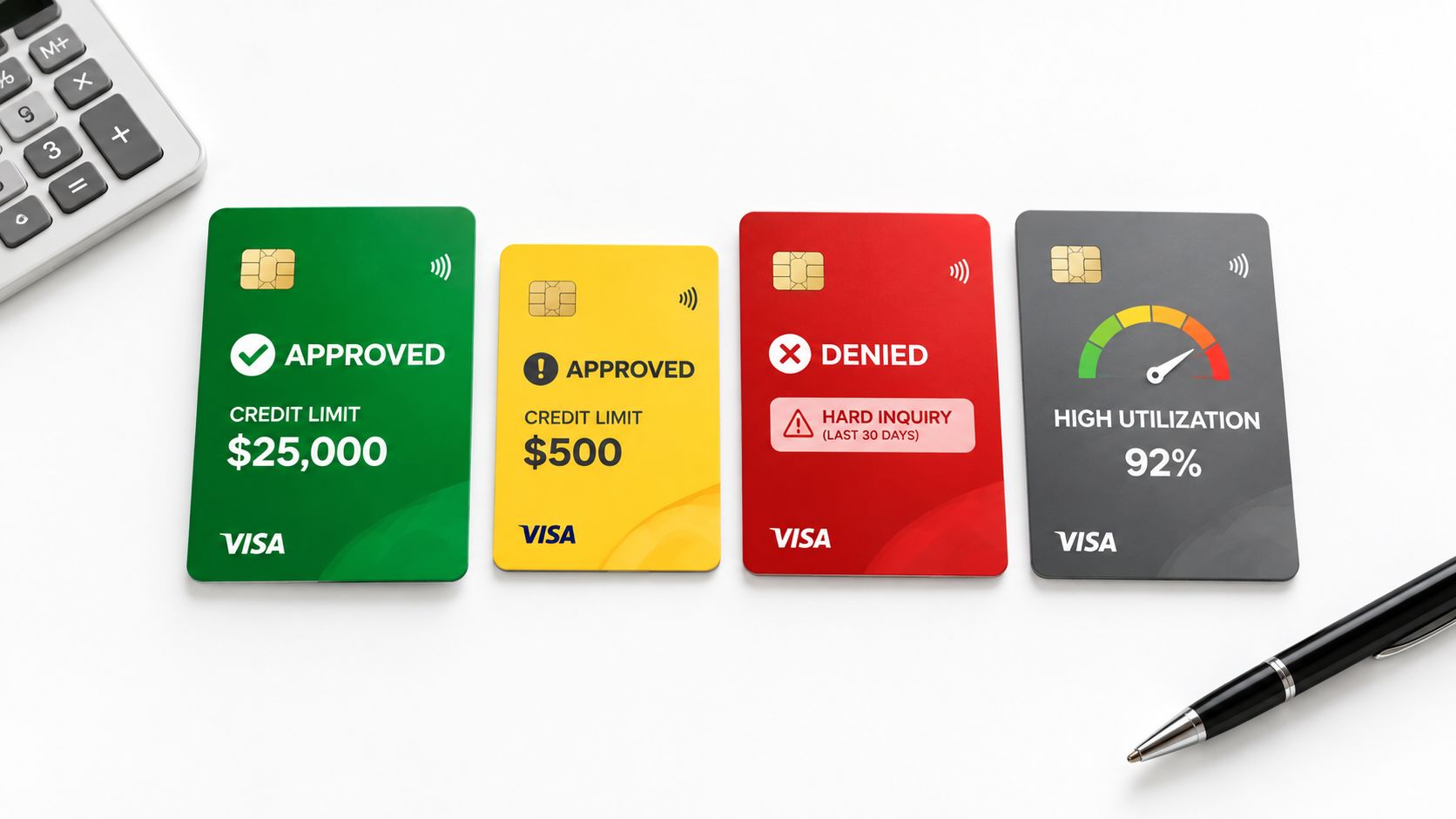
An application can succeed on paper and still fail your budget. Before submitting it, decide how you'll handle each outcome, including the ones that don't resemble the offer advertised at checkout.
The useful distinction is between getting an account and getting financing that works. Those aren't the same achievement.
Compare the decision with the purchase
| Outcome | Available credit | Credit concern | Purchase-cost decision |
|---|---|---|---|
| Usable approval | Enough room for the planned purchase | Manage the account carefully | Proceed only if repayment fits |
| Low-limit approval | Less than you need | A purchase may consume much of the line | Reduce or postpone the purchase |
| Denial | No new borrowing capacity | An inquiry without an account | Don't replace the denial with rushed borrowing |
| Approval with heavy utilization | Enough to complete the sale, but little room remains | High utilization can undermine the credit goal | Reject the purchase plan if it strains the account |
Usable approval means the account supports the purchase without forcing you to depend on uncertain future income. It still requires a cost review; approval doesn't make expensive borrowing cheap.
A low-limit approval needs a different response. Don't automatically combine the new card with another borrowing product to finish the sale. That turns a disappointing credit line into a more complicated repayment problem.
A denial leaves the purchase unfunded. Your best response is to investigate the decision, not to let embarrassment push you toward the next application.
When approval is the wrong outcome
The most misleading result is approval that leaves the new account heavily used from the start. A borrower trying to establish better credit can end up with a balance that works against that goal.
The distinction between low limits, utilization, and preliminary decisions is discussed in this checkout-offer explanation of hard pulls and credit limits. An instant response can still be followed by verification or a changed credit line, so don't make irreversible purchase commitments before the account details are confirmed.
Purchase boundary: Decide what you can accept before the issuer decides what it will offer.
Ask whether you can cancel or reduce the purchase if the financing isn't suitable. Get that answer separately from the credit decision, because a return policy and a lending agreement address different obligations.
The right outcome might be leaving with neither the card nor the merchandise. That's a sound decision when the alternative is an account you'll struggle to manage.
Running the Numbers on a Deferred Interest Promotion
Deferred interest is a repayment deadline with consequences, not permission to make minimum payments and hope. Before accepting the offer, calculate the payment needed to eliminate the promotional balance early.
The calculation starts with the promotional balance divided by the promotional months. Then add a safety margin that fits your budget and confirm how the issuer allocates payments.
For the worked example, a $600 balance over 12 months requires $50 per month before any safety margin, using the repayment method described alongside the CFPB's warning about deferred-interest promotions; that research also found that, among consumers who incurred deferred-interest charges while making other purchases, more than half paid more than the promotional balance, and more than one-third paid over 150% of that balance during the promotion.
Deferred Interest Repayment Model
| Scenario | Monthly Payment | Paid Before Deadline | Cost if Deadline Missed |
|---|---|---|---|
| Exact-payoff approach | Promotional balance divided by promotional months | Full balance only if timing and allocation work as expected | Retroactive interest may apply under the agreement |
| Safety-margin approach | Calculated payment plus an affordable buffer | Target full repayment ahead of the deadline | Contractual charges still apply if a balance remains |
| Minimum-payment approach | Issuer's stated minimum | Must be checked, not assumed | Remaining promotional debt can trigger deferred interest |
| Mixed-purchase approach | Payment covering promotional and other balances | Depends on allocation rules | Promotional debt may remain despite substantial payments |
Paying enough money into the account isn't necessarily the same as eliminating the promotional balance. That's why payment allocation deserves as much attention as the advertised deadline.
Read the conditions before accepting
Ask the issuer to explain:
- Expiration: What exact date must the promotional balance be cleared?
- Allocation: How will payments be divided between promotional debt and other purchases?
- Payment problems: What happens after a late or returned payment?
- Remaining debt: What interest becomes payable if the promotion's conditions aren't met?
- Account costs: What are the regular APR, annual fee, late-fee terms, and minimum-payment calculation?
For furniture, compare the written agreement with the arrangements discussed in Lucas Furniture & Mattress payment options. For electronics, the guide to PC financing with bad credit provides another purchase-specific comparison starting point.
My recommendation is to keep new purchases off an account carrying a deferred-interest balance. If your budget can cover only the required minimum, decline the promotion unless your calculation independently shows that it clears the debt on time.
Negotiate the purchase price or postpone buying instead. A discount doesn't compensate for a repayment deadline you already know you can't comfortably meet.
What to Do When You Are Still Denied
A denial is a reason to diagnose the application, not a challenge to find a more permissive retailer. Stop applying until you understand what prevented approval.
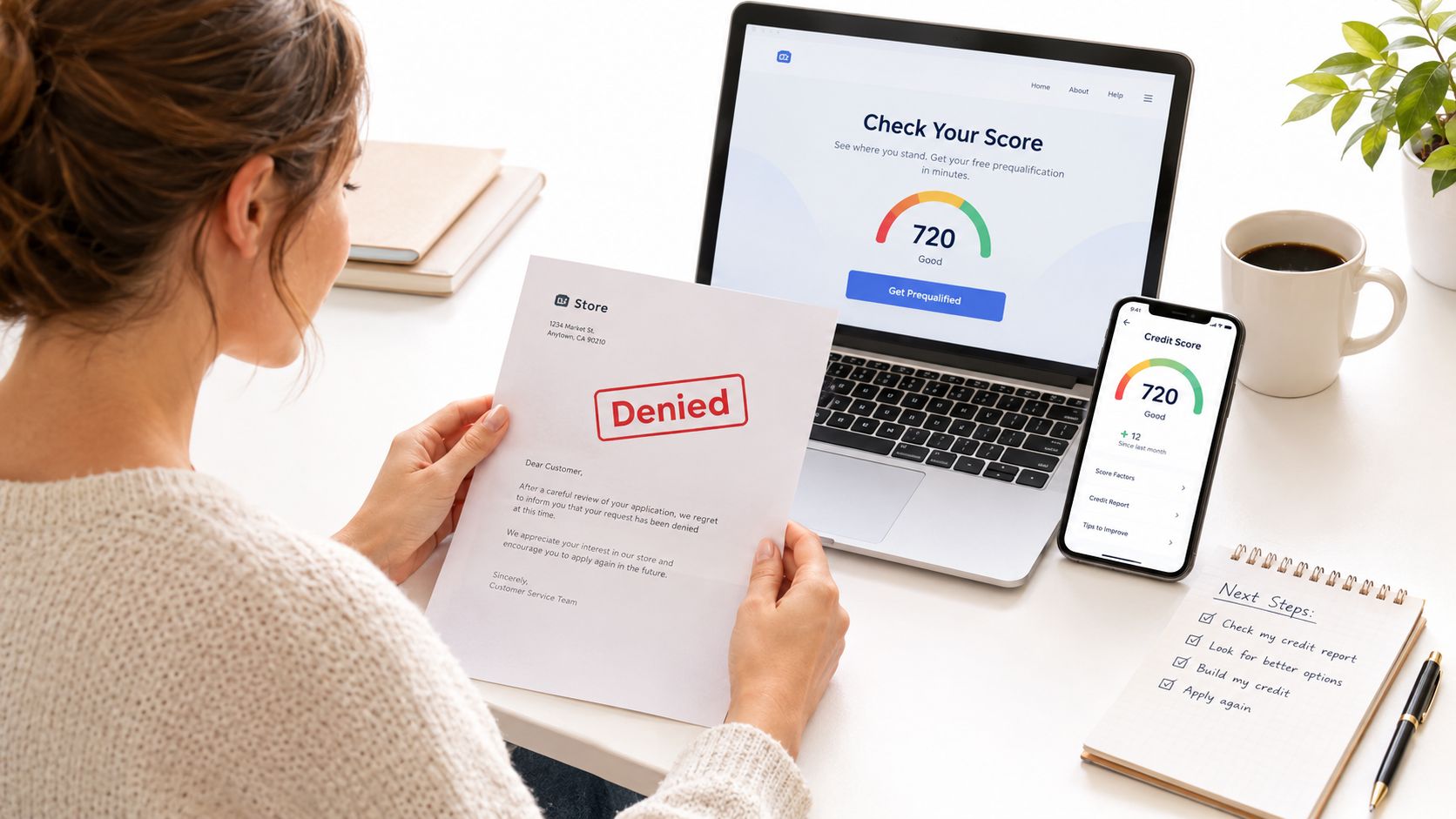
Keep the denial notice and compare it with your own records. The practical task is to separate information problems from debt problems and eligibility problems.
Use the next month to fix the cause
Start with the stated reason. Ask the issuer to clarify anything you don't understand, and check whether the information it evaluated matches your records. If you find inaccurate information, address it rather than trying to outrun it with another application.
Next, decide whether the purchase is urgent. A replacement essential deserves a different response from a discretionary upgrade, but neither justifies accepting terms you can't repay.
For a furniture need, use Gorins Furniture & Mattress's furniture financing help for poor credit to organize comparison questions. Ask about the lender, total repayment, and consequences of missed payments before submitting anything.
Then choose a rebuilding path based on its purpose:
- Secured credit card: Investigate deposit requirements, fees, reporting practices, and whether the issuer offers a route to an unsecured account. Don't commit cash you need for essentials.
- Credit-builder loan: Ask how funds are held or released, what the total cost is, and whether payments are reported. Don't assume it will fund today's purchase.
- Credit union payday alternative loan: Ask a credit union about availability, membership requirements, and repayment terms if you need a small-dollar borrowing alternative rather than a retail account.
The accompanying video offers another format for reviewing your next steps.
Reapply after a meaningful change
Don't set a guaranteed graduation date for a general-purpose card. Set milestones instead: corrected information, manageable balances, consistent payments, and a budget that can support another account.
If bankruptcy is part of your history, review the guide to credit cards after Chapter 7 discharge before selecting a rebuilding product. Match the account to your circumstances rather than assuming every product marketed to bad-credit borrowers serves the same purpose.
Time alone isn't a complete recovery plan. Before trying again, identify what has improved and why the next application is better supported than the denied one.
Your Next Decision at the Register
Your job at checkout isn't to prove that you qualify. It's to decide whether the proposed account deserves a place in your finances.
Use approval, affordability, and purpose as separate tests. An offer has to pass all of them, not just the one the salesperson emphasizes.
Carry this checklist into the store
- Purpose: Would you still buy the item without the card promotion?
- Preparation: Have you reviewed the issuer, your credit profile, existing obligations, and application disclosures?
- Terms: Can you explain the costs and any promotional conditions without relying on the cashier's summary?
- Repayment: Does the payment fit money you can reasonably count on after essentials?
- Fallback: Will you reduce or postpone the purchase if the offered account isn't suitable?
- Next step: If denied, will you investigate before applying elsewhere?
No legitimate source can promise approval. Treat anyone offering certainty as a reason to slow down, not a reason to provide more personal information.
Choose help when credit isn't the right tool
If borrowing would leave you short on housing, utilities, food, or existing payments, stop comparing cards. Ask about payment arrangements, free nonprofit credit counseling, or local assistance through 211 before adding another obligation.
For an essential purchase, also investigate whether a local assistance organization can help meet the need directly. Solving the need without new debt is better than finding a card that lets you postpone the bill.
Use the credit-card comparison guides when you're ready to evaluate account types deliberately. My recommendation remains simple: walk away from an offer you can't explain or comfortably repay, even when the retailer is willing to approve it.
BadCreditMD offers credit-card explainers, credit-score guides, and directories for free local assistance to help you compare options without treating approval as the goal. Visit BadCreditMD to review your alternatives and build a repayment plan before submitting your next store-card application.