
A title loan is a short-term loan secured by your car's title, which the lender holds or places a lien on until the loan is repaid, usually due in about 30 days. On a $1,000 loan, a 25% monthly fee means you owe $1,250 after one month, a cost equal to roughly a 300% APR.
Say rent is due Friday, the paycheck won't cover it, and the only thing you own free and clear is the car that gets you to work. A lender offers $1,000 the same day. You keep the keys. The title stays with them, or a lien goes on the record, until that $1,000 plus the finance charge is paid.
That offer is easy to take and hard to finish. Follow this same $1,000 from the signature through a renewal or a repossession, so you can see how the fee changes what you owe before you hand over the title.
Table of Contents
- What a Title Loan Is and Why Lenders Use Your Car
- How a Title Loan Works from Application to Payoff
- What a Title Loan Really Costs and How Fees Add Up
- Default, Repossession and What Happens to Your Car
- State Laws That Decide Whether a Title Loan Is Allowed
- Check Alternatives and Confirm the Payoff Before You Sign
What a Title Loan Is and Why Lenders Use Your Car
A title loan is a secured, usually short-term loan. You pledge the vehicle title as collateral and you keep driving the car. The Federal Trade Commission describes typical car-title loans as lasting about 30 days, though borrowers may renew when they can't repay the full balance at maturity.
Think of a pawn shop, with one big difference. At a pawn counter, the watch stays in the case until you pay. Here, the car secures the cash, but you keep possession. The lender holds the title, or places a lien on it, until you repay the principal, the finance charge, and any extra fees.
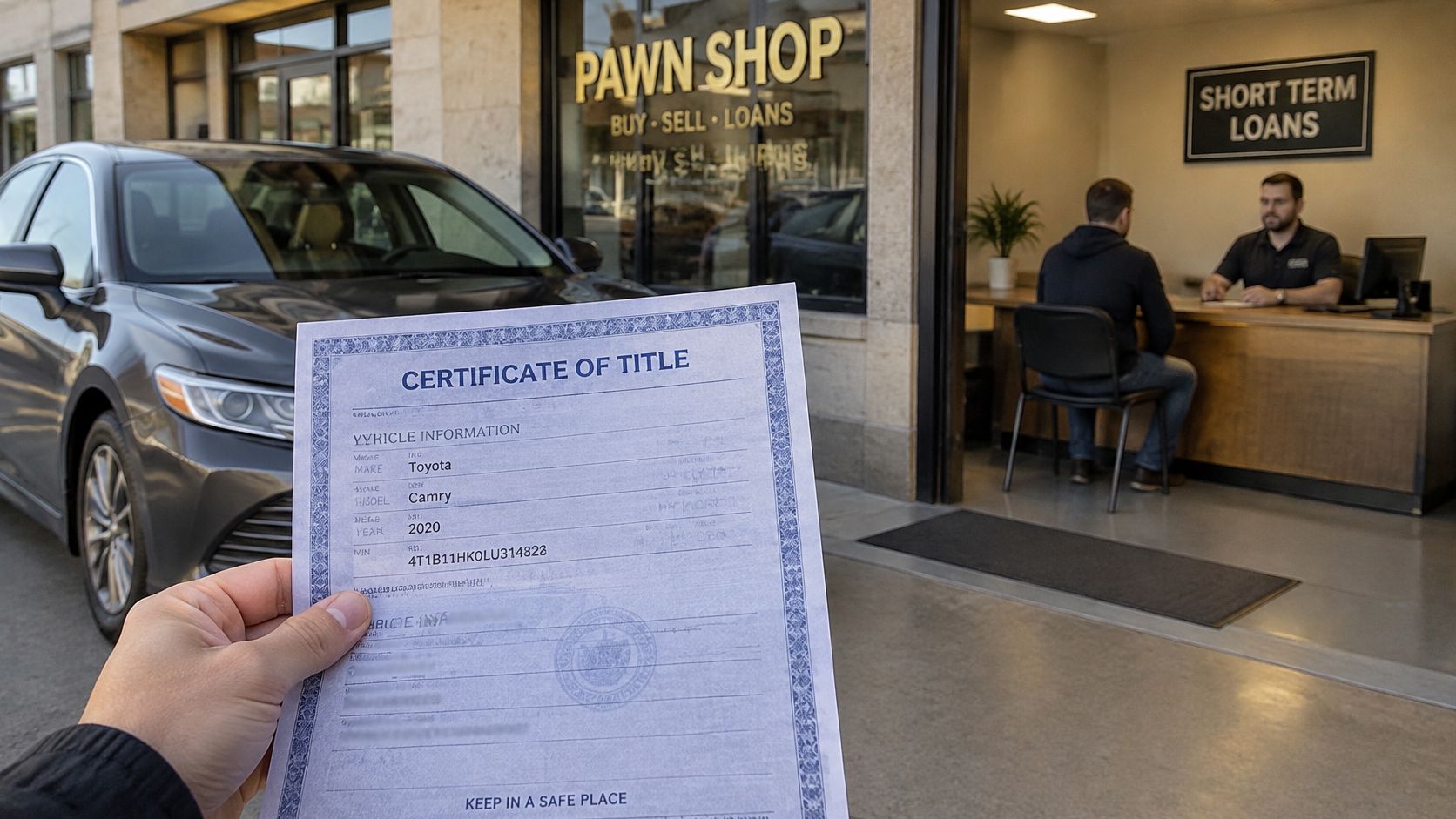
Loan amounts commonly range from $1,000 to $10,000, set largely by the vehicle's value and the lender's assessment rather than a long look at your credit score. That's why people with subprime or thin credit, who own a car outright and need cash quickly, are the usual applicants.
How this differs from an unsecured personal loan
A personal loan is a lump sum repaid in fixed monthly payments. Miss one, and the damage shows up on your credit. No specific asset is on the line. A title loan flips that trade. The lender's security is the car. A clear title and a vehicle they could sell matter more than your score.
The FTC also shows why the first month already costs more than the cash in your hand. Fees can reach 25% of the amount borrowed per month. On $1,000, you need $1,250 after one month, before processing, document, origination, or roadside-assistance charges. Renew instead of cutting principal, and the fee can come back while the debt stays put. After eight renewals, the FTC reported a borrower who took a $1,000 title loan could pay $2,000 in fees alone. Default, and the lender may repossess and sell the car, leaving you without transportation and still responsible for eligible fees or any remaining balance.
The same pledge can apply to other titled vehicles. If you're comparing a boat with a car, our guide to boat title loans shows how that version is structured.
Before you talk to a lender, confirm the title is in your name with no existing lien, and estimate the car's resale value. That number, more than your score, shapes the offer.
How a Title Loan Works from Application to Payoff
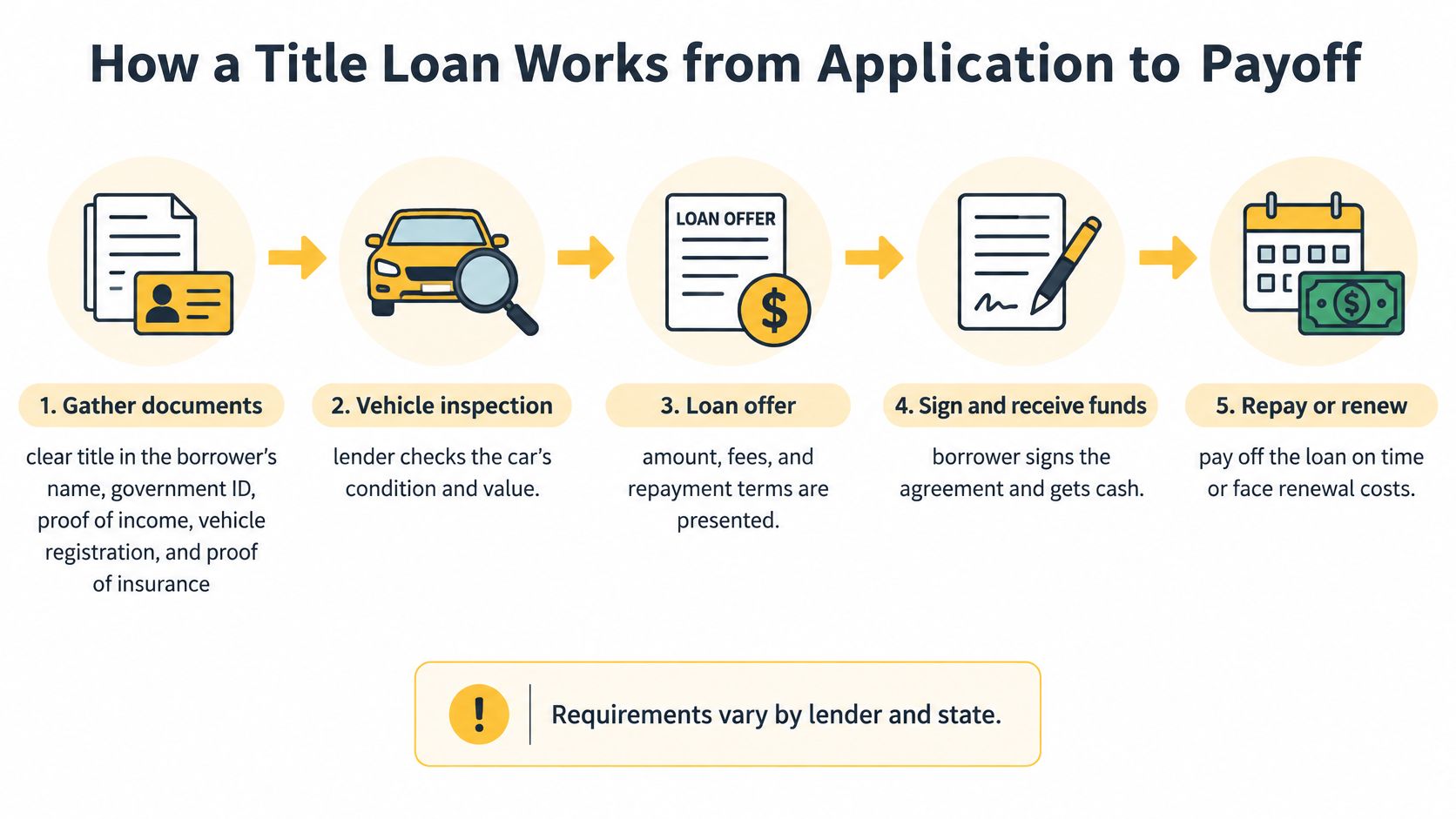
You don't get the money the moment you say yes. The path from the folder of papers to a released title has a set order, and each step has a document or a condition attached.
From the folder to the keys you still hold
- Gather documents. Bring a clear title in your name, a government ID, proof of income, the registration, and proof of insurance. Shops don't all ask for the same stack, so match their list before you drive over.
- Vehicle inspection. Someone checks mileage, condition, and market value. That look sets the maximum they'll advance against this car, which is why a cleaner, higher-value car draws a larger offer.
- Loan offer. You see the amount, the finance charge, the fees, the due date, and what counts as default. Read the default paragraph before you look at the cash figure. Lenders set their own rates and terms and decide whether to lend, so the next shop can quote a different fee on the same car.
- Sign and receive funds. You sign, they hold the title or record a lien, and you keep the car. Count the cash, or the deposit, against the contract amount before you leave the lot.
- Repay or renew. The contract sets a single payoff date. Pay the principal, the finance charge, and the fees, and the lien comes off and the title comes back. Can't cover the lump sum? Many people renew, paying the fee again while the $1,000 principal doesn't move.
Write the exact payoff date and the full amount on a calendar before you sign. If that date lands before your next reliable paycheck, a renewal is already likely.
Two offers on the same Tuesday can look nothing alike because each lender writes its own contract. A short look at the paperwork helps if you've never seen a lien recorded on a title.
Keep a copy of everything you signed. If the amount that hits your account doesn't match the contract, call that day, not on the due date.
What a Title Loan Really Costs and How Fees Add Up
The fee is usually quoted by the month, which is why it looks smaller than it is. 25% of $1,000 is $250. Pay only that fee and roll the loan, and another $250 is due the next month. The principal is still $1,000.
Fee-only months on the same $1,000
| Months of fee-only payments | Fees paid | Total paid if principal repaid then | Principal still owed before payoff |
|---|---|---|---|
| 1 month | $250 | $1,250 | $1,000 |
| 3 months | $750 | $1,750 | $1,000 |
| 6 months | $1,500 | $2,500 | $1,000 |
| 8 renewals (FTC example) | about $2,000 | about $3,000 | $1,000 |
Three months of fee-only payments cost $750, and you still owe the original $1,000. Six months cost $1,500 in fees. Repay the principal then, and you've paid $2,500 to borrow $1,000 for half a year. The eight-renewal row is the long version of that same pattern. Fees near $2,000, then the $1,000 still sitting there, put the all-in figure near $3,000.
Charges that sit on top of the monthly fee
Origination, document, and roadside-assistance charges raise the payoff, and they have to be listed in the contract. Add them after the monthly math, not instead of it.
The method is short. Multiply the amount borrowed by the monthly fee rate. Multiply that result by the number of months you expect to carry the loan. Then add every extra charge the contract names. On this $1,000 example, one extra $50 document fee doesn't replace the $250. It stacks on top, so month one is $1,300 if you pay everything off, not $1,250.
Payday loans, title loans, and some online installment loans can carry very high fees or APRs. Comparing a monthly fee on one product with an APR quoted on another will mislead you. Ask for the same three figures in writing before you sign. You want the APR, the total of all payments, and the payoff amount on a specific date.
Practical rule: If the written payoff is more than you can cover from verified income on the due date, price one alternative before you sign, not after the first renewal.
Bring that written payoff home and set it next to your actual pay dates. A fee that fits this month and fails next month is the renewal the table is built to show.
Default, Repossession and What Happens to Your Car
The $1,000 loan has three possible endings, and only one of them returns your title.
Full payoff by the due date. The lien is released and the title comes back. You've paid the fees, and this loan has no further charges.
A fee-only renewal. The lien stays. The $1,000 stays. The fee starts again.
Default. You miss the required payment. The lender may repossess and sell the car.
Repossession is not a rare edge case reserved for borrowers who ignore the loan. A 2015 analysis by The Pew Charitable Trusts estimated that title-loan customers spend approximately $3 billion each year, averaging about $1,200 per customer in fees for loans averaging $1,000. Pew also estimated that 6% to 11% of title-loan customers have a vehicle repossessed annually. The Consumer Financial Protection Bureau reported that about one-third of single-payment vehicle-title-loan sequences experienced a default and approximately one in five sequences resulted in vehicle repossession.
What each repayment outcome means for your vehicle
| Scenario | What happens to the title | Borrower exposure |
|---|---|---|
| Full payoff by due date | Lien released and title returned | Fees paid, no further charges |
| Fee-only renewal | Lien stays in place | Principal unchanged and fees recur |
| Partial payment | Lien usually remains until the contract is paid in full | Fees may be covered while principal barely drops, and repossession is still possible |
| Default | Lender may repossess and sell the vehicle | Possible deficiency balance, with state rules on any surplus |
Read the default row together with the renewal math from earlier. A borrower who has already paid $250 a month in fees can still owe the full $1,000, lose the car, and then owe more. A fee-only payment keeps you in the driver's seat for another month without cutting the debt in a meaningful way. After a sale, you may still owe eligible fees or a deficiency if the car sells for less than the balance. State law decides whether any surplus from the sale comes back to you.
The loss reaches past the loan balance. For many borrowers the car is the commute, so repossession can mean a missed shift, a skipped medical appointment, or no way to get a child to school. Our page on car title loan repossession risk lays out what to expect if the lender moves to take the vehicle.
If the due date is close, call the lender before you miss it and ask whether a payment plan exists. Get any new arrangement in writing, and keep every text and receipt. If repossession is threatened or the lender's conduct seems to break your state's rules, file a complaint with the CFPB or your state regulator and contact nonprofit credit counseling or legal aid.
State Laws That Decide Whether a Title Loan Is Allowed
The same $1,000 offer can be a lawful product on one side of a state line and unlawful on the other. Title lending is governed mainly by state law. Some states allow it with caps. Some restrict the fee, the term, or the number of renewals. Some prohibit title loans entirely, so no lender can lawfully offer them there.
What to look up before you assume the loan is legal
Check five categories, not a single yes-or-no.
- Loan types permitted. Confirm title loans are among the products your state allows.
- Rate, fee, and term caps. Note the maximum charge and the longest term.
- Rollover and extension limits. See whether a renewal is capped or banned.
- Repossession notice and surplus. Find how much notice is required and who gets money left after a sale.
- Where to complain. Locate your state regulator or attorney general.
Rules generally follow the state where you live, so your own state's law is the one that counts, even if the website looks national. Statutes change, so a write-up from last year isn't enough on its own.
Each of our state guides covers which loan types state law allows, the limits lenders must follow, a worked cost example, and who to call if something goes wrong. Start there, then confirm each statement against the cited statute or regulator and check the last-checked date. A reader in Colorado, for example, can begin with the Colorado car title loan guide and then match it to the statute.
Don't sign a contract written for another state's rules. If your state bans the product, a fast approval from an out-of-state site doesn't make the loan lawful for you.
If the guide's last-checked date is old, or the statute citation doesn't match the contract in your hand, stop and call the regulator listed on that page before you pledge the title.
Check Alternatives and Confirm the Payoff Before You Sign
Don't sign if you can't repay the full amount on the due date without borrowing again. Price at least one alternative first. The car is the collateral, and it is at risk if the loan can't be repaid.
A Consumer Financial Protection Bureau analysis of single-payment vehicle-title lending shows why the timing matters. Short maturities and high recurring charges make a rollover common, and a borrower who can't make the full payoff stays exposed to repossession rather than the protections that come with ordinary unsecured debt. Collateral can be seized even after partial payments, depending on the contract and state law.
Price these before the title
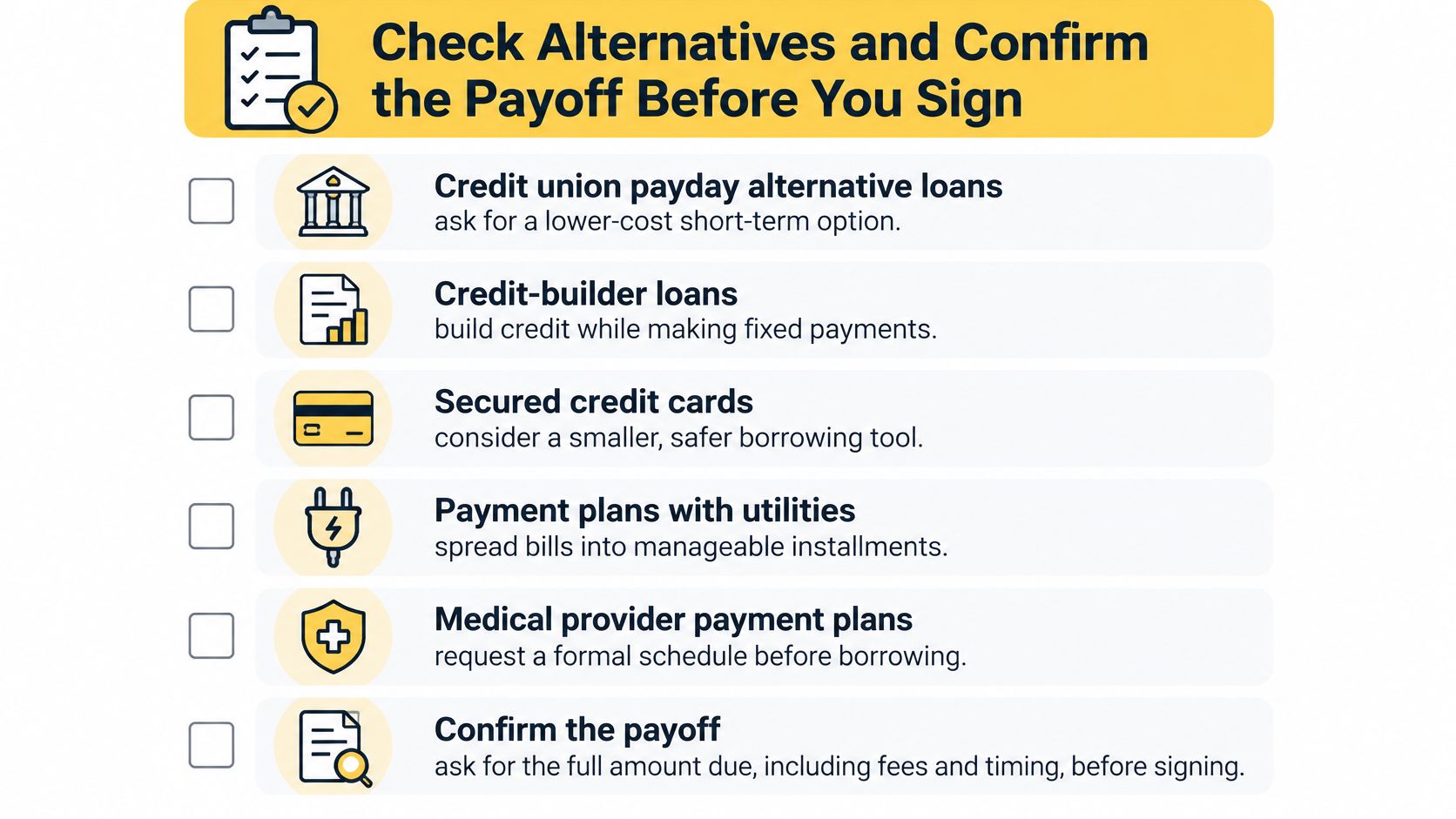
- Credit union payday alternative loans: Federal credit unions offer small loans with an APR capped at 28% under NCUA rules, a different cost structure from a monthly title fee.
- Credit-builder loans: A small loan sits in savings while you pay it off, which can help build a payment history instead of pledging the car.
- Secured credit cards: A smaller limit, backed by a deposit, can cover a short gap without a lien on the title.
- Payment plans: Utilities, medical providers, and other creditors will often split a bill if you ask before it goes to collections.
- Local help: Call 211 for assistance near you. If income support is part of the picture, check legal aid and public benefits portals.
We cover these other ways to borrow, including credit union PALs, credit-builder loans, secured credit cards, and payment plans, on our page about loan options for bad credit.
Confirm the payoff in writing
Before any signature, do four checks.
- Match the date to income. Put the payoff date next to money you've already verified, not money you hope arrives.
- Ask about capitalized fees. Find out whether an extension adds the old fee onto a new balance.
- Ask about a deficiency. Confirm whether you can still owe money after the car is sold.
- Check your state's limits. Rates, terms, repossession, and surplus proceeds are set where you live.
If repayment depends on another loan or on uncertain income, a credit-union PAL, a creditor payment plan, nonprofit counseling, or a 211 referral can lower the chance you lose the car. Compare the total owed on the title loan with the cost of one alternative. This is general information about loans and state rules, not legal or financial advice.
BadCreditMD explains title loans, other small-dollar options, and the state rules that decide whether a product is even allowed where you live. You can compare costs, see who to call if a loan goes wrong, and find free local help before you pledge a car. Start with the guides at BadCreditMD.