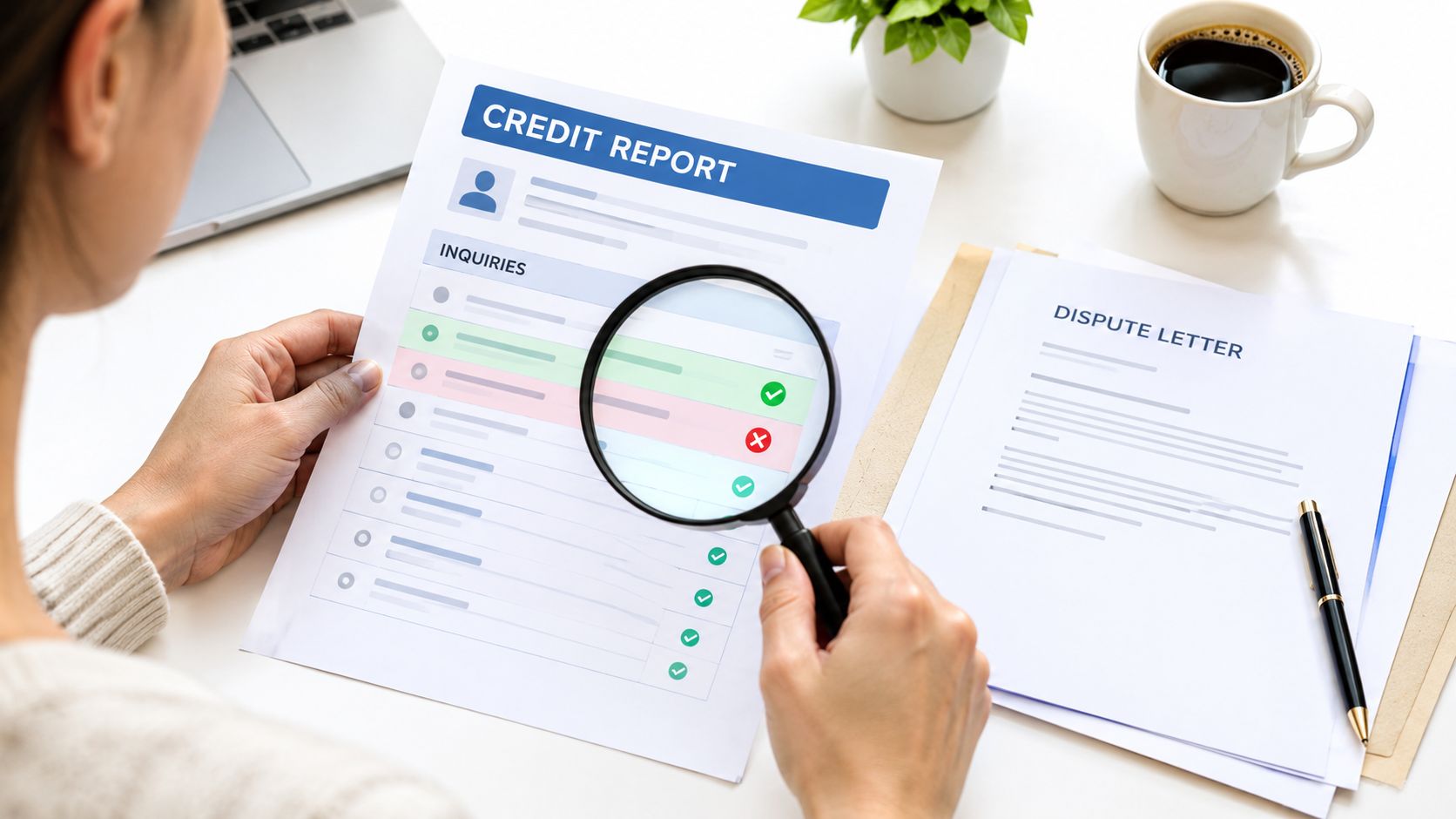
The popular advice to dispute every hard inquiry is bad advice. If you applied for credit and the lender's inquiry is accurate, a lower score isn't grounds for deletion. Before you spend money trying to get hard inquiries removed from credit report records, determine whether you're looking at a legitimate application, a reporting error, or possible identity theft. Those situations require different decisions, not the same removal letter.
Table of Contents
- Why Hard Inquiries Stay on a Credit Report
- How to Sort Inquiries Before You Dispute
- How to Dispute an Inaccurate Hard Inquiry
- What to Do When an Inquiry Is Identity Theft
- Realistic Timing and Removal Expectations
- What to Do After You Review Your Reports
Why Hard Inquiries Stay on a Credit Report
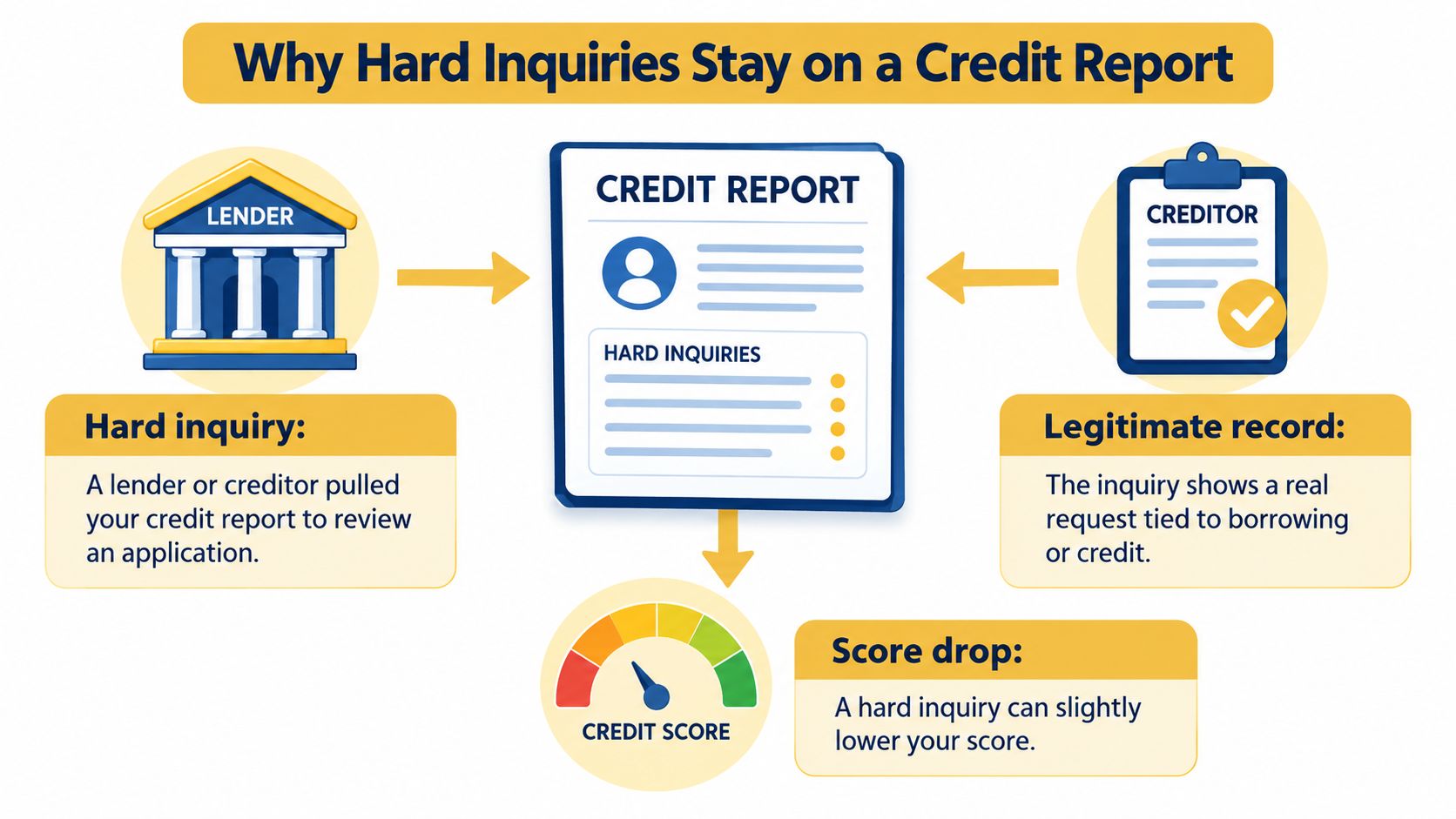
A hard inquiry records a lender or creditor accessing your credit report to evaluate an application. That application might be for a credit card, mortgage, auto loan, or personal loan. The inquiry isn't a penalty that a bureau can waive because you dislike the result.
An authorized inquiry can remain on your report for up to two years, even though its scoring effect generally ends sooner, according to Equifax's explanation of hard and soft inquiries. Once the reporting period expires, it should ordinarily disappear automatically. You generally don't need to pay anyone to make that happen.
Separate the record from the score
Keep these outcomes distinct when deciding whether to act:
- Report visibility: The inquiry appears in your application history.
- Scoring impact: A scoring model considers the inquiry when calculating your score.
- Lender review: A lender can review information still displayed on the report, even when that information no longer affects a particular score.
The diagram illustrates why a credit application can produce both a report entry and a scoring effect.
Don't assume an inquiry is still lowering your score just because you can see it. Equally, don't assume that an older inquiry has vanished from the information a prospective lender receives. A credit report and a credit score aren't interchangeable.
Decide whether accuracy is the problem
A dispute makes sense when the inquiry was unauthorized, resulted from identity theft, was recorded incorrectly, or can't be connected to an actual application. Start by contacting the company identified on the report. Ask which application or transaction prompted the credit check.
If you recognize the creditor and the application, waiting is generally the appropriate response. If you don't, investigate before choosing a dispute category. Use this guide to understanding a credit report if you need help distinguishing inquiries from account information.
Practical rule: Dispute the accuracy or authorization of an inquiry, not the fact that you dislike seeing it.
Also treat each bureau's report as a separate record. Don't assume a correction appearing on one report has reached the others. Your decision should depend on what each report shows, not on a single monitoring notification.
How to Sort Inquiries Before You Dispute
Open your reports from each nationwide credit reporting company and create a simple working list. Record the company name, inquiry date, report showing it, and whether you remember applying. Save the report itself, not just a screenshot of a score change.
Next, separate hard inquiries from soft inquiries. Checking your own credit and promotional reviews are examples of soft inquiries, which don't affect credit scores, as explained in Equifax's guide to credit report history. Don't spend your dispute effort trying to remove a harmless self-check.
What Each Inquiry Label Means
| Label | What it usually means | Sensible next move |
|---|---|---|
| Recognized and accurate | You remember the application and the details match | Keep the record and allow it to age off |
| Rate-shopping cluster | Related applications may qualify for grouped scoring treatment | Check the loan type and application dates |
| Unfamiliar company name | The entry might relate to an application under another business name | Ask the company to identify the transaction |
| Possible fraud | You can't connect the inquiry to your activity, especially if an unfamiliar account also appears | Preserve evidence and investigate promptly |
For eligible installment-loan shopping, inquiries within approximately 14 to 45 days may count as a single inquiry for scoring, depending on the model, according to the Equifax credit-history guidance linked above. That doesn't erase the individual entries. Credit-card applications generally don't receive the same treatment.
Compare applications with your own records
Suppose you compared auto financing offers during the same week. Several lender names on your report could reflect that shopping activity rather than a reporting error. Match the dates against emails, application confirmations, and dealership paperwork before accusing a lender of unauthorized access.
Now consider a different situation: a lender appears on your report, but you don't remember contacting it. That's a reason to investigate, not immediate proof of fraud. Ask the company whether the inquiry relates to a store application or another transaction you recognize.
Don't classify an entry based solely on the circumstances in which you discovered it. If an employment or screening process caused the confusion, review how background checks and credit checks differ before assuming the entry represents a new borrowing application.
- For recognized entries: Add a note identifying the application, then stop working on removal.
- For shopping clusters: Keep the relevant application confirmations together.
- For unresolved entries: Save a highlighted report page and document your contact with the company.
- For suspected fraud: Check the rest of the report for associated accounts and unfamiliar personal information.
Only unresolved errors or genuine authorization concerns should proceed toward a dispute. A long list of inquiries isn't, by itself, evidence that any of them is wrong.
How to Dispute an Inaccurate Hard Inquiry
A useful dispute identifies a specific error and provides evidence. It isn't a goodwill request, and it shouldn't ask a bureau to remove an accurate inquiry because you need a higher score.
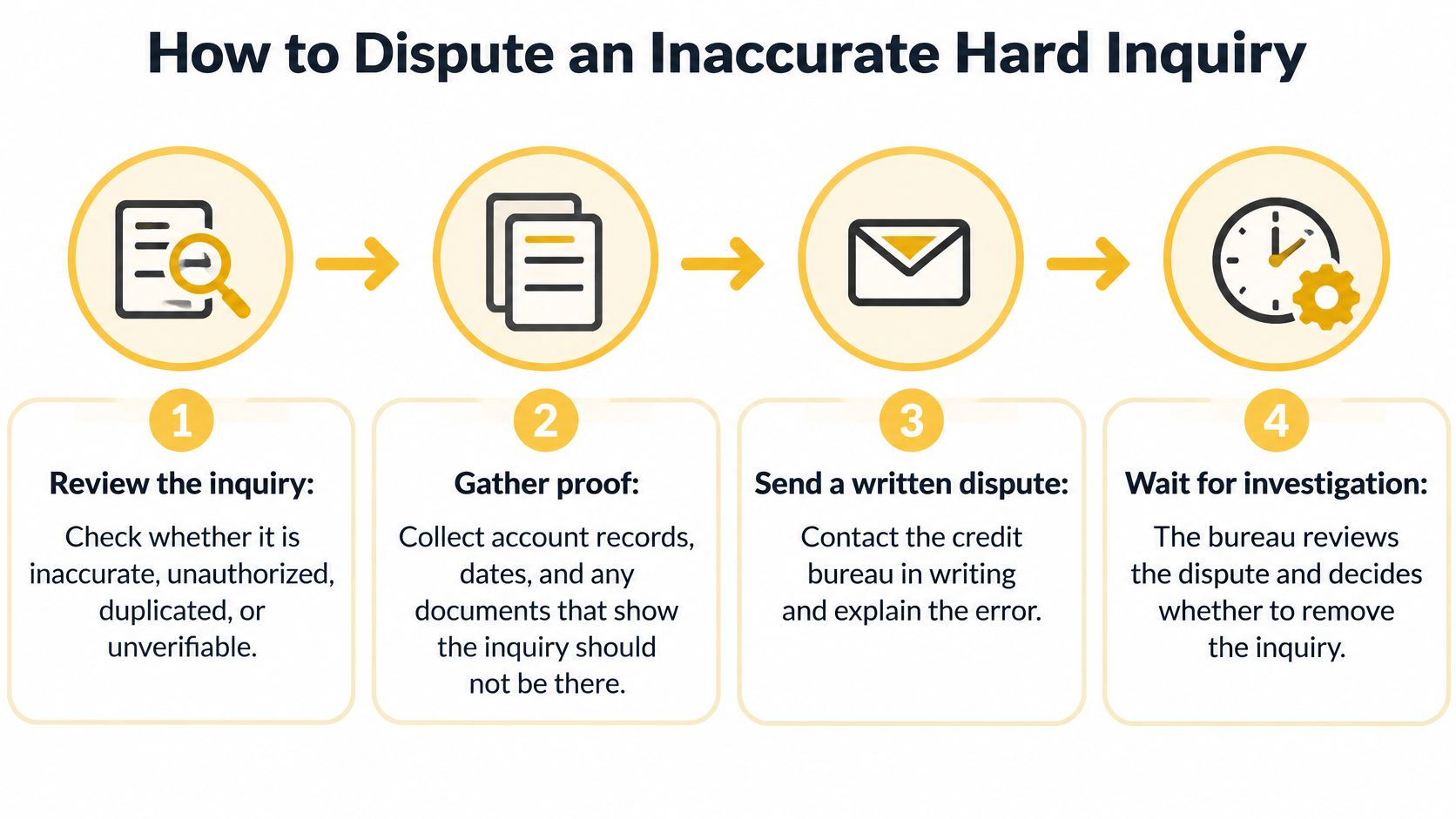
Use the process below to organize the investigation request before sending it.
Build a targeted written request
Identify the company, inquiry date, and the bureau report where the entry appears. Explain whether the problem is an unauthorized credit check, an incorrect date or company, duplication, or another verifiable error. If you didn't initiate the transaction, say that directly and ask the investigator to examine the basis for accessing your report.
Send a dispute separately to each bureau displaying the error, and send a parallel written dispute to the business that requested the report. The FTC's instructions for disputing credit report errors explain the roles of the bureau and the business supplying the information.
Your file should contain:
- The identified entry: A report page with the inquiry clearly highlighted.
- Your factual explanation: What's wrong and what correction you're requesting.
- Supporting records: Relevant lender correspondence, application records, authorization evidence, or identity-theft documentation.
- Copies of documents: Keep originals in your own records.
- Tracking information: Copies of submissions, delivery receipts, case numbers, and responses.
Avoid vague requests that say only “remove this inquiry.” The investigator needs to understand the alleged error. Don't dispute an unrelated account balance when the issue is access to your report.
For a broader explanation of the process, use this credit repair guide. Minnesota readers seeking additional context can also consult credit dispute guidance for Minnesota debtors from LifeBack Law Firm, P.A.; use it alongside the federal guidance when preparing a documented request.
Track the investigation rather than sending more templates
The bureau generally must investigate within 30 days, notify the furnisher within five business days, and send results within five business days after completion, under the FTC guidance linked above. Providing additional relevant information during the investigation can extend the period by 15 days, according to that same guidance.
If information is inaccurate, incomplete, or unverifiable, the bureau must delete or correct it. The furnisher must also notify other nationwide bureaus to which it supplied the inaccurate information. Still, review the resulting reports yourself rather than assuming every record now matches.
Keep the request narrow: Identify the inquiry, explain the error, attach the evidence, and request an investigation. A longer letter isn't automatically a stronger letter.
Don't keep resubmitting unsupported allegations while an investigation is pending. Repetitive or unsupported disputes can be treated as frivolous, so preserve your evidence and respond to the actual findings instead of cycling through removal templates.
For a video resource to accompany your written preparation:
When the result arrives, compare it with your original complaint. Did the response address the inquiry you identified? Does the explanation connect it to an application you made? Those questions determine whether the investigation resolved your concern.
What to Do When an Inquiry Is Identity Theft
Suppose your report shows a creditor in another state on a day you made no application. An unfamiliar account also appears nearby. That combination deserves a safety response, not just a letter asking to improve your score.
The location alone doesn't prove fraud. But if the company can't connect the inquiry to your activity and the account isn't yours, preserve the evidence and begin the identity-theft process.
Protect your credit while documenting the fraud
Review the other bureau reports for related entries. Save application notices, account letters, security alerts, and screenshots that help establish what happened. Create a timeline showing when you discovered the inquiry and what the creditor told you.
Use this checklist to organize the protective actions alongside your evidence.
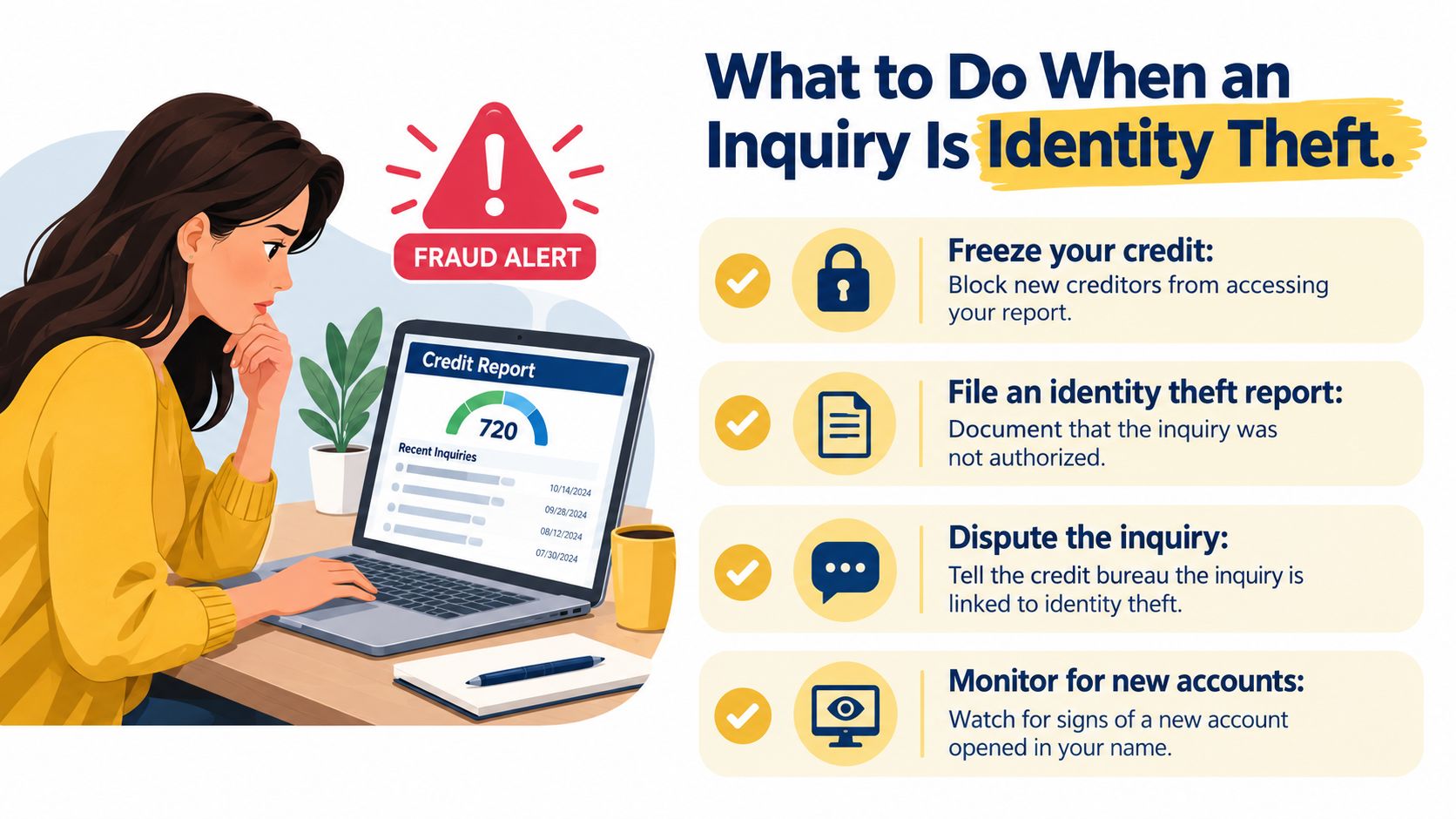
- Check connected accounts: Identify any account you didn't open, not just the inquiry that first attracted your attention.
- File an FTC identity-theft report: Describe the unauthorized activity accurately and retain the report.
- Request a credit freeze: Treat protection against further unauthorized applications as a separate task from correcting existing entries.
- Contact the business: Tell the creditor which inquiry and account you're challenging.
- Preserve communications: Keep letters, confirmation messages, and notes from conversations together.
Don't wait for a score change before checking for related accounts. Your immediate objective is to identify and document unauthorized activity, whether or not a monitoring service has flagged a problem.
Request a fraud block with the required documents
For a qualifying identity-theft block, provide an identity-theft report, proof of identity, and written identification of the fraudulent information. Credit reporting companies must block qualifying fraudulent information within four business days after receiving the required request, according to CFPB guidance for identity-theft victims.
That guidance also explains that an initial fraud alert lasts one year, while an extended alert can last seven years. Keep the distinction between a fraud block, an alert, and a freeze clear in your correspondence. Ask for the action you need rather than assuming a general fraud complaint requests everything.
An unfamiliar creditor name is a reason to check. It isn't permission to claim identity theft without supporting facts.
If the company identifies an application you did make, reassess the label you assigned. If it identifies an application you didn't make, request the relevant records and add them to your file. Accurate descriptions make a genuine fraud claim easier to evaluate and prevent ordinary brand-name confusion from becoming an unsupported allegation.
Realistic Timing and Removal Expectations
The most important question isn't always whether you can get an inquiry deleted. It's whether deletion would solve the problem you're trying to address.
FICO considers hard inquiries from the preceding 12 months, even though an inquiry can remain visible afterward, and describes their scoring effect as generally relatively small in its explanation of credit inquiries. Removing an older, accurate inquiry may therefore provide no FICO-score benefit. A lender may still see the entry while reviewing the report.
Don't confuse a cleaner report with a higher score
The timeline separates report retention from scoring treatment.
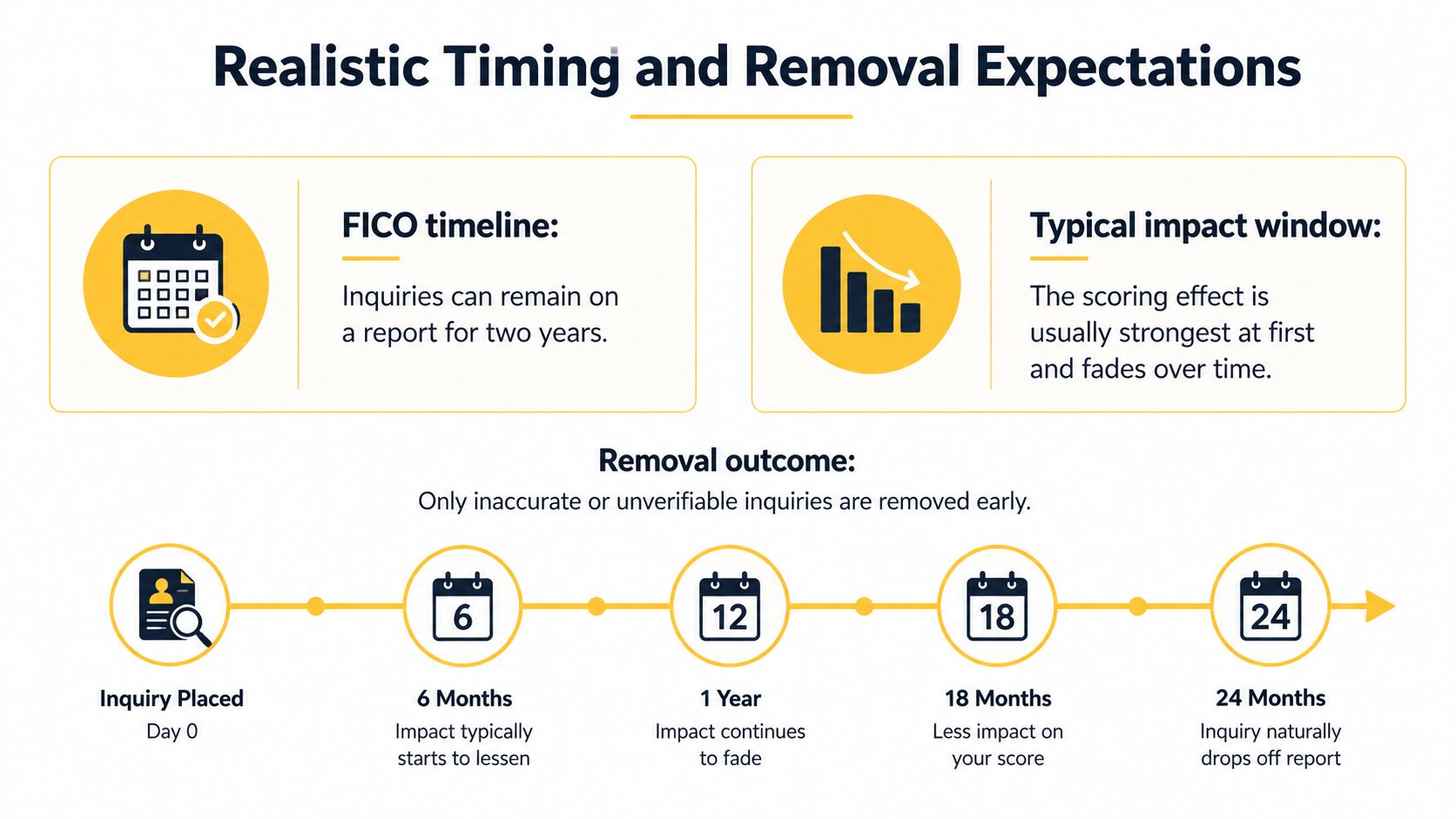
Before paying a removal company, ask what specific error it intends to dispute. If its answer is that the inquiry reduced your score, it hasn't identified a valid correction issue. Ask separately what scoring model supports its promised outcome.
There's no authoritative government success-rate benchmark for removing legitimate hard inquiries. Don't treat near-guaranteed removal percentages as evidence. The CFPB's credit report dispute guidance provides an evidence-based route for challenging errors, not a guaranteed score-improvement formula.
| Your situation | Appropriate choice | What not to expect |
|---|---|---|
| Accurate application history | Allow the inquiry to age off | Early deletion because you ask nicely |
| Documented reporting or authorization error | Request correction through a targeted dispute | A universal score increase |
| Documented identity theft | Seek the appropriate fraud block and protective measures | A complete resolution from an inquiry-only complaint |
Evaluate the outcome you actually need
If you're preparing to borrow, ask the prospective lender which score model it uses. Don't assume the score you monitor is the exact score the lender will evaluate. Also ask whether submitting the next application will involve a hard inquiry before deciding to proceed.
Remember the shopping distinction established earlier: eligible mortgage, auto, or student-loan applications may receive grouped scoring treatment without disappearing from the report. Seeing several entries doesn't automatically mean the model counted each separately.
If the bureau's answer is inadequate, don't purchase a different template and restart blindly. Keep the complete dispute file, request the method of verification where applicable, and consider a CFPB complaint after first disputing directly with the bureau and the company.
Your complaint should explain what remains unresolved and attach the earlier submissions and responses. A clear disagreement supported by records is more useful than a broad demand for deletion. Judge success by whether the information is accurate, the unauthorized activity is addressed, and the response answers your actual concern.
What to Do After You Review Your Reports
Choose an action based on the inquiry's label, not on the size of the score change you noticed. If the entry matches a real application, close the removal task and retain your records. If it remains unsupported or incorrect, finish the documented dispute rather than sending another generic request.
If you found an unauthorized account, prioritize the identity-theft file and protective measures. Don't let a narrow focus on an inquiry distract you from the account connected to it.
Give yourself one concrete task this week
- If the inquiry is accurate: Record which application it belongs to and stop shopping for deletion services.
- If the details are wrong: Assemble the highlighted report page, explanation, and supporting copies for submission.
- If the authorization is unresolved: Contact the company and ask it to identify the application.
- If fraud is documented: Complete the identity-theft request and keep protective actions on your checklist.
- If the response is inadequate: Organize the existing investigation record before escalating.
After a correction or block, recheck the reports that displayed the disputed information. Compare the result with what you requested and keep a dated copy of the outcome. Don't rely exclusively on a notification that says a dispute has closed.
Separate credit cleanup from the need to borrow
If your real concern is an upcoming bill, inquiry removal may not address it. A payment arrangement, nonprofit credit counselor, or legal-aid consultation may be more relevant than submitting another loan application. Use free local assistance, including 211 resources, when you need help locating support.
Before applying again, compare the borrowing option's total cost, repayment obligations, and state rules. Reading an educational guide doesn't create an inquiry; any credit check associated with a request happens only if you submit that request. Research first so the next application is a deliberate choice.
For credit-card decisions, consult this DIY credit-card guide alongside your report review. Keep the questions separate: whether an old entry is accurate, whether a new product is appropriate, and whether you can afford its payments.
Before another application: Know why you're applying, what the credit check involves, and which alternatives you've ruled out.
Your next step doesn't need to be expensive or complicated. Open the report, assign the right label, and complete the action that fits the evidence. Don't pay someone to turn an accurate application history into a promised score shortcut.
BadCreditMD offers free credit explainers, state-specific borrowing rules, worked cost examples, and links to nonprofit counseling, legal aid, 211, and CFPB resources so you can investigate an inquiry before applying again. It's an information site, not a lender or broker; if you choose to submit a request through its separate lending-network partner where available, third-party lenders set rates and make approval decisions. Visit to compare your next steps without treating inquiry deletion as a borrowing strategy.