
A Louisiana payday loan is capped at $350, and loans from $220 to $350 have a maximum total fee of $55. At the maximum loan amount, that means $405 due at maturity, before any later delinquency charges; these figures come from the state regulator and may change.
Those caps give borrowers with bad or thin credit a concrete way to check an offer, but a legal limit doesn't make a loan affordable. The key questions are how much you'll owe on the due date, whether that payment fits your budget, and what you can do if a lender withdraws more than agreed.
Table of Contents
- Louisiana Payday Loan Limits and Rules
- What a Louisiana Payday Loan Really Costs
- How to Verify a Louisiana Loan Offer Is Legal
- Loan Types Compared for Bad Credit Borrowers
- Alternatives That Cost Less Than a Payday Loan
- Inquiries, Documents and Timing
- What to Do After You Submit or Get Funded
- Choose Your Next Step by Credit Band
Louisiana Payday Loan Limits and Rules
Louisiana sets limits on loan size, term, and charges under the Louisiana Deferred Presentment and Small Loan Act. A covered small loan is a consumer loan of $350 or less with a term of 60 days or less. A deferred-presentment transaction involves a check for up to $350 that the lender holds for as long as 30 days, as stated in the Louisiana statute governing deferred-presentment and small loans.
The statutory caps let borrowers check the basic terms of an offer. The state regulator also publishes the current annual maximum outstanding principal balance. Check that limit before applying, since it can affect whether a lender may extend the loan.
| Limit | Louisiana figure | What it means |
|---|---|---|
| Maximum payday loan amount | $350 | A loan above this amount exceeds the stated payday-loan maximum. |
| Finance charge | $20 for each $100 borrowed | Applied to the amount borrowed. |
| Documentation fee | $10 flat | Added to the finance charge. |
| Maximum total fees on loans from $220 to $350 | $55 | Caps fees when the formula would produce a higher amount. |
| Small-loan term ceiling | 60 days or less | Defines a covered small loan. |
| Deferred-presentment check hold | Up to 30 days | The lender holds the check for the agreed period. |
The $55 fee cap begins to bind above $225: at that amount, the $20-per-$100 finance charge plus the $10 documentation fee totals $55. This threshold helps you check whether the listed fee follows the formula and cap.
The law also restricts renewals and regulates lender conduct. A short repayment period can still create pressure if the payment comes due before your next paycheck. Before signing, compare the written disclosure with the offer, focusing on the due date and total repayment amount.
Treat the published limits as a screening tool, not a reason to borrow. Before accepting, confirm the current principal limit with the regulator and check that the lender's written terms match the applicable caps. If the lender's figures or collection practices appear inconsistent with Louisiana's rules, keep the paperwork and use it when contacting the relevant regulator.
What a Louisiana Payday Loan Really Costs
A maximum loan of $350 can mean $405 due at maturity, before any later delinquency charge. The Louisiana Office of Financial Institutions says lenders may charge $20 per $100 borrowed plus a $10 documentation fee, subject to a $55 maximum fee on loans from $220 to $350. Use the Louisiana regulator's payday-loan fee and balance guidance to compare a written offer against that formula.
The figures below are calculated from the published formula and cap. Your lender's written disclosure governs the actual amount.
| Amount borrowed | Fee charged | Total due at maturity | Fee as share of amount |
|---|---|---|---|
| $100 | $30 ($20 finance charge + $10 documentation fee) | $130 | 30% |
| $220 | $54 | $274 | About 24.5% |
| $300 | $55 (cap applies; formula would give $70) | $355 | About 18.3% |
| $350 | $55 (cap applies; formula would give $80) | $405 | 15.7% |
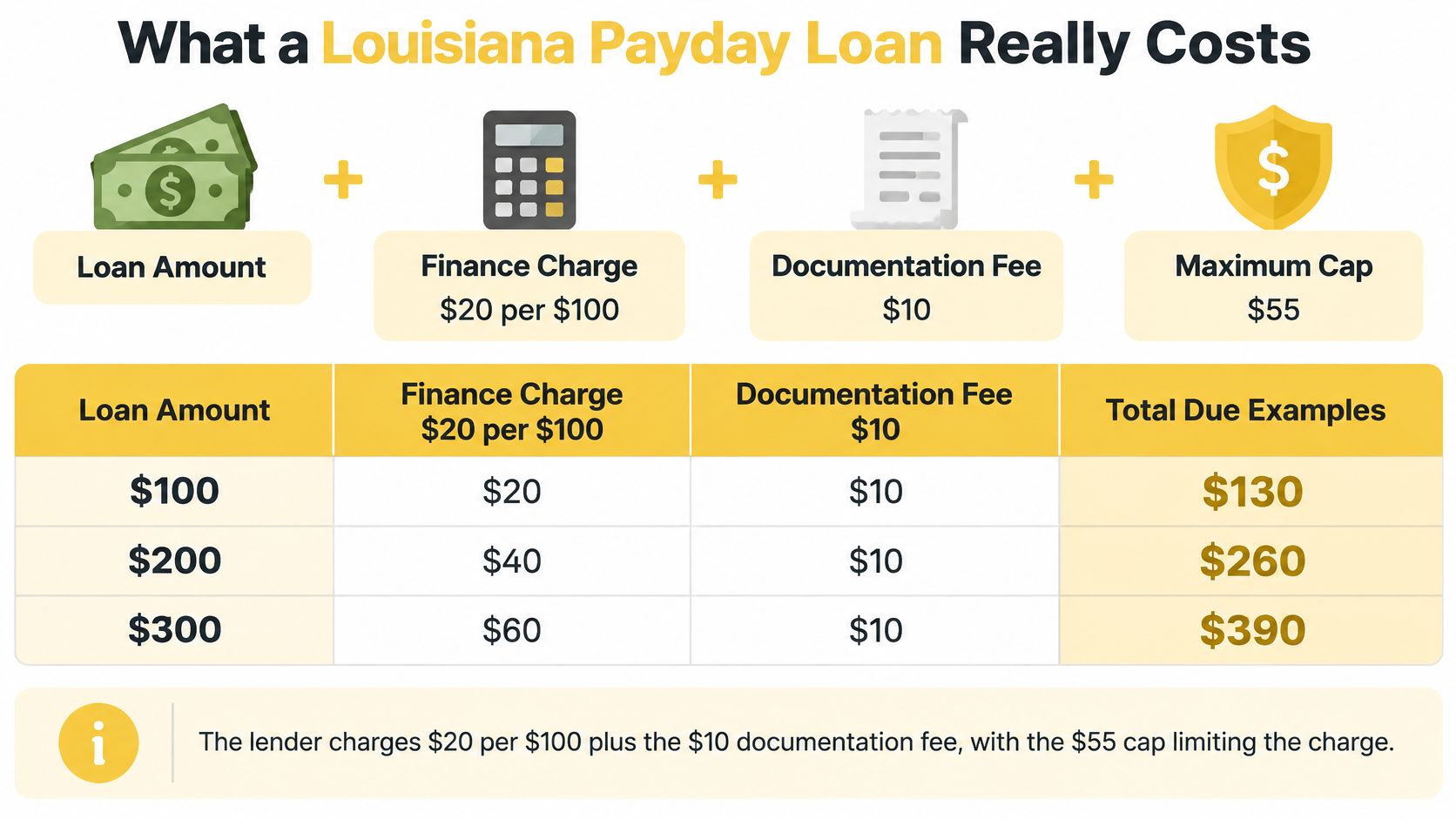
The cap changes the effective cost as the loan grows. At $100, the $30 fee is a large share of the amount borrowed. At $300 and $350, the $55 cap limits the charge, but the entire balance is still generally due at maturity. A payday advance therefore differs from an installment loan, where principal and interest are spread across scheduled payments.
The due date is the pressure point. If you can't pay the full amount, ask the lender in writing what options are allowed, whether any fee or charge will apply, and what balance the charge is based on. For example, if a $350 balance remained unpaid for a full year and the 36% charge applied to the full balance throughout, the charge would be $126. Confirm the calculation and balance used with the lender before relying on that illustration.
If you're also comparing revolving debt, calculating interest on card balances can help you understand how a card's interest differs from a fixed short-term fee. For a payday offer, keep the decision simple: compare the total due and the date it's due, not the fee alone.
How to Verify a Louisiana Loan Offer Is Legal
A useful legality check works for online offers and storefronts alike. Louisiana's rules changed effective August 1, 2025, and the law requires an annually adjusted maximum outstanding principal balance; the Louisiana Office of Financial Institutions' legislation notice is a starting point for checking the current framework.
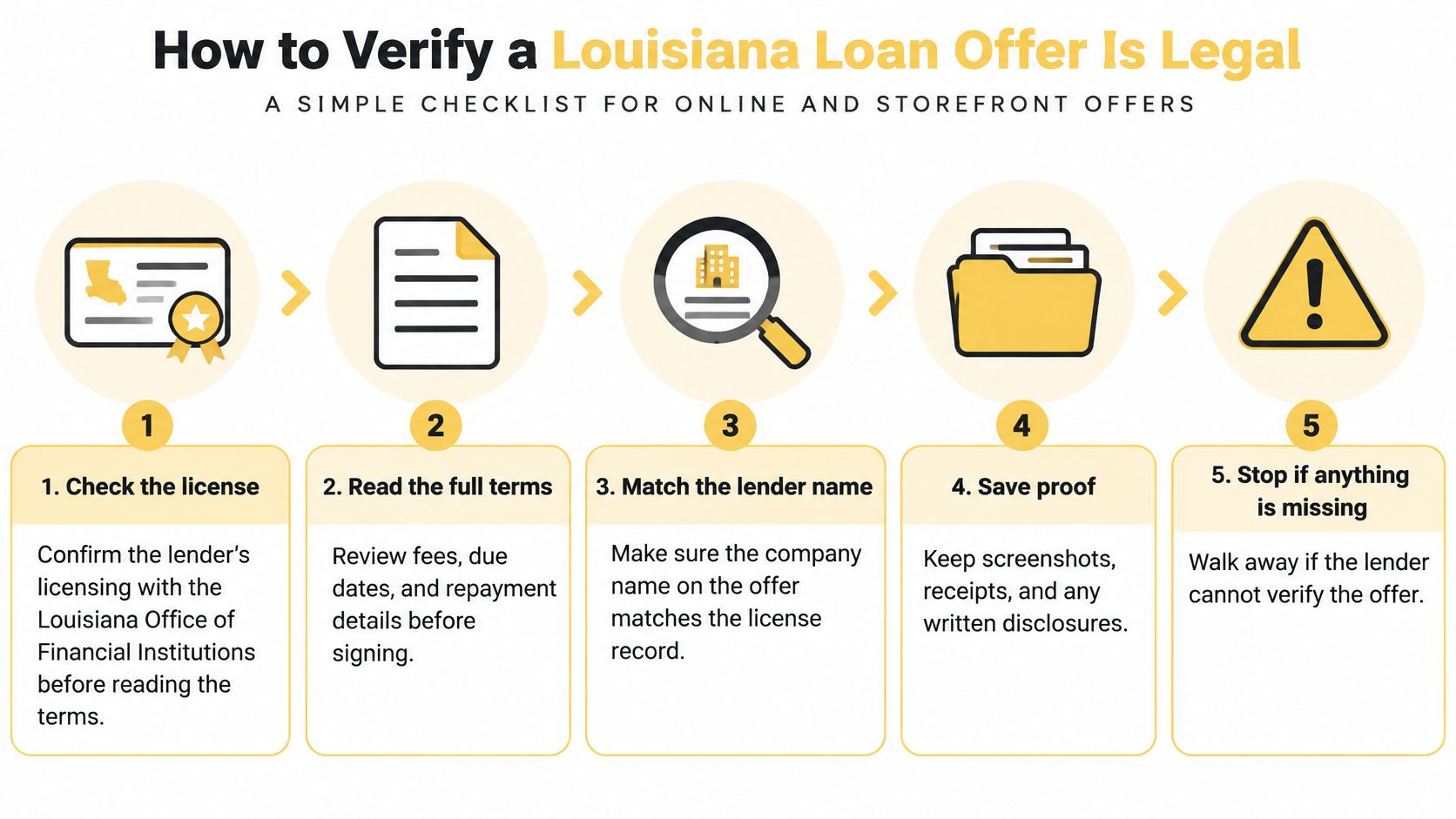
Confirm the lender's license. Check with the Louisiana Office of Financial Institutions before reviewing the offer in detail. This catches an offer from a lender whose authorization you can't verify.
Check the amount and term. Confirm that the product fits the covered small-loan definition of $350 or less and 60 days or less. An amount or term outside those boundaries may not belong to the regulated category described here.
Add the fees yourself. Include the finance charge and the $10 documentation fee, then check the total against the $55 cap on loans from $220 to $350. This catches fees stacked above the stated limit.
Get the due date and total repayment in writing. Don't rely on a payment estimate or an advertised rate alone. A missing or unclear total makes it hard to know whether the payment fits your budget.
Read renewal and refinancing language. Look for words such as “renew,” “refinance,” or “rollover,” and ask which rules apply to that product. This catches terms that could leave you paying repeatedly without a clear path to repay the principal.
Confirm the current principal limit. Ask whether the loan fits the annually adjusted maximum outstanding principal balance in force after the 2025 change. A prior year's figure may not reflect the current limit.
Review electronic withdrawal authorization. Check the scheduled date, the authorized amount, and how to revoke the authorization. This helps catch language that might allow a debit beyond what you expected.
Save the disclosure before signing. Keep a copy of the terms, fee breakdown, payment authorization, and lender contact information. That record gives you evidence if the debit or repayment amount later differs from the agreement.
If a key check fails, walk away rather than negotiate around missing information. A lender should be able to identify the company, explain the charges, and provide the repayment terms before you share bank details or sign.
Loan Types Compared for Bad Credit Borrowers
A loan's repayment structure can matter as much as approval. Compare when payments are due, how the lender reviews an application, and what could raise the total cost. The right fit depends on whether repayment is manageable without cutting into essentials or borrowing again.
Payday or deferred-presentment loan. You receive a lump sum and repay it at maturity, so the cost and principal are concentrated on one due date. If that payment is unaffordable, another advance or extension can add pressure. It may fit a brief cash gap only when repayment is already certain.
Installment loan. Scheduled payments spread repayment over time, often after a credit review. Check the total interest and fees across the full term, not only the payment amount. This comparison of installment loans and payday loans explains how their repayment structures differ.
Personal loan from an online lender or bank. These products generally use fixed scheduled payments, while rates and approval depend on the lender's underwriting. A high rate, added fees, or a long term can increase total repayment. You can also explore personal loans despite bad credit as a general comparison, but check that any terms you consider apply to U.S. lending.
Title loan. The vehicle secures the debt, so missed payments can put it at risk. Confirm whether the specific product is permitted under current Louisiana rules, and review the consequences of missing a payment before considering it.
For any offer, compare the APR, total of payments, due dates, fees, and late-payment consequences. Judge the loan by whether its full repayment schedule fits your budget, not only by the chance of approval.
Alternatives That Cost Less Than a Payday Loan
A federal credit union Payday Alternative Loan (PAL) is a structured comparison point for a short-term cash need. Under the National Credit Union Administration's PAL framework, PALs can range from $200 to $1,000 and run from one to six months. They can't be rolled over or overlap under the program rules, and the application fee is limited to actual processing costs up to $20. Membership generally must begin at least one month before borrowing.
A PAL II loan has a 28% interest-rate limit. Other federal credit union loans generally have an 18% maximum APR. As an illustration, $350 at 28% nominal annual interest for three months produces about $24.50 in simple interest before any permitted fee, compared with the $55 maximum payday fee. Actual installment payments depend on the credit union's amortization method.
| Option | Key terms | Cost signal | Where to start |
|---|---|---|---|
| Payday Alternative Loan | $200 to $1,000; one to six months; no rollover or overlapping loans | Application fee up to $20 at actual cost | Federal credit union; membership of at least one month |
| PAL II loan | Program terms set by NCUA rules | 28% interest-rate limit | Federal credit union |
| Other federal credit union loan | Terms set by the credit union | 18% maximum APR | Federal credit union |
| Credit-builder loan | Payments are made toward a savings balance or loan payoff | Ask about interest and fees | Credit union or community lender |
| Secured credit card | Deposit secures the credit limit | Check APR and fees | Bank or credit union |
| Creditor payment plan | Negotiated payment schedule | Ask whether the plan adds fees or interest | Utility, medical provider, or creditor |
| 211 | Referrals to local bill, food, and emergency help | Free | Call 211 |
| Nonprofit credit counseling | Budget review and debt-management options | Ask about fees before enrolling | Nonprofit counseling agency |
| Legal aid | Help with lending disputes and collection threats | Free for eligible households | Local legal aid office |
Before applying for a PAL, ask for its APR, total of payments, fees, payment dates, membership requirements, and whether the credit inquiry is hard or soft. A longer repayment period can reduce payment shock, but you still need to check the total cost.
If borrowing isn't necessary, start with a creditor payment plan, a utility assistance referral, or emergency help paying utility bills. A credit-builder loan or secured card may support longer-term credit goals, but neither solves an immediate bill by itself. The most protective choice may be taking on no new debt.
Inquiries, Documents and Timing
Before you submit an application, ask whether the lender's first credit check is a soft or hard inquiry, and get the answer in writing. A hard inquiry can factor into later credit decisions, so you should know when it will happen and which company will make it. For background on the distinction, see this guide to hard inquiries on a credit report.
Expect a lender to request identification, income documentation, and bank-account details for repayment. Ask for the full document list before uploading anything, and confirm the lender's identity and licensing first. Don't send sensitive information through an unfamiliar link or to a company you can't verify.
Then line up the due date with your pay schedule. A single payment that falls before income arrives can make an otherwise manageable loan difficult to repay. Applying to one lender at a time also helps you avoid multiple inquiries without knowing whether the first application will be approved.
Reading informational pages, including this one, doesn't affect your credit. A borrower who has the total due, a verified lender, and a repayment plan in hand is better positioned to apply. If any of those pieces is missing, review alternatives before submitting an application.
What to Do After You Submit or Get Funded
An unexpected debit can turn an approved loan into an urgent problem. When a withdrawal posts, compare the amount and date with your written agreement. If they do not match, document the difference and act promptly.
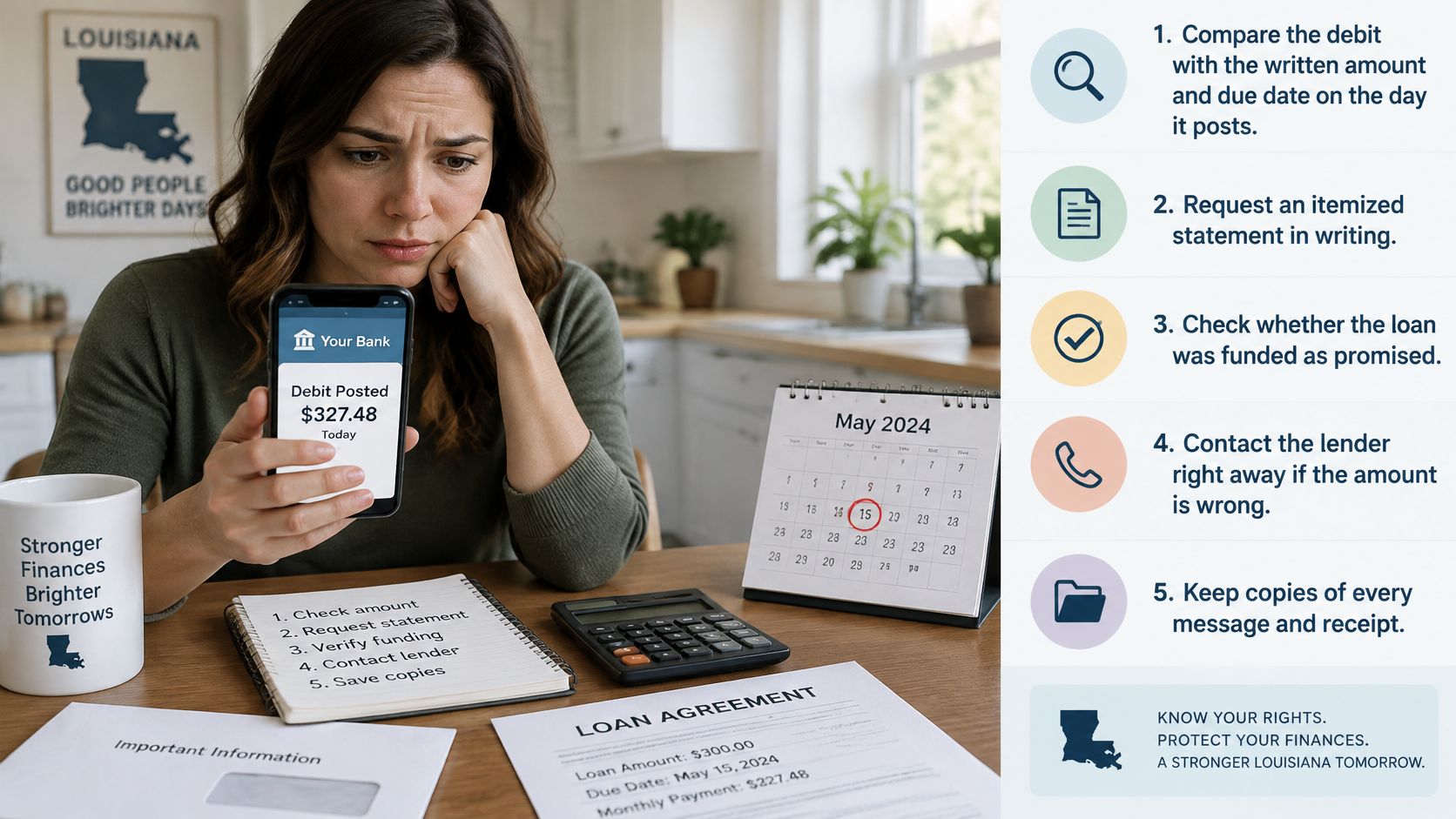
Respond to a debit that looks wrong
Compare the debit with the agreement. Check the date, amount, and lender name against your written disclosure and bank record. Save a screenshot or download the transaction details.
Request an itemized statement in writing. Ask the lender to list the principal, fees, interest, and any other amount it says you owe. A written breakdown can help you pinpoint the difference.
Revoke electronic withdrawal authorization if needed. Send written notice to the lender and contact your bank about stopping future withdrawals. Keep copies of both notices and any confirmation.
Build a record. Note dates, amounts, call times, names, and what each person told you. Keep the contract, account statements, emails, and screenshots together.
Ask for a correction and refund in writing. Identify the debit, explain why it differs from the agreement, and state the correction you want. Specify any excess amount you are asking the lender to return.
Escalate if the issue remains unresolved. The Louisiana Office of Financial Institutions takes payday-lender complaints in writing. You can also contact the Consumer Financial Protection Bureau after raising the issue with the lender, or seek help from 211, legal aid, or a nonprofit counselor.
The CFPB's 2025 consumer response annual report reported approximately 3,500 payday-loan complaints nationally in 2025. Unexpected fees or interest were the most common issue, and consumers complained about online payday loans more often than store-based loans.
Those national complaint figures do not show that a particular lender acted improperly. They do underline why it helps to keep the loan terms and check each debit against the agreement, especially after applying online.
| Contact | Handles | How to file or reach | Notes |
|---|---|---|---|
| Louisiana Office of Financial Institutions | Payday and small-loan lender complaints | In writing | The regulator directs consumers to submit payday-lender complaints in writing. |
| Consumer Financial Protection Bureau | Complaints about consumer lenders, including online lenders | Online complaint process | Best used after contacting the lender. |
| 211 | Local bill, food, shelter, and crisis referrals | Call 211 | Free; offerings vary by parish. |
| Local legal aid office | Lending disputes and collection threats | Intake at local office | Eligibility and fees vary. |
| Nonprofit credit counseling agency | Budget review and debt-management plans | Agency intake | Ask about fees before enrolling. |
| Lender's own complaint or dispute address | Fee errors, unexpected debits, and payoff disputes | Written notice to the lender | Keep a dated copy. |
A complaint should name the lender and loan amount, give the loan and debit dates and amounts, and state the correction requested. Attach copies of the agreement, statements, and written communication, and keep the originals. If the problem is missed repayment rather than an incorrect debit, review what may happen when you default on a payday loan and seek advice for your circumstances.
Online access can make applying convenient, but convenience and transparency aren't the same thing. Keep a paper trail, and put any dispute in writing so you can track what you reported and the lender's response.
Choose Your Next Step by Credit Band
If the total due won't fit your next paycheck, don't borrow yet. The score bands below are general consumer-credit ranges, not Louisiana lending rules. A score doesn't override the state's product limits, and lenders make their own approval decisions.
Below 580. Payday or title borrowing can leave little room for an income shortfall, while a vehicle-secured loan puts transportation at risk. Before taking on debt, contact 211 or a nonprofit counselor, and ask a credit union whether you qualify for a PAL. First action: seek local assistance and compare the full repayment amount before applying anywhere.
580 to 669. Installment loans, credit union PALs, and secured cards may be worth comparing. For each loan, write down the APR, total of payments, fees, payment dates, and late-payment terms in the same format. First action: ask a credit union for its loan terms and inquiry policy.
670 to 739. A personal loan or credit union loan may be an option, but don't assume the advertised rate will be your rate. Compare APR and total payments, and check whether the payment fits alongside existing bills. First action: request written terms from a lender before completing a full application.
740 and above. Mainstream personal loans and cards may be available, so a high-cost short-term loan is less likely to be the only path. Availability still depends on the lender's review and your finances. First action: compare a conventional offer with the total cost and payment timing of any short-term product.
BadCreditMD provides state-specific loan guides, cost comparisons, and references to local assistance. It isn't a lender or broker. Reading its guides doesn't affect credit; if you submit an optional request, a lending-network partner shares it with lenders, where any credit check occurs. Lenders set their own rates and make approval decisions, and request forms aren't available where state law prohibits the loan type. Referral compensation is disclosed and doesn't change editorial content.
BadCreditMD offers state-specific explanations of loan limits, costs, and alternatives for borrowers with imperfect credit. Before applying for a Louisiana loan, use BadCreditMD to compare options and find local assistance, then verify the lender's written terms and make sure the payment fits your budget.