
A person on SSI can often get approved for a loan, but keeping the money safe for benefits is the harder part. In 2026, the Social Security Administration reported 7,323,731 SSI recipients, with an average monthly payment of $738.10 and a federal resource limit that can make an unspent loan risky if it's still sitting there next month. Social Security Administration snapshot
You're usually not asking one question, you're asking three. Can I get approved, can I afford the payment, and will the loan keep my SSI safe? Those are different doors, and the biggest mistake people make is assuming that opening one means the other two open too.
Table of Contents
- When the Benefit Check Won't Quite Stretch
- How Lenders Evaluate SSI Income
- The Income vs. Resource Trap Most Articles Skip
- Common Loan Types SSI Borrowers Run Into
- A Month-by-Month Example That Could Push You Over
- Safer Alternatives Worth Trying First
- Before You Sign Anything, Do This
When the Benefit Check Won't Quite Stretch
Alex is staring at a car repair estimate on a Tuesday afternoon, doing the math in his head and already knowing the answer is ugly. His SSI check is gone once rent, groceries, and prescriptions are covered, and the car doesn't care that the month ran out early. That is the moment a lot of people start searching for loans for SSI recipients, not because they want debt, but because the bill will not wait.
What follows is usually confusion. One lender says yes, another says no, and a third offers a payment that looks manageable until you add everything else. If you have been turned down, quoted something expensive, or told not to borrow at all, that does not mean the door is shut on every option. It means you need to separate the actual problem from the sales pitch.
Three questions, not one
Approval is about whether a lender will take your application. Affordability is about whether your budget can absorb the payment after essentials. Benefit safety is about whether the money and the repayment plan could interfere with SSI rules.
Practical rule: if a loan only works when you ignore rent, food, medical costs, or the SSI resource limit, it does not really work.
That is the part too many borrowers miss. A loan can be approved and still be a bad move if it creates a resource problem or squeezes next month's budget. The lender's yes is only step one, and it does nothing to protect your benefits.
The real gatekeeper is what happens after the money lands in your account. If the loan pushes your countable resources over the SSI limit, approval does not save you from the fallout. That is why a local benefits counselor or legal aid office is often the first call, because they can explain how the rules apply before you sign anything. Keep the standard simple, get practical help, not pressure.
How Lenders Evaluate SSI Income
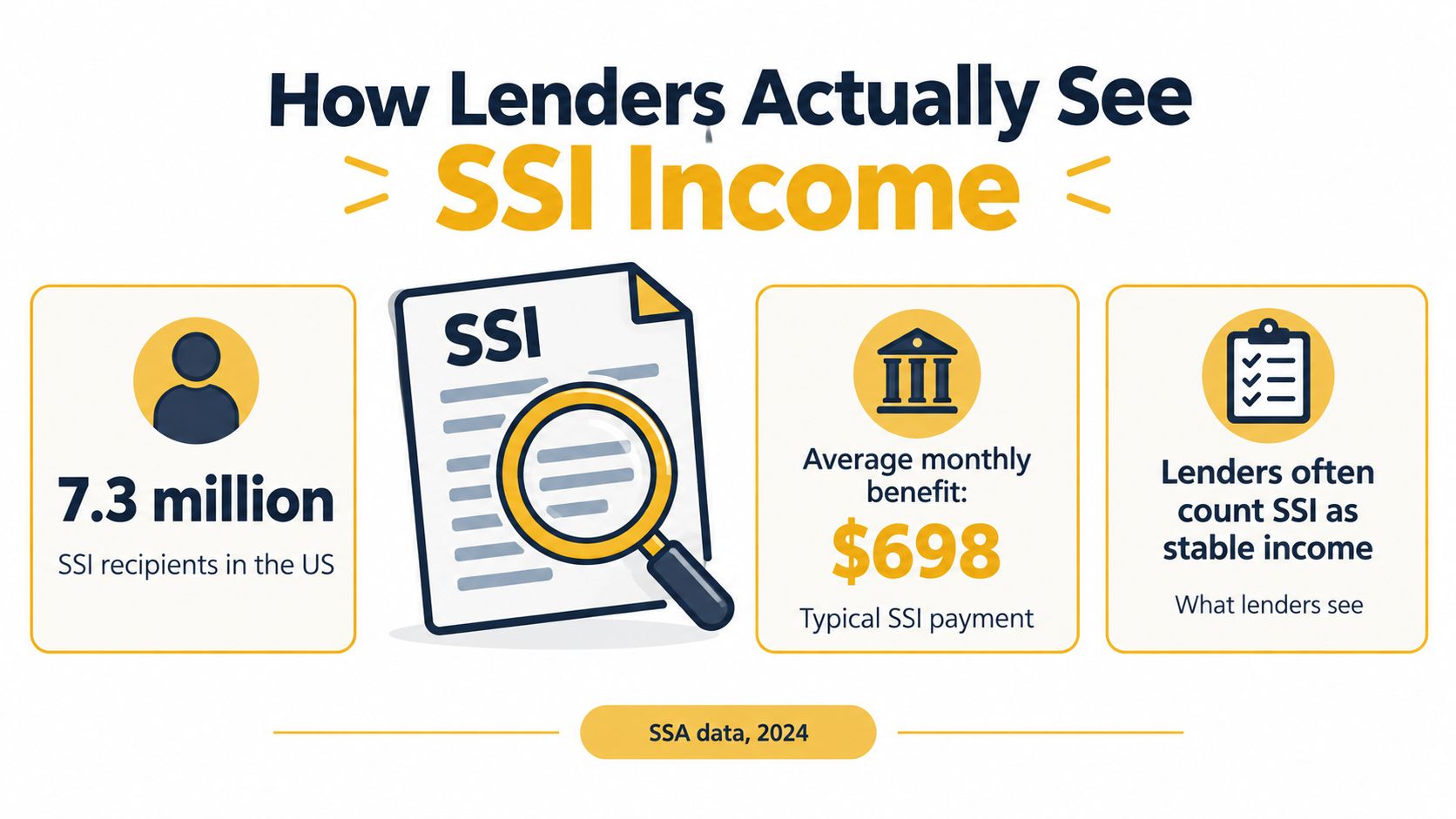
SSI is a major federal income-support program, and lenders know it shows up every month. The Social Security Administration's June 2026 snapshot shows millions of recipients across age groups and billions in monthly payments, which is enough for lenders to treat SSI as real, recurring income rather than a one-off deposit. SSA monthly snapshot
Why some lenders accept SSI at all
SSI is documented, federally administered, and regular. That is why some loan ads say SSI accepted or count it as qualifying income.
Qualifying income is only part of the story. A lender still reviews your credit history, current debts, housing costs, and state rules before saying yes. That approval can still point you toward a bad deal if the payment does not fit your budget.
For borrowers in Oregon, SSI application assistance in Oregon can help clarify how the benefit rules fit into the bigger picture before money changes hands.
What the lender is really measuring
If you are looking for loans for SSI recipients, the lender wants one answer: can the payment be collected on time. Your answer needs to be different. Can you pay it without crowding out rent, food, medicine, and your SSI limits.
A strong application does not fix a weak budget. A payment that only works if next month goes perfectly is too tight. That is the line a borrower should respect.
A short written explanation can help when your file needs context, especially if you have blemishes or exceptions to explain. A useful example is a letter of explanation for derogatory credit, but context does not change the math. The lender can still approve the loan, and the loan can still put your benefits at risk if the money or repayment plan collides with SSI rules.
The Income vs. Resource Trap Most Articles Skip
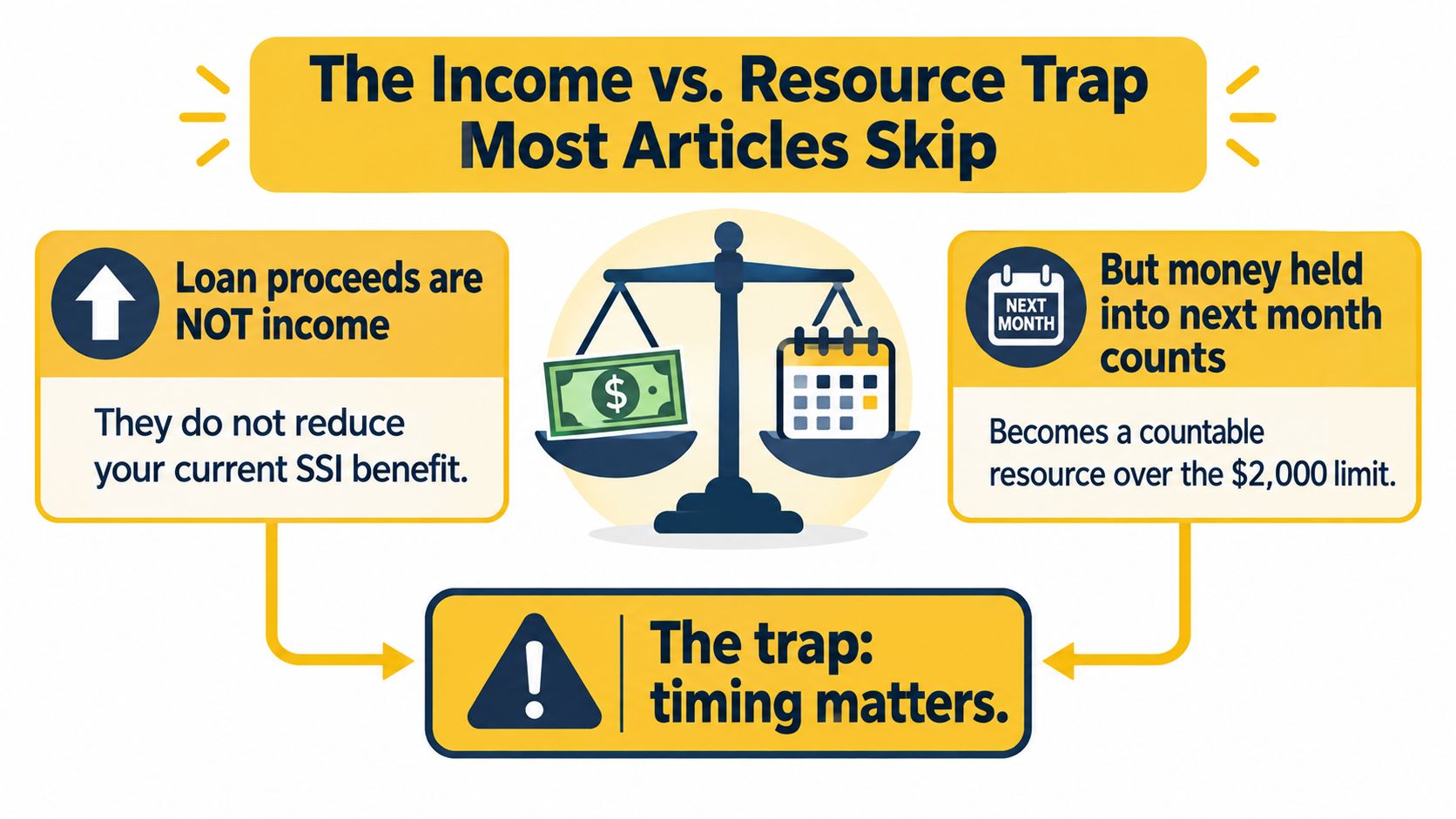
Here's the part people miss. A properly documented loan is generally not income for SSI, because it has to be repaid, whether or not interest is charged. The problem is timing. If the borrowed money is still in your hand the following month, it can become a countable resource, and SSI's resource ceiling is $2,000 for an individual and $3,000 for a couple. SSA ruling on loans and SSI
Why day one and day 31 are different
On day one, the loan may not reduce your SSI payment. That part is often true and it lulls people into thinking they're safe. On day 31, the cash still sitting in checking can become the problem, even if the lender has done nothing wrong and your repayment plan is on paper.
A loan can be clean on paper and still cause SSI trouble if you let the money sit too long.
That's why documentation matters. Keep the signed agreement, disbursement record, repayment terms, and proof of what the funds were used for. Those records help show the transaction is a genuine debt, not a gift or an uncompensated transfer.
Informal loans need real structure
Family loans can work, but only if repayment is real and the schedule is feasible. A vague promise to “pay it back when I can” is weak documentation and weak protection. If the arrangement doesn't look like a real debt, don't assume SSI will treat it like one.
The cleanest rule is simple. If you borrow, spend the money on the intended need, keep the paper trail, and don't leave the proceeds sitting around into the next month. That timing issue is the true gatekeeper, not whether a lender clicked approve.
Common Loan Types SSI Borrowers Run Into
The market tends to push the same four products at people in your position. Some are survivable, some are a trap, and some are only worth touching if you already know exactly why you're choosing them. If you want a blunt comparison, start with this: payday and title loans are usually the worst fit, while small credit-union products are the most sensible when they're available.
| Loan Type | Income Treatment | Typical APR Range | Total Cost Example | Benefit-Safety Note |
|---|---|---|---|---|
| Personal installment loan | SSI may be counted as recurring income by some lenders | Varies by lender and credit profile | Costs depend on rate, term, and fees | Can work if the payment fits a written budget |
| Payday loan | Lender may ignore benefit stability and focus on short-term repayment | Usually high-cost, often far above mainstream credit | A small loan can become expensive fast | Risky because rollover and repeat borrowing are common |
| Title loan | Often based on vehicle value, not affordability | Usually high-cost | Default can put your car at risk | Bad fit if transportation is already essential |
| Credit-builder loan or PAL | Usually structured for small, manageable payments | Often lower than payday products | Costs are typically easier to forecast | Usually the best fit when available |
If you want a deeper look at the most dangerous short-term product, this payday loans no credit check guide is worth reading before you sign anything. The phrase “no credit check” is usually a warning, not a favor.
What actually deserves your attention
A plain installment loan can be workable if the monthly payment fits your budget after necessities. A credit-builder loan is often better because the payment is small and the structure is designed to help you build history instead of dig a hole. A PAL, or payday alternative loan from a credit union, is usually one of the few products that can be both more affordable and less dangerous for benefits.
Payday loans and title loans are different. They're built for speed, not stability. If your only reason for choosing one is that the approval looks easy, that's not a good reason.
The important point is total cost, not just whether someone approved you. If you can avoid a high-cost product by using a small credit-union loan, a payment plan, or a secured card, do that first.
A Month-by-Month Example That Could Push You Over
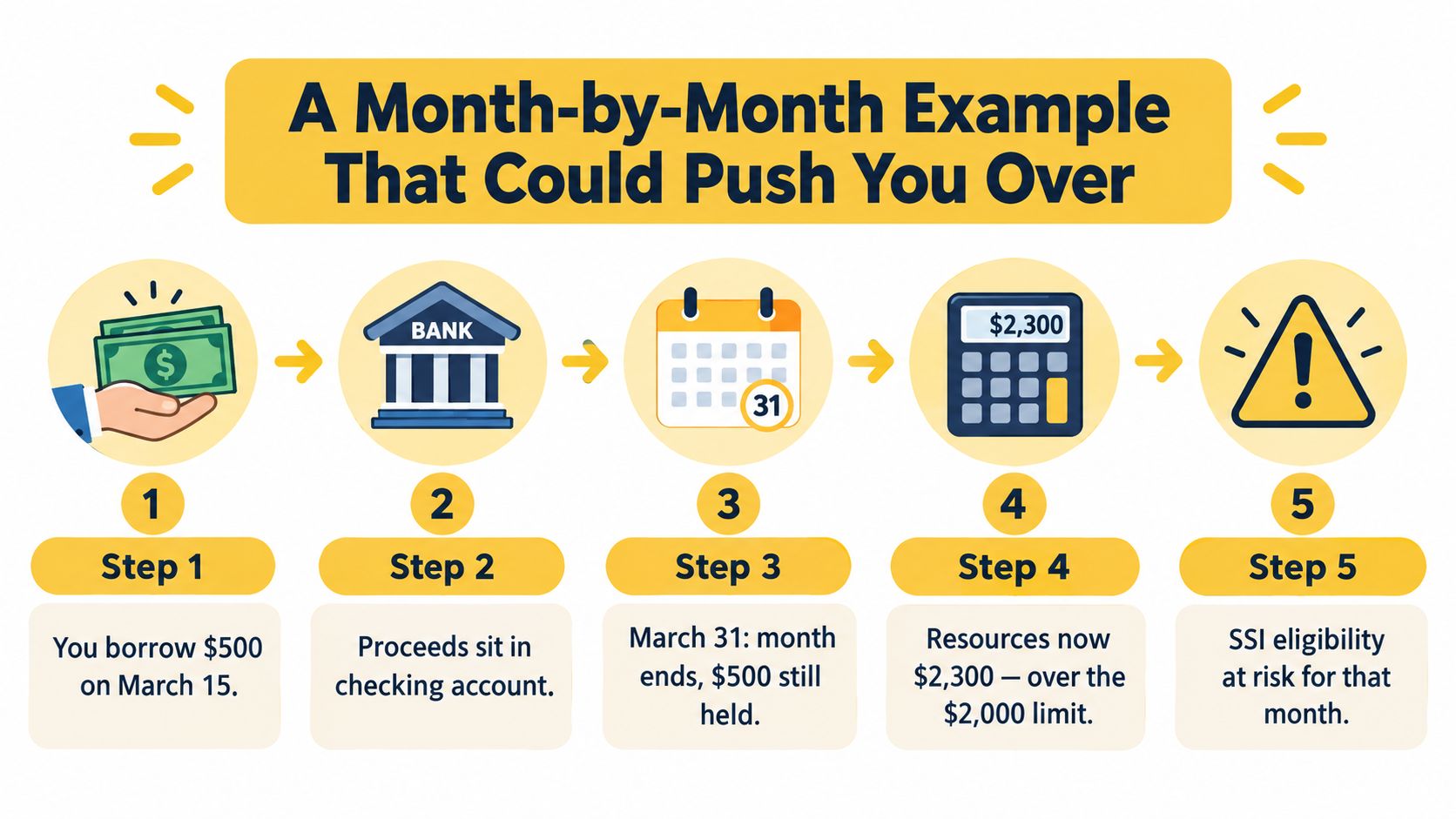
Suppose you borrow $500 in the middle of the month to fix a car. That loan doesn't automatically reduce your SSI payment, but the cash can still cause trouble if it's left untouched when the month turns over. The 2025 federal benefit rate was $967 for an individual and $1,450 for a couple, which shows how little room there can be after everyday expenses are covered. SSA SSI program description
The timeline that matters
On March 15, you borrow $500. If that money stays in your checking account through March 31 and is still there on April 1, it may count toward the resource limit. If you already had $1,800 in countable resources, that $500 can push you to $2,300, which is over the $2,000 individual limit. SSA loan guidance
If you spend the money quickly on the repair and keep the receipt, the picture changes. The loan was used for a real need, the paper trail is intact, and the proceeds didn't sit long enough to create the same resource problem. Same loan. Same $500. Very different result.
Practical rule: the question is not just whether you borrowed. It's whether the money was still yours when the calendar flipped.
What to do before taking the money
Write down your monthly budget first. List housing, food, medical costs, transportation, and existing obligations, then see what's left. If the payment only works because you're hoping next month will be easier, it isn't a safe payment.
Also, ask for benefits-specific guidance before you accept funds. If the loan could leave you with too much countable cash at month-end, or if the repayment schedule is too tight for your actual income flow, the deal is not worth it. That's especially true for high-cost credit or anything with a repayment plan built on wishful thinking.
For a look at what happens when a short-term loan goes bad, the what happens if you default on a payday loan guide shows why missed payments get ugly fast. Borrowing gets a lot less romantic once default enters the picture.
Safer Alternatives Worth Trying First

Start with the options that don't trap you in a high-cost cycle. If you receive SSI, the best order is simple. First try a payment plan, then a credit union product if you can get one, then a secured or credit-building option if your goal is to improve your file over time.
What's usually worth trying
Utility and medical payment plans come first because they attack the bill directly. Many providers would rather split the bill than send you into collections, and that's almost always better than borrowing to cover a one-time gap. Negotiated creditor arrangements can also buy breathing room without adding interest or fees.
Credit-builder loans and PALs are the two loan types that deserve serious attention when they're available. They're usually smaller, more structured, and less likely to blow up your budget than payday or title debt. Secured credit cards can help build credit too, though they don't solve a cash shortage by themselves.
If the goal is survival this month, payment plans matter more than credit points.
Help that doesn't cost you money
Free local help is often better than a bad loan. 211, nonprofit credit counseling, legal aid, and public benefits portals can point you to rent relief, utility aid, food support, and debt advice that fits your state. If you're helping an older relative or managing money for someone else, financial management for elderly loved ones can also give you a useful framework for organizing bills and support.
A new credit application doesn't automatically affect SSI, but a credit inquiry can still happen, so don't submit paperwork casually. Read the terms, know who gets the request, and don't chase a product just because the ad sounds friendly.
For a state-specific example of how small-dollar credit gets structured, the installment loans in MS guide is useful for seeing how costs and terms are presented in plain language. That kind of comparison beats guessing every time.
Before You Sign Anything, Do This
First, confirm the loan is a bona fide debt with a written agreement, repayment terms, and a clear disbursement record. Second, keep receipts or other proof showing how the money was spent. Third, make sure the proceeds won't sit in your account long enough to create a resource problem.
Then check the payment against your monthly budget after essentials, not before. If the installment doesn't fit after rent, food, medicine, transportation, and existing bills, walk away. If the deal depends on uncertain future funds, it's too fragile.
If the loan could threaten benefits, call SSA, a benefits counselor, or legal aid before you sign. For local help finding resources, California Freedom's guide to senior financial resources is a practical starting point for navigating support options. If something goes wrong, escalate through 211, the CFPB complaint process, or your state regulator.
BadCreditMD publishes plain-English guides that help you compare loan types, costs, and state rules without getting trapped in lender hype. If you're weighing loans for SSI recipients, visit BadCreditMD for straightforward borrowing explainers and free local assistance pointers that can help you make the safer call.